


The Definitive Guide to Dental Cleaning Costs
Why Dental Cleanings Matter More Than You Think
Dental cleanings are one of the most important — and most overlooked — parts of staying healthy. Most people know they should go, but aren’t sure what to expect, how much it costs, or how often they really need one.
Here’s a quick snapshot before we dive in:
| Question | Quick Answer |
|---|---|
| How often should I get a cleaning? | Every 6 months (more often if you have gum disease) |
| How long does it take? | 30–60 minutes for a routine cleaning |
| Does it hurt? | Usually no — mild pressure or scraping at most |
| Is it covered by insurance? | Most plans cover 2 cleanings per year at little or no cost |
| What does it cost without insurance? | Roughly $75–$200 for a routine cleaning |
Regular cleanings remove plaque and tartar that brushing and flossing simply can’t reach. Skipping them doesn’t just risk cavities — research links poor oral health to heart disease, stroke, and other serious conditions.
I’m Dr. Marta Milejczyk, and after decades of providing comprehensive dental care — including dental cleanings — through my General Practice Residency at Loyola University Medical Center and private practice since 1997, I’ve seen how preventive visits protect both smiles and long-term health. In this guide, I’ll walk you through everything you need to know to make informed decisions about your care.
The True Cost of Professional Dental Cleanings

When patients ask us how much dental cleanings cost, the honest answer is: it depends on what your mouth actually needs. Just like you wouldn’t expect a quick car wash to fix a dented bumper, you can’t expect a standard preventive polish to cure advanced gum disease.
To understand the financial side of oral health, it helps to look at the different categories of professional teeth cleaning. Learn more about dental checkups and cleanings to see how these services keep your smile on track. For a broader medical perspective on what these visits entail, you can also explore the Cleveland Clinic guide on dental check-ups.
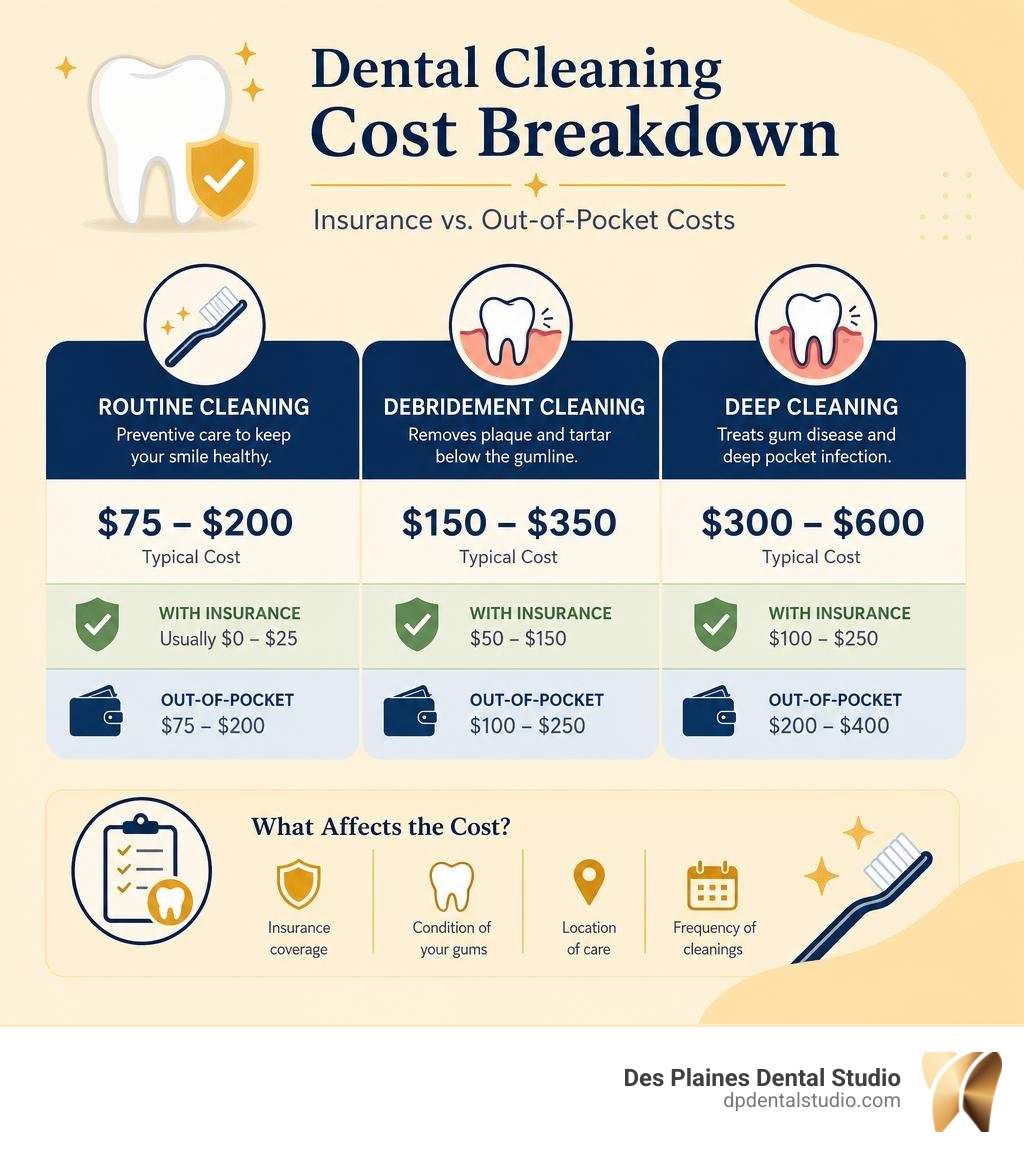
To give you an idea of what to expect financially in Illinois in July 2026, here is a general breakdown of the average cost ranges for different procedures:
| Cleaning Type | Purpose | Estimated Cost Range (No Insurance) | Typical Insurance Coverage |
|---|---|---|---|
| Routine Prophylaxis | Preventive care for healthy teeth and gums | $75 – $200 | 80% – 100% (Preventive) |
| Gross Debridement | Clears heavy buildup to allow for a proper exam | $150 – $300 | 50% – 80% (Basic) |
| Scaling & Root Planing | Deep cleaning below the gumline to treat active gum disease | $200 – $450 (per quadrant) | 50% – 80% (Basic/Major) |
| Periodontal Maintenance | Ongoing therapy to keep gum disease from returning | $115 – $250 | 50% – 80% (Basic) |
Routine Dental Cleanings and Preventive Care
A routine dental cleaning, medically known as a prophylaxis, is designed for people who generally have healthy gums and teeth. The primary goal here is prevention.
During a routine visit, our skilled dental hygienist focuses on removing plaque and tartar that have accumulated above your gumline. Plaque is that sticky, bacteria-laden film that forms on your teeth after you eat. If you don’t brush it away, it can harden into tartar (also called calculus) in as little as 24 to 48 hours. Once tartar forms, it bonds to your enamel like dental-grade concrete. No toothbrush or floss in the world can scrape it off; only professional dental instruments can safely pop it free.
After scaling away the tartar, the hygienist polishes your teeth with a special gritty paste to remove surface stains and disrupt any remaining microscopic bacterial colonies. This leaves your teeth feeling incredibly smooth, which actually makes it harder for new plaque to stick to them in the days following your visit. Investing in these routine appointments is the ultimate financial shortcut for your mouth. If you want to know how keeping these appointments protects your wallet, read about why regular dental care saves you money.
Deep Dental Cleanings for Gum Disease
If it has been several years since your last dental visit, or if you are battling active gum disease (periodontitis), a routine cleaning simply won’t cut it. In fact, performing a standard surface cleaning when you have deep bacterial pockets would be like sweeping dirt under a rug — it looks clean on top, but the underlying destruction continues.
When bacteria slip beneath the gumline, they cause your gums to pull away from your teeth, creating “pockets.” If these pockets measure 4 millimeters or deeper, you will likely need a deep cleaning, technically known as scaling and root planing (SRP). To make this therapeutic process as comfortable as possible, we often use local anesthesia to numb your gums and teeth.
During a deep cleaning, we carefully scale away the tartar and bacterial toxins from the deep root surfaces of your teeth. Then, we perform root planing, which smooths out the rough spots on your tooth roots. Smooth roots make it much easier for your gum tissue to reattach to the teeth, shrinking those dangerous pockets and stopping bone loss in its tracks. Because this process is highly detailed and therapeutic rather than preventive, it is typically billed by “quadrant” (one-fourth of your mouth) and carries a higher cost. If you suspect you might need this level of care, you can read more about our specialized deep teeth cleaning services.
What Happens Step-by-Step During Your Appointment?

A lot of dental anxiety comes from simply not knowing what those metal instruments are doing inside your mouth. Let’s demystify the entire process. A standard dental cleaning appointment is highly systematic, designed to maximize your comfort while thoroughly sanitizing your mouth.
If you’re wondering whether you can skip the diagnostic portion of this visit, we highly recommend checking out our article: Do I really need a dental exam?. Additionally, if you are looking into state-sponsored programs in Illinois, you can learn more about the Illinois Department of Healthcare and Family Services adult dental benefits.
Here is exactly what you can expect from the moment you sit back in our dental chair:
Step 1: The Physical Exam and Assessment
Before any cleaning tools touch your teeth, the dental hygienist performs a thorough visual inspection of your entire mouth. Using a small, angled dental mirror, they will check your teeth for obvious cavities, inspect your gums for redness or swelling, and look for any other potential red flags like oral sores.
If it is your first visit in a while, or if you are due for your annual checkup, we will also take digital X-rays. These low-radiation images allow us to spot cavities hiding between your teeth, evaluate the health of your jawbone, and ensure there are no infections brewing beneath your gumline.
Step 2: Scaling to Remove Plaque and Tartar
Once the exam is complete, the physical cleaning begins. This is the scaling phase. Your hygienist will use a hand scaler or an ultrasonic scaler (which uses gentle vibrations and a cool water mist) to remove the plaque and tartar from your tooth surfaces and just around the gumline.
You will hear some scraping sounds during this step. Don’t worry — this is completely normal! The scraper is simply popping the hardened calculus off your enamel. If you have a significant amount of buildup, this step will take up the majority of your appointment. If you maintain an excellent home routine, this part will be over in a flash.
Step 3: Gritty Toothpaste Polishing and Flossing
Once your teeth are completely free of tartar, the hygienist will polish them. They use a high-powered electric handpiece with a soft rubber cup on the end. This cup is filled with a gritty, flavored polishing paste (called prophy paste).
As the cup spins, it gently scrubs away surface stains from coffee, tea, or food, leaving your enamel bright and smooth. After polishing, the hygienist will professionally floss between every single tooth to remove any leftover paste or stubborn food particles trapped in the tight interdental spaces.
Step 4: Fluoride Treatment for Enamel Protection
To wrap up your cleaning, we often recommend a professional fluoride treatment. This is especially beneficial for children, teenagers, and adults who are prone to cavities or suffer from tooth sensitivity.
We apply a concentrated fluoride varnish directly to your teeth using a tiny brush. This varnish quickly sets in contact with your saliva. The fluoride works by absorbing into your enamel, remineralizing weak spots, and drastically increasing your teeth’s resistance to acid attacks from food and bacteria. To get the maximum benefit from this treatment, you should avoid eating or drinking anything hot, sticky, or hard for at least 30 minutes afterward.
Factors That Influence the Price of Teeth Cleaning
If you have ever called around to different dental offices asking for pricing, you probably noticed that the numbers can vary quite a bit. That is because dental fees are not pulled out of thin air. They are influenced by several practical factors.
If you want to keep your dental costs low in the long run, the best strategy is to focus on prevention. You can read about our 4 ways to achieve optimal oral health to learn how simple daily habits can save you thousands of dollars.
Here are the main elements that shape the final number on your dental bill:
Insurance Coverage and Out-of-Pocket Expenses
Your dental insurance plan is the single biggest factor in determining what you will pay out of pocket. Most traditional dental insurance plans operate on a “100-80-50” coverage structure. This means they cover 100% of preventive care (like routine dental cleanings, exams, and routine X-rays), 80% of basic procedures (like fillings or root canals), and 50% of major procedures (like crowns or bridges).
Because routine cleanings fall squarely under “preventive care,” most insured patients walk out of their biannual cleanings without paying a single penny. However, if you have a deductible that hasn’t been met, or if your insurance limits you to a strict maximum annual benefit, you may have some minor out-of-pocket expenses. To make sure you are maximizing your coverage, check out our guide on the optimal oral health routine.
Private Practices vs. Dental School Teaching Clinics
Where you choose to get your teeth cleaned also plays a massive role in the cost.
- Private Practices: When you visit a private practice like Des Plaines Dental Studio, you are paying for highly personalized, efficient care. Our appointments are streamlined to fit into your busy schedule, typically taking 45 to 60 minutes, and you are treated by experienced, licensed professionals using state-of-the-art technology.
- Dental School Clinics: If you are on an extremely tight budget and do not have insurance, you might consider visiting a dental school or dental hygiene teaching clinic. Because the cleanings are performed by supervised students, they are highly affordable (and sometimes even free). However, there is a major trade-off: time. Because instructors must inspect and sign off on every single step of the student’s work, a simple cleaning that takes 45 minutes in our office can easily take two to three hours at a teaching clinic.
Frequently Asked Questions about Teeth Cleaning
How much does a teeth cleaning cost without insurance?
In Illinois, the average cost of a routine professional dental cleaning for an uninsured adult typically ranges from $100 to $200. However, keep in mind that this is just for the cleaning itself. If you are a new patient, the office will also need to perform a comprehensive dental exam and take a set of diagnostic X-rays to ensure it is safe to clean your teeth. When you add the exam and X-rays, the total first-visit cost without insurance can range from $200 to $400.
To make care accessible, many modern dental offices (including ours!) offer self-pay discounts, flexible payment plans, or in-house dental membership plans that cover your yearly preventive care for a simple, discounted monthly or annual fee.
Does a professional teeth cleaning hurt?
For the vast majority of patients, a routine dental cleaning does not hurt at all. You will feel some mild pressure, vibrations, and the cool mist of water, but it should not be painful.
If you have sensitive teeth, or if your gums are inflamed due to early-stage gingivitis, you might experience some mild, temporary discomfort during the scaling phase. If you feel nervous or have a history of dental anxiety, please let our team know! We can easily apply a topical numbing gel to your gums to make the entire process completely pain-free and comfortable.
How often should I get my teeth professionally cleaned?
The American Dental Association (ADA) recommends that most children and adults get their teeth professionally cleaned every six months (twice a year). This six-month interval is designed to catch oral health issues while they are still small, reversible, and inexpensive to treat.
However, some patients may need to visit us more frequently. If you smoke, have diabetes, are pregnant, are prone to rapid tartar buildup, or have a history of periodontal disease, we may recommend scheduling cleanings every three to four months to keep your oral health stable. For more tips on keeping your teeth in top shape between visits, read our guide on effective prevention for healthier smiles.
Conclusion
Taking care of your teeth shouldn’t feel like a luxury, and it certainly shouldn’t break the bank. At Des Plaines Dental Studio, we are proud to offer patient-centered, high-quality dental cleanings in a warm, welcoming, and pain-free environment. Whether you have premium dental insurance or are looking for affordable self-pay options, our team is here to help you navigate your dental care with complete transparency.
Don’t wait for a small toothache to turn into an expensive dental emergency. Schedule your dental cleaning and exam today and take the first step toward a lifetime of healthy, confident smiles!