


The Complete Guide to Upper Dentures Cost
What Does the Price of Upper Dentures Actually Look Like in 2026?
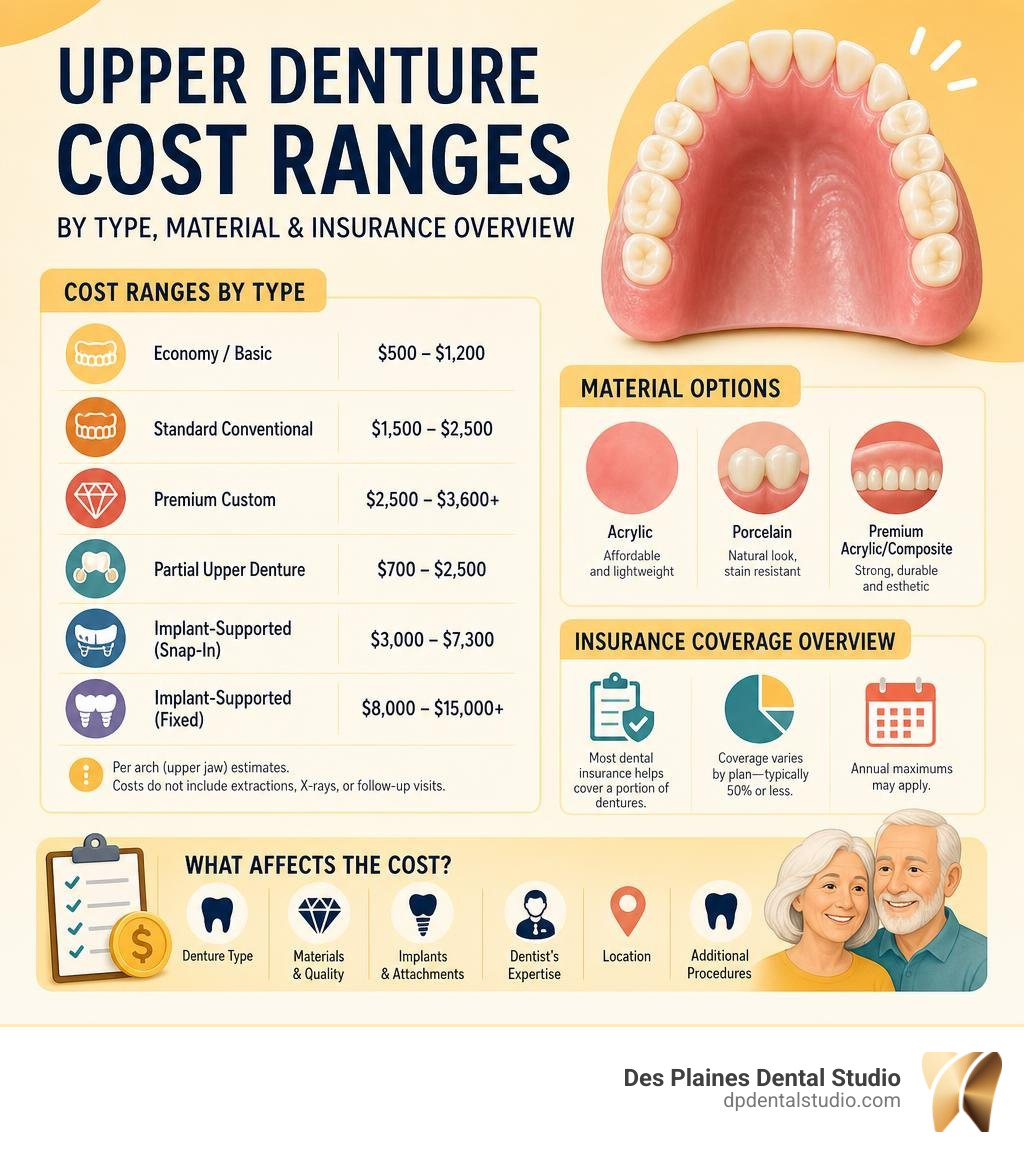
The price of upper dentures ranges widely depending on the type, materials, and where you get them. Here’s a quick snapshot so you can plan your budget right away:
| Denture Type | Typical Cost Per Arch (U.S.) |
|---|---|
| Economy / Basic | $500 – $1,200 |
| Standard Conventional | $1,500 – $2,500 |
| Premium Custom | $2,500 – $3,600+ |
| Partial Upper Denture | $700 – $2,500 |
| Implant-Supported (Snap-In) | $3,000 – $7,300 |
| Implant-Supported (Fixed) | $8,000 – $15,000+ |
Note: These are per-arch estimates for the upper jaw only. Costs do not include extractions, X-rays, or follow-up visits.
Missing upper teeth affect more than just your appearance. They change how you chew, how you speak, and how confident you feel day to day. The good news: there are more options than ever — at more price points than ever.
But the costs can feel confusing. Quotes vary. Ads show “$499 dentures.” Your insurance may or may not help. And it’s hard to know what’s actually included.
This guide breaks it all down clearly: what you’ll pay, what drives the price up or down, and how to make the most of your budget.
I’m Dr. Marta Milejczyk, a restorative dentist practicing in Chicago’s northwest suburbs since 1997, with advanced clinical training in full mouth rehabilitation — exactly the kind of care that shapes the price of upper dentures and the outcomes patients experience long-term. In the sections ahead, I’ll walk you through everything you need to know to make a confident, informed decision.
Average Cost and Types of Upper Dentures in 2026
When evaluating the price of upper dentures in 2026, it helps to understand that dentures are not a one-size-fits-all product. The national average cost for a single-arch denture sits around $2,000, but your final out-of-pocket expense depends heavily on the level of customization, aesthetic detailing, and structural support you choose.
High-quality dentures require a delicate balance of dental science and artistry. The goal is to craft a prosthetic that not only stays securely in place but also complements your natural facial structure, lip support, and skin tone.
Average Price of Upper Dentures by Material and Quality
The materials used to construct your denture base and artificial teeth are primary drivers of the overall cost. In 2026, the industry categorizes removable upper dentures into three main tiers:
- Economy Dentures ($500 – $1,200 per arch): These are typically fabricated using pre-formed, generic teeth mounted on a basic acrylic resin base. While they are the most budget-friendly option, they offer minimal customization. They often lack the natural translucency of real teeth and may require more frequent adjustments.
- Standard Dentures ($1,500 – $2,500 per arch): This tier represents the sweet spot for many patients. Standard dentures utilize higher-quality, heat-cured acrylics that resist warping. The teeth are characterized with subtle shade variations to look more lifelike, and the dentist spends more time ensuring a comfortable, personalized fit.
- Premium Dentures ($2,500 – $3,600+ per arch): Premium options incorporate high-impact acrylic bases or flexible metal-reinforced frames combined with highly durable porcelain teeth or multi-layered composite resin teeth. These materials resist wear, staining, and chipping, and they are customized extensively to replicate natural gum tissue textures and individual tooth positioning.
To explore a detailed analysis of these tiers, you can read the Average Cost of Upper Dentures 2026.
Comparing the Price of Upper Dentures vs. Lower Dentures
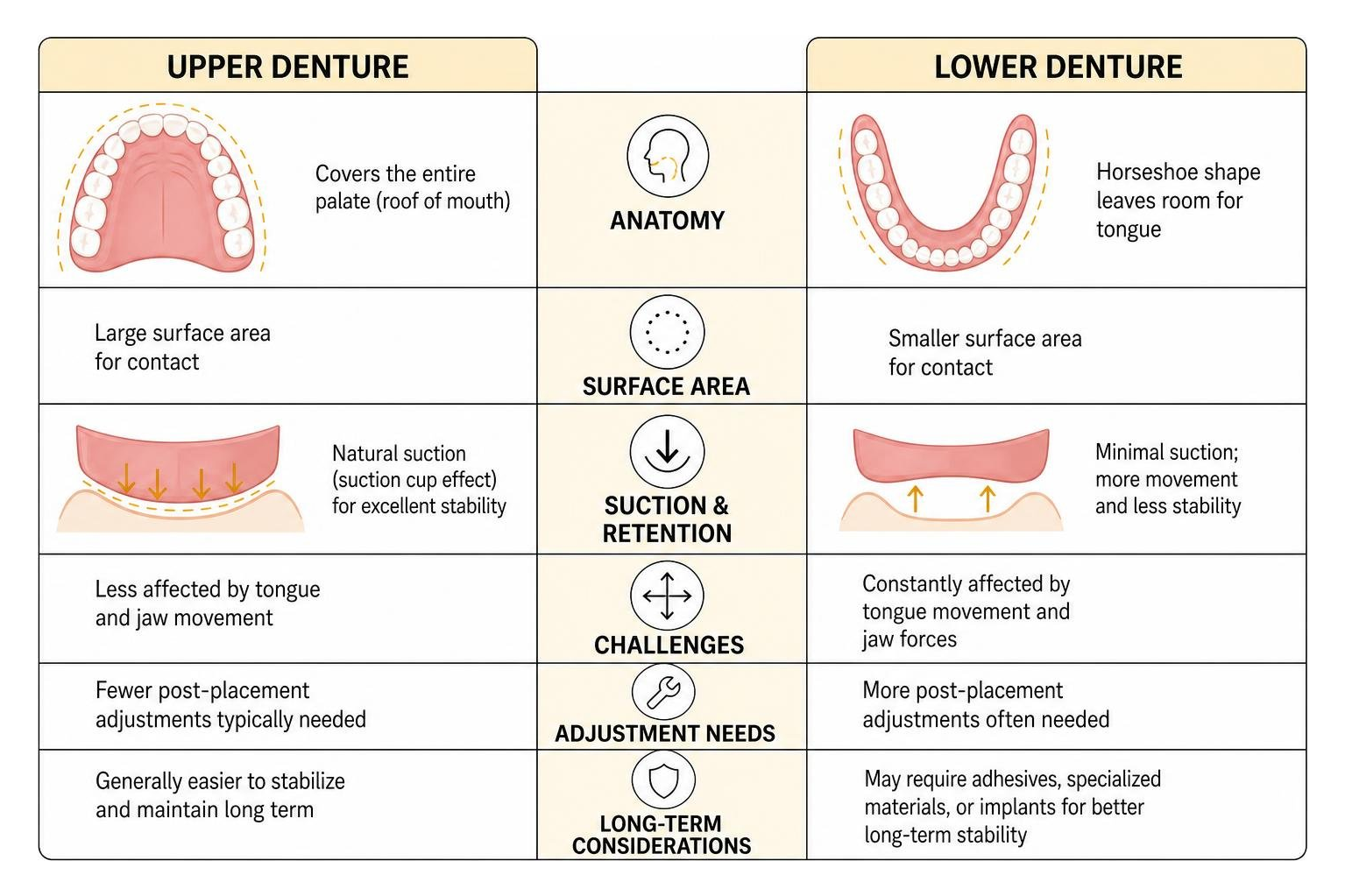
If you are replacing teeth on both arches, you might assume that the upper and lower plates cost exactly the same. However, their physical design and anatomical demands are quite different.
The upper arch has a major natural advantage: the palate (the roof of your mouth). A full upper denture covers this entire surface, creating a natural suction cup effect. This natural suction provides excellent stability without requiring adhesives.
Conversely, a lower denture has to shape itself like a horseshoe to leave room for your tongue. It has a much smaller surface area to grip and must constantly combat jaw movement and tongue elevation. Because lower dentures are inherently less stable, they often require more post-placement adjustments, specialized materials, or implant stabilization, which can occasionally make them slightly more expensive to manage long-term.
| Denture Location & Type | Average Out-of-Network Cost Range |
|---|---|
| Full Upper Denture | $1,220 – $2,540 |
| Full Lower Denture | $1,115 – $2,425 |
| Partial Upper Denture | $1,435 – $2,785 |
| Partial Lower Denture | $1,425 – $2,490 |
To learn more about how full-set averages compare across different regions, check out How Much Do Dentures Cost in 2026?.
Conventional, Partial, and Implant-Supported Options
Depending on how many healthy teeth you have left and your budget, we categorize upper dentures into three functional styles:
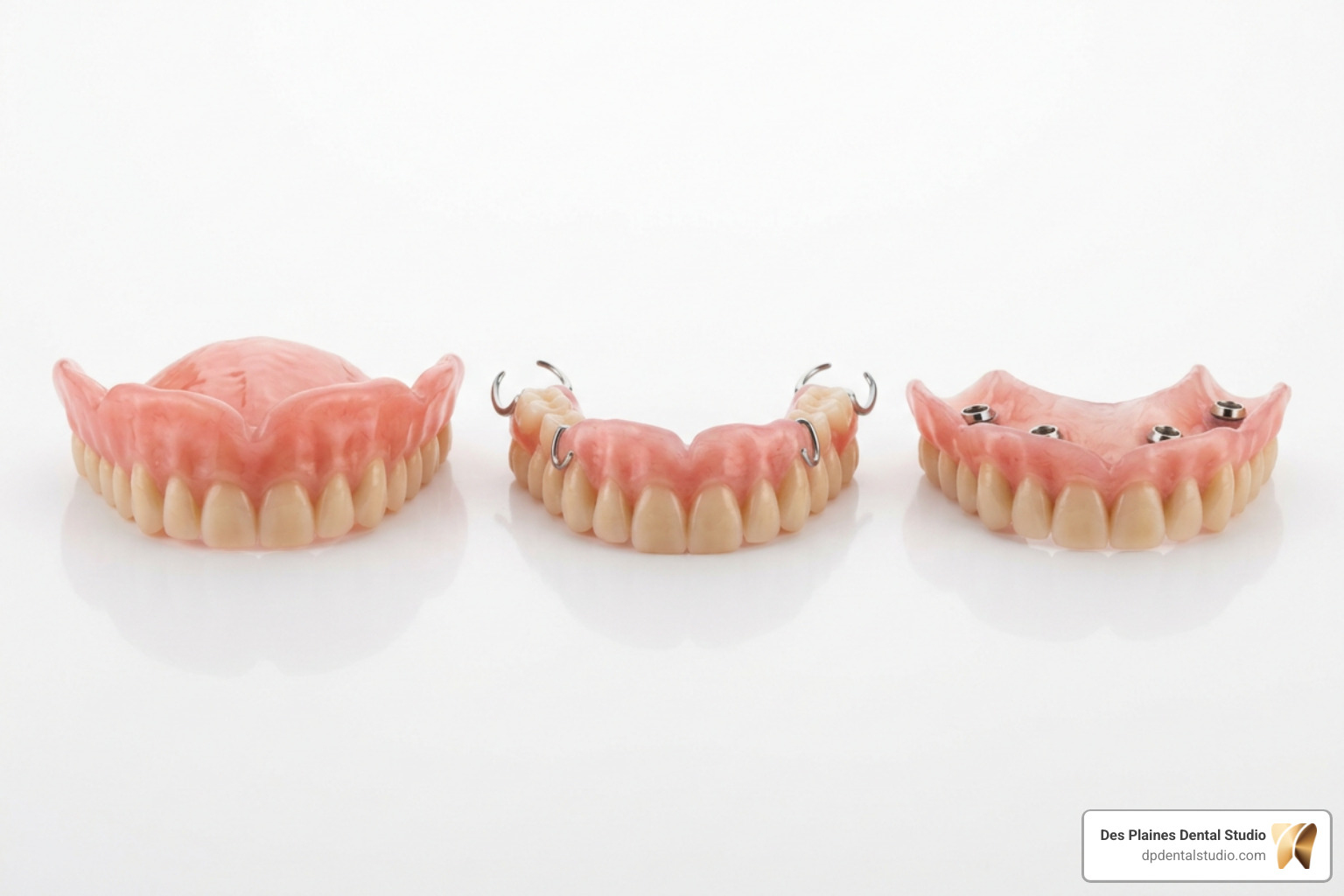
- Conventional Complete Upper Dentures: Designed for patients who are missing all of their teeth on the upper arch. The denture sits directly on the gums and is held in place by natural suction.
- Partial Upper Dentures: If you still have several healthy teeth, a partial plate is an excellent choice. These partials use metal or flexible nylon clasps that anchor onto your remaining natural teeth, filling in the gaps while keeping your existing smile intact.
- Implant-Supported Upper Dentures (Overdentures & Snap-Ins): For the ultimate in stability, dental implants can be surgically placed into the upper jawbone. The denture then “snaps” onto these implants. Because the upper jaw has softer bone density than the lower jaw, implant-supported upper dentures typically require 4 to 6 implants to distribute chewing forces safely, bringing the total cost range to $8,000 – $15,000+ per arch.
For a comprehensive breakdown of these types and their associated costs, refer to How Much Do Dentures Cost?.
Key Factors That Influence the Price of Upper Dentures
When you receive a dental estimate, the figure isn’t arbitrary. The price of upper dentures is shaped by your unique oral health status, the complexity of your case, and the physical location of the practice.
Preparatory Procedures and Extractions
Many patients look at the base price of a denture and forget that their mouth must be prepared to receive it. If you have failing, decayed, or broken teeth on your upper arch, they must be extracted before a complete denture can be placed.
- Oral Exams & Consultations: $50 – $350
- Panoramic X-Rays or 3D Cone Beam Scans: $130 – $880
- Simple Extractions: $150 – $400 per tooth
- Surgical Extractions: $300 – $600+ per tooth
- Alveoloplasty (Bone Smoothing): If your jawbone has sharp ridges after extractions, the bone must be smoothed out so the denture can sit comfortably without causing painful sore spots. This surgical preparation can add $500 – $1,500 to your treatment plan.
To explore all of your restorative choices when dealing with tooth loss, read our guide on More info about missing teeth options.
Geographic Location and Practice Overhead
Dental fees are directly influenced by regional economic factors, including commercial rent, staff wages, and local dental laboratory fees.
In Illinois, the average cost for a traditional removable denture plate is approximately $1,927, which aligns closely with the national average. However, within the Chicago metropolitan area — including suburbs like Des Plaines — high-demand overhead can cause prices to fluctuate slightly compared to rural downstate Illinois.
We minimize these regional price spikes by working with top-tier local labs to ensure you receive highly durable, American-made prosthetics without unnecessary commercial markups. For more localized details on getting fitted in our area, view More info about dentures in Des Plaines.
Insurance, CDCP, and Financing Options
Paying for restorative dental care requires careful planning. Fortunately, there are several pathways to reduce your out-of-pocket expenses, whether you have private dental coverage, government assistance, or prefer flexible payment plans.
Dental Insurance and the Canadian Dental Care Plan
Most private dental insurance PPO plans classify dentures as a “major restorative service.”
- Coverage Percentages: Insurance typically covers 40% to 60% of the denture cost after you meet your deductible.
- Annual Maximums: Most plans cap their annual payout between $1,000 and $2,000. Because a high-quality upper denture can easily exceed this limit, your insurance will cover a portion of the fee, leaving you responsible for the remaining balance.
- Waiting Periods: Be aware of waiting periods (often 6 to 12 months) for major services if you recently purchased a new policy.
- Medicare Advantage: While original Medicare does not cover routine dentures, many private Medicare Advantage plans offer supplemental dental benefits that include coverage for dentures.
- Canadian Dental Care Plan (CDCP): For our Canadian readers or those researching international options, the Canadian Dental Care Plan (CDCP) covers eligible denture services (including complete dentures, relines, and repairs), though it generally excludes implant-supported prosthetics. You can read more about Canadian benchmarks and provincial fee guides in How Much Do Dentures Cost in Canada?.
Out-of-Pocket Savings and Financing Strategies
If your insurance coverage falls short, or if you are paying entirely out of pocket, several strategies can help make your care affordable:
- HSA and FSA Accounts: You can use pre-tax dollars from your Health Savings Account (HSA) or Flexible Spending Account (FSA) to pay for dentures, extractions, and maintenance.
- Third-Party Financing: We partner with reputable healthcare lending services like CareCredit to offer flexible monthly payment plans, often featuring 0% interest promotional periods.
- Dental Savings Plans: These membership-based programs offer pre-negotiated discounts (often 20% to 50% off standard fees) at participating dental offices for an annual fee.
For more details on navigating insurance policies and maximizing your benefits, read Understanding dentures costs and insurance coverage.
Frequently Asked Questions About Upper Dentures
How long do upper dentures typically last?
On average, a well-crafted complete upper denture lasts between 5 and 10 years.
Even though the acrylic teeth and base are highly durable, your mouth is constantly changing. Once your natural teeth are gone, your jawbone no longer receives the chewing stimulation it needs to maintain its bulk. Over time, a process called bone resorption causes the jawbone to shrink.
As your bone structure changes, your once-snug upper denture will gradually begin to feel loose. To maintain a secure fit, you will need periodic professional relines, and eventually, a complete replacement plate. To learn more about restoring your bite and keeping your smile healthy, read More info about repairing your smile.
Are upper dentures more comfortable than lower dentures?
Yes, most patients find upper dentures significantly more comfortable and easier to adapt to than lower dentures.
Because the upper plate covers the roof of the mouth, it utilizes natural suction to stay firmly in place. This suction minimizes slipping and sliding when you eat or speak.
A lower denture, however, has to contend with the constant movement of the tongue and has a much smaller surface area to rest upon. While the upper plate does require a brief adjustment period for speech (as your tongue learns to press against the acrylic palate to make certain sounds), most patients adapt within a few weeks. For patients with remaining healthy teeth, partial plates offer an even easier transition. You can learn more about this in More info about partial dentures.
What are the ongoing maintenance costs for upper dentures?
Your financial investment in your smile doesn’t end the day you take your new dentures home. To keep your prosthetic hygienic and fitting properly, you should budget for the following ongoing maintenance costs:
- Professional Hard Relines ($300 – $800): Required every 1 to 2 years to reshape the inside of the denture base to match your changing gum and bone structure.
- Soft Relines ($150 – $350): A temporary, medical-grade soft material applied to the denture base to give irritated gums a chance to heal.
- Emergency Repairs ($150 – $500): If you accidentally drop your denture on a hard bathroom tile, the acrylic can fracture or a tooth can chip. Professional laboratory repairs are required to restore structural integrity. Tip: Never attempt to use drugstore superglue on your dentures, as it can ruin the acrylic and introduce toxic chemicals to your mouth!
- Daily Cleansers & Brushes ($20 – $50 annually): Non-abrasive denture pastes, soaking tablets, and specialized soft-bristle brushes are essential to prevent bacterial buildup and staining.
Conclusion

Investing in an upper denture is about much more than just filling empty spaces in your mouth — it is about reclaiming your ability to eat your favorite foods, speak clearly, and smile without hesitation.
At Des Plaines Dental Studio, we believe in patient-centered, warm, and transparent care. We work closely with you to design a customized treatment plan that fits your lifestyle, aesthetic goals, and budget. Whether you are exploring standard conventional plates, partials, or advanced implant-supported options, our team is here to guide you through a comfortable, pain-free experience.
Ready to take the first step toward a restored, beautiful smile? View pricing for your local office and book an appointment with us today for your personalized consultation!