


The Grown-Up Guide to Dental Sealants
What Are Dental Sealants and How Do They Work?
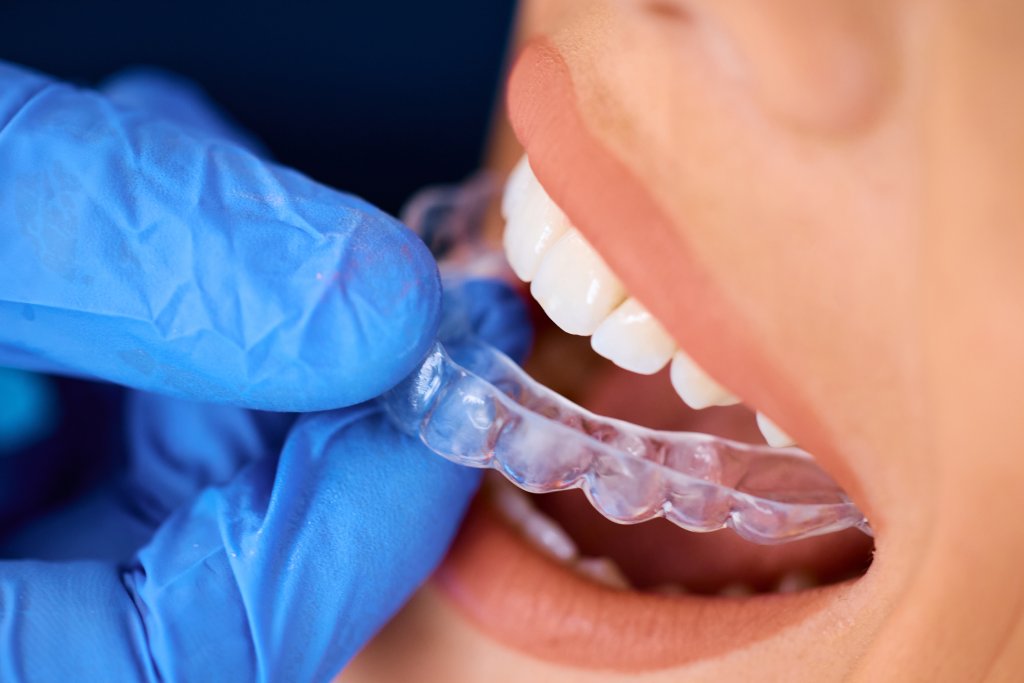
Dental sealants for adults are thin, protective coatings painted onto the chewing surfaces of your back teeth (molars) to block bacteria and prevent cavities — and yes, adults can absolutely get them.
Quick facts at a glance:
- What they are: Thin plastic or resin coatings applied to molar surfaces
- Who they’re for: Adults with healthy, unfilled molars — especially those prone to cavities
- How effective: Prevent up to 80% of cavities in back teeth over the first two years
- How long they last: Typically 5 to 10 years
- Does it hurt: No — no drilling, no anesthesia, no downtime
- Cost: Around $30–$60 per tooth (compared to $150–$350 for a filling)
- Insurance: Most plans cover sealants for children under 18; adult coverage varies by plan
Most people think dental sealants are only for kids. They’re not.
The CDC reports that adults aged 20 to 34 actually have more untreated cavities in their back teeth than any other age group. Yet only about 5% of adults aged 18 to 24 have sealants. That’s a huge gap between who needs protection and who’s actually getting it.
Nine out of ten cavities form on the chewing surfaces of back teeth — the exact spots sealants are designed to shield. Even with great brushing habits, a toothbrush simply can’t reach deep into the narrow pits and grooves of your molars. Sealants seal those grooves shut so bacteria and food particles have nowhere to hide.
If you’ve ever put off a filling because of the cost, the time, or the anxiety — sealants are worth understanding. This guide covers everything: how they work, who should get them, what they cost, and what to expect at your appointment.
I’m Dr. Marta Milejczyk, and I’ve been providing comprehensive preventive and restorative dental care in Chicago’s northwest suburbs since 1997, including dental sealants for adults as part of personalized treatment plans developed through my General Practice Residency at Loyola University Medical Center. In the sections ahead, I’ll walk you through everything you need to know to decide if sealants are the right fit for your smile.
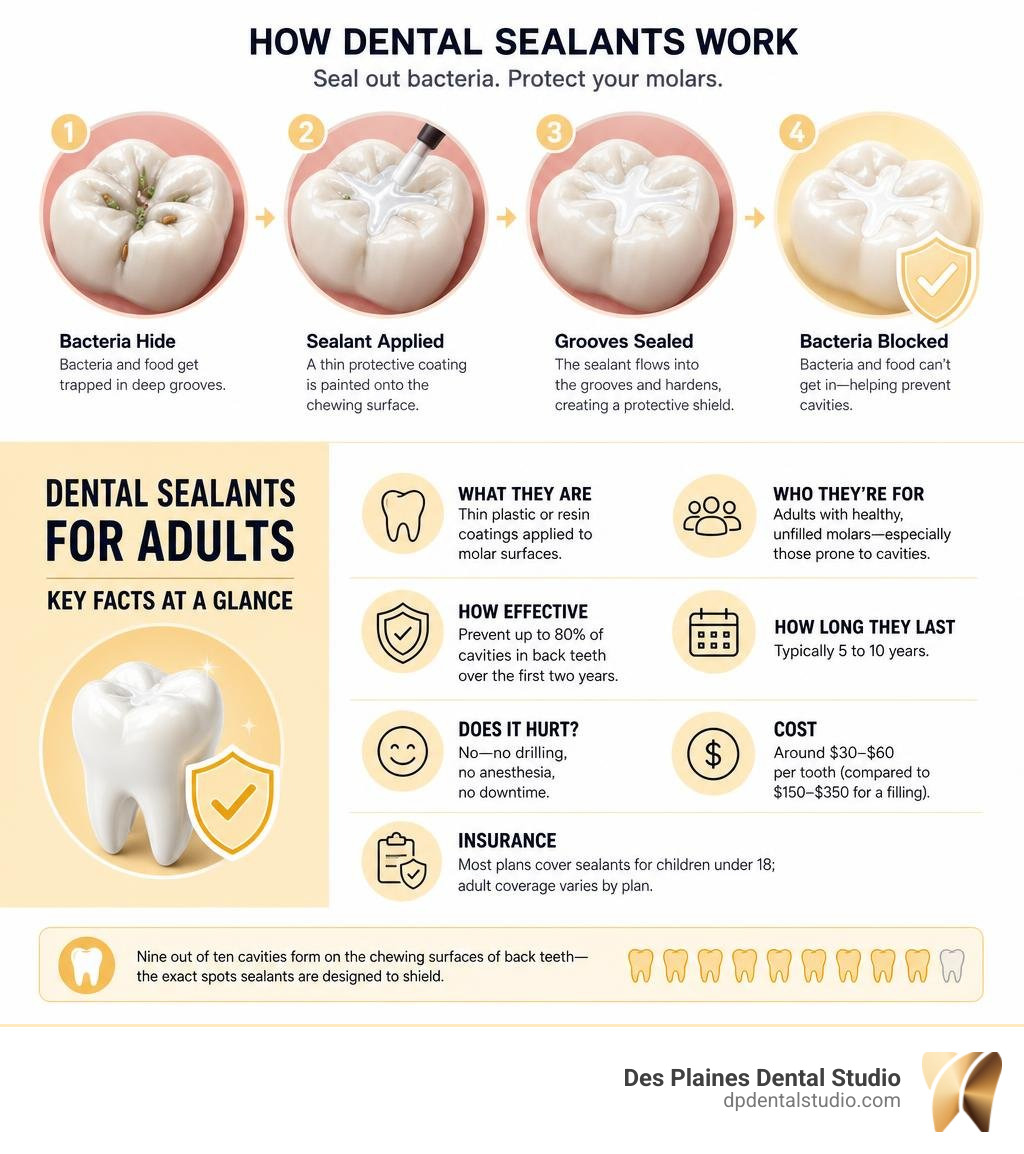
At their core, dental sealants act like a custom-fitted raincoat for your teeth. When you eat, microscopic food particles and bacteria settle into the deep, narrow valleys of your back teeth. Even if you brush and floss religiously twice a day, your toothbrush bristles are actually too thick to reach the bottom of these microscopic grooves.
By applying a thin, liquid plastic or glass ionomer coating over these surfaces, we create a smooth, protective barrier. This barrier physically blocks plaque, acid, and food debris from collecting in those hard-to-clean areas.
By smoothing out these tiny cracks, sealants make your daily toothbrushing significantly more effective. Instead of trying to sweep debris out of deep pits, your toothbrush can easily glide over a sealed, flat surface. This simple barrier is one of the most powerful tools we use in More info about preventative dental care to stop decay before it ever has a chance to damage your enamel.
The Science Behind Molar Protection
Our teeth are covered in a highly mineralized outer layer called enamel. While enamel is incredibly strong, the anatomy of our molars and premolars naturally includes deep pits and fissures. These grooves are formed during tooth development, leaving thin valleys where the enamel is much harder to clean.
Fluoride is highly effective at strengthening smooth enamel surfaces, but it cannot fully protect these deep pits and fissures from the physical accumulation of bacteria. This is why pits and fissures are approximately eight times more vulnerable to decay than the smooth sides of your teeth.
By using sealants, we isolate these deep crevices from cariogenic (cavity-causing) bacteria and their nutrient sources (like sugars). We recommend exploring More info about tooth decay prevention to see how combining sealants with daily habits completely transforms your defense against decay.
Resin-Based vs. Glass Ionomer Materials
When you get dental sealants for adults, we typically choose between two primary types of materials, depending on your unique oral anatomy and risk factors:
- Resin-Based Sealants: These are the most common type of sealants. They are made of plastic resins—often using bisphenol A-glycidyl methacrylate (bis-GMA) as their primary component. They are highly durable, tooth-colored or clear, and typically last between 5 to 10 years. They require excellent moisture control during application to bond properly.
- Glass Ionomer Sealants: These materials bond chemically to the tooth structure rather than mechanically. They are highly moisture-tolerant, making them easier to apply in hard-to-reach areas. Most importantly, glass ionomers release fluoride over time, which actively strengthens the surrounding enamel. However, they are slightly less wear-resistant and typically last between 2 to 5 years.
For a deeper dive into the clinical efficacy of these materials, you can read this Scientific research on dental sealants for adults.
Are Dental Sealants for Adults Safe?
Yes, dental sealants are exceptionally safe. They have been endorsed by major health organizations—including the American Dental Association (ADA), the FDA, and the CDC—with a clinical safety record spanning more than 50 years.
A common question we hear from our patients in Des Plaines, IL is whether sealants contain harmful chemicals like Bisphenol A (BPA). While some resin-based sealants release trace amounts of BPA immediately after placement, the exposure is incredibly tiny. The average resin sealant releases roughly 0.09 nanograms of BPA. To put that in perspective, this is 50,000 times lower than the levels considered harmful, and it is far less BPA than you absorb daily from touching thermal paper cash register receipts or eating canned food.
Furthermore, the trace amount of BPA completely dissipates within a few hours of the procedure. For patients who prefer a completely BPA-free option, we also offer clear, BPA-free resin and glass ionomer alternatives.
Why Dental Sealants for Adults Are a Smart Investment
In the dental world, prevention is always easier, cheaper, and far less invasive than treatment. Yet, the misconception persists that cavities are a “kid problem.”
In reality, about 90% of adults aged 20 and older have had at least one cavity, and 1 in 4 adults aged 20 to 64 currently has active, untreated decay. By investing a small amount of time and money into sealants, you can protect your natural tooth structure and avoid the cycle of fillings, root canals, and crowns. To learn more about how we protect adult smiles, check out More info about sealants for adults.
Addressing the High Risk of Adult Cavities
As we age, our cavity risk doesn’t disappear—it actually changes and often increases. According to the CDC, 26% of adults aged 20 to 64 have untreated dental caries. Several age-related factors make adults highly vulnerable to new decay:
- Receding Gums: As gums naturally recede over time, they expose vulnerable root surfaces that lack protective enamel.
- Dry Mouth (Xerostomia): Saliva is your mouth’s natural defense system; it washes away food particles and neutralizes acid. Hundreds of common prescription medications (for blood pressure, allergies, and depression) cause dry mouth, which drastically accelerates decay.
- Enamel Wear: Decades of chewing, grinding, and consuming acidic foods naturally wear down adult enamel, making teeth more susceptible to bacterial invasion.
If you struggle with these issues, you can read More info about reducing tooth decay to discover practical strategies to protect your teeth.
Who Is an Ideal Candidate for Dental Sealants for Adults?
While sealants are highly beneficial, they aren’t necessary for everyone. The ideal candidates for adult sealants are individuals who have:
- Deep, Unfilled Molar Grooves: If your molars have natural, deep crevices where a dental explorer “catches” during an exam, you are prime for sealants.
- A History of Frequent Cavities: If you seem to get a new cavity at every six-month checkup despite brushing and flossing, sealants can break that cycle.
- Medication-Induced Dry Mouth: As mentioned, a lack of saliva makes your teeth highly vulnerable to rapid decay.
- Recently Completed Orthodontic Treatment: Freshly exposed molar surfaces that were previously covered by brackets or bands are highly susceptible to plaque accumulation.
To read more about the clinical criteria for adult preventive treatments, check out this Scientific research on adult sealants.
Maintenance, Longevity, and Reapplication
On average, high-quality resin-based sealants last between 5 to 10 years in adults. However, their longevity depends heavily on your daily habits and oral environment.
For instance, if you suffer from bruxism (teeth grinding or clenching), the intense mechanical force can cause sealants to chip or wear down prematurely. In these cases, wearing a custom nightguard is highly recommended to protect both your natural teeth and your sealants.
During your routine six-month checkups, we will evaluate the integrity of your sealants. If a sealant has chipped or partially worn away, we can easily repair or reapply it in just a couple of minutes during your cleaning. Studies show that maintaining your sealants with minor annual repairs can reduce your risk of back-tooth decay by up to 95% over a 10-year period.
Comparing Sealants to Restorative Fillings
To truly appreciate the value of dental sealants for adults, it helps to compare them directly to the treatment they are designed to prevent: dental fillings.
| Feature | Dental Sealants | Restorative Fillings (Composite) |
|---|---|---|
| Primary Purpose | Preventive (stops decay before it starts) | Restorative (repaired damage after decay occurs) |
| Invasiveness | Non-invasive (no drilling, no tooth structure removed) | Invasive (requires drilling away damaged tooth structure) |
| Pain Level | Completely pain-free (no anesthesia required) | May cause mild discomfort (requires local anesthesia) |
| Average Cost | $30 to $60 per tooth | $150 to $350 per tooth |
| Lifespan | 5 to 10 years (easily repaired) | 5 to 15 years (requires replacement over time) |
| Tooth Preservation | Preserves 100% of your natural tooth structure | Removes a portion of your natural tooth structure forever |
As the table shows, sealants are a proactive shield, while fillings are a reactive cure. If you already have a cavity, a filling is necessary to restore the tooth. You can read More info about composite fillings to learn how we restore teeth using natural-looking, tooth-colored materials.
Financial Benefits and Long-Term Savings
When it comes to dental care, spending a little on prevention saves a massive amount on future treatments. A single dental sealant typically costs between $30 and $60 out-of-pocket. In contrast, treating a cavity with a composite filling costs $150 to $350. If the decay spreads deeper, a root canal and crown can easily exceed $1,500 to $2,500.
An economic analysis found that for every $1 spent on dental sealants, patients saved approximately $4.76 in restorative treatment costs over 10 years.
By choosing to seal your teeth today, you are protecting both your physical health and your wallet from the financial burden of complex dental work. For more details on budgeting and planning your care, explore More info about restorative dentistry.
The Pain-Free Application Process
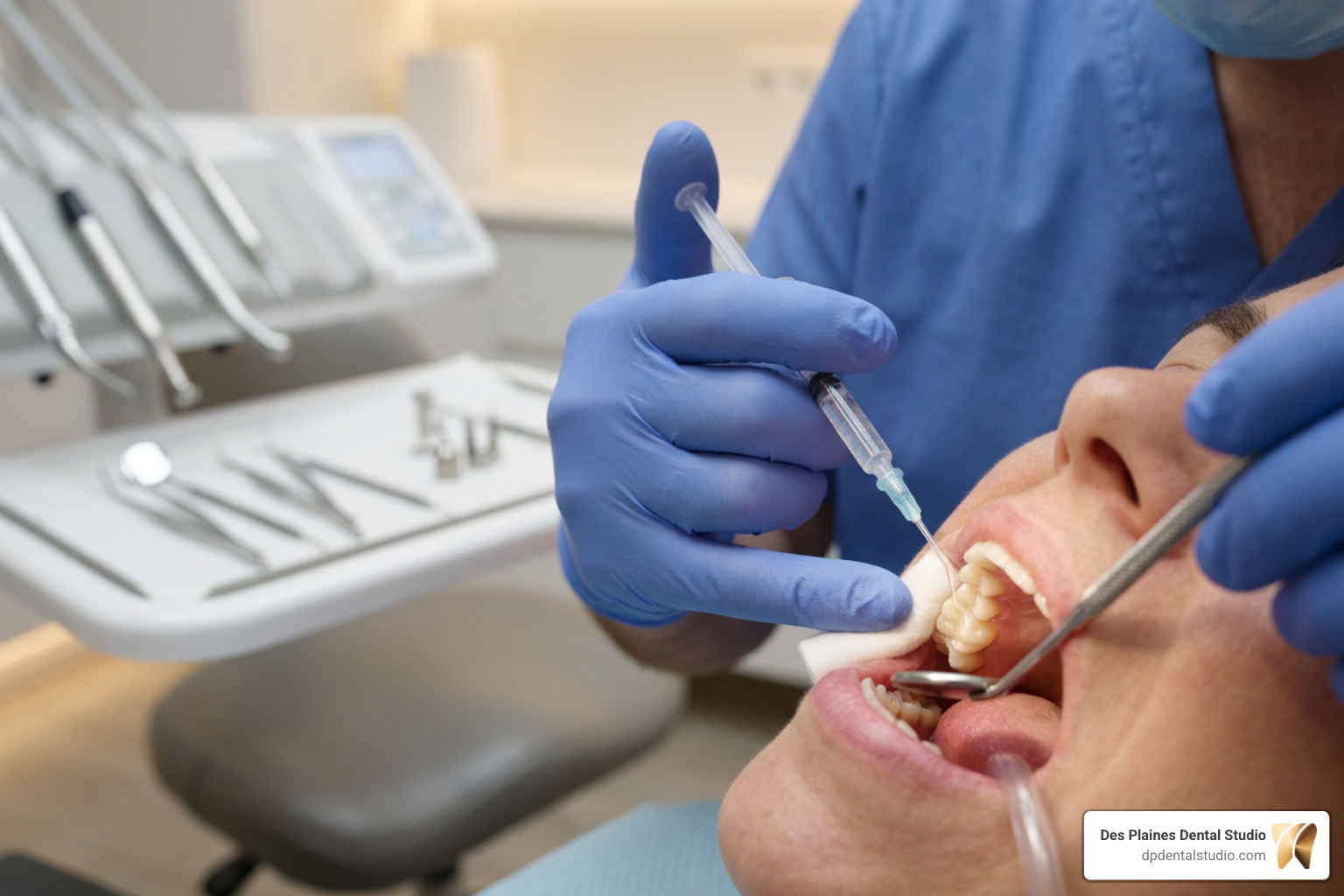
One of the best things about dental sealants is how incredibly easy and comfortable the procedure is. It is completely non-invasive, requires absolutely no drilling, and does not need any local anesthetic (numbing shots). The entire process for a full set of molars takes less than 30 minutes.
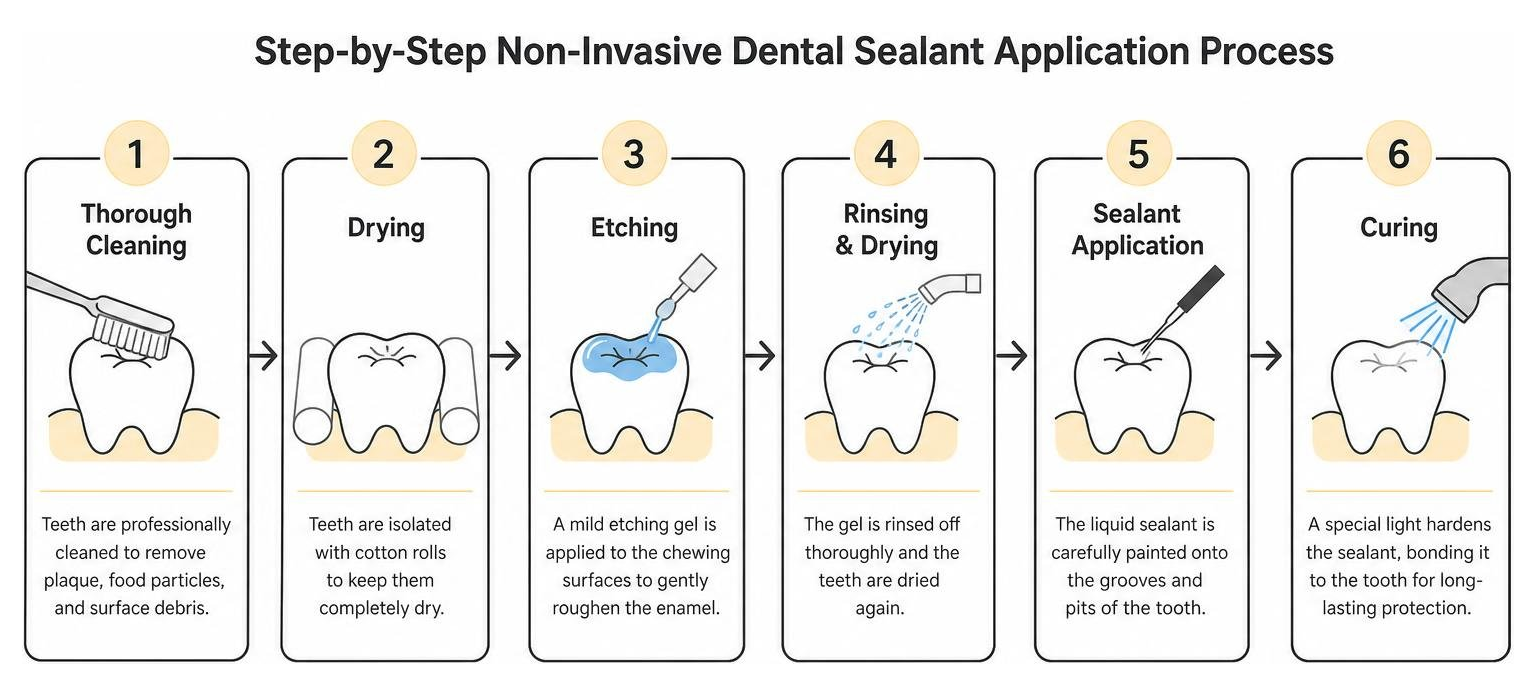
Here is exactly what you can expect during your appointment:
- Thorough Cleaning: We professionally clean the target teeth to ensure all plaque, food particles, and surface debris are completely removed.
- Drying: We isolate the teeth with cotton rolls to keep them completely dry, as moisture can prevent the sealant from bonding properly.
- Etching: We apply a mild, gel-like etching solution to the chewing surfaces. This gently roughens the enamel on a microscopic level, creating a textured surface that helps the sealant form a strong, permanent bond.
- Rinsing and Drying: We rinse away the etching gel and dry the teeth once more.
- Application: We carefully paint the liquid sealant material directly into the deep pits and grooves of your molars.
- Curing: We use a special, safe blue curing light to harden the liquid material in about 20 to 30 seconds.
- Bite Check: We verify your bite to ensure the sealed teeth feel completely natural and comfortable when you chew.
To see how easily this procedure can be integrated into your next routine visit, read More info about dental checkups.
Frequently Asked Questions about Adult Sealants
Are sealants visible when I smile?
No. Because sealants are applied only to the chewing surfaces of your back molars and premolars, they are virtually invisible to other people. The materials we use are either completely clear or custom-shaded to match the natural color of your teeth.
Most of our adult patients are pleasantly surprised by how natural their teeth look and feel after the procedure. In fact, we often recommend clear sealants because they allow us to easily monitor the healthy tooth structure underneath during your routine exams.
Does dental insurance cover sealants for adults?
Dental insurance coverage for adult sealants varies significantly depending on your specific policy. Because sealants have historically been viewed as a pediatric treatment, many traditional insurance plans restrict coverage to patients under the age of 18.
However, because sealants are highly affordable (typically $30 to $60 per tooth), many of our patients choose to pay for them out-of-pocket as a smart, self-funded investment to avoid the much higher costs of future fillings and crowns.
At Des Plaines Dental Studio, we are committed to helping you maximize your benefits. Our team will happily contact your insurance provider to check your preventive coverage and help you find flexible payment options. To learn more about our insurance support and patient financing, check out More info about patient resources.
Can sealants be placed over existing fillings or early decay?
No, sealants cannot be applied over existing fillings or crowns. If a tooth has already been restored, the chewing surface is already sealed by the filling material. However, if you have fillings in some of your molars, any of your remaining healthy, unfilled teeth can still be excellent candidates for sealants.
When it comes to early, noncavitated decay (very early-stage, superficial soft spots), clinical research shows that applying a sealant is actually highly beneficial. Sealing over these minor, incipient lesions cuts off the bacteria’s supply of oxygen and nutrients. This completely halts the progression of the decay, rendering the area sterile and preventing the need for a physical filling.
We will thoroughly evaluate your enamel during your exam to determine the health of your teeth. To schedule an evaluation, read More info about dental checkups in Des Plaines.
Conclusion
Preventive dental care has no age limit. While dental sealants are often associated with childhood, they are a highly effective, painless, and incredibly cost-effective way for adults to protect their natural smiles and avoid expensive restorative treatments down the road.
At Des Plaines Dental Studio, we specialize in providing warm, patient-centered care designed to make your dental experience completely stress-free. Whether you are dealing with age-related dry mouth, deep molar grooves, or simply want to take a proactive approach to your oral health, we are here to support you with expert clinical care and comprehensive insurance guidance.
Take the first step toward a lifetime of strong, healthy, and cavity-free teeth. Schedule a consultation at our Dental Clinic for Adults today!