


Straight Talk: How Much Does Invisalign Really Cost Without Insurance?
The Real Answer to “Invisalign How Much Does It Cost” in 2026
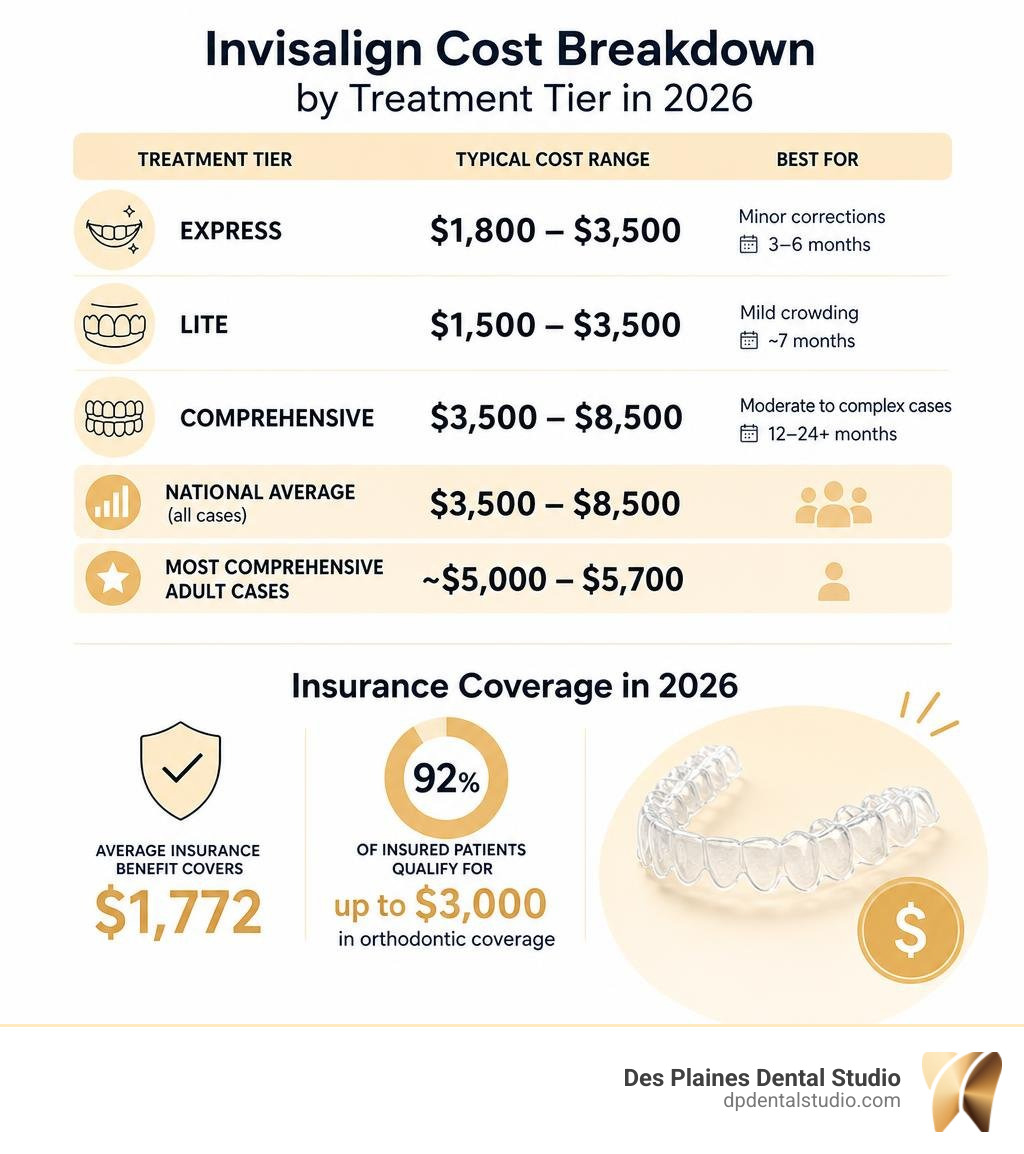
Invisalign, how much does it cost in 2026? Here’s the quick answer before we dive deeper:
| Treatment Tier | Typical Cost Range | Best For |
|---|---|---|
| Invisalign Express | $1,800 – $3,500 | Minor corrections, 3–6 months |
| Invisalign Lite | $1,500 – $3,500 | Mild crowding, ~7 months |
| Invisalign Comprehensive | $3,500 – $8,500 | Moderate to complex cases, 12–24+ months |
| National Average (all cases) | $3,500 – $8,500 | — |
| Most comprehensive adult cases | ~$5,000 – $5,700 | — |
After insurance, most patients pay significantly less. The average insurance benefit covers around $1,772, and up to 92% of insured patients qualify for up to $3,000 in orthodontic coverage.
So the honest range is wide — and that’s exactly the problem. Search online and you’ll find numbers anywhere from $1,800 to over $9,000. That spread isn’t random. It reflects real differences in case complexity, the treatment tier your provider recommends, your geographic location, and what’s actually included in the quoted price.
Most people budgeting for Invisalign start with a number they found online, only to discover their specific situation costs more — or sometimes less — than expected. Before you can plan your budget, you need to understand what drives the price, not just what the average is.
I’m Dr. Marta Milejczyk, a general and cosmetic dentist serving the Des Plaines area since 1997, with advanced clinical training in full-mouth rehabilitation and smile restoration — including clear aligner treatment. Helping patients understand Invisalign, how much does it cost for their specific case is one of the most common conversations I have, and this guide is built around giving you the clearest, most honest answers possible.
Invisalign How Much Does It Cost in 2026?
When patients ask us about the bottom-line cost of clear aligners, they are often surprised to learn that there isn’t a single, fixed retail price. Align Technology (the parent company of Invisalign) does not set a standard retail price for patients. Instead, they charge dental providers a laboratory fee to manufacture your custom aligner trays, and your dentist or orthodontist determines the final fee based on their clinical time, overhead, and the complexity of your treatment.
Nationally, the average cost for a full course of Invisalign treatment in 2026 ranges from $3,500 to $8,500, with most comprehensive adult cases landing right around $5,000 to $5,700. If you are looking at local data here in Illinois, the average cost for clear aligner therapy typically settles around $5,238 before any insurance benefits or promotional discounts are applied.
To understand how these numbers are calculated, it helps to look at the official guidelines from the makers of the system. According to the Average Cost of Invisalign® Aligners, your final financial investment is highly customizable. The final price tag is a direct reflection of how many aligner trays must be manufactured to safely guide your teeth into their ideal positions.
| Invisalign Treatment Element | What It Costs (Averages) | Is It Always Included? |
|---|---|---|
| Initial 3D iTero Digital Scan | $150 – $500 | Usually bundled |
| Aligner Tray Lab Fee | $1,000 – $2,000 | Yes, paid to Align Technology |
| Clinical Supervision & Monitoring | $2,000 – $4,500 | Yes, covers office visits |
| Mid-Course Refinement Trays | $300 – $800 | Included in Comprehensive; extra in Lite/Express |
| Post-Treatment Retainers (Vivera) | $400 – $900 | Often billed separately |
Case Complexity and Invisalign How Much Does It Cost
The single most influential factor in determining your final price is the current state of your smile. Orthodontic issues are categorized into three primary levels of severity, each requiring a different amount of clinical planning, laboratory manufacturing, and treatment time:
- Mild Cases (Minor Crowding or Spacing): If you only have slight overlapping of your front teeth or a small gap you want closed, your treatment is relatively straightforward. These cases typically require fewer than 14 aligner trays, take 3 to 7 months to complete, and cost between $1,500 and $3,500.
- Moderate Cases: This category includes more noticeable crowding, moderate gaps, or minor bite misalignments. These cases generally require 15 to 26 aligner trays, take 12 to 18 months of active wear, and cost between $3,000 and $6,000.
- Severe Cases (Complex Bite Misalignment): If you are dealing with severe crowding, deep overbites, underbites, crossbites, or rotated teeth, your treatment requires advanced biomechanics. This often involves auxiliary tools like clear attachments bonded to your teeth, orthodontic elastics, and a high number of aligner trays. These cases can take 18 to 30+ months and cost between $6,000 and $8,500+.
The more aligners your teeth require to move safely, the higher the laboratory cost, and the more clinical visits you will need to monitor your progress.
Understanding Tiers: Invisalign Express, Lite, and Comprehensive
To accommodate different levels of complexity, Invisalign offers distinct product “tiers.” Understanding which tier you actually need is a great way to protect your wallet and prevent yourself from being upsold on a comprehensive package if a simpler option will yield the same clinical result.
- Invisalign Express: This is the entry-level tier designed for very minor cosmetic adjustments or patients experiencing minor orthodontic relapse (when teeth shift years after wearing traditional braces). It is limited to 5, 7, or 10 sets of aligners and typically costs $1,800 to $3,500, with an average cost of around $2,400.
- Invisalign Lite: This tier is ideal for moderate crowding or spacing that does not require complex bite corrections. It provides up to 14 sets of aligners, usually spanning about 7 months of treatment, and ranges from $1,500 to $3,500.
- Invisalign Comprehensive (formerly Invisalign Full): This is the flagship treatment option for moderate-to-severe malocclusions. It includes an unlimited number of aligners and covers all necessary mid-course corrections and refinement trays for up to five years. This tier ranges from $3,500 to $8,000+, depending on the provider’s experience and your specific clinical needs.
Invisalign vs. Traditional Braces and Alternatives
When weighing the financial investment of a straighter smile, it is natural to compare clear aligners to traditional orthodontic appliances. Many patients assume that clear aligners are vastly more expensive than metal brackets, but the financial gap has closed significantly over the last decade.
When deciding between Braces or Invisalign: What’s Right for Me?, the decision often comes down to lifestyle preferences rather than a massive price difference.
A peer-reviewed clinical study published by the PMC/NIH found that clear aligners can actually reduce overall treatment times for comparable mild-to-moderate cases. The study showed that Invisalign patients averaged 18 months of active treatment compared to 24 months for patients wearing conventional metal braces. Shorter treatment times mean fewer visits to our office, saving you valuable time and reducing travel costs.
Beyond the timeline, the lifestyle benefits of clear aligners are hard to ignore:
- Aesthetics: Aligners are virtually invisible, allowing you to smile confidently in professional settings or at school without visible metal wires.
- Comfort: Smooth, medical-grade polyurethane resin eliminates the painful cheek lacerations and emergency wire-clipping appointments common with metal brackets.
- Hygiene: Because you remove your aligners to brush and floss, maintaining excellent oral health is much easier. This drastically lowers your risk of developing cavities or gum disease during your orthodontic journey.
- Dietary Freedom: You don’t have to worry about breaking brackets on apples, popcorn, or crusty bread. Just pop your trays out, enjoy your favorite meals, brush, and put them back in.
Comparing the Financial Investment of Aligners and Braces
To put the numbers into perspective, let’s look at how the costs of various orthodontic options stack up side-by-side in 2026:
- Traditional Metal Braces: $3,000 – $7,000
- Ceramic (Clear) Braces: $4,000 – $8,500
- Invisalign Clear Aligners: $3,000 – $8,000
- Lingual Braces (behind the teeth): $8,000 – $13,000
- At-Home/Mail-Order Aligners: $1,800 – $3,500
For a typical moderate case, the price difference between traditional metal braces and Invisalign is usually within $500 to $1,000. Ceramic braces, which use tooth-colored brackets to offer a more discreet look, often cost more than Invisalign due to the high material cost of the ceramic brackets and the increased friction they place on the archwires, which can extend treatment times by several months.
The Importance of Professional Supervision and Clinical Safety
We understand the temptation of direct-to-consumer, mail-order aligner brands. With starting prices advertised under $2,000, they seem like an incredibly budget-friendly shortcut. However, orthodontic movement is a complex biological process that involves remodeling the jawbone. Moving teeth without direct clinical supervision can lead to irreversible dental damage, including root resorption, severe gum recession, and a permanently ruined bite.
According to the comprehensive Invisalign Cost in 2026: Full Treatment Price Breakdown, the primary value of choosing a professional provider is the safety of dentist-led care. At-home aligner companies rely on self-taken dental impressions or quick, unsupervised scans. They do not take 3D digital X-rays to assess the health of your tooth roots or jawbone before moving your teeth.
Professional, in-person care ensures that any underlying issues — like active cavities, gum disease, or bone loss — are diagnosed and treated before orthodontic pressure is applied. Furthermore, in-office monitoring allows us to make real-time adjustments if your teeth are not tracking precisely as planned, preventing costly and painful treatment failures.
Hidden and Additional Costs of Clear Aligner Treatment
One of the most common complaints patients have when researching orthodontic care online is encountering “hidden fees.” Some practices advertise an incredibly low base price to get you through the door, only to bill you separately for essential components of your care.
To ensure you can budget accurately, here is a breakdown of the additional costs that may or may not be included in your initial quote:
- Pre-Treatment Dental Work ($200 – $2,000+): Your teeth and gums must be perfectly healthy before we can safely move them. If you have active decay, gum disease, or require wisdom teeth extractions, these procedures must be completed first. While these are separate dental treatments, they are a necessary precursor to your clear aligner journey.
- Refinement Aligners ($300 – $800): At the end of your initial tray series, some teeth may not have fully rotated or shifted into their exact target positions. “Refinements” are extra sets of aligner trays designed to fine-tune your results. While these are completely covered under the Invisalign Comprehensive tier, some providers charge extra for refinements if you are on an Express or Lite plan.
- Post-Treatment Retainers ($200 – $900): Once your teeth are perfectly straight, they will naturally want to drift back to their original positions. To prevent this, you must wear a retainer (initially full-time, then nightly). Vivera retainers (made by the creators of Invisalign) are highly durable and cost between $400 and $700 for a set of four. Generic clear retainers typically cost $200 to $500. Always ask if your first set of retainers is included in your initial quote.
- Replacement Trays ($75 – $300 per tray): Accidents happen. If you accidentally throw your active aligner tray into a restaurant napkin dispenser or your dog uses it as a chew toy, you will need a replacement. While we always try to help our patients minimize these costs, some practices charge a replacement fee per tray if you lose them frequently.
- Attachments and Buttons: These are tiny, tooth-colored composite bumps bonded to your teeth to give the aligners leverage for complex movements. In a professional dental setting, the placement and removal of these attachments are always bundled into your treatment fee, but it is always wise to double-check.
How to Make Invisalign Affordable Without Insurance
If you do not have dental insurance, or if your current policy does not cover adult orthodontics, you do not have to put your dream of a confident smile on hold. There are several highly effective financial strategies we utilize to help our patients fit the cost of clear aligners into their monthly budgets:
- Flexible Spending Accounts (FSA) & Health Savings Accounts (HSA): Because Invisalign is classified as a qualified medical expense, you can pay for your entire treatment using pre-tax dollars. Depending on your tax bracket, utilizing an FSA or HSA can effectively save you 20% to 35% on your out-of-pocket costs. The 2026 contribution limits are $3,200 for FSAs and $4,300 for individual HSAs, meaning you can fund a substantial portion of your treatment tax-free.
- Third-Party Financing (CareCredit): We proudly accept CareCredit, a dedicated healthcare credit card that offers low-interest and interest-free promotional financing plans. This allows you to break down a $5,000 treatment plan into highly manageable monthly payments of around $119 to $180 per month.
- In-House Payment Plans: Many dental practices, including ours, offer flexible, interest-free in-house financing. By splitting your balance over the course of your active treatment (usually 12 to 24 months) after a modest down payment, you can keep your monthly payments predictable and interest-free.
- Upfront Cash Discounts: If you have the financial means to pay for your entire treatment upfront, always ask your provider for a cash discount. Most practices will gladly offer a 5% to 10% discount for paying in full on day one, as it eliminates their administrative costs and credit card processing fees.
Frequently Asked Questions About Invisalign Costs
Does dental insurance cover Invisalign in 2026?
Yes! Most dental insurance policies that include orthodontic benefits cover Invisalign exactly the same way they cover traditional metal braces. Typically, these plans will pay a set percentage (usually 50%) of your treatment cost up to a lifetime orthodontic maximum.
This lifetime maximum generally ranges from $1,000 to $3,000, with the average actual insurance contribution hovering around $1,772.
When calling your insurance company, ask if your plan covers adult orthodontics (some plans restrict coverage to dependents under the age of 19) and ask them to verify benefits for dental billing codes D8080 (for adolescents) or D8090 (for adults).
Can I use my HSA or FSA to pay for Invisalign?
Absolutely. Invisalign is a fully approved medical expense under IRS guidelines. You can use your HSA or FSA debit card directly at our office to make your down payment or cover your monthly installments.
A popular financial strategy is to “front-load” your FSA account during your employer’s open enrollment period to align with the start of your orthodontic treatment, allowing you to maximize your tax savings right away.
Are post-treatment retainers included in the initial quote?
This depends entirely on the dental practice you choose. Some clinics include your first set of post-treatment retainers and your final retention monitoring visits in their base fee. Others unbundle these costs, meaning you will receive a separate bill for your retainers once active treatment is complete.
Before signing any treatment contract, always ask for an itemized breakdown to confirm whether post-treatment retainers are included.
Conclusion
Investing in a straighter smile is about so much more than just aesthetics. Correcting misaligned teeth makes them significantly easier to clean, reduces your risk of tooth decay and periodontal disease, prevents uneven wear on your enamel, and can even alleviate chronic jaw pain (TMJ).
At Des Plaines Dental Studio, we believe that financial barriers should never stand between you and excellent oral health. We pride ourselves on providing patient-centered, warm, and highly supportive care. We work closely with your dental insurance provider to maximize your lifetime orthodontic benefits, and we offer highly flexible, interest-free monthly payment plans designed to fit your unique household budget.
If you are ready to take the first step toward a healthier, more confident smile, we invite you to find an experienced Invisalign Dentist Near Me and schedule a comprehensive consultation. Contact us today to learn more about our personalized approach to Invisalign in Des Plaines, IL, and let us help you achieve the beautiful, healthy smile you deserve!