


The Ultimate Strength Test Between Composite and Amalgam Fillings
Are Composite Fillings Stronger Than Amalgam? Here’s What You Need to Know First
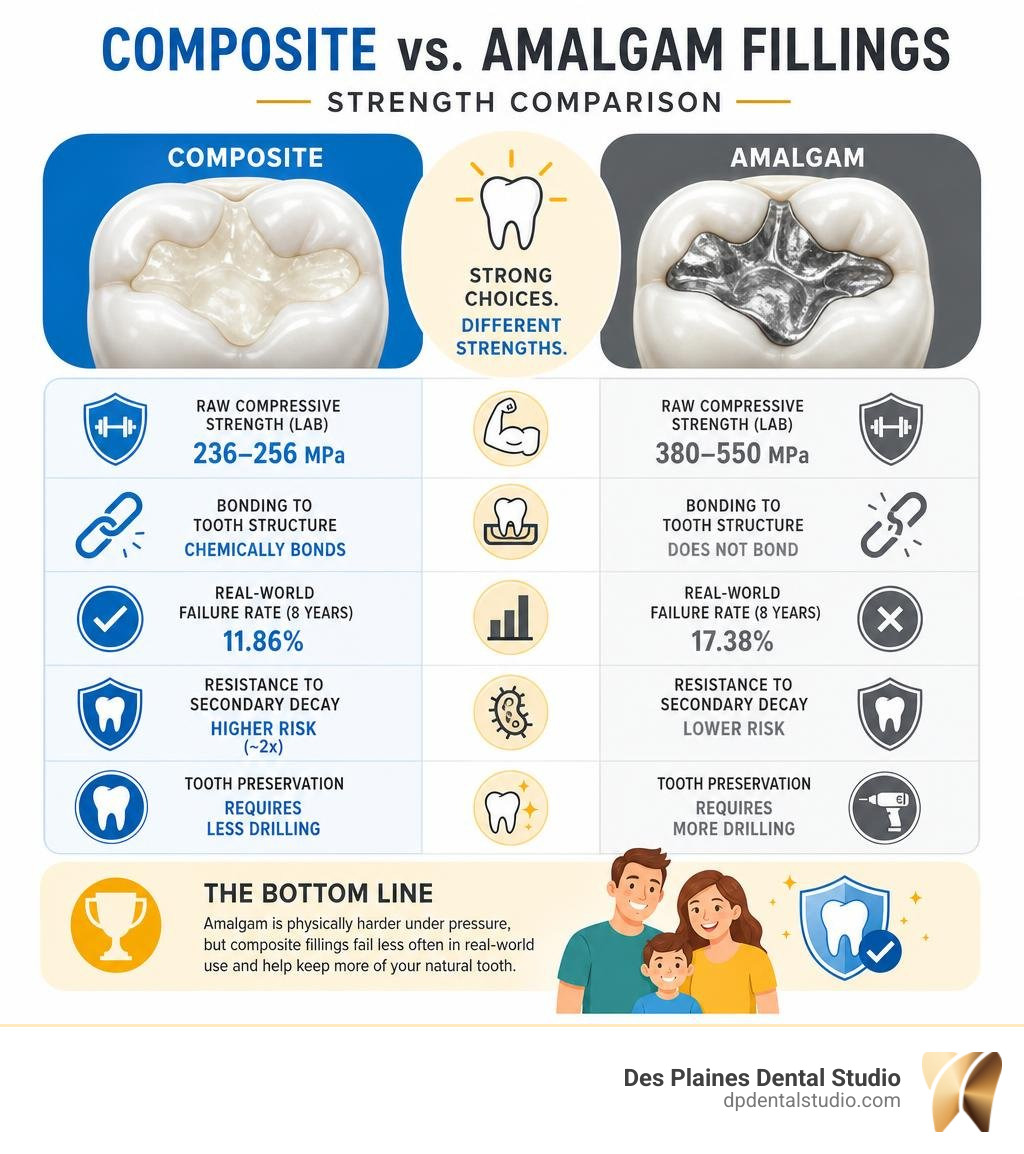
The question of whether are composite fillings stronger than amalgam doesn’t have a single yes or no answer — it depends on what type of “strength” you’re measuring.
Here’s the quick breakdown:
| Strength Category | Winner |
|---|---|
| Raw compressive strength (lab) | Amalgam (380–550 MPa vs. 236–256 MPa) |
| Bonding to tooth structure | Composite (chemically bonds; amalgam does not) |
| Real-world failure rate | Composite (11.86% vs. 17.38% over 8 years) |
| Resistance to secondary decay | Amalgam (composite has ~2x higher risk) |
| Tooth preservation | Composite (requires less drilling) |
The short version: amalgam is physically harder under pressure, but modern composite fillings actually fail less often in real-world use and help keep your natural tooth stronger by bonding directly to it.
For decades, dentists and patients have debated this exact question. Amalgam — the silver filling that’s been around since the 1800s — was long considered the gold standard for back teeth. It’s tough, cheap, and long-lasting. But composite resin (the tooth-colored filling) has improved dramatically, and a 2024 study of over 650,000 patients found that composite restorations actually had a lower failure rate than amalgam in real-world clinical settings.
So the debate is more nuanced than it looks. The “stronger” material in the lab isn’t always the one that holds up better in your mouth.
I’m Marta Milejczyk, a general dentist with decades of clinical experience in restorative dentistry, including extensive hands-on training in full mouth rehabilitation and cosmetic smile restoration — experience that puts the question of are composite fillings stronger than amalgam at the center of everyday patient decisions. In this guide, I’ll walk you through exactly what the science says so you can make the most informed choice for your teeth.
Material Science: Composition and Properties of Fillings
To understand which material wins the strength test, we have to look at what they are made of. These two materials belong to completely different chemical families, which dictates how they behave under the immense pressure of your bite.
Dental amalgam is a metallic alloy that has been used in restorative dentistry for over 150 years. It is composed of a mixture of liquid mercury (making up approximately 45% to 50% of the compound by weight) and a powdered alloy of silver, tin, and copper. When these components are mixed (a process called trituration), they form a soft paste that the dentist packs into the prepared cavity. As it cures, it crystallizes into a solid, highly durable metallic mass.
On the other hand, composite resin is a tooth-colored mixture of plastic (acrylic) and glass. Specifically, it consists of an organic polymer matrix — most commonly Bisphenol A-glycidyl methacrylate, or Bis-GMA — reinforced with inorganic filler particles like silica, quartz, or glass.
Unlike amalgam, which sets through a chemical crystallization process, composite resins are cured using a specialized blue UV light. This light triggers polymerization, causing the liquid monomer chains to cross-link into a rigid plastic matrix. During this curing process, composites experience volumetric contraction (polymerization shrinkage) ranging from 2.6% to 4.8%. This shrinkage is a key engineering challenge because it can create microscopic gaps at the edge of the filling if not managed carefully by the dentist.
For a deeper dive into the chemical structures and historical development of these materials, you can read the comprehensive Scientific review of dental restoration materials.
Are Composite Fillings Stronger Than Amalgam? The Mechanical Strength Showdown
When patients ask if composite fillings are stronger than silver ones, they are usually thinking of physical durability. In engineering and material science, “strength” is split into different categories, mainly compressive strength (the ability to withstand crushing forces) and tensile/shear strength (the ability to resist pulling or sliding forces).
The table below highlights these mechanical differences:
| Physical Property | Dental Amalgam | Composite Resin |
|---|---|---|
| Compressive Strength | 380 – 550 MPa | 236 – 256 MPa |
| Tensile/Shear Strength | Low | Moderate to High |
| Retention Mechanism | Mechanical interlocking (undercuts) | Chemical & Micromechanical bonding |
| Thermal Behavior | Expands 2x more than dentin | Expands 4x more than dentin |
| Marginal Seal over Time | Improves (due to corrosion products) | Can degrade (due to thermal cycling) |
As we can see, amalgam has a massive advantage in raw crushing resistance. However, a major downside of metal is how it reacts to temperature. Amalgam expands and contracts when exposed to hot coffee or cold ice water. Over time, these micro-movements put stress on the surrounding enamel, which can lead to microleakage and structural cracks in the tooth.
To explore the physics of these materials further, check out this Technical analysis of material strength.
Compressive Strength: Why Amalgam Historically Dominated
Your jaw muscles can exert incredible force, especially on your back molars during chewing (masticatory forces). This is where dental amalgam has historically dominated.
High-copper amalgam boasts a compressive strength of 380 to 550 Megapascals (MPa). To put that in perspective, this is very close to the natural strength of human enamel and dentin. Traditional composite resins, by comparison, sit much lower at 236 to 256 MPa. Because back teeth endure the brunt of your bite, amalgam was long considered the only logical choice for large cavities in molars. It simply does not crush under pressure.
Tensile and Bonding Strength: How Composite Reinforces the Tooth
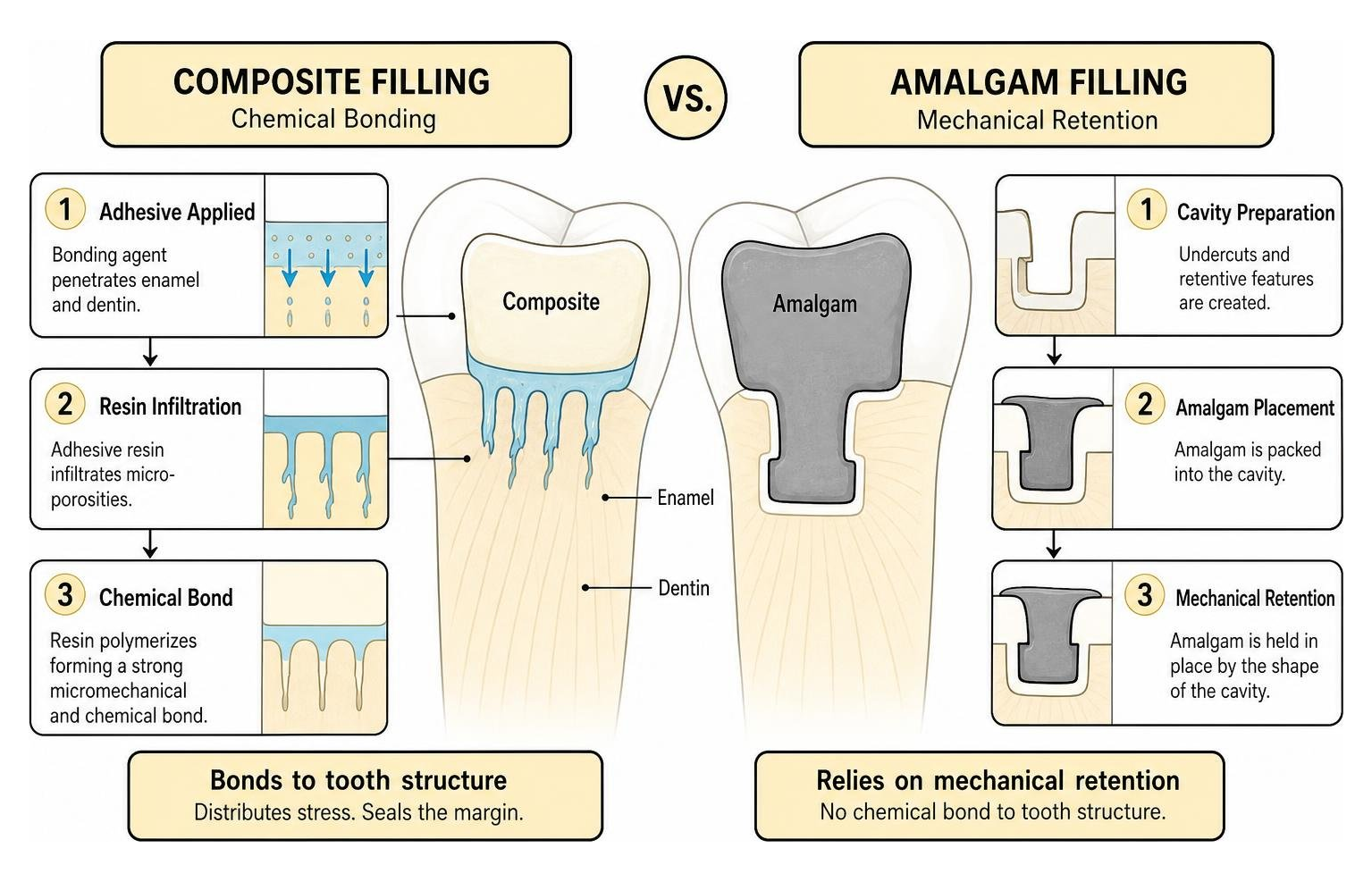
While amalgam wins the raw crushing contest, it has a fatal flaw: it does not bond to your tooth. To place an amalgam filling, a dentist must drill “undercuts” into your tooth structure — essentially shaping the cavity like an upside-down wedge so the metal is mechanically locked in place. This means we have to drill away healthy tooth structure just to keep the filling from falling out.
Composite fillings work completely differently. They rely on adhesive bonding. We apply a mild acidic gel to etch the microscopic pores of your enamel and dentin, then apply a liquid bonding agent that flows into those pores. When we cure the composite, it creates a micromechanical interlocking bond.
Because composite chemically bonds to the tooth, it works as a single cohesive unit with your natural structure. This actually reinforces the remaining walls of the tooth, distributing biting forces more evenly and reducing the risk of a future tooth fracture. Plus, because we don’t need to create mechanical undercuts, we can perform much more conservative cavity preparations, leaving more of your natural tooth intact.
If you want to learn more about how adhesive bonding can repair and enhance your smile, explore our page on More info about dental bonding services.
Longevity and Real-World Failure Rates: What the Data Shows
For decades, dental textbooks taught that silver fillings last far longer than white ones. While that was certainly true of older generations of plastic fillings, modern dental materials have closed the gap. Today, composite restorations account for over 70% of all direct fillings placed in the United States, and real-world clinical data is challenging old assumptions.

When we look at how fillings fail, we usually look at two main culprits: physical restoration failure (the filling breaking or falling out) and secondary caries (a new cavity forming around the edges of the filling).
Historically, randomized controlled trials suggested that composite fillings had a higher risk of failing due to recurrent decay. However, newer, large-scale studies are painting a different picture, especially as global environmental initiatives like the Minamata Convention on Mercury push dental practices to phase down the use of silver amalgam.
To see how these materials perform across massive population studies, you can read the Big data study on restoration survival rates.
What Big Data Says: Are Composite Fillings Stronger Than Amalgam in Practice?
A landmark retrospective study analyzed real-world clinical data from over 650,000 patients to see how fillings actually held up over an eight-year period. The results surprised many traditionalists:
- Amalgam restorations had a failure rate of 17.38%.
- Composite restorations had a lower failure rate of 11.86%.
- The Mean Annual Failure Rate (mAFR) was 3.55% for amalgam compared to 3.06% for composite.
- For single-surface restorations, amalgam failed 14.01% of the time, while composite failed only 10.75% of the time.
This massive real-world dataset suggests that in modern clinical settings, composite fillings are highly durable and, in many cases, outlast their silver counterparts. This is largely due to advancements in nanohybrid and bulk-fill composite technologies, which resist wear much better than the materials used in the 1990s and early 2000s.
The Risk of Secondary Caries: Are Composite Fillings Stronger Than Amalgam Against Decay?
Despite composite’s excellent physical survival rates, amalgam still holds a distinct biological advantage: it is much more forgiving.
Amalgam fillings naturally corrode slightly over time. While “corrosion” sounds like a bad thing, in a wet mouth, those metallic corrosion by-products actually expand to seal the tiny space between the filling and the tooth. This self-sealing property dramatically reduces microleakage and blocks bacteria from sneaking underneath. In fact, studies show the risk of secondary caries (new cavities) can be up to 3.5 times higher with composite fillings than with amalgam.
Composite resin is highly technique-sensitive. If a dentist doesn’t achieve perfect moisture control during placement — meaning even a tiny drop of saliva contaminates the prep before the bonding agent is cured — the adhesive bond will fail. This creates micro-gaps that invite recurrent decay.
At Des Plaines Dental Studio, we use advanced isolation protocols, such as rubber dams and high-volume evacuation, to ensure a completely dry environment for long-lasting composite bonds. You can learn more about how we handle these advanced treatments on our page detailing More info about restorative dentistry procedures.
Practical Factors: Aesthetics, Safety, and Environmental Concerns
Beyond mechanical strength, several practical, environmental, and health factors influence whether we choose composite or amalgam for our patients in Des Plaines, IL.
First, there is the question of safety. Because dental amalgam is roughly 50% elemental mercury, it releases trace amounts of mercury vapor, particularly during chewing or when the filling is being placed or removed. While the FDA and ADA maintain that amalgam is safe for adults and children over the age of six, the FDA updated its guidance in 2020 to recommend that high-risk populations — including pregnant or nursing women, children under six, and people with pre-existing kidney issues — avoid getting new amalgam fillings when possible.
Conversely, composite resins are entirely mercury-free, though some patients raise questions about trace amounts of Bisphenol A (BPA) in the plastic matrix. Fortunately, modern high-quality dental composites are highly biocompatible and release negligible chemical traces, well within safety limits.
There are also major environmental factors at play. The global Minamata Convention on Mercury has prompted a steady phase-down of dental amalgam to prevent mercury waste from contaminating water systems. Modern dental offices, including ours, utilize specialized amalgam separators to capture and safely recycle metal waste before it can enter the local Des Plaines water supply.
To read a detailed safety breakdown compiled by health researchers, consult this Clinical safety comparison of fillings.
Choosing the Right Material: When to Choose Composite vs. Amalgam
In our practice, we believe in patient-centered care, which means we customize our recommendations based on your unique oral health, budget, and aesthetic goals.
We almost always recommend composite fillings for:
- Anterior (front) teeth, where matching your natural tooth color is essential for a beautiful smile.
- Small to medium cavities, where we want to preserve as much of your healthy, natural tooth structure as possible.
- Patients with metal allergies or those who prefer a mercury-free lifestyle.
We may discuss alternative high-strength options (like porcelain inlays, onlays, or crowns) if:
- The cavity is extremely large and covers multiple surfaces of a back molar that takes heavy biting abuse.
- A patient has a very high caries index (frequent cavities) and struggles with oral hygiene, meaning they need the cavity-resistant properties of a self-sealing material.
If you have a tooth that is cracked, painful, or has an old, failing silver filling, you can read more about how we restore structural integrity on our page about More info about broken tooth repair.
Frequently Asked Questions about Dental Fillings
Do composite fillings last as long as silver amalgam fillings?
Historically, silver fillings lasted 10 to 15 years (and sometimes 20+ years in low-stress areas), while composites lasted only 5 to 10 years. However, modern nanohybrid composite resins have closed this gap significantly. In many clinical settings, a well-placed composite filling can easily last 10 to 15 years, especially when paired with good oral hygiene and regular dental cleanings.
Should I replace my old silver fillings with composite?
We do not recommend replacing functional, healthy silver fillings solely because they contain mercury. Removing a stable amalgam filling actually releases a brief spike of mercury vapor and requires drilling away more healthy tooth structure, which can weaken the tooth. However, if your old silver filling is showing signs of structural failure, has micro-fractures in the surrounding enamel, or has a new cavity forming underneath, we will gladly replace it with a beautiful, tooth-colored composite.
Why are composite fillings more expensive than amalgam?
Composite fillings cost more because they are incredibly technique-sensitive and take longer to place. While an amalgam filling can be quickly packed into a cavity even in a damp environment, a composite filling requires step-by-step acid etching, bonding, incremental layering, and precise UV light curing under strict moisture control. The materials themselves are also more costly to manufacture than simple metal alloys. While some basic insurance plans have limitations on white fillings for back teeth, our team at Des Plaines Dental Studio works closely with your provider to maximize your benefits.
Conclusion
So, are composite fillings stronger than amalgam? While silver amalgam is technically harder and more resistant to raw crushing forces in a laboratory, modern composite fillings are the clear winners when it comes to preserving your natural tooth, preventing cracks, and delivering a beautiful, metal-free smile. Thanks to advanced adhesive technology, composites bond directly to your enamel, reinforcing your tooth from the inside out and delivering outstanding real-world longevity.
At Des Plaines Dental Studio, we are committed to providing welcoming, pain-free, and patient-centered care. Whether you need a simple cavity repaired or want to evaluate your existing restorations, we offer state-of-the-art restorative treatments designed to keep your smile healthy and bright.
If you are ready to experience high-quality, comfortable dental care with full insurance support right here in Des Plaines, IL, Schedule a consultation for composite fillings with our warm and experienced team today!