


How Much Do Metal Partial Dentures Cost with and without Insurance?
What Do Metal Partial Dentures Actually Cost?
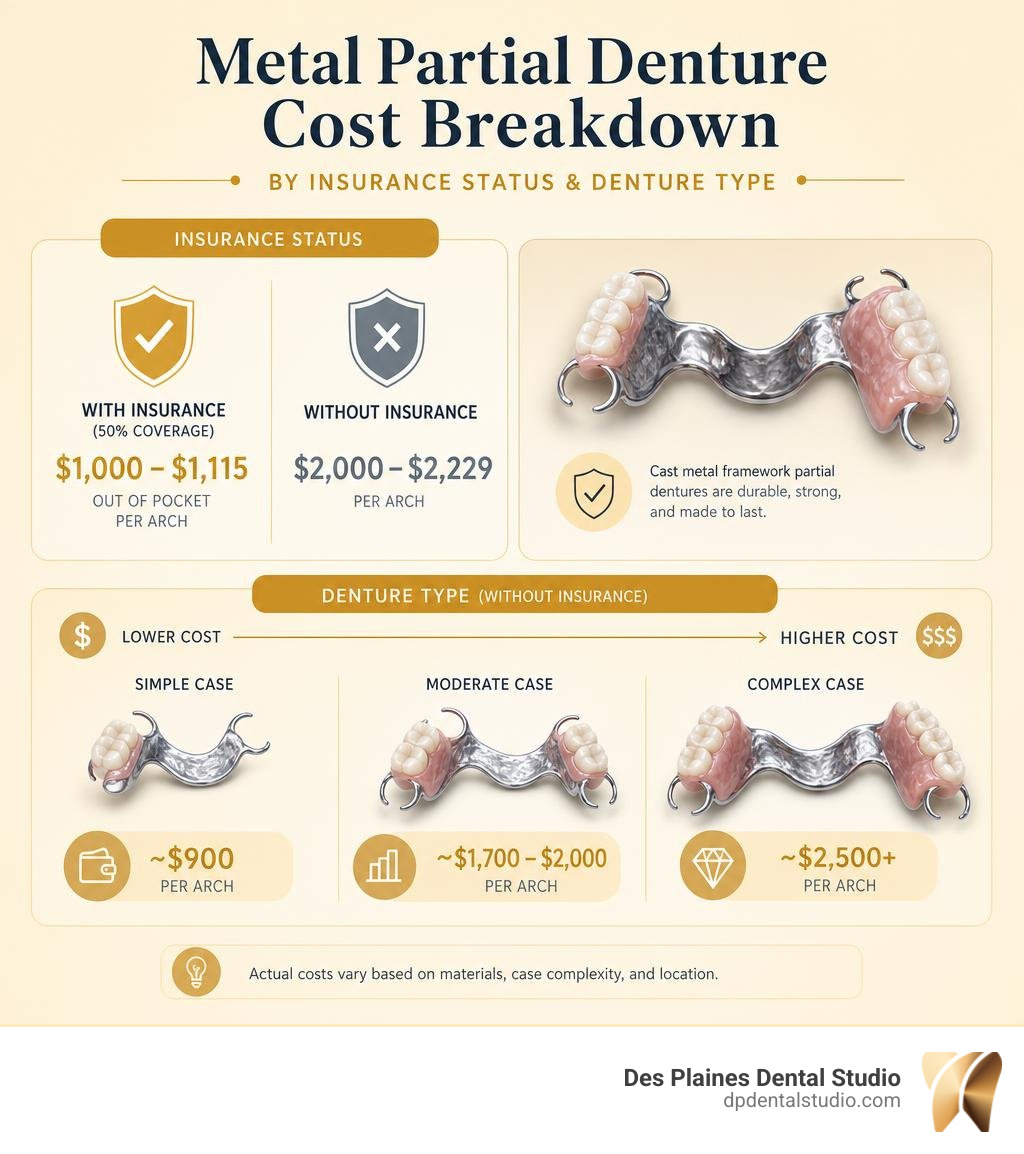
Metal partial dentures cost between $900 and $2,500 per arch on average, depending on materials, complexity, and where you live. Here’s a quick snapshot:
| Situation | Estimated Cost |
|---|---|
| Without insurance (national average) | ~$2,000–$2,229 per arch |
| With insurance (50% coverage) | ~$1,000–$1,115 out of pocket |
| Low end (simple case) | ~$900 |
| High end (complex case) | ~$2,500+ |
These figures are for cast metal framework partial dentures — the most durable removable option available.
Nearly 45% of adults between the ages of 20 and 64 have lost at least one permanent tooth. For many of them, a metal partial denture is one of the most practical, long-lasting ways to restore their smile and chewing ability. But the price range is wide — sometimes spanning thousands of dollars — and it’s not always clear what drives those differences or how much insurance will actually cover.
This guide breaks down exactly what you can expect to pay, what affects the price, and how to make the cost as manageable as possible.
I’m Dr. Marta Milejczyk, and after nearly 30 years of restorative dentistry practice in Chicago’s northwest suburbs — including advanced training in full mouth rehabilitation — I’ve helped hundreds of patients navigate metal partial dentures cost and find solutions that fit both their mouth and their budget. In the sections below, I’ll walk you through everything you need to know before making a decision.
Understanding the Average Metal Partial Dentures Cost
When looking to replace missing teeth, navigating the financial side of restorative dentistry can feel a bit like reading a map in a different language. To help clear up the confusion, let’s look at the real numbers.
The national average cost for a cast metal framework partial denture is approximately $2,229 per arch, with a typical cost range of $1,728 to $4,203 depending on your specific case. Why is there such a broad range? A lot of it comes down to the quality of the materials, the number of teeth being replaced, and the engineering required to make the denture sit comfortably in your mouth.
To give you an idea of how metal compares to other common materials, here is a breakdown of what you can expect to pay for different types of partial dentures per arch:
| Denture Type | Average Retail Price Range | Expected Lifespan | Primary Benefit |
|---|---|---|---|
| Cast Metal Framework | $1,000 – $2,500 | 10 – 15 Years | Exceptional durability & chewing power |
| Acrylic (Flipper) | $300 – $1,200 | 1 – 5 Years | Low upfront cost; great temporary fix |
| Flexible Thermoplastic | $900 – $2,500 | 3 – 7 Years | Excellent aesthetics (no metal clasps) |
While cast metal partials require a higher upfront investment, they are widely considered the gold standard for long-term removable tooth replacement. They distribute chewing forces beautifully, protect your remaining natural teeth from shifting, and outlast plastic alternatives by a landslide.
Average metal partial dentures cost without insurance
If you do not have a dental insurance plan, the out-of-pocket expenses for a cast metal partial denture typically hover around $2,000 per arch. This price generally covers the fabrication of the metal framework, the attachment of the pink acrylic “saddles” that mimic your gums, and the customized resin teeth.
For example, a cast metal partial denture with resin teeth replacing a moderate gap of 4 to 6 teeth averages around $1,400 to $1,685 for the appliance itself. However, as an uninsured patient, it is crucial to look at the big picture. Your total out-of-pocket cost will also include the clinical steps leading up to the final fitting, such as diagnostic exams, dental impressions, and custom fittings. To get a broader sense of how these fees fit into the overall landscape of tooth replacement, you can explore the average cost for dentures in our comprehensive pricing overview.
Average metal partial dentures cost with insurance
For patients with dental insurance, the financial outlook is often much more encouraging. Most private dental insurance plans classify partial dentures as a “major restorative procedure.”
Under a typical PPO plan, insurance will cover up to 50% of the cost of your metal partial denture, leaving you with an out-of-pocket responsibility of roughly $1,000 to $1,115. However, there are a few important details to keep in mind:
- Annual Maximums: Most dental insurance plans have an annual maximum benefit limit (often between $1,000 and $2,000 per year). If your metal partial costs $2,200 and your insurance covers 50%, they will pay $1,100—assuming you haven’t used any of your annual limit on other treatments like fillings or crowns earlier in the year.
- Waiting Periods: Many policies enforce a 6- to 12-month waiting period for major procedures after you sign up.
- Deductibles: You will need to meet your annual deductible (typically $50 to $150) before your coverage kicks in.
To better understand your policy’s fine print, check out this detailed Guide to partial denture insurance coverage for a complete breakdown of typical coinsurance percentages and structural benefits.
Factors That Influence the Price of Metal Partials
No two mouths are identical, which means the process of designing a partial denture is highly customized. Because of this, the final price tag is influenced by several distinct clinical and geographic factors.
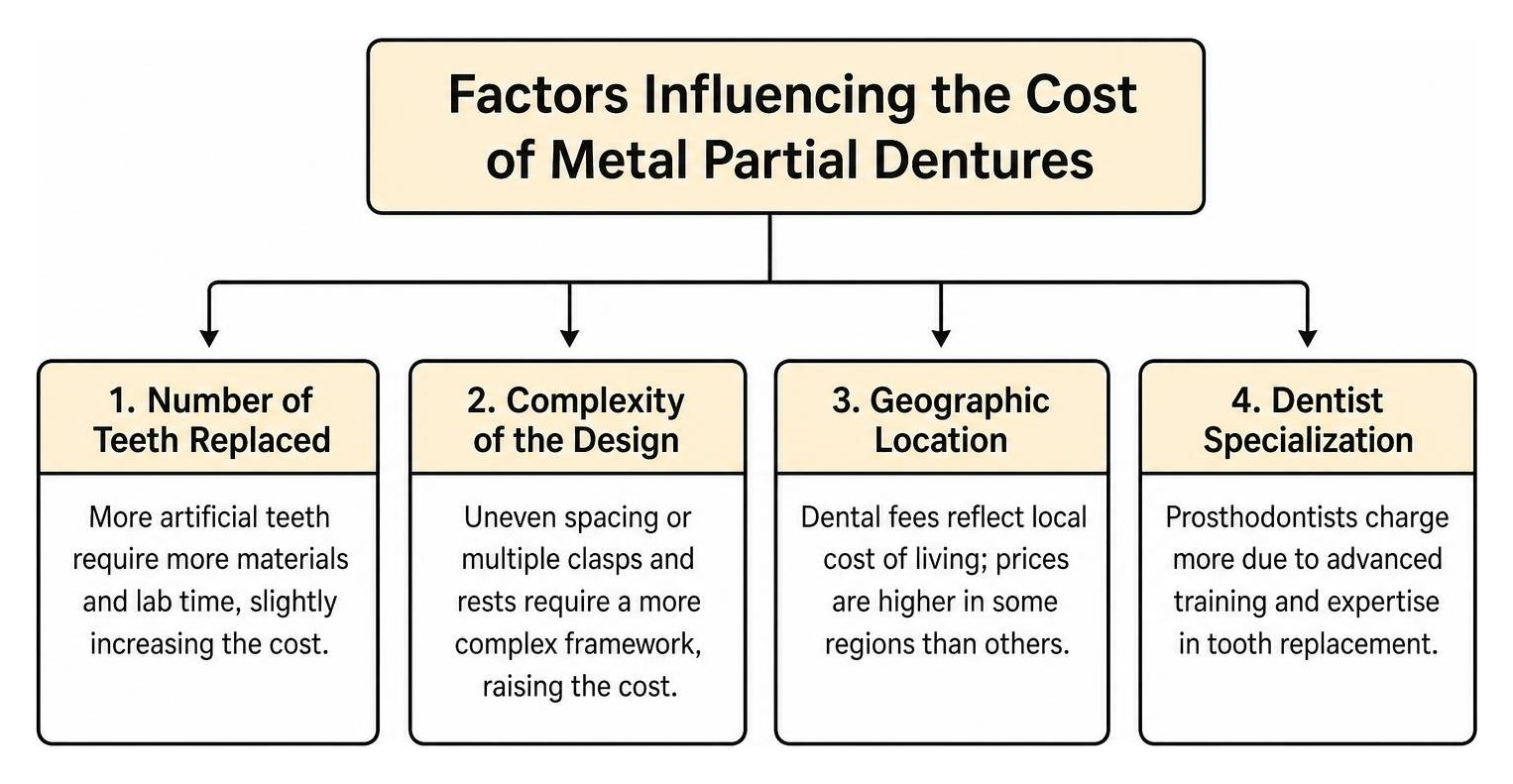
- Number of Teeth Replaced: While the bulk of the cost lies in fabricating the custom metal framework itself, the price will scale slightly based on how many artificial resin teeth need to be set into the pink acrylic saddles.
- Complexity of the Design: If your remaining teeth are unevenly distributed, your dentist will need to design a more complex framework with multiple clasps and rests to keep the denture stable.
- Geographic Location: Dental fees naturally reflect the local cost of living. For example, if you are getting treated here in Illinois, the average cost of traditional removable dentures is approximately $1,927, which is slightly lower than high-cost coastal states like California ($2,488) or Hawaii ($2,867).
- Dentist Specialization: A general dentist will typically charge standard regional rates, whereas a prosthodontist (a dentist who has completed three additional years of specialized training in tooth replacement) will charge higher fees due to their advanced expertise.
Materials and Manufacturing: Cobalt-Chrome vs. Titanium
The specific metal alloy used to create your denture framework plays a massive role in both comfort and cost. Traditionally, medical-grade cobalt-chromium (CoCr) has been the industry standard. It is incredibly strong, rigid, and cost-effective.
However, modern dental technology has introduced titanium frameworks and advanced manufacturing techniques like Selective Laser Melting (SLM).
SLM is a 3D-printing process that uses a high-powered laser to fuse metal powder layer-by-layer. This creates a highly precise, homogeneous framework that is stronger and less prone to microscopic fractures than traditional cast metal. Furthermore, titanium frameworks are up to 60% lighter than traditional cobalt-chromium alloys and are 400% lighter than old-school casting metals. This dramatic reduction in weight significantly improves patient comfort and is highly recommended for individuals with known metal allergies.
To see how advanced 3D-printing and materials are changing modern prosthodontics, you can Learn more about SLM technology and its structural benefits.
Additional Dental Procedures and Hidden Fees
When budgeting for a metal partial denture, patients often overlook the auxiliary treatments required to prepare their mouth for the appliance. A partial denture can only be as healthy and stable as the remaining teeth and gums supporting it.
Before your denture is fabricated, you may need to account for these common pre-treatment costs:
- Comprehensive Oral Exam: $75 – $200
- Panoramic or Digital X-rays: $130 – $250
- Simple Tooth Extractions: $100 – $300 per tooth (necessary if remaining teeth are severely decayed or structurally compromised)
- Tissue Conditioning: ~$190 (a temporary soft liner used to heal inflamed gums before taking final impressions)
- Denture Relining: $250 – $500 (adjusting the pink acrylic base as your jaw bone and gums naturally shrink over time)
If you have teeth that are damaged but can still be saved to act as strong anchors for your new partial, your dentist might recommend crowns or fillings first. For a complete look at these preparatory treatments, read this Information on tooth extractions and replacement options.
Comparing Metal Partials to Other Tooth Replacement Options
Choosing the right tooth replacement option is all about balancing upfront cost, long-term durability, and daily comfort. Let’s look at how metal partials stack up against the alternatives.
Metal Partials vs. Acrylic and Flexible Partials
Acrylic partials (often called “flippers”) are the most budget-friendly option, but they are designed to be temporary placeholders. Because they rest entirely on your soft gum tissue, they do not distribute chewing forces well. Over time, this direct pressure can actually accelerate bone loss (resorption) in your jaw.
Flexible thermoplastic partials (like Valplast) offer a beautiful, metal-free aesthetic and are highly comfortable. However, they are difficult to repair, cannot be relined if your mouth changes shape, and tend to attract bacteria more easily than metal.
In contrast, cast metal partials feature small metal “rests” that clip onto your remaining natural teeth. These rests act like tiny shock absorbers, redirecting chewing forces through your teeth and down into the bone. This biomechanical support dramatically slows down bone loss and provides superior chewing efficiency. With proper care, a metal partial can last 10 to 15 years—more than double the lifespan of plastic alternatives. To dive deeper into how these materials function in daily life, check out our guide on What you should know about partial dentures.
Metal Partials vs. Dental Implants and Bridges
If you are looking for a non-removable solution, dental implants and fixed bridges are the primary alternatives to partial dentures.
A fixed dental bridge is a great option if you are only missing one or two teeth in a row, but it requires your dentist to shave down the healthy neighboring teeth to support the crowns. Dental implants, on the other hand, are titanium posts surgically placed directly into the jawbone. They are the closest thing to natural teeth, but they require a significant financial investment—often costing $3,000 to $5,500 per single implant.
For patients missing multiple teeth across an arch, a metal partial denture offers a highly reliable, minimally invasive, and budget-friendly middle ground. Some patients even opt for “implant-supported partials,” which combine the stability of implants with the affordability of a partial framework. To compare the long-term value of these treatments, you can read our Guide to dental implants costs.
Frequently Asked Questions about Metal Partial Dentures
How long do metal partial dentures typically last?
With proper maintenance and daily cleaning, a high-quality cast metal partial denture can easily last 10 to 15 years. Because the metal framework is highly rigid and resistant to warping, it maintains its precise fit much longer than plastic-based dentures. However, because your natural gum line and jawbone will slowly change shape over time, you will likely need a professional “reline” every 3 to 5 years to keep the fit snug and comfortable.
Are metal partial dentures covered by Medicare or Medicaid?
Basic Medicare (Part A and Part B) does not cover routine dental care, including dentures. If you have a Medicare Advantage (Part C) plan, it may offer some dental coverage, but you will need to check your specific policy limits.
Medicaid coverage for dentures varies heavily by state. In Illinois, adult Medicaid coverage for prosthodontics is highly restricted and often limited to specific clinical situations. Most patients find that private dental insurance or dental savings plans offer the most reliable path to reducing their out-of-pocket costs.
Can a broken metal partial denture be repaired?
Yes! Unlike flexible dentures, which often have to be completely remade if they break, metal partial dentures are highly repairable. If a clasp breaks, a tooth chips, or you lose another natural tooth and need to add a new artificial tooth to your existing framework, a skilled dental lab can usually perform these modifications.
At Des Plaines Dental Studio, we work closely with trusted local laboratories to ensure your repairs and relines are handled quickly and precisely, minimizing the time you have to spend without your smile. If you are currently dealing with a damaged appliance, you can learn more about our denture repair services.
Conclusion
Investing in a metal partial denture is about more than just filling the gaps in your smile—it is about restoring your ability to eat your favorite foods, speak clearly, and live with confidence. While the metal partial dentures cost can feel like a significant step, its exceptional durability and health benefits make it one of the most cost-effective long-term investments you can make for your oral health.
At Des Plaines Dental Studio, we believe that high-quality dentistry should be accessible and stress-free. Our welcoming team is proud to serve the Des Plaines, IL community with patient-centered care, comprehensive insurance coordination, and flexible financing options to fit your budget.
Ready to explore your options and get a personalized cost breakdown? Schedule a consultation for partial dentures with us today, and let us help you bring back your healthy, complete smile!