



Understanding the Basics: What Is a Bridge in Music and How Does It Function?
In songwriting, a bridge is a standalone passage designed to take the listener on a temporary detour. If a verse sets up the narrative context and a chorus delivers the central emotional theme or core hook, the bridge acts as the dynamic turning point. It provides relief from harmonic predictability, injects fresh melodic material, and builds dramatic tension before the song reaches its grand finale.
Music theorists and producers often refer to the bridge as a “departure and return” mechanism. When listeners hear two consecutive verse-chorus cycles (Verse 1 – Chorus 1 – Verse 2 – Chorus 2), their ears adapt to the pattern. Introducing an unexpected tonal shift or a brand-new lyric keeps the track engaging.
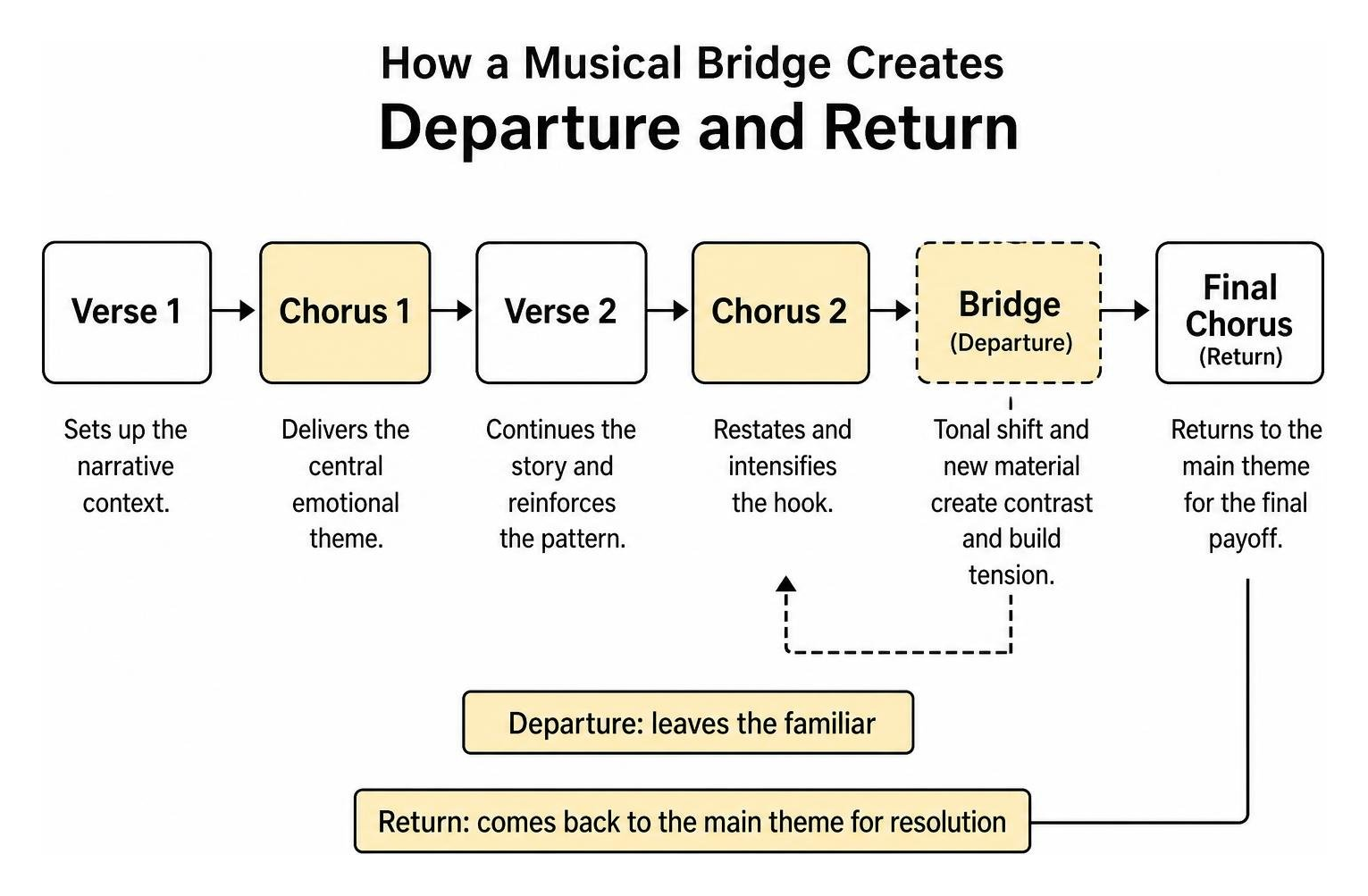
This technique has long driven commercial success. For example, 80% of the top 20 songs from the Billboard Year-End Hot 100 list of 2011 followed a song form featuring a bridge. Furthermore, a 2012 study from the University of Southern Mississippi highlighted that bridges are a fundamental piece of the formula for drafting a hit song in Western popular music. By preventing monotony and amplifying the emotional stakes, a bridge prepares the listener for the final payoff.
Historical Origins: From Medieval Bar Form to Modern Pop
The structural idea behind the bridge has a deep musical lineage. The concept traces back to medieval German song structures known as Bar form (AAB pattern), where the transitional, contrasting passage was called the Steg (literally meaning “bridge” or “footbridge”). German Meistersingers used this device to cross over between primary themes.
In the 1930s, émigré European composers brought classical traditions into American popular composition, formally embedding the terminology into English songwriting vocabulary. In classical music, a bridge-passage was often used to smooth out modulations between principal subject themes in sonata forms or fugues, such as George Gershwin’s famous orchestral transitions in An American in Paris or César Franck’s modulatory transitions in his Symphony in D minor.
During the golden era of Tin Pan Alley and Broadway showtunes, songwriters standardized the 32-bar form (AABA). In this context, the B section—the bridge—served as an eight-measure contrast to the repeating A themes before resolving home.
Structural Variations: What Is a Bridge in Music Compared to a Pre-Chorus or Middle 8?
In contemporary music composition, structural terms are sometimes conflated. Understanding their practical differences helps when mapping out an arrangement:
- Bridge: A non-repeating section that typically appears only once, late in the song (usually following the second chorus in an ABABCB structure), providing fresh melodic, harmonic, and lyrical perspective.
- Pre-Chorus: A short, recurring transition placed directly between a verse and a chorus designed specifically to build momentum and elevate energy toward the hook.
- Middle 8: A traditional British term for a bridge, named because it historically occupies eight bars right in the middle of a standard 32-bar jazz or pop tune.
- Breakdown: A modern arrangement technique, common in electronic dance music and rock, where instrumentation is stripped back to create space before an explosive drop or chorus.
| Song Section | Typical Placement | Harmonic Role | Lyrical Purpose | Repeats in Track? |
|---|---|---|---|---|
| Verse | Beginning & middle | Establishes key/tonic | Sets scene, advances plot | Yes (different lyrics) |
| Pre-Chorus | Between verse & chorus | Builds upward tension | Connects story to central hook | Yes (same lyrics) |
| Chorus | Core recurring anchor | Reinforces root tonality | Delivers main message/theme | Yes (identical hooks) |
| Bridge (Middle 8) | After Chorus 2 (late) | Departs from tonic | Provides revelation or twist | No (appears once) |
The Core Elements of an Unforgettable Bridge
A memorable bridge relies on contrast. Songwriting instructors often recommend altering at least two primary musical elements—such as harmony, melody, rhythm, or instrumentation—to make the bridge stand out.
The Musical Anatomy: What Is a Bridge in Music Composed Of?
From a music theory perspective, an effective bridge creates tension by leaving the tonic (the “home” chord or key of the song). If your verses and choruses revolve around the home key of C major, looping back to C major at the start of the bridge can make the arrangement feel static.
Common harmonic techniques for crafting a bridge include:
- The Subdominant Movement (IV chord): Moving to the IV chord (e.g., F major in the key of C) opens up the tonal field, creating an expansive, uplifting feel.
- The Relative Minor Departure (vi chord): Shifting to the vi chord (e.g., A minor in C major) injects immediate moodiness, introspection, or emotional weight.
- Borrowed Chords & Modal Interchange: Borrowing chords from the parallel minor key, like a flat-III ($\flat\text{III}$) or flat-VII ($\flat\text{VII}$), adds surprise and color. Johnny Nash famously used modal shifts to add brightness to “I Can See Clearly Now.”
- Secondary Dominant Chains: Common in jazz and classic pop, stringing dominant seventh chords together (e.g., $\text{III}^7 \rightarrow \text{VI}^7 \rightarrow \text{II}^7 \rightarrow \text{V}^7$) creates continuous harmonic pull that leads cleanly back to the home key.
Lyrical Perspectives and the Narrative Pivot
Lyrically, the bridge is the place to deliver the emotional thesis or the plot twist. If the verses describe what happened and the chorus expresses how it feels, the bridge answers: What have I learned, and where do we go from here?
Techniques for writing bridge lyrics include:
- The Perspective Shift: Shifting from storytelling in the past/present to looking forward into the future using phrases like “Someday…” or “Looking back now…”
- The Emotional Climax (“The Rant Bridge”): Artists like Taylor Swift frequently use the bridge as a stream-of-consciousness dynamic peak (such as in “All Too Well”), where the singer reveals their rawest thoughts in an extended vocal delivery.
- Direct Address: Changing the narrative frame from talking about a third party to speaking directly to the subject of the song.
Step-by-Step Guide: How to Write an Effective Bridge for Your Song
Writing a bridge is easiest when the surrounding verse-chorus framework is already in place. Once the main sections are established, follow these steps to build a purposeful transition.
Step 1: Select a Non-Tonic Harmonic Starting Point
Begin your bridge on a chord that has not started any other section in your song. If your chorus begins on the I chord, start your bridge on the IV, vi, or ii chord. This immediate harmonic shift alerts the listener that the song is entering new territory.
Step 2: Shift Dynamic Energy and Vocal Range
Decide whether your bridge needs to lift the energy or pull it back:
- To build up: Push the vocal melody into a higher register, use wider vocal intervals, and introduce driving rhythm patterns.
- To drop down: Strip out the rhythm section, pull the vocal down into a lower octave or intimate whisper, and allow ambient pads or guitars to hold long chords.
Step 3: Build Harmonic Tension to Set Up the Final Chorus
The primary job of the bridge’s final measure is to make the return of the chorus feel satisfying. The most reliable way to achieve this is to end the bridge on the dominant chord (V) or dominant seventh ($\text{V}^7$). Holding the V chord creates suspense that naturally resolves the second your final chorus lands on the tonic (I).
Analyzing Iconic Song Bridges Across Popular Genres
Looking at how different genres use bridges illustrates just how versatile this section can be.

Classic Rock and Pop Masterpieces
- The Beatles – “Something”: George Harrison modulates from the verses in C major directly into A major for the bridge, completely shifting the tonal landscape before gliding effortlessly back.
- The Police – “Every Breath You Take”: Features two distinct bridge passages that alter both harmony and dynamic weight, heightening the obsessive tone of the lyrics.
- Lady Gaga & Bradley Cooper – “Shallow”: The bridge strips back the acoustic guitar to introduce a rising vocal belt and drum build-up that sets up the final chorus climax.
Modern Streaming Era Bridges and Genre Evolutions
In modern pop, hip-hop, and R&B, arrangement trends have shifted. While some streaming-focused tracks shorten runtimes by omitting bridges, many artists lean into bold sonic departures:
- Beat Switches: In hip-hop and R&B, producers often alter the tempo, drum samples, and bassline entirely during the bridge.
- EDM & Pop Breakdowns: Synthesizer filters sweep down, vocals are chopped and layered, and percussion builds into an explosive final drop.
- Minimalist Textures: Modern bridges often strip away the entire drum kit to showcase a single vocal line before bringing all elements back at once.
When to Include a Bridge vs. When to Skip It
Not every song requires a bridge. Forcing an eight-bar section into a track that already feels complete can slow down its momentum.
You should consider including a bridge if:
- The transition between the second chorus and a third verse feels repetitive.
- Your lyrics need a moment of emotional resolution or a change in perspective.
- The musical arrangement needs a dynamic peak before winding down.
You might choose to skip a bridge if:
- You are writing a traditional folk or country narrative ballad where continuous verse-chorus storytelling drives the song.
- The track is built on an infectious dance groove or minimalist loop where arrangement builds, instrument mutes, and subtle variations maintain energy.
- The song delivers its emotional peak naturally through an extended outro or solo section.
Frequently Asked Questions About Songwriting Bridges
How long should a musical bridge typically last?
Most standard pop, rock, and country bridges last between 4 and 8 bars. In medium-to-upbeat tempos, an 8-bar bridge provides enough time to establish a new melody and resolve back to the dominant chord without disrupting the song’s overall pacing.
Can an instrumental solo serve as a bridge?
Yes. An instrumental solo—whether played on an electric guitar, saxophone, synthesizer, or piano—often fills the exact structural and harmonic role of a bridge. By altering the chord progression underneath the solo and building dynamics, the instrument takes on the expressive role of the lead vocal.
What is the difference between a song bridge and a bridge on an instrument?
In song composition, a bridge is a musical section within a song’s structure. On a physical stringed instrument (such as a violin, acoustic guitar, cello, or piano), the bridge is a physical piece of carved wood or metal. Its job is to physically support the strings and transmit their vibrations directly into the soundboard or pickups to create acoustic resonance.
Conclusion
Mastering song structure is all about balancing familiarity with surprise. When you know how to build tension, shift harmonic perspectives, and guide a story toward its peak, your music resonates more deeply with listeners. For a broader look at how this section fits into the larger architecture of a track, the song structure entry on Wikipedia offers a useful overview of common popular music forms.
Just as a musical bridge provides vital balance and structural strength to an entire composition, maintaining your personal health requires strong foundations. At Des Plaines Dental Studio, we help patients across our local Illinois community maintain functional, confident smiles by restoring stability with custom bridges for teeth. Whether you are refining an arrangement in the studio or taking care of your daily health, durable connections make all the difference.