


Cracked Smile? Here is How to Handle Partial Denture Repair Safely
Common Types of Damage to Partial Dentures
Partial denture repair is something many people need — and most don’t know where to start when a clasp snaps or a tooth pops off.
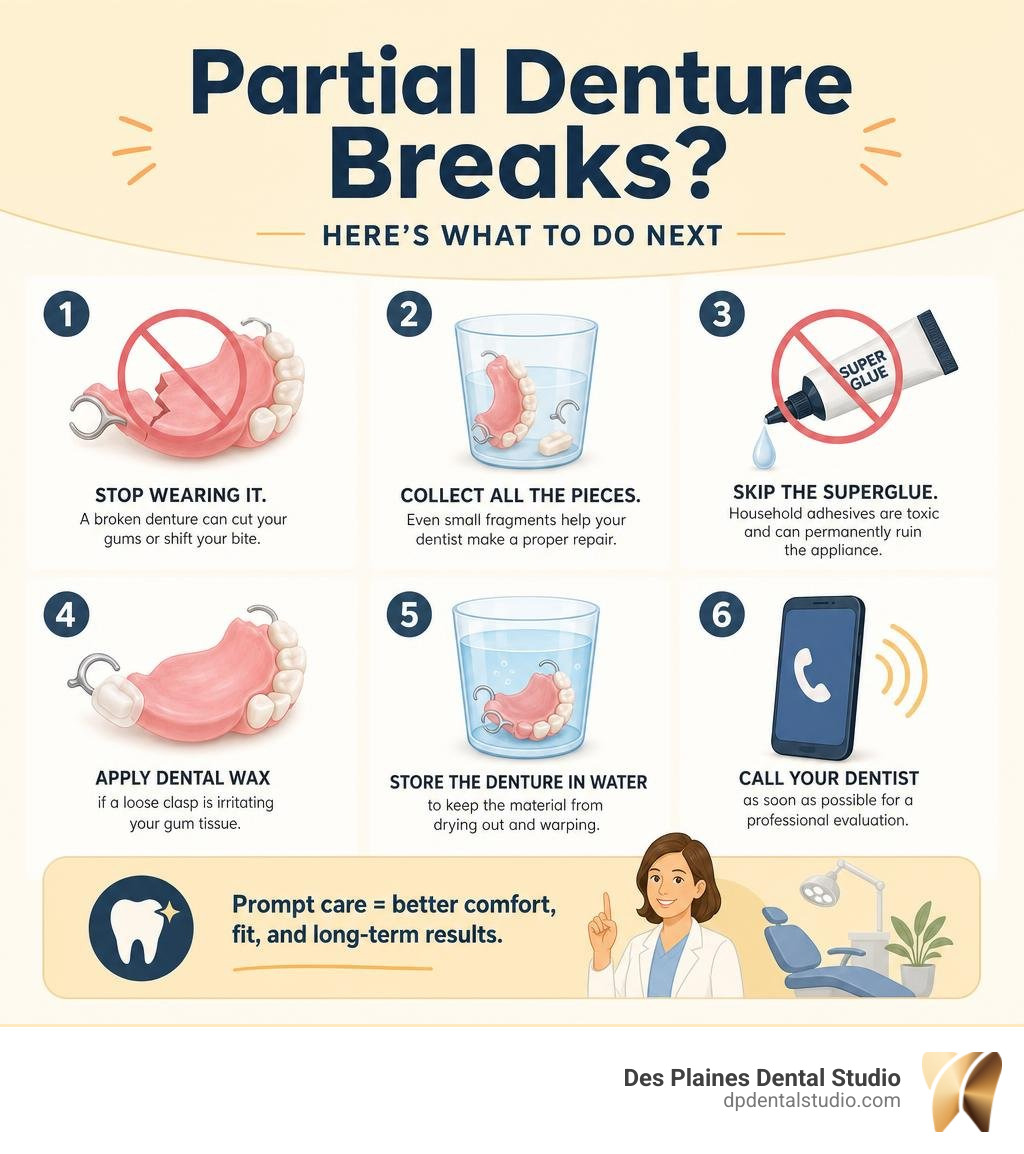
Here is a quick overview of what to do when your partial denture breaks:
- Stop wearing it. A broken denture can cut your gums or shift your bite.
- Collect all the pieces. Even small fragments help your dentist make a proper repair.
- Skip the superglue. Household adhesives are toxic and can permanently ruin the appliance.
- Apply dental wax if a loose clasp is irritating your gum tissue.
- Store the denture in water to keep the material from drying out and warping.
- Call your dentist as soon as possible for a professional evaluation.
Dentures are more delicate than they look. Dropping one on a bathroom tile, biting into something hard, or simply years of daily wear can crack the base, fracture a metal clasp, or knock out an artificial tooth. And when that happens, the next step can feel overwhelming — especially when you are not sure whether you need a quick fix or a brand-new appliance.
The good news is that many partial denture breaks are fully repairable by a dental professional, often faster and for less cost than people expect.
I’m Dr. Marta Milejczyk of Des Plaines Dental Studio, and with decades of clinical experience in restorative dentistry — including partial denture repair — I have helped countless patients get back to eating, speaking, and smiling comfortably after an unexpected break. In the sections below, I will walk you through everything you need to know, from the most common types of damage to your real repair options.
Partial dentures are complex dental appliances. They combine a pink acrylic or flexible thermoplastic base with artificial teeth and metal or plastic clasps that anchor onto your remaining natural teeth. Because they are constantly subjected to biting forces, moisture, and temperature changes in the mouth, they are highly susceptible to several types of wear and tear.
The most common issues we see in our practice include:
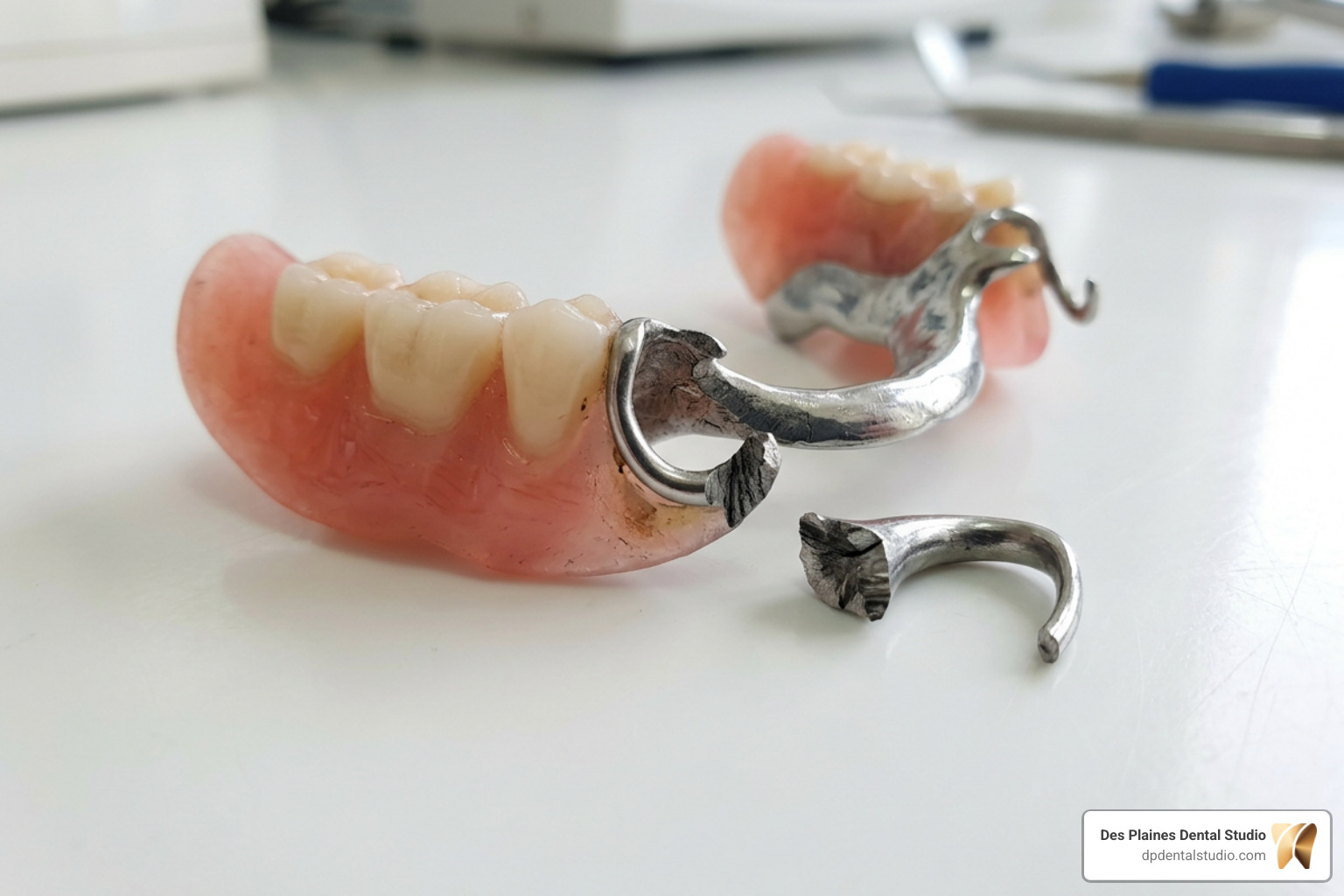
- Clasp Fractures: The clasps are the metal or tooth-colored arms that hold the partial denture securely in place. Because these components must flex slightly every time you insert or remove the appliance, they suffer from structural fatigue over time. In fact, clasp fracture is the most common problem in removable prosthetics, making up over 60% of flexible partial denture repairs.
- Base Fractures and Splitting: The pink base of the denture can develop micro-cracks from the pressure of chewing. If left unaddressed, these small fissures can turn into complete splits. Base fractures and splitting make up about 25% of flexible partial denture repairs.
- Tooth Debonding and Loss: Artificial teeth are bonded to the pink base. Over time, the chemical bond can weaken, causing a tooth to pop off entirely while eating. Tooth debonding and loss accounts for approximately 15% of flexible partial denture repairs.
- Metal Fatigue and Structural Failure: The cast metal frameworks of traditional partials can warp, bend, or crack due to repeated adjustments or accidental physical impact.
Why Clasps and Teeth Break
To understand why these components fail, we have to look at the physics of your mouth. Every time you chew, your partial denture distributes forces across your remaining teeth and gums.
If the metal clasps are bent repeatedly during routine handling, they undergo “flexure fatigue.” This is similar to bending a paperclip back and forth — eventually, the metal recrystallizes and snaps. Accidental drops onto hard surfaces, like porcelain bathroom sinks or tile floors, are another major culprit.
Furthermore, biting into exceptionally hard or sticky foods can put uneven leverage on the artificial teeth, causing them to shear off the base. According to clinical literature on 22: Repairs and Additions to Removable Partial Dentures | Pocket Dentistry, structural failures like fractured occlusal rests (the small metal tabs that sit on the chewing surfaces of your teeth) almost always occur because the supporting tooth was not prepared with enough clearance during the initial fitting, leaving the metal component too thin to withstand daily chewing.
The Risks of DIY vs. Professional Partial Denture Repair
When a partial denture breaks, it is tempting to look for a quick, cheap fix. Over-the-counter DIY denture repair kits are widely available at pharmacies, but using them comes with significant risks to your oral health and the longevity of your appliance.
These retail kits typically contain a liquid monomer (methyl methacrylate) and a polymer powder. When mixed, they form a self-curing acrylic. However, handling these chemicals at home is highly challenging:
- Toxic Chemical Exposure: The liquid monomer is highly volatile, flammable, and can cause painful chemical burns or severe allergic reactions (methacrylate allergy) if it comes into contact with your bare gums or skin.
- Improper Bite Alignment: Dentures are custom-crafted to fit your mouth down to the micrometer. If you attempt to glue a broken base or tooth back together at home, even a microscopic misalignment will completely throw off your bite. This uneven pressure causes localized sore spots and accelerated alveolar bone resorption (the permanent shrinking of your jawbone).
- Chronic Tissue Irritation: An improperly aligned repair causes constant rubbing against the delicate soft tissues of your mouth. This can lead to chronic stomatitis (painful inflammation) and, in severe cases, the development of inflammatory tissue overgrowths (epulis fissuratum) that may require surgical removal.
| Feature / Consideration | At-Home DIY Repair Kits | Professional Dental Repair |
|---|---|---|
| Average Cost | $10 – $40 | $150 – $300+ |
| Primary Materials | Self-curing acrylic monomer & powder | Laboratory-grade heat-cured resins, metal welding |
| Bite Precision | Very poor (done by hand without models) | Perfect (aligned on a dental duplicator/articulator) |
| Durability | Temporary (typically fails within days) | Highly durable (restores original structural strength) |
| Health Risks | Chemical burns, tissue irritation, bone loss | None (safe, biocompatible, adjusted by a dentist) |
| Warranty / Support | None | Often backed by clinical adjustments |
Limitations of At-Home Denture Repair Kits
If you do choose to use an over-the-counter kit as an absolute emergency stopgap, you must understand its strict limitations. First, these repairs are strictly temporary and should never be worn for more than 30 days.
Second, standard retail acrylic kits are completely incompatible with flexible thermoplastic dentures (such as Valplast or TCS). The acrylic resin will not form a chemical bond with nylon-based materials, meaning the repair will fail immediately under the slightest biting pressure.
Finally, DIY kits cannot replace missing pieces. If a tiny fragment of your denture base is lost, a home kit cannot safely recreate that structural gap, and attempting to do so will ruin the appliance’s fit permanently.
How the Repair Process Varies by Material
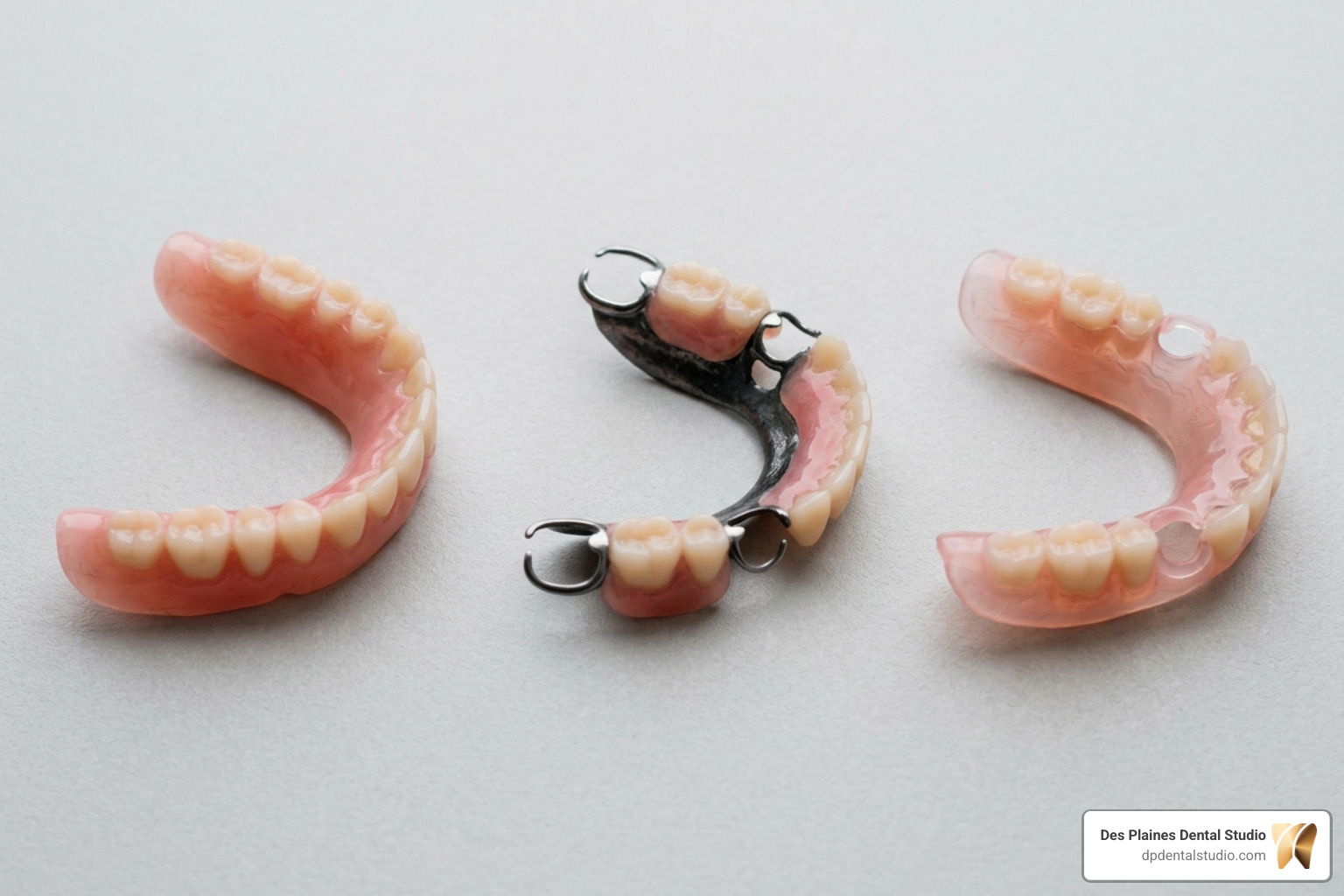
The exact technique we use to repair your partial denture depends entirely on the material it is made of. Modern dentistry utilizes three primary categories of materials, each requiring a distinct scientific approach to restore structural integrity.
Acrylic and Metal-Frame Partial Denture Repair
Acrylic partial dentures are the most straightforward to repair. When an acrylic base cracks or a tooth pops off, we use a specialized cold-cured or heat-cured PMMA (polymethyl methacrylate) resin. The broken edges are lightly sandblasted, treated with a chemical primer, and bonded back together under precise pressure and temperature controls to eliminate microscopic air bubbles.
For metal-frame partials, repairing a broken clasp or framework is more complex. Because these appliances rely on a rigid cobalt-chromium or titanium framework, traditional soldering is rarely used today because the high heat can warp the metal or damage the adjacent acrylic teeth.
Instead, modern dental laboratories use advanced micro-laser welding or mechanical reinforcement techniques. If a clasp arm snaps off a metal framework, we can often embed a new, highly flexible wrought wire clasp directly into the surrounding pink acrylic saddle. This saves the patient from needing an entirely new metal casting.
To learn more about the advanced materials used in modern restorative dentistry, you can read our guide on Restorative Dentistry Procedures.
For dental technicians looking for an economical, solder-free method to repair cast partials in a laboratory setting, products like the EZ Partial Fix Denture Repair Kit – Dental Creations, Ltd. provide specialized hardware. This system allows technicians to mechanically attach new wrought wire clasps using micro-bolts and nuts, bypassing the need for expensive thermal welding equipment.
More technical details on this method can be found in the EZ PARTIAL FIX REPAIR KIT Product Catalog.
Thermoplastic and Flexible Partial Denture Repair
Flexible partial dentures, made from thermoplastic polyamides (like Valplast), are highly comfortable but notoriously difficult to repair. Because nylon does not have free chemical bonds on its surface, standard acrylic resins cannot stick to it.
To repair a flexible partial, specialized dental laboratories must use advanced techniques:
- Mechanical Undercuts: The technician carves microscopic “dovetail” undercuts into the flexible base so that the repair material is locked in place mechanically rather than chemically.
- Advanced Surface Treatments: Some high-tech labs utilize atmospheric plasma treatment (using argon or oxygen gas) to temporarily modify the surface chemistry of the nylon. This advanced treatment can increase the adhesive bond strength of repair resins up to 15–20 MPa in clinical studies.
- Glass Fiber Reinforcement: To prevent future fractures in high-stress areas, we can embed glass fiber or polyethylene reinforcement strips (such as Ribbond) directly into the repair zone, making the final bond up to 40% stronger.
- SOP Quality Control: By utilizing strict Standard Operating Procedures (SOPs) and digital scanning checklists during the repair process, modern labs have successfully reduced remake and rework rates by 25% to 30%.
To understand the specialized equipment required for these thermoplastic restorations, you can explore the technical workflows outlined by Fast Denture Repair Service | Istar Dental Lab.
What to Do Immediately After Your Denture Breaks
How you handle your broken partial denture in the first few hours can make the difference between a simple, inexpensive repair and needing a complete, costly replacement. If your denture breaks, follow these step-by-step instructions to protect both your mouth and your investment:
- Remove the Appliance Immediately: Do not attempt to keep wearing a cracked or broken denture. Sharp edges can cut your tongue, cheeks, or gums, and a loose clasp can scratch your natural tooth enamel.
- Collect Every Single Fragment: Carefully search the area where the break occurred. Gather every piece of acrylic, any detached teeth, and any broken metal wires. Bring all of these pieces with you to your appointment.
- Clean the Pieces Gently: Rinse the broken fragments under lukewarm water to remove saliva and food debris. Do not use boiling water, as extreme heat will warp the acrylic and ruin the fit permanently.
- Keep the Pieces Hydrated: Place the broken denture and its fragments in a clean container filled with water or a denture soaking solution. If acrylic dries out, it can undergo microscopic warping, making it impossible for the lab to align the pieces accurately.
- Use Dental Wax for Sharp Edges: If you have an absolute emergency where you must wear the denture for a few hours (such as an important public speaking event), you can apply a small ball of soft dental wax over any sharp metal clasps to protect your gums. However, this is a last-resort temporary measure.
- Avoid Superglue and Household Adhesives: We cannot stress this enough: never use superglue to fix your denture. Cyanoacrylate adhesives dissolve quickly in the moist environment of the mouth, releasing toxic chemicals. Furthermore, superglue creates an irregular layer on the broken edges, which prevents our laboratory from aligning the pieces perfectly. If you apply superglue, we often have to replace the entire denture because the original edges have been ruined.
For comprehensive advice on keeping your oral appliances clean and structurally sound to prevent breaks in the first place, check out our guide on Do I Really Need To Clean My False Teeth Des Plaines Il Dentist.
Professional Repair Options, Costs, and Timelines
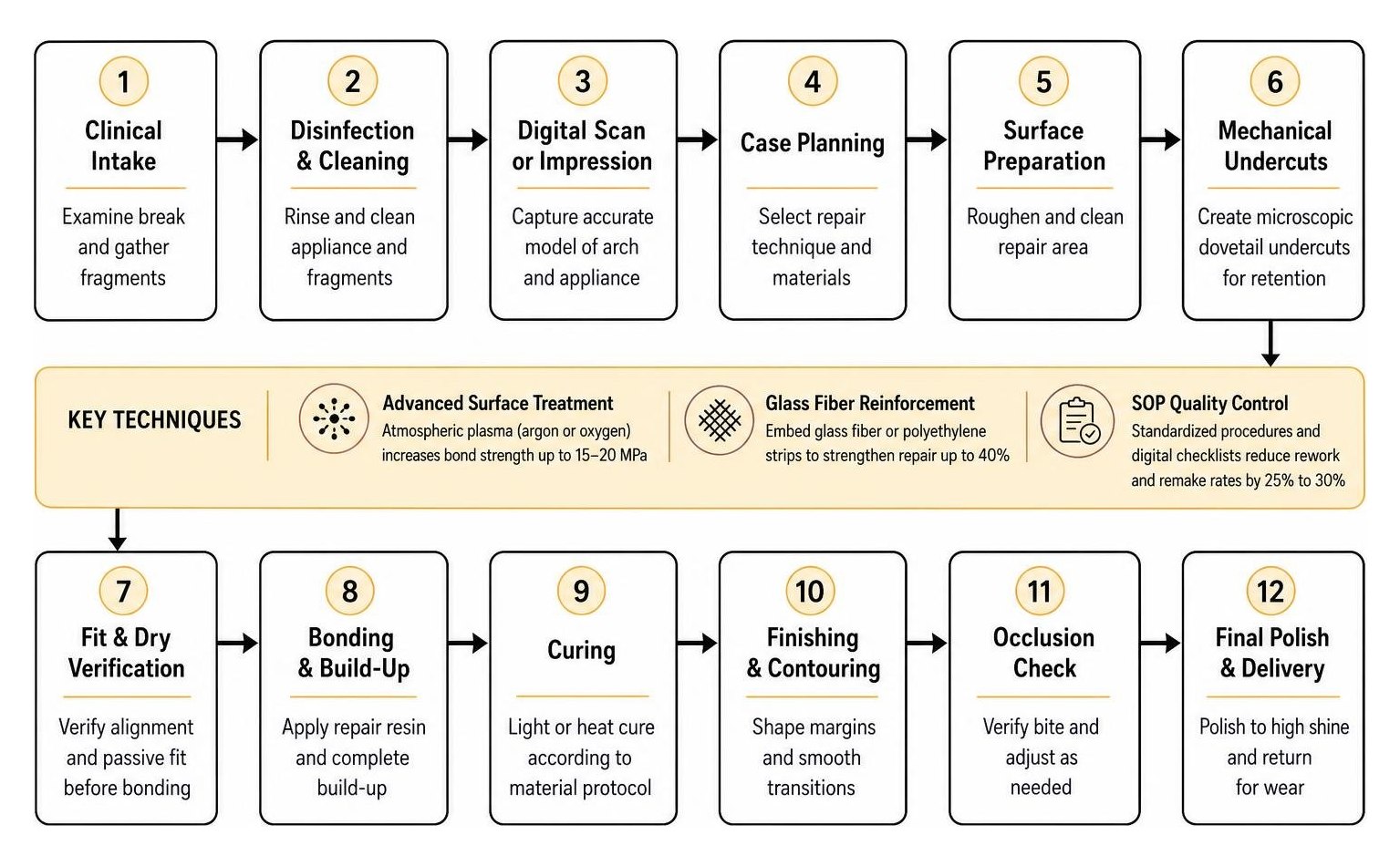
When you bring your broken partial denture to Des Plaines Dental Studio, we evaluate the damage to determine the safest and most efficient repair method. Depending on the severity of the break, we offer several professional pathways to restore your smile.
- In-Office Same-Day Repair: For minor issues — such as a single detached tooth or a simple hairline crack in an acrylic base — we can often perform the repair right here in our office. Utilizing rapid-curing cold resins, we can have your denture fixed, polished, and adjusted to your bite in just a few hours.
- Professional Laboratory Services: For complex breaks, fractured metal frameworks, or thermoplastic flexible denture repairs, we partner with specialized local dental laboratories. We take a precise physical or digital impression of your mouth with the broken denture in place. This ensures the lab technician can rebuild the appliance on a perfect model of your jaw.
- Mail-In Repair Alternatives: While some national mail-in services (such as Expert Partial Denture & Flipper Repair | Denture Repair Lab) offer direct-to-consumer repairs, we strongly advise having a local dentist oversee the process. A mail-in lab can bond the pieces back together, but they cannot perform the essential chairside adjustments needed to ensure the repaired denture doesn’t damage your natural teeth or gums when you put it back in your mouth.
Factors Influencing Repair Costs
The cost of a professional partial denture repair in 2026 typically ranges from $150 to $350, depending on several key factors:
- Material Type: Acrylic repairs are the most economical. Metal framework welding and flexible thermoplastic repairs require specialized equipment and are therefore more costly.
- Number of Broken Components: Fixing a single cracked line is less expensive than replacing multiple broken teeth and adding a new wrought wire clasp.
- Need for Structural Reinforcement: If the denture has broken repeatedly in the same spot, we may need to embed a metal mesh or glass fiber strip to reinforce the area, which adds to the laboratory fee.
- Insurance Coverage: Many dental insurance plans cover a portion of denture repairs and relines (often up to 50% to 80% of the cost). Our team at Des Plaines Dental Studio works closely with your insurance provider to maximize your benefits and minimize your out-of-pocket expenses.
To see how the cost of a repair compares to the price of a brand-new prosthetic, read our detailed breakdown on the Average Cost For Dentures.
Frequently Asked Questions About Denture Damage
Can a broken clasp or lost tooth be fixed without replacing the entire framework?
Yes, in the vast majority of cases, we can repair a broken clasp or replace a missing tooth without fabricating an entirely new metal framework. If a metal clasp snaps, we can grind away a small portion of the pink acrylic base and embed a new, highly resilient wrought wire clasp in its place.
Similarly, if an artificial tooth is lost or broken, we can select a matching acrylic tooth from our stock, shape it to fit the gap perfectly, and chemically bond it to the existing pink base. This makes the repair highly cost-effective and saves you from the lengthy process of having a new framework cast.
When is a partial denture repairable, and when does it need to be replaced?
While we can fix many types of damage, there are times when a partial denture is simply beyond saving. A replacement is usually necessary if:
- The Metal Framework is Severely Bent or Distorted: If you accidentally step on or drop your metal partial, and the main cast bar is bent, attempting to bend it back will weaken the metal and ruin the precision fit.
- The Denture Breaks in Half Repeatedly: This is a clear sign that your jawbone has changed shape, causing the denture to flex excessively under biting pressure.
- The Prosthesis is Past Its Lifespan: On average, partial dentures have a lifespan of about 7 years. Over time, the acrylic becomes brittle, and the artificial teeth wear down, losing their natural chewing efficiency.
If you are wondering whether your appliance is still safe to use, read our informative guide on What You Should Know About Partial Dentures Dentist In Des Plaines Il 60016.
What are the long-term consequences of wearing an ill-fitting repaired denture?
Wearing a partial denture that has been poorly repaired (especially via DIY methods) can cause permanent damage to your mouth. When a denture does not sit evenly, it places excessive, unnatural lateral forces on the remaining natural teeth that hold the clasps. Over time, this can loosen those teeth, leading to bone loss and potential tooth loss.
Additionally, the uneven pressure accelerates alveolar bone resorption (the shrinking of your jawbone), which permanently changes your facial structure and makes it much harder to fit comfortable dentures in the future. Chronic rubbing can also cause painful oral ulcers, infections, and chronic inflammatory conditions like stomatitis.
Conclusion
A broken partial denture can feel like a major setback, but it doesn’t have to keep you from enjoying your favorite foods or smiling with confidence. The safest, most reliable way to handle a cracked base, a broken clasp, or a missing tooth is to seek professional care immediately.
At Des Plaines Dental Studio, we are dedicated to providing our community in Des Plaines, IL, with patient-centered, high-quality restorative care. We understand how important your smile is to your daily life, which is why we offer efficient, welcoming, and pain-free repair services designed to get your appliance back in perfect working order as quickly as possible.
Our experienced team will carefully evaluate your partial, explain your repair options, and handle all the coordination with your insurance provider to keep your care highly affordable.
If your partial denture is damaged, uncomfortable, or simply needs a professional adjustment, don’t wait for a minor crack to turn into a major break. Contact us today to Schedule a consultation for dentures in Des Plaines, and let us help you restore your healthy, functional smile!