


The Ultimate Guide to Dental Implants Insurance
Why Dental Implants Insurance Is More Complicated Than You Think
Dental implants insurance coverage is one of the most confusing topics patients face when considering tooth replacement. Here’s a quick answer to what most people want to know:
- It depends on your plan. Most standard dental plans treat implants as a major restorative service.
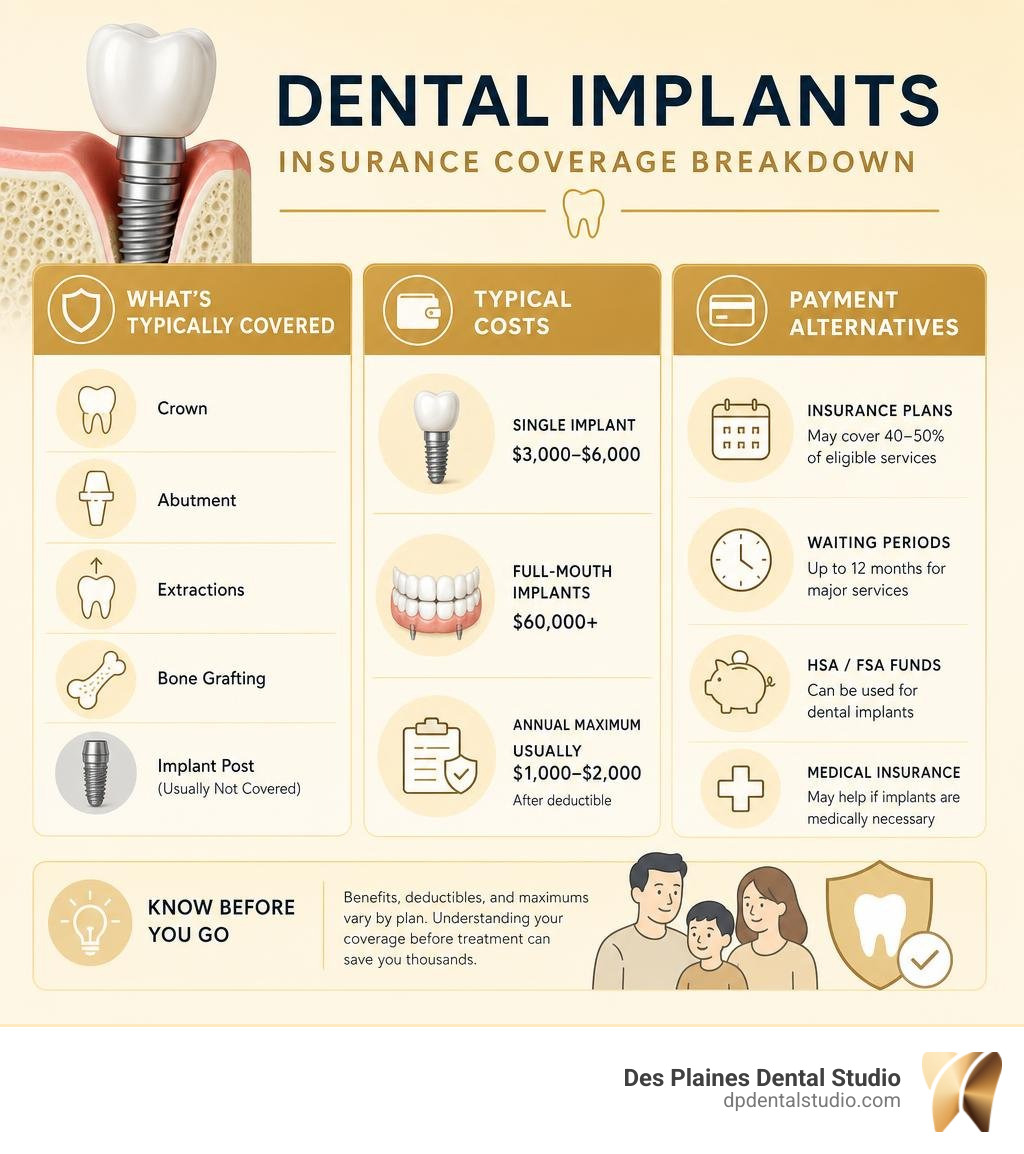
- Many full-coverage plans cover 40–50% of implant costs — but only after your deductible, and only up to your annual maximum (usually $1,000–$2,000).
- Most plans do not cover the implant post itself, but may cover the crown, abutment, extractions, and bone grafting.
- Some plans have waiting periods of up to 12 months before major services are covered.
- HSA and FSA funds can be used for dental implants.
- If implants are medically necessary (e.g., due to injury or oral cancer), medical insurance may also help cover costs.
The challenge is that a single implant can cost $3,000–$6,000, and full-mouth implants can exceed $60,000. With most dental plan annual maximums capped at just $1,000–$2,000, out-of-pocket costs can still be significant even with coverage.
Knowing your plan’s details before treatment starts can save you thousands.
I’m Dr. Marta Milejczyk, and through decades of implant dentistry practice in Chicago’s northwest suburbs — including advanced clinical training in restorative dentistry and oral surgery — I’ve guided countless patients through the realities of dental implants insurance coverage. In this guide, I’ll walk you through everything you need to know to make a confident, informed decision.
What Are Dental Implants and What Do They Cost?
To understand how insurance treats dental implants, we must first look at what they are and why they cost what they do.
At their core, dental implants are artificial tooth roots designed to replace missing or severely damaged teeth. Unlike traditional dentures or bridges that sit on top of the gums, dental implants are surgically inserted directly into the jawbone. These titanium posts act as anchor points for custom-made teeth.
The magic behind this technology is a natural process called osseointegration. Over several months, your natural jawbone actually fuses with the biocompatible titanium post, creating an incredibly secure, permanent foundation. Learn more about titanium bone implants and how they interact with your jawbone to provide unmatched stability.
While the clinical benefits are outstanding—including a 90% to 95% success rate for people with good health and oral hygiene, and a 97% success rate at 10 years—the upfront financial investment can feel overwhelming.

When patients ask us about the cost, we emphasize that no two dental implant procedures are exactly the same. The total price is heavily influenced by the number of teeth being replaced, the health of your jawbone, and the specific materials used.
To help you plan, you can check the average cost of dental implants to see how these variables come together. Generally, the baseline costs can be broken down into two main categories:
| Implant Scope | Typical Price Range | What It Typically Includes |
|---|---|---|
| Single Dental Implant | $3,000 – $6,000 | Implant post, abutment, and a single custom crown |
| Full-Mouth Dental Implants | $60,000+ | Multiple surgical posts, temporary restorations, and full-arch fixed prostheses |
The True Cost of Dental Implant Components
When reviewing a treatment plan, the price tag isn’t just one flat fee. The procedure is billed in distinct phases, which is also how insurance companies evaluate claims. The physical tooth replacement is divided into three primary components:
- The Implant Post ($1,000 – $3,000): The medical-grade titanium screw that is surgically placed into your jawbone.
- The Abutment ($500 – $1,000): The connector piece that screws into the implant post and sits just above the gumline to hold the new tooth.
- The Crown Restoration ($800 – $3,000): The visible, custom-crafted ceramic or porcelain tooth that matches your surrounding teeth. Read about dental implant restorations to understand how these custom crowns are designed for maximum durability.
Additional Procedures That Impact Total Cost
Most patients require preparatory treatments before the implant post can actually be placed. These auxiliary procedures add to the total timeline and cost:
- Tooth Extraction: If the damaged tooth is still present, it must be carefully extracted.
- Bone Grafting: More than half of all implant patients need bone grafts before receiving implants. If your jawbone lacks the density or thickness to support the titanium post, a bone graft (which can cost anywhere from $300 to $4,000) is required to build up the site. Explore bone grafting for dental implants to see why this step is so crucial for long-term success.
- Sinus Lift: If you are replacing teeth in your upper jaw, a sinus lift may be necessary to ensure the implant does not penetrate your sinus cavity.
Understanding Dental Implants Insurance Coverage
Now, let’s address the big question: how does dental implants insurance actually work?
Historically, dental insurance companies labeled dental implants as “cosmetic” and refused to cover them. Today, the industry recognizes that implants are vital for maintaining jaw structure and overall health. However, “covered” does not mean “free.”
Most full-coverage dental plans classify implants as a “Major Service.” This classification comes with several structural limitations:
- Deductibles: You must pay your annual deductible (typically $50 to $150) before your benefits kick in.
- Coinsurance: Many plans cover 40% to 50% of major services, leaving you responsible for the remaining 50% to 60% of the bill.
- Annual Maximums: This is the most restrictive barrier. Most dental plans limit their total annual payout to between $1,000 and $2,000 per calendar year.
If your single implant costs $4,000 and your insurance covers 50% up to a $1,500 annual maximum, the insurance company will only pay $1,500. You will be responsible for the remaining $2,500 out of pocket.

To navigate these limits, our clinical team closely monitors industry guidelines, such as those detailed in the UnitedHealthcare Dental Implant Supported Prostheses Policy. These policies outline exactly how insurance companies evaluate the structural integrity and clinical necessity of implant-supported restorations.
How to Choose Dental Implants Insurance Plans
If you are shopping for a new policy in Illinois to help cover an upcoming implant procedure, you will primarily choose between two plan structures:
- Dental PPO (Preferred Provider Organization): These plans offer the most flexibility. You can see any dentist, though you will save more by staying in-network. PPOs are the most likely plans to cover implants, but they almost always impose waiting periods and annual maximums. To explore your options, you can compare individual dental plans from Delta Dental of Illinois or review options through Dental Insurance Plans | Blue Cross and Blue Shield of Illinois.
- Dental HMO (Health Maintenance Organization): DHMOs require you to see a primary network dentist. While they rarely have annual maximums or waiting periods, they also rarely cover dental implants, or they limit coverage to very specific, narrow circumstances.
If you are a state employee, it is also worth checking the Dental Plan – Illinois Department of Central Management Services to see how public employee benefits handle major restorative services.
No matter which plan you choose, always evaluate these five key factors:
- The “Missing Tooth Clause”: Many policies will not pay to replace a tooth that was already missing before you signed up for the plan.
- Waiting Periods: Most plans require you to hold the policy for 6 to 12 months before they will pay for major restorative care like implants.
- The Annual Maximum Limit: Look for plans with higher maximums (some modern plans offer up to $3,000 or have maximum rollover benefits).
- In-Network Discounts: In-network dentists have pre-negotiated rates with insurers, which can instantly lower your base costs by 20% to 40% even before insurance pays a dime.
- Exclusions: Check if the plan specifically excludes “implants” or “implant-supported prostheses” in the fine print.
What Dental Insurance Typically Covers
Even if your plan does not cover the titanium post itself, it may cover the surrounding steps of your treatment journey. A standard comprehensive policy often covers:
- Diagnostic Services: Preventive care, including initial consultations, 3D imaging, and diagnostic x-rays, is often covered at 80% to 100%.
- Preparatory Procedures: Tooth extractions and bone grafting are frequently covered under basic or major services (usually at 50% to 80%).
- The Final Restoration: The crown, bridge, or denture that attaches to the implant is highly likely to be covered at 50% as a major restorative service.
To see how these individual components impact your long-term health and financial planning, read our ultimate guide to dental implants costs and benefits.
How to Get Dental Implants Covered by Medical Insurance
One of the best-kept secrets in restorative dentistry is that your medical insurance might actually help pay for your dental implants.
While dental insurance is designed to cover routine maintenance and basic restorations, medical insurance is designed to treat systemic health issues, trauma, and structural joint problems. If your tooth loss directly compromises your physical health, medical coverage can be unlocked.
To qualify for medical coverage, we must prove medical necessity. Common scenarios include:
- Accidental Trauma: If you lost teeth due to a car crash, sports injury, or any external accident, your medical insurance will often cover jaw reconstruction and implants.
- Oral Cancer Reconstruction: If teeth and sections of jawbone were removed during cancer treatment, implants are considered essential medical reconstructive devices.
- Severe Bone Atrophy: When extreme bone loss makes it physically impossible to chew or speak—often leading to severe nutritional deficiencies or digestive disorders like GERD—implants may be deemed medically necessary.
- Congenital Defects: Conditions like a cleft palate that require dental implants to restore basic oral function.
To successfully navigate this pathway, you must learn how to get dental implants covered by medical insurance. The process requires a highly detailed “6-step playbook” that includes obtaining a formal Letter of Medical Necessity from your physician, securing pre-authorization, and using medical billing CPT codes (such as 21248 for partial jaw reconstruction or 41899 for unspecified dentoalveolar procedures) instead of standard dental CDT codes.
Frequently Asked Questions about Dental Implants Insurance
Does standard dental insurance cover the entire implant procedure?
No. Standard dental insurance almost never covers 100% of the entire procedure. Because of the combined cost of the surgery, the abutment, and the crown, the total price quickly surpasses the annual maximum of most plans.
Additionally, insurance companies use coinsurance structures where they only pay a percentage (usually 40% to 50%) of the negotiated rate. For a highly detailed look at how different insurance networks restrict or permit implant benefits, you can review the Excellus BCBS Dental Implants Policy.
Is there dental implants insurance with no waiting period?
Yes, but they are rare and require careful comparison. Some private dental plans offer immediate coverage for major services, meaning you can get your implants placed right away.
However, these “no waiting period” plans typically come with much higher monthly premiums, lower initial coinsurance rates (e.g., they may only cover 15% of major work in year one, increasing to 50% in year two), or lower annual maximums.
Can I use HSA or FSA funds for dental implants?
Absolutely. Because dental implants are a medical procedure designed to restore basic human function (chewing and speaking), they are fully eligible expenses under both Health Savings Accounts (HSAs) and Flexible Spending Accounts (FSAs).
Using these tax-free funds is one of the smartest ways to reduce your out-of-pocket costs. By paying for your treatment with pre-tax dollars, you can instantly save an average of 20% to 30% depending on your tax bracket.
Conclusion
Navigating dental implants insurance can feel like learning a second language, but you don’t have to do it alone.
At Des Plaines Dental Studio, we are committed to providing patient-centered, stress-free, and pain-free care right here in Des Plaines, IL. We know that the financial side of dentistry is just as important as the clinical side. That is why our dedicated team handles the heavy lifting for you—from submitting pre-authorizations and coordinating benefits between your dental and medical insurance, to structuring your treatment across calendar years to maximize your annual maximums.
If you are ready to restore your smile and want to explore the most affordable way to do it, we invite you to take the first step. Schedule a consultation for dental implants near me at Des Plaines Dental Studio today, and let us help you build a healthy smile that fits your budget.