


How Applegate’s Rules Ensure Long-Term Oral Comfort
Why Applegate’s Rules Are the Foundation of a Well-Fitting Partial Denture
Applegate’s rules are a set of 8 clinical guidelines that govern how dentists classify partially edentulous arches — mouths where some, but not all, teeth are missing — before designing a removable partial denture (RPD).
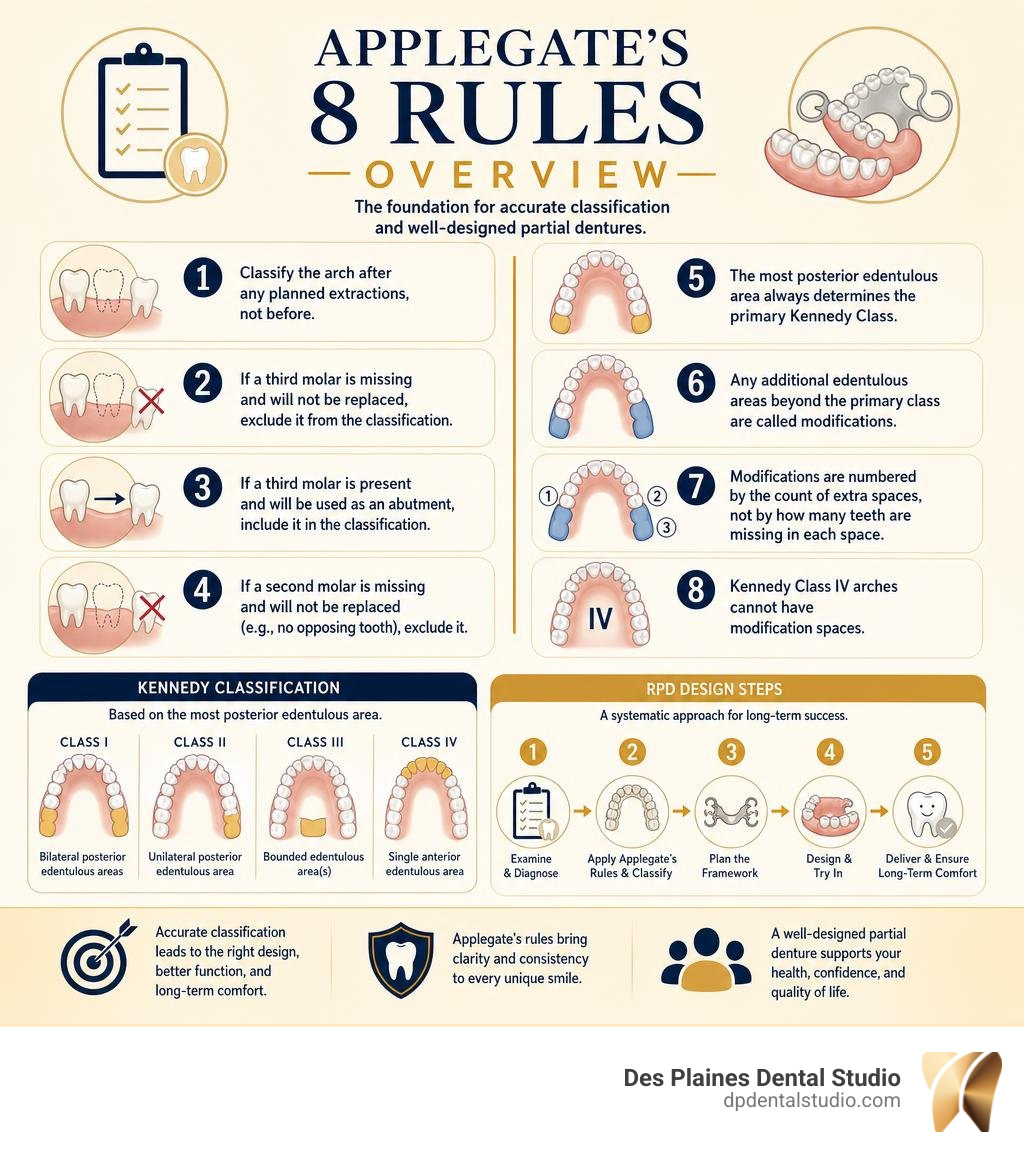
Here is a quick overview of all 8 rules:
- Rule 1 — Classify the arch after any planned extractions, not before.
- Rule 2 — If a third molar is missing and will not be replaced, exclude it from the classification.
- Rule 3 — If a third molar is present and will be used as an abutment, include it in the classification.
- Rule 4 — If a second molar is missing and will not be replaced (e.g., no opposing tooth), exclude it.
- Rule 5 — The most posterior edentulous area always determines the primary Kennedy Class.
- Rule 6 — Any additional edentulous areas beyond the primary class are called modifications.
- Rule 7 — Modifications are numbered by the count of extra spaces, not by how many teeth are missing in each space.
- Rule 8 — Kennedy Class IV arches cannot have modification spaces.
These rules work alongside the Kennedy Classification system, which was introduced by Dr. Edward Kennedy in 1925. Without Applegate’s rules, that system would be too rigid to apply to real patients — who rarely fit neatly into a textbook example. In fact, partially edentulous arches can produce nearly 65,000 possible combinations, making a clear, consistent framework essential for accurate diagnosis and denture design.
Getting the classification right matters more than most patients realize. A misclassification can lead to a poorly designed denture framework — one that puts stress on the wrong teeth, fits badly, or fails to support the bite properly.
I’m Dr. Marta Milejczyk, and through my General Practice Residency at Loyola University Medical Center and decades of restorative dentistry experience in the Chicago area, I’ve applied Applegate’s rules in countless treatment planning cases to ensure each patient receives a partial denture that truly fits their unique arch. In the sections below, I’ll walk you through exactly how these rules work and why they matter for your long-term oral comfort.
What is the Kennedy Classification and Why Do We Need Applegate’s Rules?
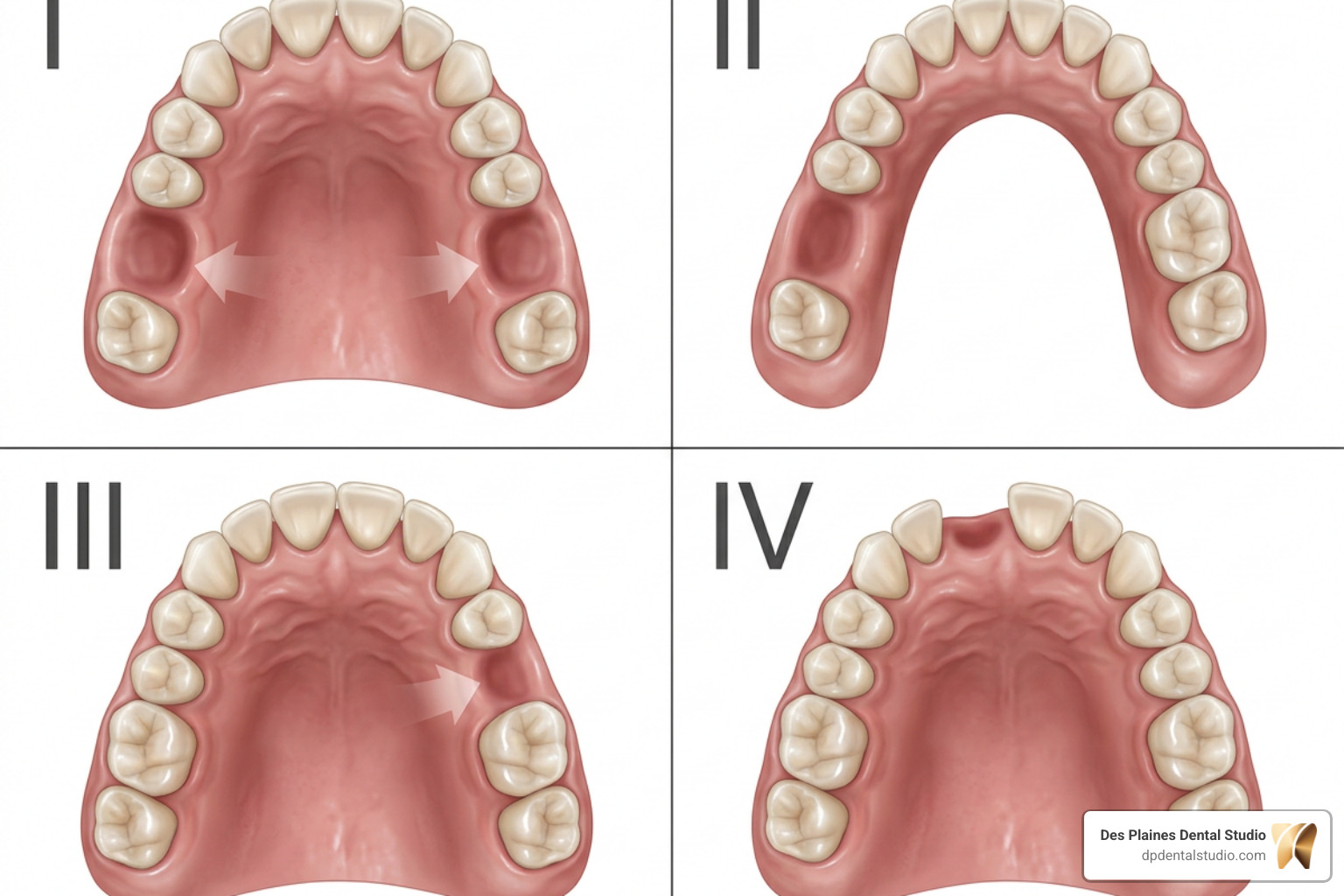
To understand why Oliver C. Applegate introduced his eight rules in 1954, we first have to look at the system he was trying to refine. In 1925, Dr. Edward Kennedy of New York proposed a brilliant, elegant method to categorize partially edentulous arches. He divided them into four primary classes based on where the missing teeth were located:
- Class I: Bilateral edentulous areas located posterior to the remaining natural teeth. (Picture missing all your back chewing teeth on both the left and right sides).
- Class II: A unilateral edentulous area located posterior to the remaining natural teeth. (You are missing your back teeth on only one side).
- Class III: A unilateral edentulous area with natural teeth remaining both anterior and posterior to it. (A “bounded” space where you are missing a tooth or two in the middle, but have solid teeth on either side to act as anchors).
- Class IV: A single, bilateral edentulous area located anterior to the remaining natural teeth that crosses the dental midline. (Missing your front teeth).
While Kennedy’s system was highly popular and remains the easiest way to classify arches, it had a major flaw: it was purely anatomical. It didn’t tell us how to handle real-world clinical curveballs. What happens if a patient is missing their wisdom teeth? What if we need to pull a weak tooth next week? What if there are multiple random gaps throughout the mouth?
Without a standardized set of laws, two different dentists could look at the same mouth and come up with two completely different classifications. This lack of standardization made communication between dental clinics and laboratory technicians incredibly difficult.
To bridge this gap, Dr. Applegate established his rules. By applying these rules, we can look at any of the nearly 65,000 possible combinations of missing teeth and instantly determine its biomechanical support class. This tells us exactly how the denture will distribute chewing forces—whether it will rely entirely on the remaining teeth (tooth-supported) or a combination of teeth and the soft gum tissue (tooth-tissue supported). For a deep dive into how these two systems interact, you can read about Kennedy Classification and Applegate’s Rules in RPD.
The 8 Applegate Rules Explained Step-by-Step
Now, let’s break down these rules so you can see exactly how they guide our clinical decisions. Think of these rules as a chronological checklist. You must apply them in order to avoid misclassifying an arch.
Rules 1 to 4: Managing Extractions and Molar Exclusions under Applegate’s Rules
The first four rules are all about establishing the “playing field.” They tell us which teeth actually count toward the final design and when we should officially make our decision.
- Rule 1: Classification should follow, rather than precede, any extractions of teeth. Imagine designing a beautiful, custom cast metal partial denture, only to realize a week later that a decayed premolar is non-restorable and must be pulled. Suddenly, your “bounded” space becomes a “free-end” space, and the entire physical framework of the denture is completely useless. Rule 1 dictates that we must perform all planned extractions first. The mouth must be in its final, stable state before we classify and design.
- Rule 2: If a third molar (wisdom tooth) is missing and is not to be replaced, it is not considered in the classification. Wisdom teeth are frequently missing or extracted. If a patient is missing a third molar and we have no intention of replacing it with the denture, we completely ignore that empty space. It does not make the patient a “Class II” distal extension.
- Rule 3: If a third molar is present and is to be used as an abutment, it is considered in the classification. An “abutment” is a tooth that supports or anchors the denture. If a patient has a healthy, fully erupted third molar and we plan to place a clasp on it to hold the denture in place, it officially enters our calculations. This can turn what would have been a free-end Class II saddle into a highly stable, tooth-bounded Class III saddle.
- Rule 4: If a second molar is missing and is not to be replaced, it is not considered in the classification. This is a common scenario. If a patient is missing a lower second molar, but the upper second molar is also missing (meaning there is no opposing tooth to chew against), we often choose not to replace it. In this case, we ignore the space.
To see these first four rules demonstrated with visual examples and clinical models, you can watch this helpful Kennedy’s Classification and Applegate’s rules video.
Rules 5 to 8: Determining Primary Classes and Modification Spaces under Applegate’s Rules
Once we have cleared the board of excluded molars and completed our extractions, we apply the remaining four rules to determine the main classification and any “modifications” (extra spaces).
- Rule 5: The most posterior edentulous area (or areas) always determines the primary classification. This is the golden rule of prosthodontics. If a patient has a missing front tooth (Class IV) but is also missing their back molars on the right side (Class II), the back space wins. The primary classification is Class II. Why? Because posterior spaces require much more complex biomechanical support and clasp design than anterior spaces.
- Rule 6: Edentulous areas other than those determining the primary classification are designated as modifications and are designated by their number. Any extra gap in the arch that is not part of the primary class is called a modification space.
- Rule 7: The extent of the modification is not considered; only the number of additional edentulous areas is considered. This is where many dental students get tripped up. If a patient has an extra gap where three teeth are missing, that counts as one modification space. If they have two separate gaps where only one tooth is missing in each, that counts as two modification spaces. We count the spaces, not the teeth.
- Rule 8: There can be no modification areas in Class IV arches. By definition, a Class IV arch consists of a single, bilateral space crossing the midline. If there were any other edentulous space in the mouth, it would have to be posterior to the front teeth. According to Rule 5, that posterior space would automatically become the primary classification, turning the front gap into a modification space instead.
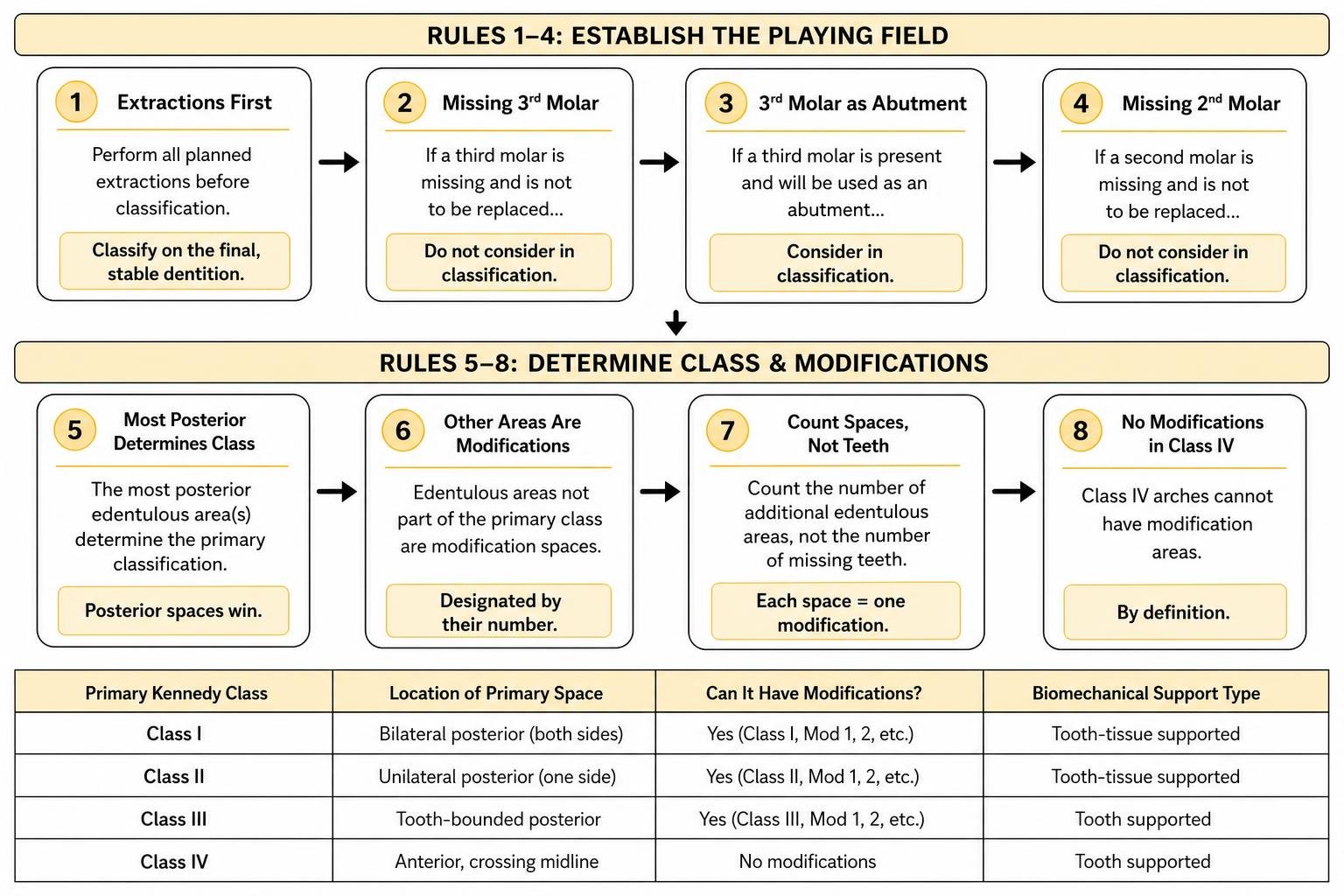
To help visualize how these rules interact, let’s look at this comparison table:
| Primary Kennedy Class | Location of Primary Space | Can It Have Modifications? | Biomechanical Support Type |
|---|---|---|---|
| Class I | Bilateral posterior (both sides) | Yes (Class I, Mod 1, 2, etc.) | Tooth-tissue supported |
| Class II | Unilateral posterior (one side) | Yes (Class II, Mod 1, 2, etc.) | Tooth-tissue supported |
| Class III | Unilateral bounded (teeth on both sides) | Yes (Class III, Mod 1, 2, etc.) | Tooth-supported |
| Class IV | Single bilateral anterior (crosses midline) | No (Any extra space changes class) | Tooth-supported (usually) |
Biomechanical Design and RPD Selection Based on Classification
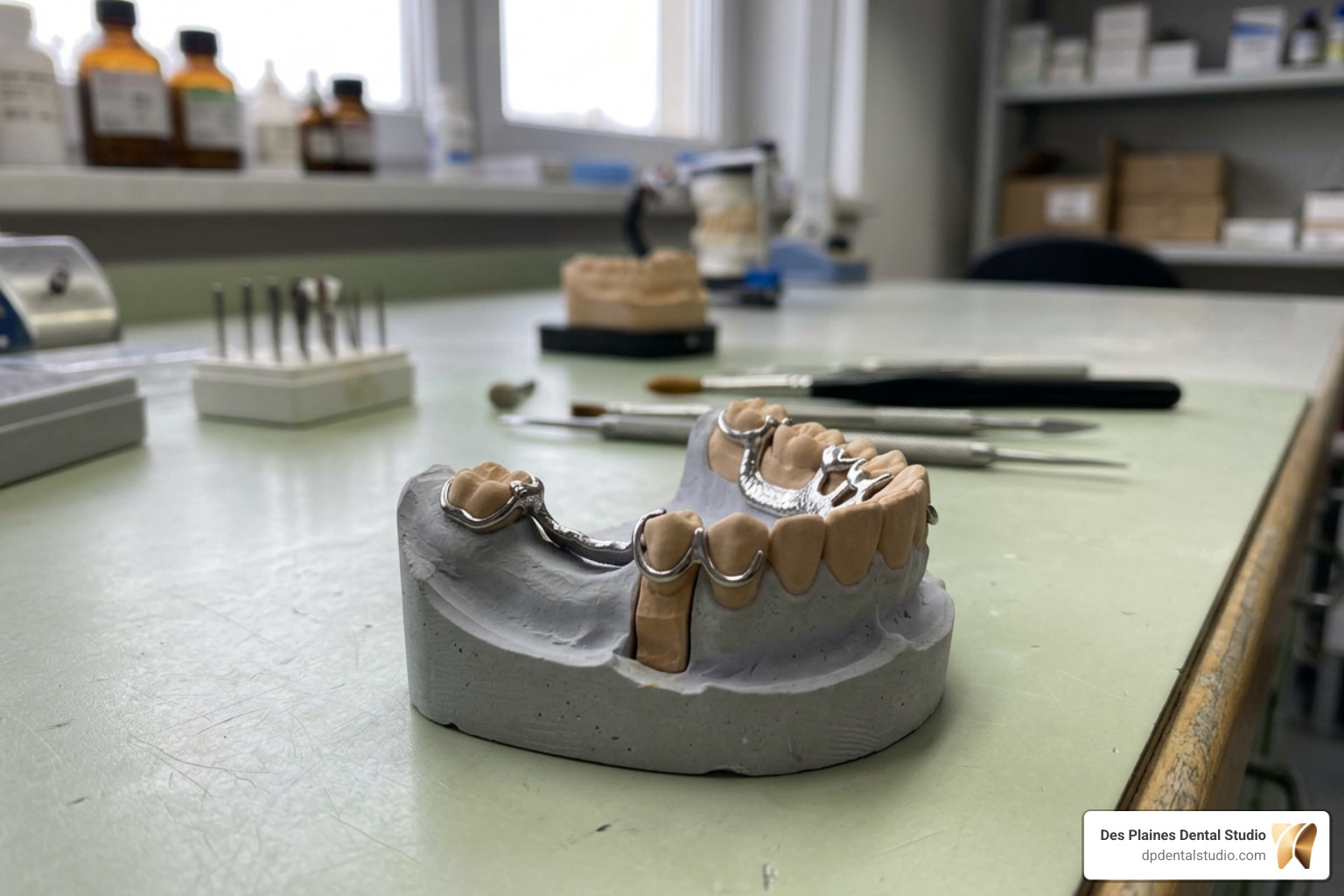
Why do we spend so much time classifying these arches? Because the classification dictates the entire physics of the denture. At Des Plaines Dental Studio, we use these classifications to determine how to distribute chewing forces so that your remaining teeth are protected and your denture feels completely stable.
When we design a Class I or Class II denture, we are dealing with “distal extensions.” Because there are no teeth at the very back to support the denture, the plastic base rests directly on your gums. When you bite down, the gum tissue yields slightly, while the anchor teeth do not. This creates a leverage effect.
To prevent this leverage from acting like a bottle opener on your natural teeth, we must use specialized, stress-releasing clasps (such as RPI or RPA clasp systems) and place “indirect retainers” (rests placed further forward in the mouth) to stabilize the denture.
Conversely, a Class III denture is a dream to design. Because there are healthy teeth at both the front and back of the empty space, the denture is entirely “tooth-supported.” We can use rigid metal clasps and a simpler framework because the chewing forces are transferred directly down the long axes of your sturdy anchor teeth. It won’t rock, slide, or press heavily into your gums.
For Class IV cases, our primary focus is esthetics and anterior support. We want to place the metal clasps as far back in the mouth as possible so they are completely invisible when you smile, while using a rigid major connector across the roof of the mouth to keep the front teeth perfectly stable.
Clinical Guidelines: Practical Steps for Applying the Rules
When you visit us at Des Plaines Dental Studio, we follow a highly systematic, step-by-step workflow to ensure your partial denture fits flawlessly:
- Comprehensive Clinical Exam & Digital Imaging: We take high-resolution digital X-rays to evaluate the bone health and root strength of every remaining tooth.
- Diagnostic Casts: We create highly accurate physical or digital models of your upper and lower jaws.
- The Extraction Plan: We identify any non-restorable teeth that must be removed. Only after these extractions are planned and completed do we officially apply Applegate’s Rules.
- Determine the Class & Modifications: We locate the most posterior space to establish the primary Class, then count the remaining spaces to determine the modifications.
- Biomechanical Design: We carefully draw the framework design onto your diagnostic model, strategically placing rests, clasps, and major connectors.
- Clear Laboratory Communication: We send the exact design and classification to our trusted dental laboratory technicians, ensuring there is zero room for error during the fabrication of your custom cast partial denture.
Frequently Asked Questions about Applegate’s Rules
Why can a Kennedy Class IV arch have no modification spaces?
According to Applegate’s Rule 8, a Class IV arch cannot have modifications because of the “most posterior rule” (Rule 5). A Class IV space is at the very front of the mouth. If any other empty space exists—even a tiny gap where a single premolar or molar is missing—that space is physically posterior to the front teeth. Therefore, that back space must be designated as the primary classification (making it a Class II or Class III), and the front gap is demoted to a modification space.
How do missing third molars affect the final RPD classification?
It depends entirely on whether we plan to use them. Under Rule 2, if a wisdom tooth is missing and we do not plan to replace it, we completely ignore it. However, under Rule 3, if the wisdom tooth is present, healthy, and we plan to use it as an anchor (abutment) for the denture, it is included. This often transforms a free-end Class II space into a much more stable, bounded Class III space.
Why must classification occur only after planned extractions are complete?
Rule 1 is designed to prevent catastrophic design failures. If we classify and design a denture before extracting a weak tooth, the loss of that tooth after the denture is made will completely alter the biomechanics of your mouth. A tooth-supported denture might suddenly become a tissue-supported distal extension, rendering the expensive metal framework completely useless and highly uncomfortable.
Conclusion
At Des Plaines Dental Studio, we believe that long-term oral comfort starts with absolute precision. By meticulously applying Applegate’s rules, we take the guesswork out of partial denture design. Whether you need to replace a few missing teeth or require a comprehensive mouth rehabilitation, our patient-centered team is here to guide you through a comfortable, stress-free, and pain-free experience.
If you are ready to restore your smile and chew with absolute confidence, Schedule a consultation for custom partial dentures with us today in Des Plaines, IL!