


How Digital Denture Design is Revolutionizing Modern Smiles
Why Digital Denture Design Is Changing the Way People Get Dentures
Digital denture design is a modern approach to creating removable dentures using computer software, digital scanning, and precision manufacturing — instead of the messy, manual methods that have been used for decades.
Here’s a quick overview of what that means for you:
| Question | Quick Answer |
|---|---|
| What is it? | Creating dentures using digital scans, CAD software, and milling or 3D printing |
| How many appointments? | As few as 2, compared to 5+ with traditional methods |
| Are they stronger? | Yes — up to 8x stronger than conventional dentures |
| Can lost dentures be replaced easily? | Yes — design files are stored for up to 5 years |
| Who is it for? | Anyone who needs full or partial dentures |
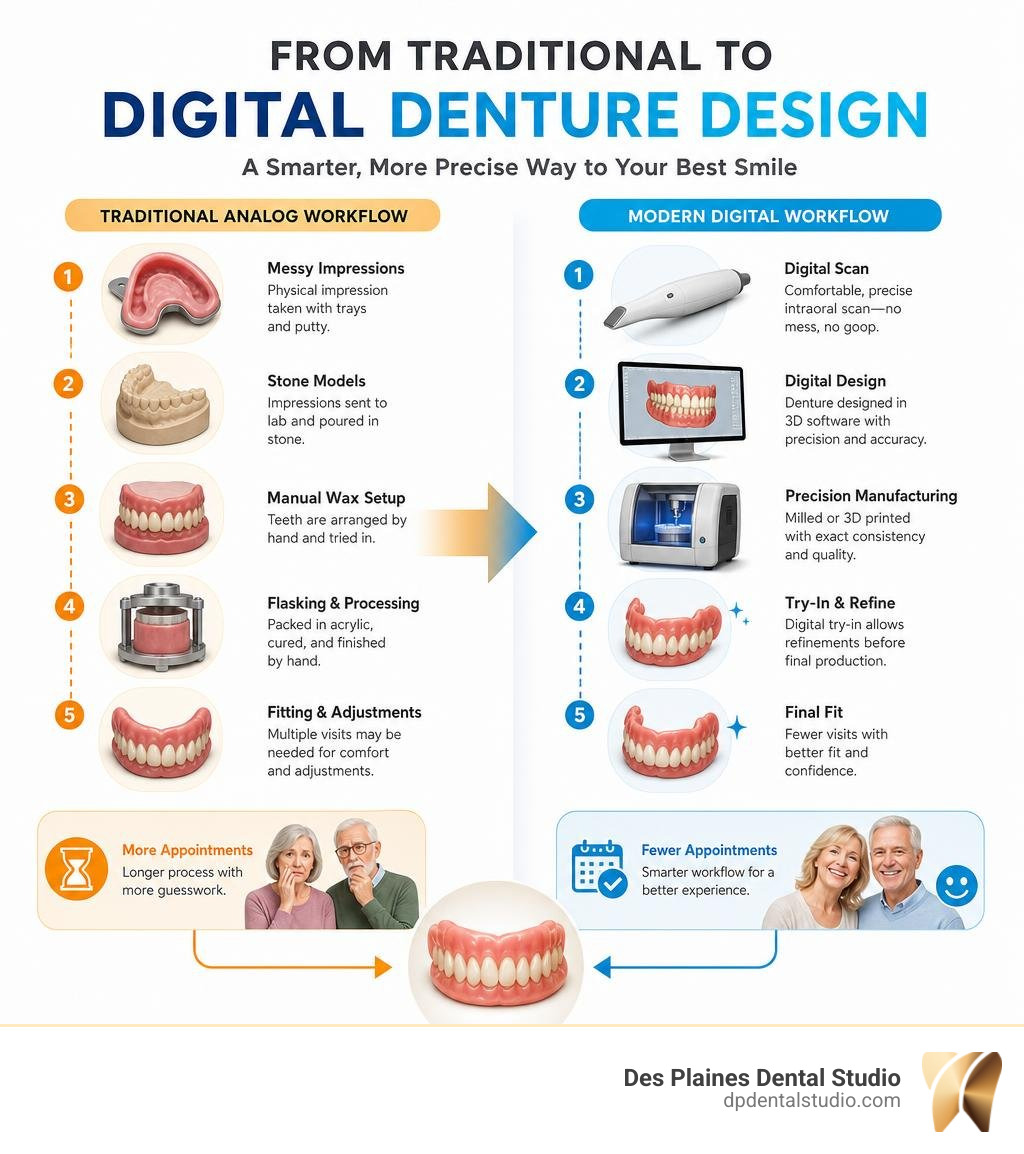
Traditional dentures have been around for centuries. The process works — but it’s slow, uncomfortable, and imprecise. Patients sit through multiple appointments, bite down on goopy impression trays, and wait weeks for a result that may still need significant adjustments.
Digital workflows change all of that. From the first scan to the final fitting, everything is guided by data — not guesswork.
I’m Dr. Marta Milejczyk, and with nearly three decades of experience in restorative and cosmetic dentistry, including advanced training in full mouth rehabilitation, I’ve seen how digital denture design is transforming patient outcomes. I’ll walk you through exactly how this technology works and what it means for your care at Des Plaines Dental Studio.
The Core Technology Behind Digital Denture Design
At the heart of this dental revolution is CAD/CAM technology (Computer-Aided Design and Computer-Aided Manufacturing). Instead of a dental technician hand-carving wax and packing acrylic into plaster molds, we use sophisticated software to design every millimeter of your prosthetic.
This shift from analog handcrafting to digital precision is explored in depth by industry leaders in this guide on Digital dentures: fabrication, workflow and benefits. By digitizing the patient’s anatomy, we can analyze the relationship between the upper and lower jaws with mathematical accuracy.
Once the virtual model is perfected, the design is sent to a manufacturing machine. In modern dental labs and advanced practices, two primary manufacturing methods are used: subtractive milling and additive 3D printing. Both represent a massive leap forward from conventional processing, but they achieve the final result in very different ways.
Subtractive Milling vs. Additive 3D Printing
To understand how your future smile is built, think of subtractive milling as sculpting and additive 3D printing as building.
Subtractive milling starts with a solid, pre-cured disc of high-density polymethyl methacrylate (PMMA). A computer-controlled CNC milling machine uses tiny, precise drill bits to carve the denture base and teeth out of this single, solid block. Because the material is cured under immense industrial pressure before it is carved, it has virtually zero porosity. This means there are no microscopic air bubbles where bacteria, odors, or stains can hide.
Additive 3D printing, on the other hand, builds the denture layer by layer using liquid biocompatible photopolymer resins. A specialized dental 3D printer projects light onto the resin, curing it micro-layer by micro-layer until the denture base and teeth are formed.
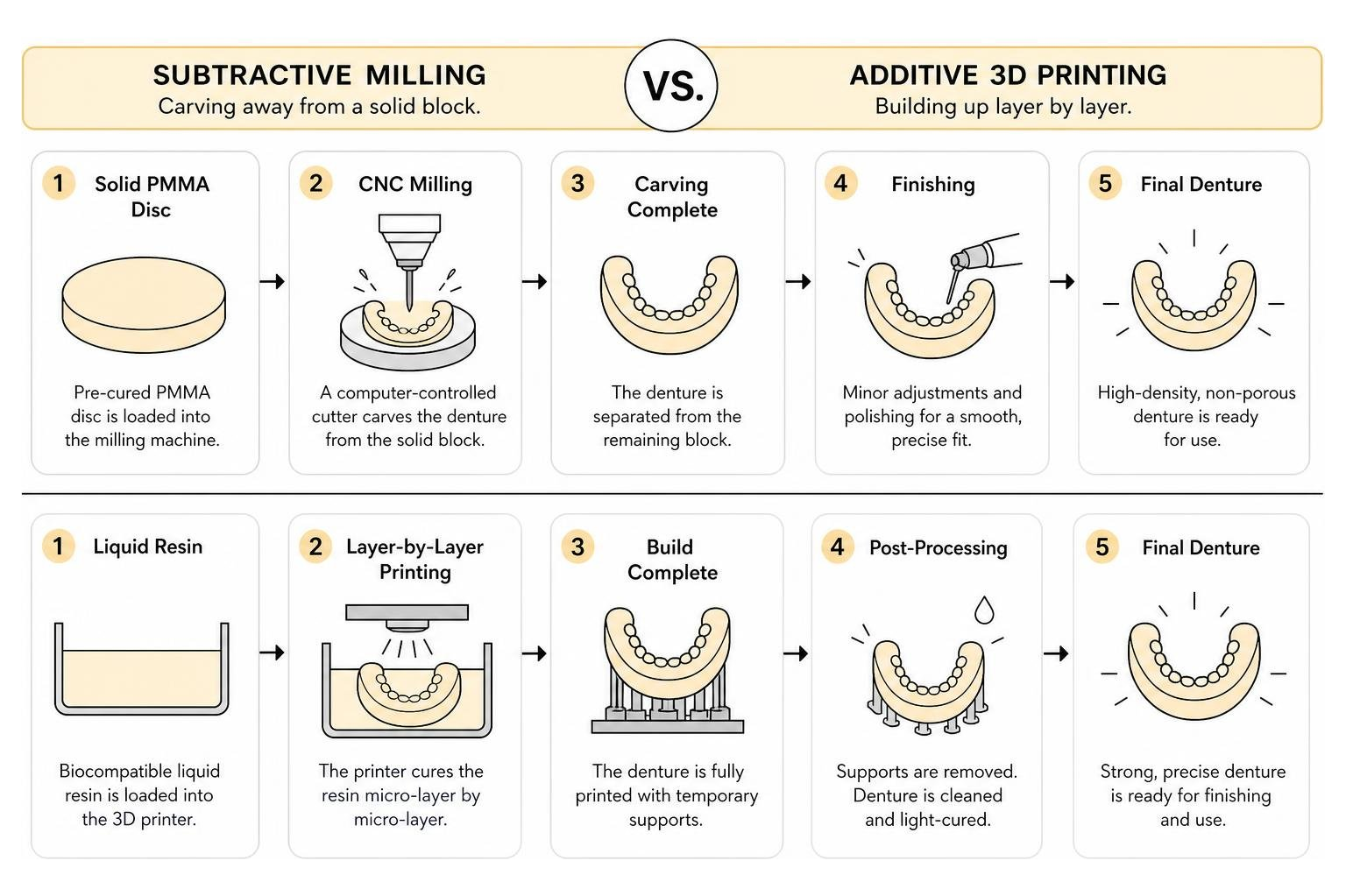
Here is a direct comparison of how these two manufacturing methods stack up:
| Feature | Subtractive Milling | Additive 3D Printing |
|---|---|---|
| Process Type | Subtractive (carving away from a solid block) | Additive (building up layer by layer) |
| Material Base | High-density pre-cured PMMA | Biocompatible photopolymer resin |
| Porosity | Extremely low (virtually non-porous) | Low (requires meticulous post-processing) |
| Flexural Strength | Base: ~96 MPa, Teeth: ~110 MPa | Highly comparable, optimized for flexibility |
| Best For | Ultimate long-term durability and stain resistance | Rapid turnaround, cost-effective try-ins, and immediate dentures |
| Material Waste | Higher (residual material from the disc is discarded) | Extremely low (only uses the exact resin needed) |
While milled dentures are often preferred when long-term durability is the primary clinical consideration, 3D printing is rapidly gaining ground. In 2026, modern 3D printers and advanced resins allow us to produce highly accurate, beautiful prosthetics with incredible speed and minimal waste.
Material Science and Biocompatibility
The materials used in modern digital denture design are a far cry from the brittle plastics of the past. Traditional dentures are made from liquid monomer and polymer powders mixed by hand and cured in a hot water bath. This manual process can lead to slight shrinkage, warping, and microscopic voids.
Digital dentures utilize advanced, highly cross-linked polymers. For instance, milled PMMA and advanced 3D-printed resins exhibit a flexural modulus of up to 2,953 MPa for the base and 2,785 MPa for the teeth. This high flexural strength makes them incredibly resilient to the daily forces of chewing. In fact, some monolithic digital designs can be up to eight times stronger than their conventional counterparts.
Furthermore, these materials are exceptionally biocompatible. Because they undergo strict industrial curing processes, there is virtually no residual free monomer left in the material, which significantly minimizes the risk of allergic reactions or tissue irritation. Whether you are looking for complete or dentures des plaines il, these advanced materials ensure a comfortable, tissue-friendly fit.
The Step-by-Step Digital Denture Workflow
The transition to a digital workflow streamlines the entire clinical process, making it faster, cleaner, and far more predictable for everyone involved.
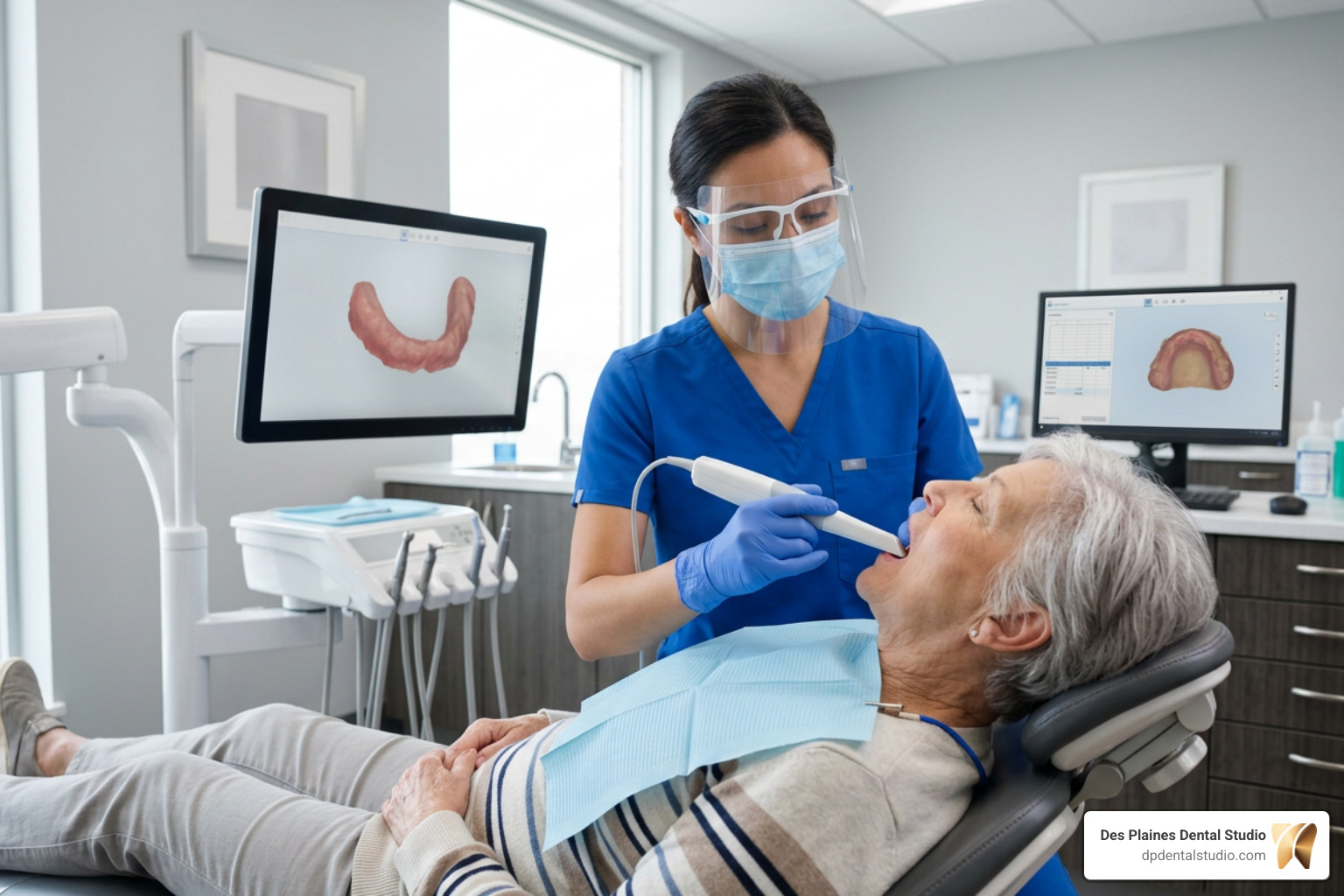
Instead of forcing you to bite down on a tray filled with cold, wet plaster or alginate putty, the digital journey begins with light.
Here is how the modern 4-step workflow progresses from your first visit to your brand-new smile:
- Data Acquisition: We capture a highly accurate, 3D digital map of your mouth using a handheld intraoral scanner.
- CAD Design: The digital scans are imported into advanced design software where the virtual denture is built.
- Manufacturing: The finalized design file is sent to a precision milling machine or a medical-grade 3D printer.
- Try-In and Final Delivery: We test the fit using a temporary printed model before fabricating and delivering your final, permanent denture.
Step-by-Step Digital Denture Design in CAD Software
Once we capture your digital impressions, the virtual design phase begins. Utilizing advanced software ecosystems, a dental technician or designer can perform a highly detailed model analysis.
The software automatically identifies key anatomical landmarks, such as the incisive papilla, the tuberosities, and the retromolar pads. This ensures that the denture boundary is designed perfectly to distribute chewing forces evenly across your ridges.
Next, we use virtual “smile composers” and extensive digital tooth libraries to select the perfect shape, size, and shade of teeth to match your natural facial proportions. The software even features AI-powered design proposals that can generate highly accurate initial tooth setups for common cases in as little as 90 seconds.
For a deeper dive into the technical details of this process, the Digital Denture Design in 3Shape manual illustrates how software settings, tooth pocket depths, and structural supports are calibrated to ensure a flawless physical output.
During this CAD phase, the designer can also control the occlusion (how your teeth bite together). Whether your jaw relationship is Class I (normal), Class II (overbite), or Class III (underbite), the software allows us to simulate jaw movements virtually and adjust the teeth to prevent tipping or sliding when you eat.
The Role of Try-Ins in Digital Denture Design
One of the most important milestones in the digital workflow is the physical try-in phase. In the traditional workflow, this involved a wax baseplate with loose plastic teeth stuck into it. If you bit down too hard, the wax could warp, ruining the measurements.
With digital design, we print a “monoblock try-in.” This is a single, solid, 3D-printed prototype of your future denture, usually printed in a tooth-colored or translucent resin.
Because the try-in is completely rigid, it allows us to verify several critical factors with absolute certainty:
- The Fit (Intaglio Surface): We make sure the denture base hugs your gums perfectly without any rocking or sore spots.
- The Bite (Occlusion): We verify that your upper and lower teeth meet evenly.
- The Esthetics: You get to look in the mirror and see exactly how your teeth will look, how they support your lips, and how they affect your speech.
If any minor adjustments are needed, we don’t have to start over. We simply make a quick adjustment in the CAD software, update the digital file, and print the final, perfected denture.
Clinical and Practical Benefits of Digital Dentures
The shift to digital prosthetics is a win-win for both the dental team and the patient. It removes the guesswork from the clinical side and eliminates the physical discomforts of the traditional process for the patient.
Advantages for the Dental Practice
For our team at Des Plaines Dental Studio, digital denture design allows us to deliver a level of consistency that was simply impossible with manual methods. Because the software guides the design process, the risk of human error during the wax-up, investing, and processing stages is completely eliminated.
This translates to a massive reduction in remakes and tedious chairside adjustments. Instead of spending valuable time grinding down high spots on a new denture, the digital prosthetic typically fits perfectly right out of the box.
Furthermore, because all data is stored digitally, collaborating with our lab partners is instantaneous. We can send 3D scans across the miles in seconds, speeding up turnaround times and keeping the average cost for dentures highly competitive and accessible for our patients.
Advantages for the Patient
For you, the patient, the benefits are life-changing. First and foremost is comfort. The elimination of messy, gag-inducing impression materials is a massive relief, especially for patients with a sensitive gag reflex or dental anxiety.
Additionally, the precision of CAD/CAM manufacturing means your dentures will fit more securely, reducing the need for messy denture adhesives. Because the materials are non-porous and incredibly dense, your dentures will resist stains and odors, staying fresh and beautiful for years to come.
If you only need to replace a few missing teeth, this digital precision is equally beneficial for partial restorations. You can learn more about how we design customized, comfortable partial prosthetics by reading our guide from a 60016 dentist what you should know about partial dentures.
Limitations and Challenges of Digital Workflows
While digital denture design is incredibly advanced, it is important to understand that it is not a magic wand. There are still clinical and technical challenges that require a highly skilled dental team to navigate.
The primary clinical challenge in fully edentulous cases is soft tissue mobility. Unlike teeth or dental implants, which are anchored firmly in bone, your gums and cheeks move. An intraoral scanner captures a “static” snapshot of these tissues. If a patient has highly mobile, loose, or resorbed ridges, capturing an accurate digital boundary can be difficult.
In these complex cases, we often combine the best of both worlds: we may take a physical “mucostatic” impression to capture how the tissues behave under gentle pressure, and then scan that physical mold to bring it into the digital design software.
There is also a steep learning curve and a significant initial investment required for dental practices to adopt this technology. From high-end intraoral scanners to specialized CAD software licenses and 3D printers, the barrier to entry is high.
Fortunately, at Des Plaines Dental Studio, we have invested in this advanced training and technology so that our patients in the Des Plaines, IL area can enjoy the benefits of modern dentistry without compromise.
Frequently Asked Questions about Digital Dentures
How long are digital denture design files stored for future replacements?
Your digital denture design files are stored securely in our digital archive for up to 5 years. This is one of the greatest peace-of-mind benefits of digital dentistry.
If you lose your denture on vacation, drop it on a hard tile floor, or if your dog mistakes it for a chew toy, you do not have to undergo the entire scanning and fitting process again. You simply call us, and we can retrieve your exact design file and print or mill an identical duplicate within days.
Can a digital denture be made in just two appointments?
Yes! Because the digital workflow condenses several steps, many uncomplicated cases can be completed in as few as two clinical appointments:
- Appointment 1: Digital scanning, bite registration, and virtual design setup.
- Appointment 2: Delivery of your final, custom-fit digital dentures.
For more complex cases, we may add a third appointment for a physical monoblock try-in to guarantee absolute perfection before we manufacture the final prosthetic.
How much stronger are digital dentures compared to traditional ones?
Milled digital dentures can be up to eight times stronger than conventional, hand-processed acrylic dentures. This incredible strength is due to their monolithic design and the high-density, pre-cured PMMA material from which they are carved.
Because the teeth and the base are often milled from the same solid block (or chemically fused using advanced bonding protocols), there are no weak joints between the teeth and the pink base, drastically reducing the risk of chipped or popped-out teeth.
Conclusion
At Des Plaines Dental Studio, we believe that restoring your smile should be a comfortable, predictable, and life-changing experience. By embracing digital denture design, we are able to offer our patients in Des Plaines, IL, a faster, more precise, and virtually pain-free path to a beautiful, functional smile.
Whether you are looking to replace an old, loose denture or are exploring tooth replacement options for the first time, our team is here to guide you with personalized, patient-centered care. If you are ready to experience the future of restorative dentistry, we invite you to repair your smile with dentures by scheduling a consultation with us today.