


The Ultimate Guide to Full Mouth Bridges: Don’t Let Missing Teeth Get You Down
What Is a Full Mouth Bridge — and Is It Right for You?
A full mouth bridge is a fixed dental restoration that replaces all or most of the teeth in one or both jaws, anchored in place so it never comes out.
Quick answer for busy readers:
| Question | Answer |
|---|---|
| What is it? | A fixed arch of artificial teeth supported by implants or natural teeth |
| Who is it for? | Adults missing most or all teeth in one jaw (or both) |
| How long does it last? | 10–30 years with proper care |
| Is it removable? | No — it stays in your mouth like natural teeth |
| How is it different from dentures? | It’s fixed, more stable, and helps preserve jawbone |
| Rough cost range? | $20,000–$80,000 depending on type and materials |
Losing most or all of your teeth changes more than just your smile. It affects how you eat, how you speak, and — honestly — how you feel about yourself. Simple things like biting into an apple or laughing in a photo can start to feel stressful.
The good news? Modern dentistry has come a long way. A full mouth bridge can restore up to 90% of your natural chewing capacity — compared to just 20–30% with traditional removable dentures.
This guide walks you through everything you need to know: how full mouth bridges work, what types exist, what the procedure looks like, what it costs, and whether it might be the right fit for you.
I’m Dr. Marta Milejczyk, and after decades of restorative and implant dentistry — including advanced training in full mouth rehabilitation at Loyola University Medical Center — I’ve helped many patients in the Des Plaines area reclaim their smiles with a full mouth bridge. Let’s break it all down in plain language so you can make a confident, informed decision.
Understanding the Full Mouth Bridge and How It Works
To understand what a full mouth bridge is, it helps to look at how we traditionally replace missing teeth.
A standard dental bridge is used to fill a gap left by one to four missing teeth in a row. It relies on the healthy natural teeth on either side of the gap (called abutment teeth) to hold the artificial tooth (the pontic) in place. You can read more about how standard bridges work in our guide on Bridges for Teeth.
A full mouth bridge (or full-arch bridge) takes this concept and scales it up to replace an entire upper or lower arch of teeth. Instead of relying on a couple of natural teeth, a full-arch bridge is typically anchored securely to the jawbone using strategically placed dental implants.
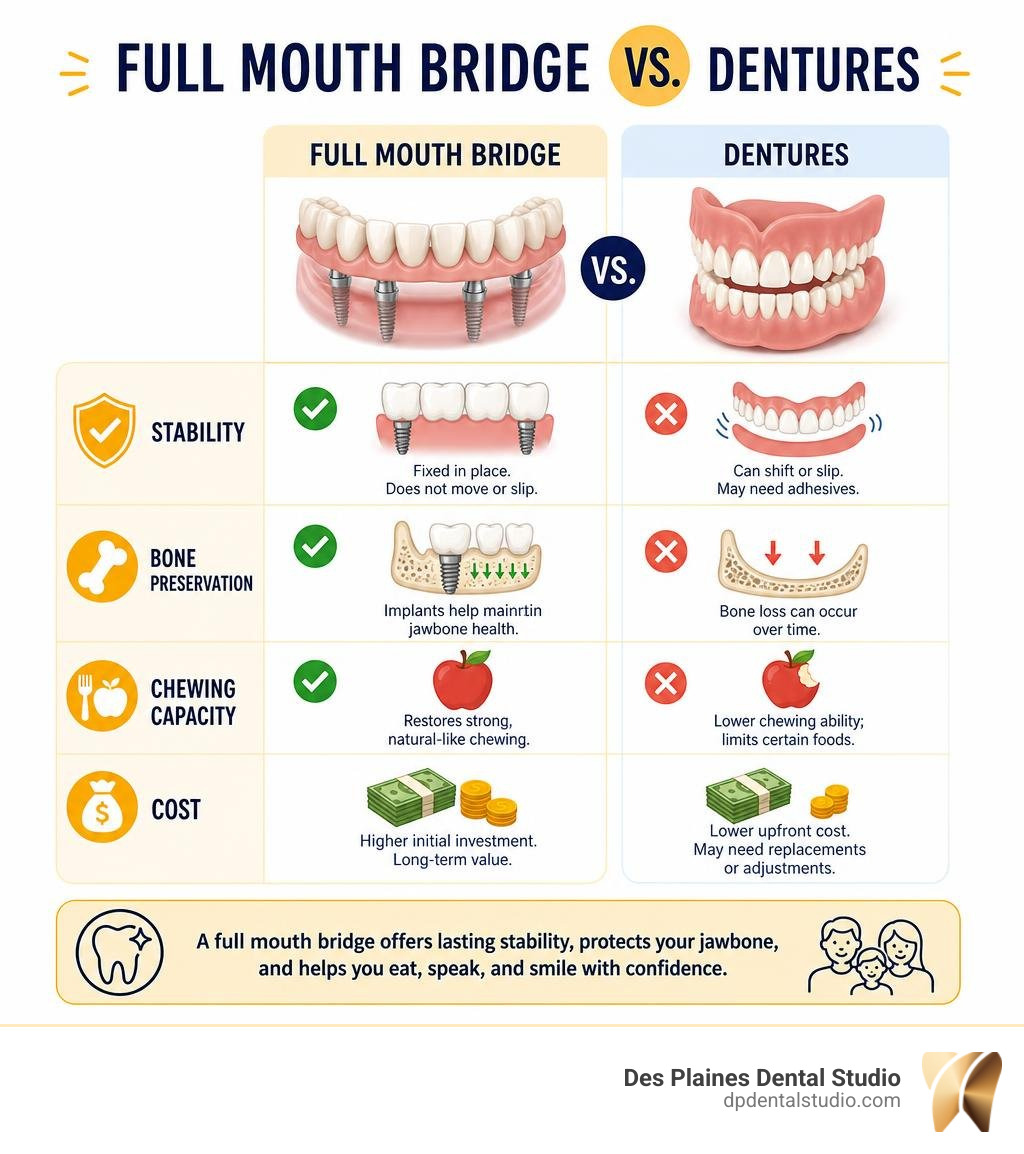
Unlike traditional dentures, which sit loosely on top of your gums and require messy adhesives, a full mouth bridge is permanently fixed. It does not slip, slide, or click when you talk, and you do not have to take it out at night to soak in a glass on your nightstand.
If you are currently wearing a partial denture, you know how frustrating metal clasps and shifting prosthetics can be. Learn more about how these compare in our overview of What You Should Know About Partial Dentures.
Main Types of Full-Arch Bridges
Not all full-arch bridges are created equal. Depending on your budget, your jawbone density, and how many healthy teeth you have left, we may recommend one of three primary options.
Here is a quick look at how they compare:
| Feature | Implant-Supported Bridge | Traditional Tooth-Supported Bridge | Hybrid / All-on-4 Style |
|---|---|---|---|
| Primary Support | 4 to 8 dental implants | Remaining healthy natural teeth | 4 to 6 angled implants |
| Removability | Fixed (only removed by dentist) | Fixed (only removed by dentist) | Fixed (only removed by dentist) |
| Bone Preservation | Excellent (implants stimulate bone) | Minimal (only around natural roots) | Excellent (implants stimulate bone) |
| Surgery Required | Yes (implant placement) | No (unless extractions are needed) | Yes (implant placement) |
| Average Lifespan | 10 to 30+ years | 5 to 15 years | 10 to 25+ years |
Prosthetic Materials: Zirconia, Acrylic, and Composite
The material used to craft your new teeth plays a massive role in how natural they look and how long they last.
- Monolithic Zirconia: This is the gold standard of modern restorative dentistry. Boasting an incredible strength of up to 1200 MPa, zirconia is virtually chip-proof, highly stain-resistant, and looks beautifully translucent—just like natural tooth enamel. It typically lasts 15 to 25+ years.
- Porcelain-Fused-to-Metal (PFM): A classic option where porcelain is baked over a strong metal alloy base. It offers excellent aesthetics and high strength (around 300 MPa), with a typical lifespan of 10 to 15 years.
- Acrylic/Composite: Often used for temporary bridges during the healing phase, or as a more budget-friendly permanent option (such as a Toronto Bridge). While lightweight and easily repairable, acrylic has a lower strength (100 to 200 MPa) and is prone to staining and wearing down over 5 to 10 years.
Implant-Supported Full Mouth Bridge
An implant-supported full mouth bridge is the most durable, natural-feeling tooth replacement option available in 2026.
This system utilizes dental implants—small titanium posts surgically inserted directly into your jawbone—to act as artificial tooth roots. Over a period of three to six months, a biological miracle called osseointegration occurs: your natural jawbone actually fuses with the titanium posts, creating an incredibly secure foundation.
Once healed, a custom-designed ceramic or zirconia bridge is screwed or cemented onto these implants. Because the implants mimic natural roots, they prevent the jawbone from shrinking over time. This approach boasts an exceptional success rate of 80% to 90% even beyond the 10-year mark when patients maintain excellent oral hygiene. For a deeper dive into this surgical protocol, explore the technical details of Immediate Full-Arch on 4/6 Implants.
Traditional Tooth-Supported Full Mouth Bridge
While far less common for an entire arch, a traditional tooth-supported full mouth bridge can sometimes be used if a patient still has several exceptionally strong, healthy natural teeth spread across their jaw.
In this scenario, the remaining natural teeth are reshaped to accept crowns, which act as the anchor points (abutments) to support the bridge. In highly specific, minimally invasive cases—especially for elderly patients where surgery is contraindicated—dentists may utilize a natural tooth pontic fiber-reinforced composite (FRC) bridge. This technique can even incorporate a patient’s own extracted natural teeth, bonded to a high-strength fiber framework to maintain a highly organic, biocompatible smile. To see how this unique approach works in clinical practice, read this detailed medical case report on the Reconstruction of Natural Smile and Splinting with Natural Tooth Pontic Fiber-Reinforced Composite Bridge – PMC.
Hybrid Fixed Dentures and All-on-4 Style Bridges
Often referred to as “Teeth-in-a-Day,” the All-on-4® or All-on-6 protocol is a brilliant hybrid solution.
Instead of placing an implant for every single missing tooth (which would be incredibly expensive and surgically exhausting), this technique uses just four to six strategically placed implants per arch. The two rear implants are placed at a precise angle (usually 45 degrees). This angling maximizes the use of your available natural bone, meaning we can often avoid the need for complex, costly bone grafting surgeries.
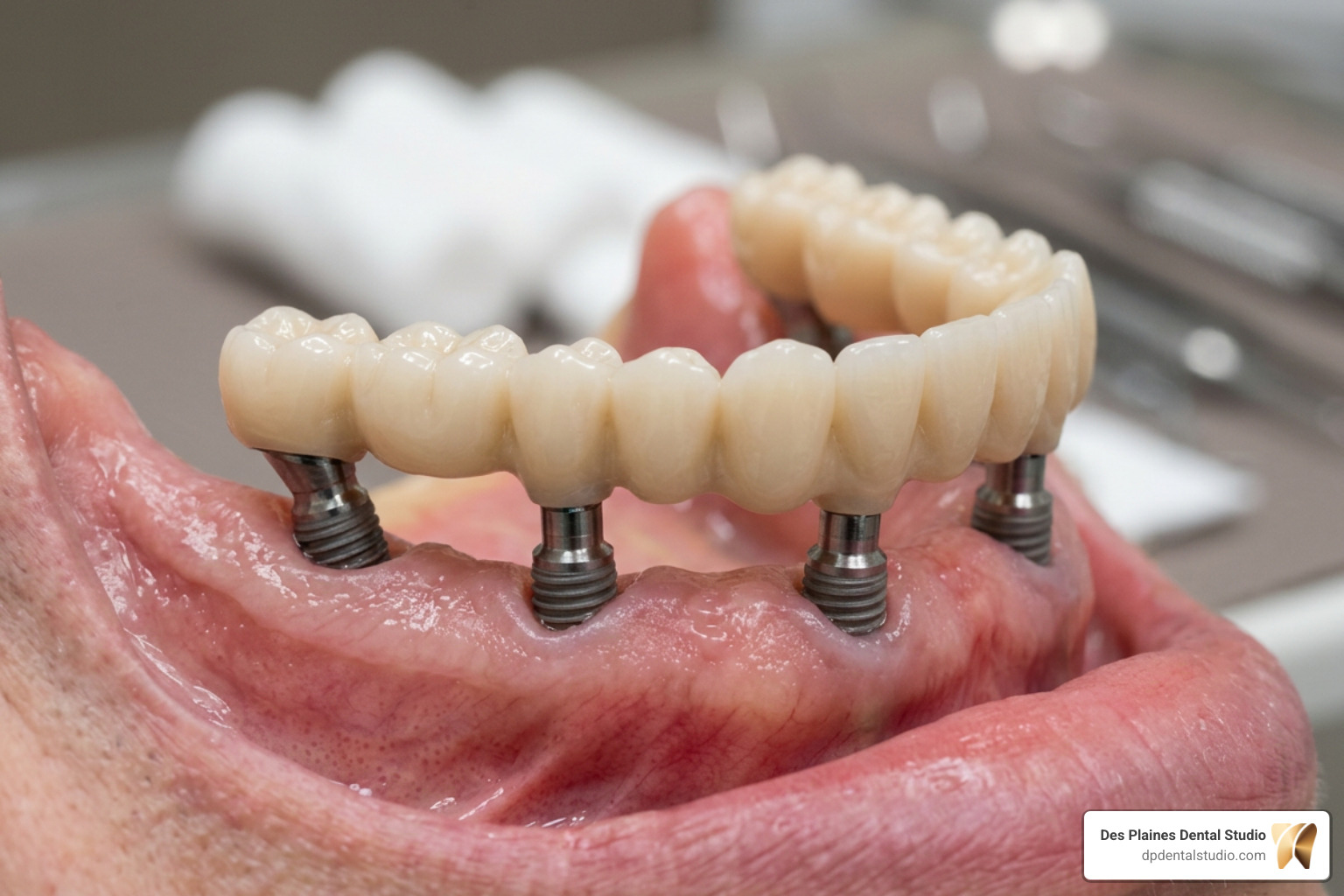
Best of all, this protocol often allows for immediate loading. This means we can place a temporary, highly aesthetic bridge on the very same day as your implant surgery, so you never have to spend a single day without teeth. To learn more about the basic mechanics of crowns and bridges, you can review the UIC College of Dentistry Crowns & Bridges resource.
Benefits, Candidacy, and Jawbone Preservation
Choosing a full mouth bridge over removable dentures is an investment in your systemic health, confidence, and daily comfort.
- Facial Structure Support: When you lose teeth, your jawbone naturally begins to deteriorate (resorb) because it no longer receives stimulation from chewing forces. This leads to a collapsed, aged facial appearance, characterized by sunken cheeks and a puckered mouth. Implants stimulate the bone, preserving your natural facial contours.
- Restored Chewing Capacity: While traditional dentures restore only 20% to 30% of your bite force—forcing you to give up steak, nuts, and crunchy vegetables—an implant-supported bridge restores up to 90% of your natural chewing capacity.
- Clear Speech and Enhanced Taste: Traditional upper dentures cover the entire palate (the roof of your mouth), which can muffle your speech and severely dull your sense of taste. A full mouth bridge leaves your palate completely open, allowing you to speak clearly and fully enjoy the flavors of your favorite meals.
Who is an Ideal Candidate?
While full-arch bridges are life-changing, they require a thorough clinical evaluation to ensure long-term success.
An ideal candidate typically meets the following criteria:
- Is missing most or all of their teeth in a single arch, or has “terminal dentition” (remaining teeth damaged beyond repair by severe decay or advanced periodontal disease).
- Has sufficient jawbone density to support dental implants (or is a candidate for bone grafting or angled All-on-4 implants).
- Is in good overall health. Chronic conditions like uncontrolled diabetes or autoimmune disorders can slow down the healing process and increase the risk of implant failure.
- Is a non-smoker, or is willing to commit to quitting during the surgical and healing phases, as smoking significantly hinders osseointegration.
- Maintains a commitment to excellent, consistent daily oral hygiene.
The Treatment Process, Costs, and Longevity
Embarking on the journey to a restored smile is a multi-step process that requires close collaboration between you and our clinical team. To get an idea of the wide range of treatments we provide, you can read about our general Restorative Dentistry Procedures.
Step-by-Step Procedure and Recovery Timeline

- Initial Consultation & 3D Imaging: We begin with a comprehensive exam using advanced 3D Cone Beam CT (CBCT) scans. This allows us to visualize your jawbone structure, nerve pathways, and sinus cavities in three dimensions, ensuring we plan your implant placement with microscopic precision.
- Surgical Phase (Implant Placement): Under comfortable local anesthesia or sedation, any remaining compromised teeth are extracted. The dental implants are then carefully placed into the jawbone. If you are receiving an immediate-load hybrid bridge, your temporary teeth will be securely attached during this same visit.
- Healing and Osseointegration (3 to 6 Months): During this phase, you will eat a soft-food diet to protect the implants while they fuse with your bone. We will monitor your progress closely to ensure perfect healing.
- Restorative Phase (Fitting the Final Bridge): Once osseointegration is complete, we take highly accurate digital impressions of your mouth. Our dental laboratory then custom-crafts your permanent zirconia or ceramic bridge. We will carefully verify the fit, bite alignment, and aesthetics before permanently securing it in place.
Cost Breakdown and Financial Considerations
A full mouth bridge is a major financial investment, but it is one that pays dividends in your quality of life for decades.
The national average cost for a traditional single dental bridge is $5,197, but because a full mouth bridge replaces an entire arch of teeth and requires surgical implant placement, the total cost for a full-arch implant-supported bridge typically ranges from $40,000 to $80,000 per arch.
The final price depends on several key variables:
- The number of implants required (e.g., All-on-4 vs. All-on-8).
- The materials chosen (monolithic zirconia will cost more upfront than acrylic, but saves money long-term due to its extreme durability).
- Pre-surgical treatments, such as bone grafting, sinus lifts, or extensive extractions.
While dental insurance often covers a portion of the preparatory extractions or diagnostic scans, they rarely cover the entire cost of implant surgery. To help you plan, we offer flexible financing options and in-house payment plans. For more details on budgeting, explore our guide on the Average Cost of Full Dental Implants.
Lifespan, Maintenance, and Long-Term Care
With proper care, a high-quality full mouth bridge can easily last 10 to 30 years—or even a lifetime.
To protect your investment, you must care for your bridge just like natural teeth:
- Brush twice daily with a soft-bristled toothbrush and non-abrasive toothpaste.
- Use a water flosser or specialized dental floss (like Superfloss) to clean the small space between your bridge and your gums. This prevents plaque buildup and protects against gum infections.
- Wear a custom night guard if you have a habit of clenching or grinding your teeth (bruxism) to prevent the prosthetic materials from fracturing.
- Visit us every six months for professional cleanings and examinations. During these visits, we will check the integrity of your implants and ensure your bite remains perfectly balanced.
Risks, Limitations, and Alternatives
As with any surgical procedure, it is important to understand the potential risks and limitations before making your decision.
- Peri-implantitis: This is an inflammatory condition similar to gum disease that affects the tissue and bone surrounding a dental implant. It is almost always caused by poor oral hygiene and can lead to implant failure if left untreated.
- Surgical Risks: These include minor risks of temporary swelling, bruising, infection at the implant site, or rare nerve irritation.
- Bone Grafting Needs: If you have been missing teeth for many years, your jawbone may have shrunk too much to support implants safely, requiring a preparatory bone grafting procedure.
Alternatives to Full-Arch Bridges
If a fixed full mouth bridge isn’t the right fit for your budget, health, or personal preferences, several excellent alternatives exist:
- Implant-Supported Overdentures: A wonderful middle-ground option. These are dentures that snap onto two to four implants for added stability, but they are still removable by the patient at night.
- Traditional Full Dentures: The most budget-friendly option. They require no surgery but do not prevent bone loss and can slip. Learn more about local denture services in our overview of Dentures Des Plaines IL and explore pricing details in our guide to the Average Cost for Dentures.
- Individual Dental Implants: Replacing every single tooth with an individual implant and crown. While highly aesthetic, this is rarely practical or cost-effective for an entire arch of missing teeth.
Frequently Asked Questions about Full-Arch Restorations
Is a full mouth bridge better than traditional dentures?
For the vast majority of patients, yes. A full mouth bridge is permanently fixed, meaning it won’t slip out of place when you laugh or chew. It restores up to 90% of your chewing capacity, keeps your palate open so you can taste your food, and actively stimulates your jawbone to prevent the bone loss associated with traditional dentures.
How many implants are typically needed for a full-arch bridge?
Most full-arch bridges require between four to six implants per jaw. The exact number depends on your individual jawbone density, the type of material used for the bridge (heavier materials like monolithic zirconia may require more support), and whether we utilize angled implants like the All-on-4 protocol.
How do you clean and maintain a fixed bridge?
While you cannot remove the bridge yourself, you can easily keep it clean using a water flosser, interdental brushes, and specialized floss threaders to sweep away food particles beneath the bridge. Regular professional cleanings at our Des Plaines office every six months are also vital to keep the supporting tissues healthy.
Conclusion
Losing your teeth can feel incredibly isolating, but you do not have to live with the discomfort and embarrassment of missing teeth or loose, unstable dentures. A full mouth bridge is a remarkable, long-lasting solution that can fully restore your oral health, protect your facial structure, and give you back the freedom to eat, speak, and smile with absolute confidence.
At Des Plaines Dental Studio, we are dedicated to providing patient-centered, welcoming, and pain-free care. We understand that investing in your smile is a major step, and our warm, experienced team is here to guide you through every step of the process—from your initial 3D scan to your final, gorgeous restoration—while helping you maximize your insurance benefits.
Ready to take the first step toward reclaiming your smile? Click here to find Dental Implants Near Me and schedule your personalized, comfortable consultation with us today!