


Everything You Need to Know About Full Lower Dental Implants
When You’ve Lost Most or All of Your Lower Teeth, Here’s What You Need to Know
Full lower dental implants are a permanent, fixed solution for replacing all the teeth in your bottom jaw — using just 4 to 6 titanium posts anchored into the jawbone to support a full arch of new teeth.
Here’s a quick overview of what they involve:
| Topic | Quick Answer |
|---|---|
| What they are | Titanium implants placed in the lower jaw that support a full set of fixed replacement teeth |
| Best for | Adults missing most or all lower teeth, or those with failing lower teeth |
| Main types | All-on-4, All-on-6, implant-supported overdentures |
| Typical cost | $15,000–$30,000+ per arch depending on materials and treatment needs |
| Healing time | 3–6 months for osseointegration; same-day temporary teeth often available |
| Success rate | Up to 98% with proper care |
| Longevity | 25+ years with good oral hygiene |
Losing your lower teeth affects more than just your smile. It changes how you eat, how you speak, and even how you look. The lower jaw bears most of your chewing load — so when those teeth are gone, everyday things like eating a meal or holding a conversation can become genuinely difficult.
Millions of Americans are in this situation. About 30 million people are missing all teeth in one or both jaws, and the number of people choosing implants over traditional dentures grows by 500,000 every year.
If you’ve tried lower dentures, you already know the problem: they slip, they shift, and they restore only a fraction of your natural bite force. Full lower implants are designed to solve exactly that.
I’m Dr. Marta Milejczyk, and my clinical background spans full mouth rehabilitation, implant dentistry, and restorative care — including advanced training through a General Practice Residency at Loyola University Medical Center and a national cosmetic and implant dentistry program that only 3% of dentists complete. My hands-on experience with full lower dental implants and complex restorations means you’ll get straightforward, evidence-based guidance throughout this guide — so let’s get into everything you need to make a confident decision.
What Are Full Lower Dental Implants and How Do They Work?
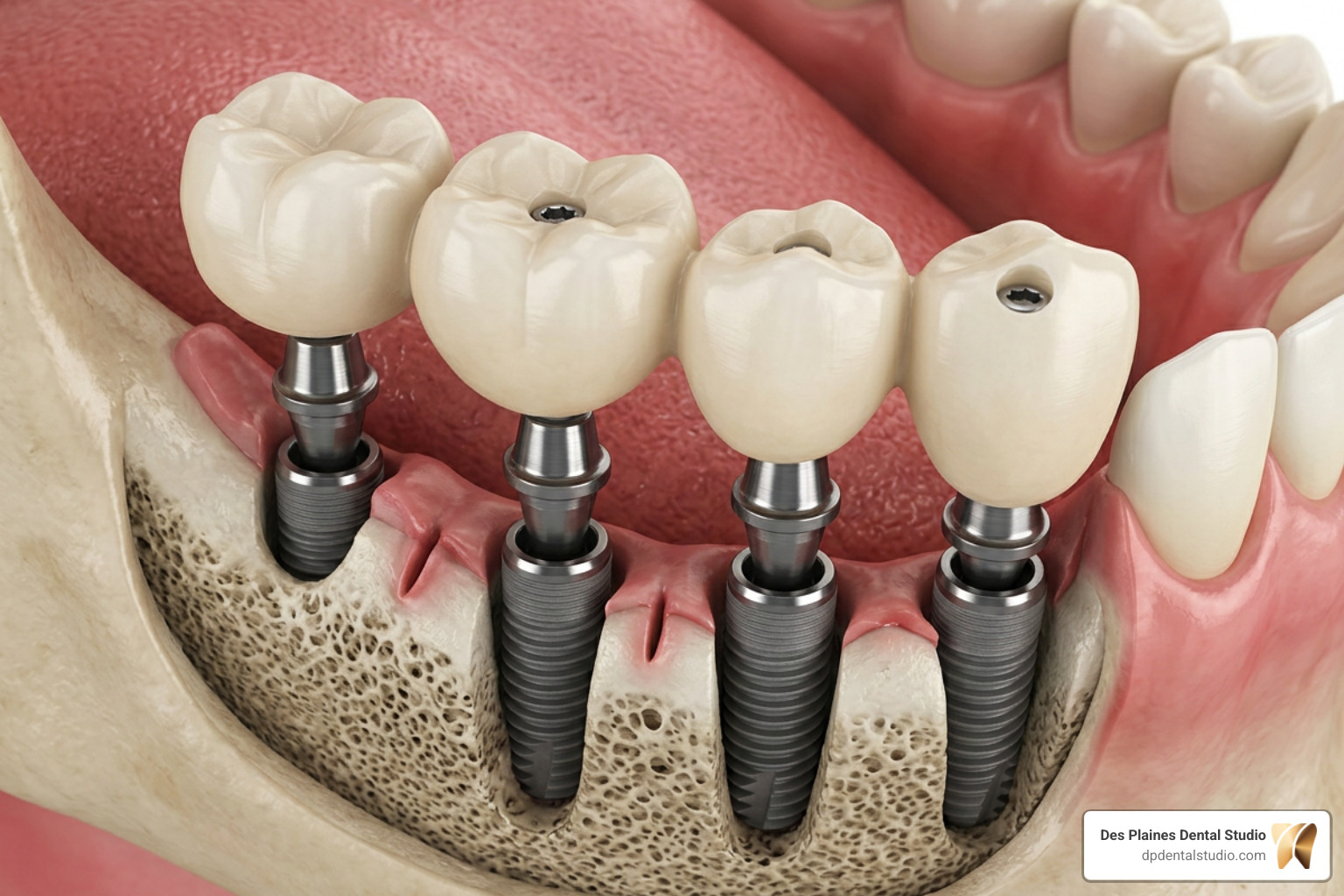
When we talk about full lower dental implants, we are referring to a comprehensive restorative system designed to replace the entire lower (mandibular) arch of teeth. Rather than replacing every single missing tooth with an individual implant post—which would be highly complex, costly, and anatomically impractical—this advanced treatment utilizes a strategically positioned set of titanium posts to support a single, customized bridge or overdenture.
The system relies on three primary components:
- The Implants: Small, biocompatible titanium posts that act as artificial tooth roots. These are surgically placed into the lower jawbone.
- The Abutments: Connector pieces that attach to the top of the implants, extending slightly above the gum line to secure the new teeth.
- The Prosthesis: The custom-designed arch of artificial teeth (typically made from high-strength zirconia, porcelain, or acrylic) that looks, feels, and functions like healthy, natural teeth.
Once placed, these implants undergo a biological process called osseointegration. Because titanium is highly biocompatible, your jawbone naturally fuses with the posts over a period of three to six months. This fusion creates an incredibly stable foundation, allowing the lower prosthetic teeth to withstand the full pressure of chewing and biting without shifting, slipping, or requiring messy adhesives.
Understanding the Anatomy of the Lower Jaw
The anatomy of the lower jaw, or mandible, presents unique clinical opportunities and challenges compared to the upper jaw.
First, the lower jawbone consists of the alveolar bone—the specific ridge of bone that surrounds and supports tooth roots. When teeth are lost, this bone no longer receives the mechanical stimulation it needs from chewing. Consequently, the body begins to resorb (absorb) the bone tissue, leading to a progressive loss of jawbone height and width. This is why long-time denture wearers often experience a “collapsed” facial appearance and increasingly loose-fitting prosthetics.
Second, the lower jaw contains the mandibular nerve (specifically the inferior alveolar nerve), which runs through a canal inside the bone and provides sensation to the lower lip and chin. Precise surgical planning is essential to avoid this nerve. Fortunately, the lower jaw generally features higher bone density than the upper jaw. This dense bone structure often provides exceptional initial stability for implants, which is a major advantage during the healing phase.
Ideal Candidates for Full Lower Dental Implants
Most adults who are missing all or a significant majority of their lower teeth are excellent candidates for this procedure. However, a successful outcome depends on several key health and structural factors:
- Adequate Bone Volume: There must be enough healthy jawbone structure to securely anchor the titanium posts. If substantial bone resorption has occurred, we can often perform pre-surgical bone grafting solutions to rebuild the ridge and create a solid foundation.
- Good Gum Health: Active periodontal (gum) disease must be treated and resolved before surgery to prevent bacteria from compromising the newly placed implants.
- Overall Systemic Health: Candidates should be in good general health. Chronic conditions such as uncontrolled diabetes, severe cardiovascular disease, or auto-immune disorders can interfere with the body’s natural healing process and osseointegration.
- Lifestyle Factors: Tobacco use can significantly restrict blood flow to the gums and bone, increasing the risk of implant failure. While smokers can still receive implants, committing to pausing tobacco use before and during the recovery phase is highly recommended.
Types of Full Arch Lower Implant Systems
To find the right approach for your budget and lifestyle, it is helpful to evaluate the primary implant configurations available for the lower arch. The medical community recognizes several highly effective protocols for addressing lower edentulism (complete tooth loss). For a deep dive into the scientific literature, you can read this study on the evidence-based clinical management of lower edentulism.
When restoring the lower arch, we match the implant system to your bone density and functional goals, eventually completing the process with custom-engineered implant restorations.
All-on-4® Dental Implants
This widely popular technique uses four titanium implants placed strategically in the front and sides of the lower jaw. The two posterior (back) implants are placed at an angle of up to 45 degrees. This angling allows us to maximize contact with the densest areas of the remaining bone, often eliminating the need for extensive bone grafting. It is a highly efficient, fixed solution that allows for a temporary bridge to be attached on the very same day as surgery.
All-on-6 Dental Implants
For patients with a stronger bite force, larger jaw anatomy, or slightly lower bone density, we may recommend using six implants instead of four. By spreading the chewing load across two additional posts, the All-on-6 configuration provides enhanced stability and structural support. Like the All-on-4, this is a fixed, non-removable solution.
Implant-Supported Overdentures (Snap-In Dentures)
If you are looking for a highly stable but more cost-effective alternative to a fully fixed bridge, snap-in overdentures are an excellent choice. This system typically utilizes two to four implants. Rather than being permanently screwed into place, the custom denture features specialized retention caps (such as locator or ball attachments) that snap securely onto the implants. You can easily remove them at night for cleaning, yet they remain firmly in place while eating and speaking.
| Feature | All-on-4 | All-on-6 | Implant-Supported Overdentures |
|---|---|---|---|
| Number of Implants | 4 | 6 | 2 to 4 |
| Type of Attachment | Fixed (Screwed-in) | Fixed (Screwed-in) | Removable (Snap-on) |
| Bite Force Restored | 80% to 90% | 90% to 95% | 60% to 80% |
| Bone Grafting Needed? | Rarely | Sometimes | Rarely |
| Ease of Cleaning | Brushed in mouth | Brushed in mouth | Removed and soaked |
| Relative Cost | Moderate to High | High | Budget-Friendly |
Comparing Lower Arch Implants vs. Traditional Dentures
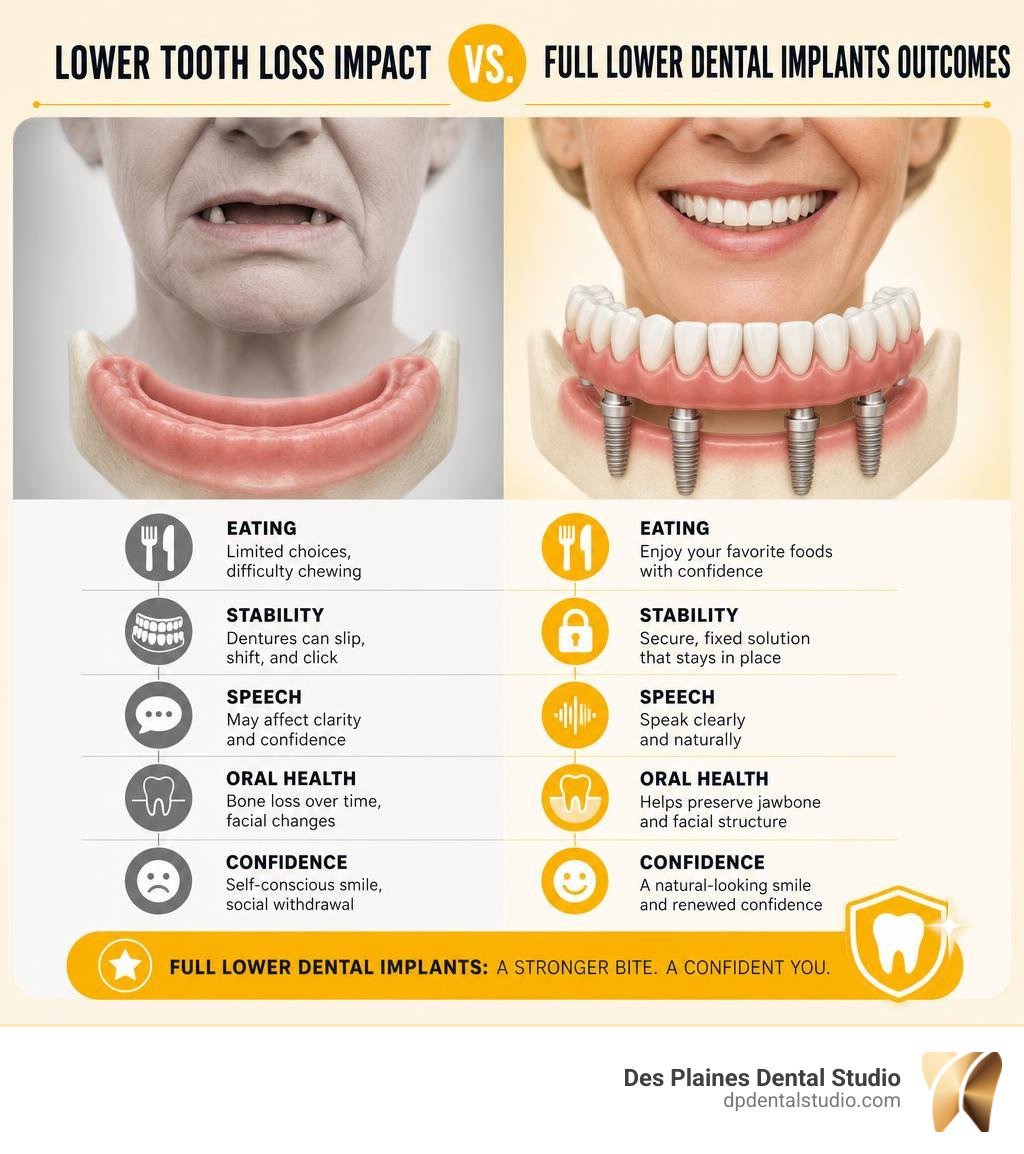
Traditional lower dentures are notorious for being difficult to wear. Because the lower jaw has a smaller surface area than the upper jaw and must accommodate constant movement from the tongue, conventional lower dentures often float, slip, and cause painful friction sores.
In terms of raw performance, traditional dentures only restore about 10% to 20% of your natural chewing efficiency. This forces many denture wearers to give up their favorite foods, such as raw vegetables, nuts, and tough meats, which can lead to nutritional deficiencies over time.
By contrast, full lower dental implants completely change the game. By anchoring directly into the jawbone, they restore up to 80% to 95% of your natural bite force. This allows you to eat virtually anything you want with absolute confidence.
Furthermore, traditional dentures do nothing to stop the biological process of bone loss. As the jawbone shrinks, the shape of your face changes, and the denture must be periodically refitted (relined) or replaced entirely every 5 to 7 years. Implants, on the other hand, actively preserve your jawbone and facial structure by delivering healthy biting stimulation directly into the bone tissue.
To explore a detailed breakdown of these long-term financial and health dynamics, review our ultimate guide to dental implants costs and benefits.
Why Choose Full Lower Dental Implants Over Dentures?
Choosing a permanent implant-supported arch offers a wide range of life-changing benefits:
- Unmatched Stability: Say goodbye to embarrassing slips during meals or mid-conversation. Your teeth remain locked in place.
- No More Messy Adhesives: You will never need to buy, apply, or clean up gooey denture creams again.
- Preserved Facial Youthfulness: By preventing bone resorption, implants help maintain the natural contours of your jawline, chin, and lips.
- Clearer, Confident Speech: Traditional dentures can cause a slight lisp or clicking sound. Implants function like natural teeth, allowing you to speak clearly and naturally.
- Simple, Familiar Maintenance: Fixed implant bridges are cared for just like natural teeth—simply brush twice daily, floss with a water flosser, and visit us for routine check-ups.
- Exceptional Durability: While traditional dentures require constant adjustments and eventual replacement, implants are designed to be a permanent, lifetime investment.
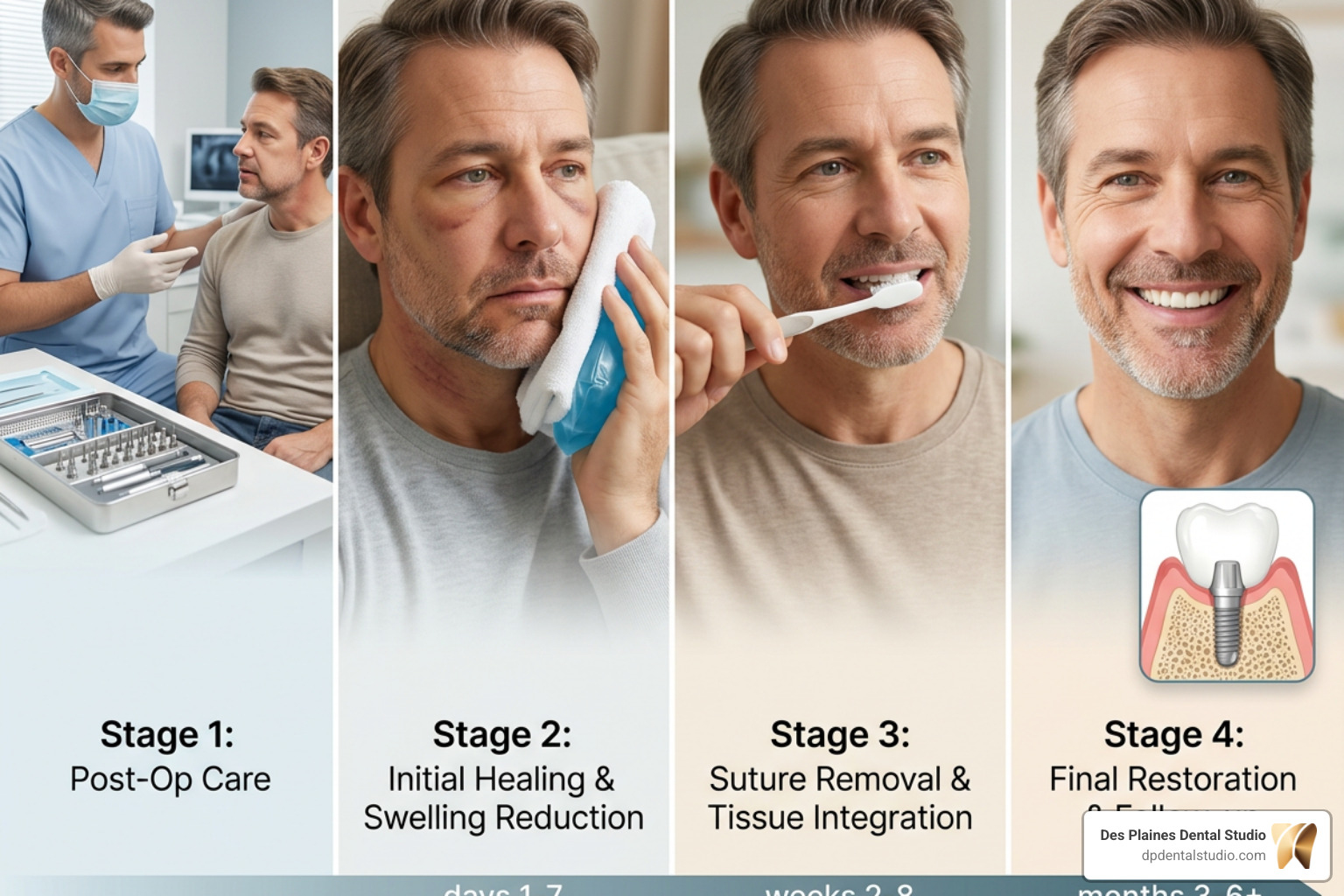
The Step-by-Step Surgical and Recovery Process
Getting full lower dental implants is a highly coordinated, multi-step journey designed to ensure your safety, comfort, and a beautiful final result.
Step 1: Comprehensive Consultation and Digital Diagnostics
We begin with an in-depth examination of your teeth, gums, and medical history. Using state-of-the-art 3D CBCT imaging, we capture high-resolution, three-dimensional views of your lower jawbone. This allows us to assess your bone density, locate the precise path of the mandibular nerve, and plan the exact angle and depth of each implant before the surgery even begins.
Step 2: Pre-Surgical Preparation
If you have failing teeth that need to be removed, or if you require bone grafting for dental implants to strengthen the ridge, we will perform these steps first. In many cases, gentle extractions and bone grafting can be completed during the same appointment as implant placement.
Step 3: Surgical Implant Placement
On the day of your surgery, we prioritize your comfort. We offer local anesthesia and various sedation options to ensure you feel relaxed and completely pain-free. Following a precise surgical guide generated from your 3D scans, we place the titanium posts into the jawbone. If you are receiving a “Teeth-in-a-Day” style restoration, we will also attach a beautiful, functional temporary acrylic bridge during this same visit. You will walk out of our office with a complete, confident smile!
Step 4: The Osseointegration and Healing Phase (3 to 6 Months)
Over the next several months, your body works behind the scenes to fuse the titanium posts with your living bone. During this critical healing period, you will wear your temporary bridge and eat a soft-food diet to avoid placing excessive pressure on the healing implants. Most patients report that post-operative discomfort is highly manageable and easily controlled with standard over-the-counter pain relievers.
Step 5: Designing and Attaching Your Final Prosthesis
Once osseointegration is complete, you will return to our office to transition to your permanent teeth. We take detailed digital impressions to custom-design your final arch. This permanent bridge is typically crafted from solid zirconia—a incredibly strong, biocompatible ceramic that perfectly mimics the translucent light reflection of natural tooth enamel. We will securely screw your final bridge onto the implants, instantly restoring your full chewing power and a gorgeous, lifetime smile.
During your initial planning phases, we will walk you through all material options and explain the average cost of full dental implants so there are never any surprises.
Frequently Asked Questions
How much do full bottom teeth implants cost?
The cost of restoring a lower arch with dental implants varies based on several factors, including the number of implants used, the material of the final prosthesis (such as premium zirconia versus acrylic), and whether pre-surgical extractions or bone grafting are required.
Generally, a single arch of fixed implant-supported teeth (like All-on-4) ranges from $15,000 to $30,000+ nationally, depending on your specific clinical needs and choice of materials.
At our practice, we believe in complete financial transparency. We provide a detailed, itemized breakdown of your personalized treatment plan during your consultation. For more information on what goes into these fees, check out our resource on the price of full mouth dental implants and the general Average Cost of Dental Implants.
How long do lower arch dental implants last?
With proper care and maintenance, the titanium implant posts themselves are designed to last a lifetime. Studies show that dental implants have an exceptional success rate of up to 98% and are highly likely to last at least 25 years.
While the surgical posts are permanent, the custom prosthetic bridge mounted on top of them may experience normal wear and tear over the decades. A high-quality zirconia bridge typically lasts 15 to 25+ years before needing any minor restoration or replacement.
To maximize the lifespan of your implants:
- Brush twice daily with a soft-bristled toothbrush.
- Use a water flosser (Waterpik) to clean beneath the fixed bridge daily.
- Avoid chewing on extremely hard objects like ice, hard candy, or pens.
- Visit us twice a year for professional cleanings and routine check-ups.
Does dental insurance cover full lower implants?
Because many traditional dental insurance plans classify dental implants as a “cosmetic” or elective procedure, they may not cover the full cost of surgical placement. However, many insurance policies will cover a portion of the restorative components, such as the custom prosthetic bridge or overdenture, sometimes covering up to 50% of major restorations.
We recommend requesting a pre-treatment estimate from your insurance provider before starting treatment. Additionally, some medical insurance plans may offer coverage if your tooth loss is a direct result of a medical condition, severe physical trauma, or oral cancer. To learn more about navigating these options, read our guide on how to get dental implants covered by medical insurance.
To keep this life-changing treatment within reach, we also accept flexible third-party financing options like CareCredit, which allow you to split the cost into affordable monthly payments.
Conclusion
Losing your lower teeth does not mean you have to settle for the discomfort, slipping, and limited chewing power of traditional dentures. Full lower dental implants offer a scientifically backed, highly durable, and incredibly natural-looking solution that can truly restore your quality of life.
At Des Plaines Dental Studio, we are dedicated to providing patient-centered care in a warm, welcoming, and pain-free environment right here in Des Plaines, IL. Our experienced team will guide you through every step of your journey—from your initial 3D scan to the placement of your final, beautiful zirconia smile.
Are you ready to sit down to dinner with absolute confidence again? Schedule a consultation with a dental implants provider near you today, or visit our dedicated page for a trusted Dental Implants Provider Des Plaines. We look forward to helping you smile freely again!