


How to Find the Cheapest Dental Implants Without Losing Your Mind
Why the Price of Dental Implants Varies So Much (And What You Can Actually Do About It)
Finding the cheapest dental implants doesn’t have to mean settling for poor quality — but knowing where to look makes all the difference.
Quick Answer: What Are the Cheapest Dental Implants Available?
| Option | Price Range (Single Implant, All-In) | Wait Time | Quality Notes |
|---|---|---|---|
| US Dental Schools | $400–$1,200 | 6–18 months | Supervised, reputable brands |
| Discount Chains | $1,800–$3,500 (after add-ons) | 1–4 weeks | Advertised price rarely includes everything |
| Colombia (e.g. Medellin) | $800–$1,200 | 1–2 weeks | Nobel Biocare quality, significant savings |
| US Mid-Tier Clinics | $2,000–$3,500 | 1–3 weeks | Straumann/Zimmer, solid value |
| US Specialist (Miami/NYC) | $3,500–$6,000 | 1–3 weeks | Top brands, highest overhead |
The national average for a single tooth implant in the US sits at around $2,143 — but that number hides a lot. Depending on where you go and what’s included, the real bill can land anywhere from $400 at a dental school to over $6,500 at a specialist clinic.
And here’s what most people don’t realize until it’s too late: the advertised price and the final price are often very different things. Scans, extractions, bone grafts, and abutments can quietly double your estimate before you’ve even sat in the chair.
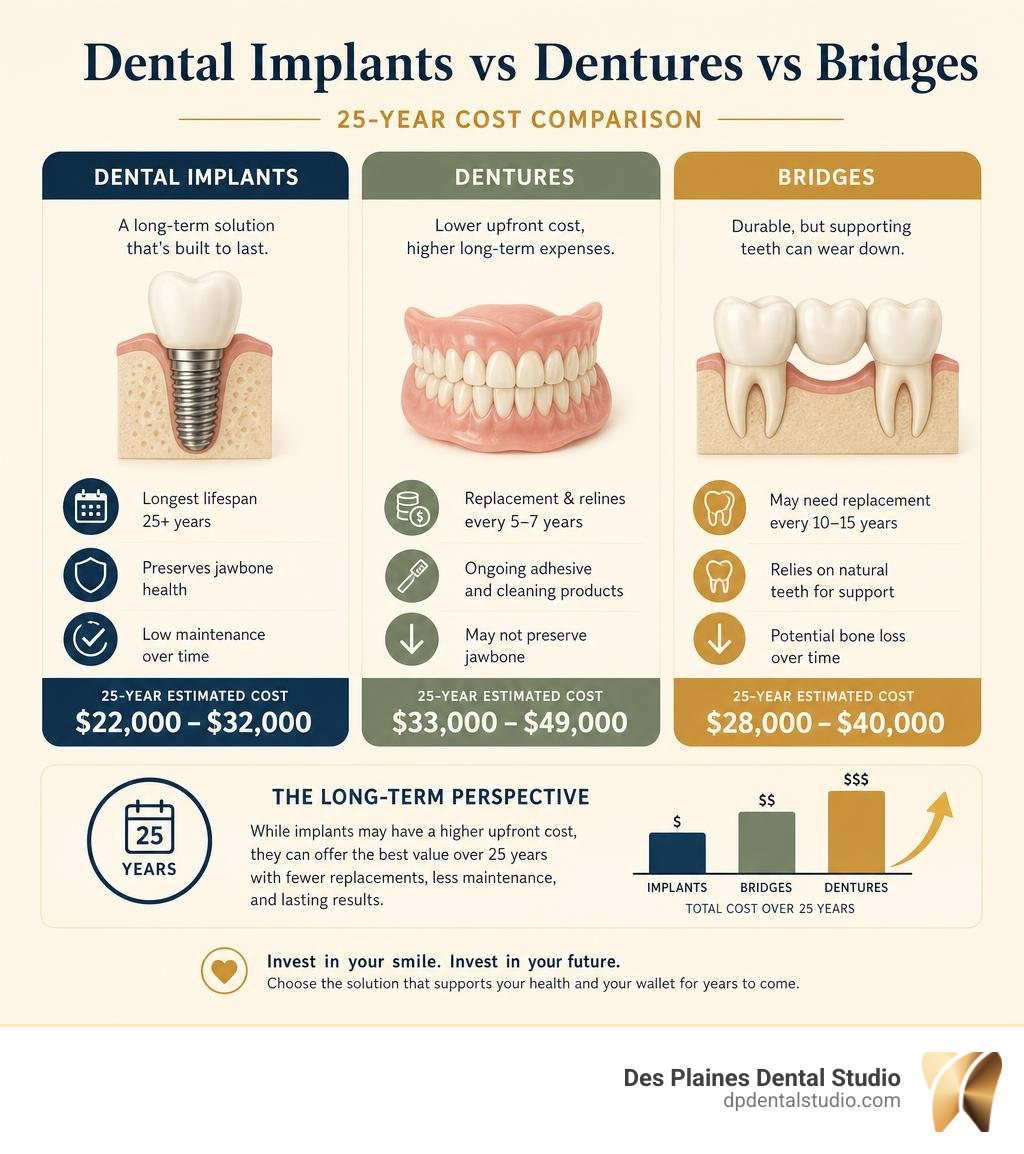
Beyond the sticker price, there’s also the cost of not acting. When a tooth is lost, the surrounding jawbone can lose 25% of its structure within the first year alone — which can turn a straightforward implant case into a much more complex (and expensive) one later.
I’m Dr. Marta Milejczyk, and I’ve spent decades in restorative and implant dentistry helping patients in the Chicago area navigate exactly these decisions — including how to find the cheapest dental implants without compromising safety or long-term results. In this guide, I’ll walk you through every realistic option so you can make a confident, clear-eyed choice.
The Real Cost of the Cheapest Dental Implants
When you see an advertisement offering a dental implant for $699, it is incredibly tempting to jump at the offer. However, to understand if you are actually getting a good deal, you must first understand the anatomy of an implant.
An implant is not a single piece of metal; it is a three-part system engineered to replace a natural tooth:
- The Implant Post: This is the medical-grade titanium screw surgically placed into your jawbone. It acts as your new tooth root.
- The Abutment: This is the connector piece that screws into the post and sits just above your gumline.
- The Prosthetic Crown: This is the custom-made ceramic or zirconia tooth that attaches to the abutment, restoring your bite and smile.
If a clinic advertises a price that sounds too good to be true, they are almost always quoting the cost of the implant post only. To get a realistic picture of your budget, you need to look at the complete, all-in cost. To understand how these pieces fit into your overall healthcare budget, you can learn about average implant costs in detail.
The True All-In Cost of a Single Tooth Implant
In the United States, the true all-in cost of a single dental implant — including surgical placement of the post, the abutment, and the final crown — averages between $3,000 and $4,500.
While the national average for just the surgical post placement is $2,143, the custom-milled crown typically adds another $1,000 to $3,000. At national corporate discount chains, patients pay an average of $4,259 per completed implant, with prices ranging from $3,158 to $6,533 depending on the complexity of the case.
To help you plan your budget without any unpleasant surprises, we recommend reading our comprehensive breakdown to discover the ultimate guide to implant costs.
Hidden Fees That Inflate the Cheapest Dental Implants
The surgical placement of the implant is only one part of the journey. Several common “add-on” procedures are frequently excluded from low-cost advertisements:
- 3D CBCT Imaging ($200 – $600): A standard 2D X-ray is not enough. Safe placement requires a 3D Cone Beam Computed Tomography scan to assess bone density and map nerves.
- Tooth Extractions ($150 – $500): If the damaged tooth is still in your mouth, it must be carefully extracted first.
- Bone Grafting ($300 – $1,200): If you do not have enough healthy bone to support the titanium post, a bone graft is required. This is highly common, as jawbone deterioration begins immediately after tooth loss. You can read about bone grafting for implants to see why this step is so crucial for long-term success.
- Sinus Lifts ($1,500 – $3,000): If you need implants in your upper jaw, your sinuses may need to be gently lifted to make room for the bone graft and implant post.
Without these preparatory procedures, placing an implant in weak bone is a recipe for early implant failure.
Comparing Low-Cost Options: Dental Schools, Discount Chains, and Border Clinics
If you are determined to find the absolute lowest price within or near the US, you will generally find yourself choosing between three main avenues: dental school clinics, high-volume discount corporate chains, and border clinics in Mexico.
| Provider Type | Price (All-In Single) | Est. Wait Time | Key Pros | Key Cons |
|---|---|---|---|---|
| Dental Schools | $800 – $1,500 | 6 – 12 months | Supervised by specialists; high-quality materials | Extremely long appointments; slow process |
| Discount Chains | $2,500 – $3,500 | 1 – 4 weeks | Fast service; high financing approval rates | Aggressive sales; potential hidden fees |
| Border Clinics | $1,200 – $2,000 | 1 – 2 weeks | Immediate savings; quick turnaround | Limited legal recourse; travel expenses |
To see how local fees compare to national trends, you can check dental implant costs by state. For example, while the national average for a single post is $2,143, Illinois averages slightly higher at $2,207.
Dental Schools: High Quality, Long Wait Times
Dental schools are an excellent way to get top-tier clinical quality at a fraction of private practice rates. At a dental school, your treatment is performed by dental students or residents who are directly supervised by board-certified oral surgeons and prosthodontists.
Because dental schools are non-profit educational institutions, they do not mark up material costs. You can often save 40% to 60% on your treatment.
The catch? Time. Because every step must be checked and approved by an attending faculty member, a single appointment can take three to four hours. Additionally, waitlists to get into these programs can stretch from six months to over a year, and the entire treatment process can take up to 18 months.
Discount Chains: High Volume, Fine Print
Corporate discount dental chains keep their initial sticker prices low through high-volume purchasing and vertical integration, often utilizing on-site dental labs to avoid third-party markups.
However, many patients find that these clinics operate on an aggressive sales model. The advertised “cheap” price often acts as a hook. Once you are in the chair, the treatment plan may quickly expand to include mandatory bone grafts, custom abutments, and upgraded crown materials, bringing the final cost right back up to standard private practice averages.
Border Clinics: Immediate Savings, Travel Risks
For patients living in the southern US, driving across the border to Mexican towns like Los Algodones can offer immediate savings. Single implants can often be completed for under $1,500.
However, dental tourism comes with inherent risks. If you experience a complication — such as an infection, implant mobility, or a cracked crown — traveling back across the border for emergency care is highly inconvenient. Most local US dentists are hesitant to work on implants placed abroad because they may not stock the specific tools or prosthetic parts required for foreign implant brands.
Dental Tourism: Is Traveling to Colombia Worth It?
If you are looking beyond the US border for the cheapest dental implants, Colombia — specifically Medellin — has emerged as a premier global hub for high-quality, affordable dental care in 2026.

Unlike border towns that rely purely on proximity, Colombia has invested heavily in state-of-the-art medical infrastructure, attracting patients who want US-standard care at a fraction of the cost. This makes it easier than ever to compare international All-on-4 costs and see how different countries stack up globally.
The Math Behind the Cheapest Dental Implants Abroad
Let’s look at the actual math for a patient traveling from Chicago to Medellin for a single tooth implant:
- Single Implant + Zirconia Crown (US Specialist): ~$4,000
- Single Implant + Zirconia Crown (Medellin Clinic): ~$1,000
- Round-trip Flight (Chicago to Medellin): ~$450
- 6 Nights Accommodation in El Poblado: ~$500
- Total Colombia Cost: ~$1,950
- Net Savings: ~$2,050
If you only need a single implant, the savings are respectable, though you must factor in the time off work. However, if you need multiple implants or a full-mouth restoration, the savings become life-changing, often reaching $15,000 to $30,000.
Quality Standards and Warranties in Colombia
The primary concern with dental tourism is quality. Reputable clinics in Medellin do not use generic, unbranded hardware to save money. Instead, they utilize the exact same FDA-approved premium brands used in top US clinics, such as Nobel Biocare and Straumann.
Because these premium manufacturers offer global warranties, an implant placed in Colombia can often be serviced by a certified provider back home in Illinois if necessary. Furthermore, top Colombian dentists undergo rigorous training, often completing postgraduate specialties in the US or Europe.
How to Safely Lower Your Out-of-Pocket Implant Costs
If traveling abroad or waiting months at a dental school isn’t the right fit for you, there are several highly effective ways to lower your out-of-pocket costs right here at home.
Many patients assume their insurance won’t cover dental implants, but this is changing. While traditional dental insurance historically viewed implants as cosmetic, many modern PPO plans now cover 30% to 50% of the implant restoration (the crown and abutment).
Additionally, if your tooth loss was caused by a traumatic accident, oral cancer, or a congenital condition, you can learn how to get implants covered by medical insurance, which can save you thousands of dollars in surgical fees.
Maximizing Insurance and Tax-Free Funds
To make the most of your benefits, timing is everything. Because dental insurance plans have relatively low annual maximums (usually $1,500 to $2,500), you can work with your dentist to split your treatment across two calendar years. For example, you can have the surgical post placed in December using your 2026 benefits, and have the crown attached in January using your 2027 benefits.
To navigate these complexities, we recommend checking out our comprehensive 2026 dental implants insurance guide.
You can also use tax-free funds from your Flexible Spending Account (FSA) or Health Savings Account (HSA) to pay for your implants, which instantly saves you an amount equal to your federal income tax bracket.
Financing and Payment Plans
Most reputable implant providers offer flexible financing options to help break the total cost down into manageable monthly payments. Third-party healthcare lenders like CareCredit and Alphaeon offer promotional 0% APR financing plans for 6 to 24 months.
For larger treatments, extended payment plans with low interest rates can bring your monthly payment down to as little as $109 per month for a single implant, making the treatment highly accessible.
Frequently Asked Questions About Cheap Dental Implants
What is the absolute cheapest way to get a dental implant?
The absolute cheapest way to get a dental implant in the US is through a clinical trial or a dental school clinic, where costs range from $400 to $1,200. Clinical trials, which are occasionally run by universities or research institutions to test new implant designs or techniques, sometimes offer the treatment entirely free of charge to qualifying candidates.
Are cheap dental implants safe?
Yes, provided they are placed by a qualified professional using FDA-approved materials. The safety of an implant is determined by the sterile technique of the surgeon, proper 3D planning, and the use of high-quality medical-grade titanium. To understand why the material of the post is so critical to your body’s safety, you can read about titanium bone implants and how they naturally fuse with your jawbone.
What red flags should I watch out for with low-cost providers?
Be highly skeptical of clinics that demand cash-only payments up-front, refuse to provide an itemized written estimate, or do not perform a 3D CBCT scan before surgery. Another major red flag is a dentist who is a generalist with very little surgical training; always ask how many implants your provider places annually and request to see documented before-and-after cases.
Conclusion
At Des Plaines Dental Studio, we believe that finding the cheapest dental implants shouldn’t mean sacrificing your health, safety, or peace of mind. True affordability isn’t about cutting corners on materials or skipping essential diagnostic scans — it is about transparent pricing, maximizing your insurance benefits, and providing flexible financing options that fit your monthly budget.
We are proud to serve the Des Plaines, Illinois community with patient-centered, welcoming, and pain-free dental care. If you are ready to explore your options and get an honest, all-inclusive estimate tailored to your unique smile, schedule a consultation for dental implants near me with our friendly team today!