


Getting to the Bottom of Full Lower Jaw Dental Implants
When Your Lower Teeth Are Gone: What You Need to Know First
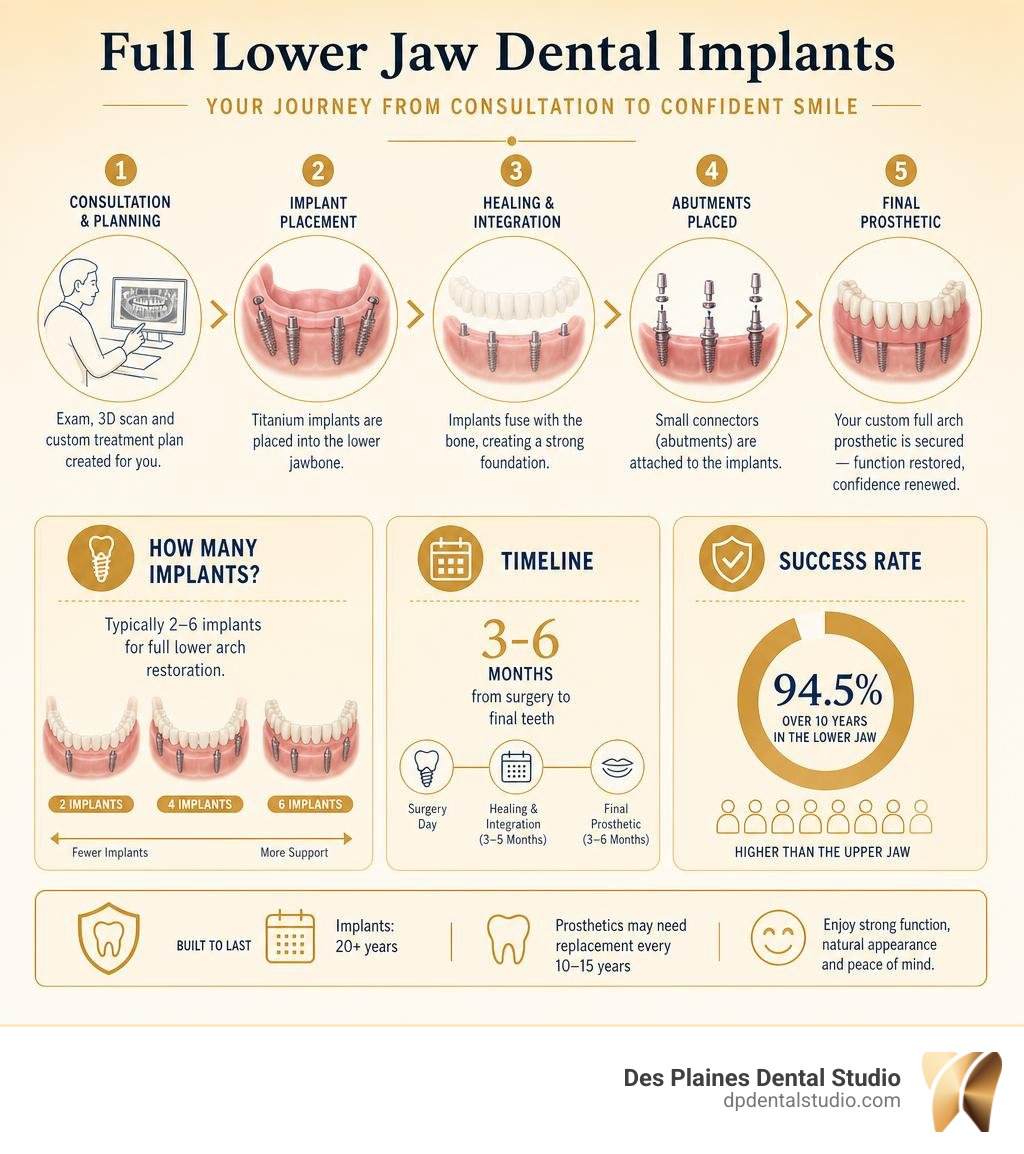
Full lower jaw dental implants are titanium posts surgically placed into the mandible (your lower jawbone) to support a full set of replacement teeth — either fixed permanently or snapped in and out like a denture.
Here’s a quick answer to what most people want to know:
| Question | Quick Answer |
|---|---|
| What are they? | Titanium implant posts that replace all lower teeth and anchor a full prosthetic arch |
| How many implants are needed? | Typically 2–6, depending on the system (All-on-4, All-on-6, or overdenture) |
| How long does it take? | 3–6 months from surgery to final teeth |
| How long do they last? | 20+ years for the implants; prosthetics may need replacement every 10–15 years |
| What’s the success rate? | 94.5% over 10 years in the lower jaw — higher than the upper jaw |
| Who qualifies? | Most adults with tooth loss, even with some bone loss — a scan will confirm |
Losing your lower teeth isn’t just a cosmetic problem. It affects how you chew, how you speak, and — over time — the shape of your face. Up to 88% of people with lower dentures report that they slip, shift, or simply don’t work well enough to eat comfortably. That’s not a small inconvenience. That’s a daily frustration that affects what you eat, how you talk, and how confident you feel.
The lower jaw is actually better suited for implants than the upper jaw. The bone is denser, which means implants integrate more reliably and last longer. That’s good news if you’ve been told implants might not work for you.
I’m Dr. Marta Milejczyk, and my clinical background — including advanced training in full mouth rehabilitation and rotations in oral surgery and anesthesiology — has given me direct, hands-on experience with full lower jaw dental implants across a wide range of patient needs. In the sections below, I’ll walk you through exactly how the process works, what your jawbone needs to qualify, and how to make sense of your options.
What Are Full Lower Jaw Dental Implants and How Do They Work?
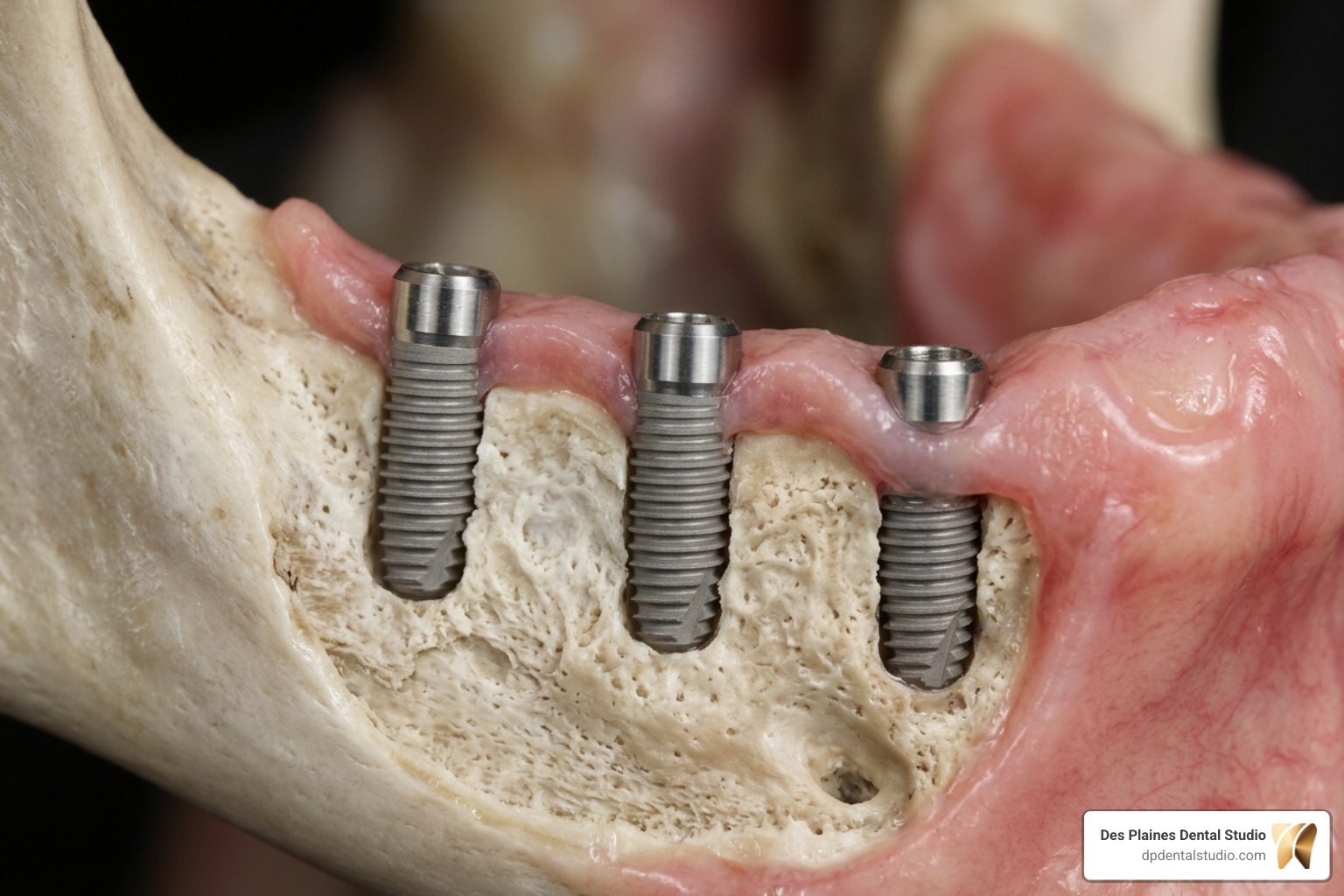
If you have lost all or most of your teeth on the bottom arch, a single-tooth replacement strategy is neither practical nor cost-effective. Instead, we use a strategically mapped series of dental implants to anchor a complete, custom-crafted bridge or overdenture.
But how does this system actually function? It all comes down to the miracle of biocompatibility. Most modern implants are made of medical-grade titanium. When we place these posts into your jaw, your body doesn’t reject them. Instead, a biological phenomenon called osseointegration occurs: your living bone tissue actually grows around and fuses directly to the implant surface. This creates a rock-solid, permanent anchor that acts exactly like natural tooth roots. To understand the science behind these biocompatible anchors, you can read more info about titanium bone implants.
Once the implants are securely integrated into the mandibular bone, we attach a custom prosthetic arch. Because the prosthetic is anchored directly into the bone, it cannot slip, wobble, or click when you speak or chew. It becomes a true, highly functional extension of your body.
Understanding the Anatomy of the Mandible
The lower jaw, or mandible, is a unique bone with its own set of anatomical rules. Unlike the upper jaw (maxilla), which is relatively soft and porous, the mandible is composed of highly dense cortical bone. This dense structure is incredibly advantageous for dental implants because it provides exceptional primary stability — meaning the implants can be tightened securely into the bone right from day one. In fact, peer-reviewed clinical studies show that dental implants have a 10-year survival rate of 94.5% in the lower jaw, compared to 89.4% in the upper jaw.
However, the mandible also presents a biomechanical challenge known as mandibular flexure. Your lower jaw isn’t completely rigid; it actually flexes and deforms slightly (between 0.46 mm and 1.06 mm) when you open wide, chew, or swallow. If a full-arch restoration is made as a single, ultra-rigid piece, this natural flexing can put immense strain on the implants and the surrounding bone.
To resolve this, modern implant dentistry utilizes advanced digital workflows to design segmented or specialized structures. For instance, a landmark scientific study on segmented mandibular prostheses demonstrated that splitting the lower bridge into segments can accommodate natural jaw movement, reduce marginal bone strain, and prevent biomechanical complications over long-term follow-ups.
This anatomical stability translates directly into chewing efficiency. While traditional lower dentures restore a mere 25% to 30% of your natural chewing power, implant-supported lower restorations boost your chewing efficiency to an incredible 60% to 80% (and in some cases, up to 95%) of natural function. You can finally return to eating the healthy, crunchy, and tough foods you love without fear.
How Full Lower Jaw Dental Implants Prevent Bone Loss
The moment you lose a tooth, a silent process called bone resorption begins. Your jawbone requires constant stimulation from the roots of your teeth to maintain its volume and density. When those roots are missing, your body assumes the bone is no longer needed and begins to break down and resorb the minerals.
Traditional dentures actually accelerate this bone loss. Because they sit on top of the gums, they exert uneven, rubbing pressure on the alveolar ridge, causing the bone to melt away over time. This is why traditional dentures become loose and require frequent relining. As the bone disappears, the lower third of the face can collapse, leading to deep wrinkles, a sunken appearance, and a prematurely aged look.
Dental implants are the only tooth replacement option that actively halts this process. By mimicking natural roots, they transmit chewing forces directly into the mandibular bone, signaling to your body that the bone is still active and necessary. This consistent stimulation reduces mandibular bone loss by up to 80% compared to conventional denture wearers, protecting your facial structure and keeping you looking younger, longer. To explore these structural advantages in depth, read more info about dental implant benefits.
Jawbone Requirements and Candidacy for Lower Arch Restoration

Many patients ask us, “Am I a good candidate for full lower jaw dental implants if I’ve already lost some bone?” The answer is often a reassuring yes, but determining your eligibility requires a detailed diagnostic evaluation. If you are looking for local care in the Chicagoland area, you can find more info about dental implants in Des Plaines to see how our team evaluates candidates.
To be a strong candidate for full lower implants, you generally need:
- Adequate bone volume and density: To securely hold the implant posts.
- Healthy gum tissues: Free from active periodontal disease.
- Good systemic health: Controlled medical conditions that allow for proper healing (uncontrolled diabetes or active smoking can slow down bone integration).
- A commitment to oral hygiene: Implants cannot get cavities, but the gums around them must be kept clean to prevent infection.
Evaluating Bone Density and Mandibular Nerve Mapping
Before we even touch a surgical instrument, we must map out your unique anatomy. The lower jaw houses a major nerve pathway called the inferior alveolar nerve, which runs through the mandibular canal and provides sensation to your lower lip and chin. Avoiding this nerve is our absolute highest priority during surgery.
To do this, we use advanced 3D Cone Beam Computed Tomography (CBCT) imaging. This technology allows us to create a highly accurate, three-dimensional digital model of your jaw. We can measure your exact bone width and height down to the millimeter and map the precise path of the mandibular nerve.
This meticulous planning is backed by rigorous clinical data. For a deeper look at how advanced imaging protects patients, you can review this clinical study on mandibular nerve mapping and implant stability. By utilizing these 3D scans, we can select the exact length and angle of your implants to achieve maximum primary stability while completely avoiding any risk of nerve injury.
When Bone Grafting is Required for Full Lower Jaw Dental Implants
If you have been missing teeth for several years, your lower jawbone may have shrunk to a narrow, thin ridge. In these cases, we may recommend bone grafting to rebuild the foundation before placing the implants.
Bone grafting involves placing specialized bone-replacement materials into the areas of bone loss. Over several months, your body naturally processes this material and replaces it with your own strong, living bone. While upper jaw implants sometimes require a sinus lift (because the sinus cavities sit directly above the upper teeth), lower jaw preparations focus on ridge augmentation to widen or heighten the mandibular ridge. To understand how this preparatory step works, check out more info about bone grafting for implants.
The great news is that modern techniques, such as the All-on-4 concept, are specifically designed to place posterior implants at an angle. This angling allows us to anchor the implants into the dense bone at the front of the jaw, frequently eliminating the need for extensive bone grafting altogether, even in patients with moderate bone loss.
Step-by-Step Procedure and Recovery Timeline
Embarking on a full lower jaw restoration is a journey, but it is one that we carefully manage to ensure your absolute comfort at every step. From your initial consultation to the day you walk out with a permanent, beautiful smile, we make sure you know exactly what to expect. To learn more about the custom prosthetics used to complete this process, read more info about dental implant restorations.
The Surgical and Osseointegration Phases
The entire process typically spans a few months, broken down into these key phases:
- Diagnostic Planning: We take 3D CBCT scans, digital impressions, and design your new smile digitally.
- Surgical Placement: Under local anesthesia (and dental sedation if you prefer a deeply relaxed, anxiety-free experience), we gently place the titanium implants into your lower jaw. If you have remaining failing teeth, we can often extract them and place the implants during the very same appointment.
- Immediate Provisionalization (Temporary Teeth): In many cases, we can attach a lightweight, natural-looking temporary bridge to your implants on the day of surgery. This means you never have to go without teeth.
- The Osseointegration Period: Over the next 3 to 6 months, your bone will quietly fuse with the titanium posts. You will wear your temporary teeth and eat a soft-food diet to avoid putting excessive force on the healing implants. For an evidence-based perspective on managing this healing process, see this clinical study on restoring lower complete edentulism.
- The Final Restoration: Once healing is complete, we swap out your temporary bridge for your permanent, custom-designed final prosthetic (made of durable zirconia or high-grade acrylic).
Comparing All-on-4, All-on-6, and Snap-On Overdentures
When restoring a full lower arch, you have several excellent options depending on your budget, bone density, and personal lifestyle preferences. To understand the differences between traditional options and modern implant-supported designs, you can review more info about dentures and overdentures.
Here is how the three main full-arch lower systems compare:
| Feature | Snap-On Overdentures | All-on-4 Fixed | All-on-6 Fixed |
|---|---|---|---|
| Type | Removable by the patient | Fixed permanently | Fixed permanently |
| Implant Count | 2 to 4 implants | 4 implants | 6 implants |
| Stability | Good (much better than dentures) | Excellent | Maximum stability |
| Palate/Under-Tongue | Slightly open, highly stable | Completely open and natural | Completely open and natural |
| Bone Grafting | Rarely needed | Often avoided via angled posts | May be needed if bone is limited |
| Cleaning | Take out daily to brush | Brush and water-floss in place | Brush and water-floss in place |
For patients seeking a highly stable but budget-friendly option, a 2-to-4 implant overdenture is a life-changing step up from traditional dentures. However, if you want your new teeth to feel, look, and function exactly like natural teeth without ever having to take them out, a fixed All-on-4 or All-on-6 bridge is the gold standard.
Cost, Longevity, and Comparing Your Options
Investing in full lower jaw dental implants is an investment in your overall health, systemic nutrition, and daily peace of mind. When evaluating the total cost, it is helpful to understand the various factors that influence the final price:
- The number of implants: A 2-implant snap-on denture is more economical than a 6-implant fixed zirconia bridge.
- The prosthetic material: Hand-crafted monolithic zirconia is highly durable and stain-resistant, while acrylic-titanium hybrid bridges are more budget-friendly but may require more frequent maintenance over a 15-year period.
- Pre-surgical treatments: Whether you require tooth extractions, bone grafting, or treatment for gum disease.
- Sedation preferences: Options range from local numbing to IV sedation.
To help you plan, you can read more info about the average cost of dental implants as well as more info about the price of full mouth dental implants to understand how these variables affect your bottom line.
Understanding the Financial Investment and Insurance
Because dental implants are highly customized medical devices, dental insurance plans often categorize them as a major restorative or cosmetic procedure. While some plans may cover a portion of the extractions, diagnostics, or the prosthetic crown itself, they rarely cover the entire cost.
To help navigate these out-of-pocket expenses, we highly recommend exploring your coverage options. You can read more info about the average cost of full dental implants, find out how to get dental implants covered by medical insurance, and review our comprehensive guide on dental implant costs and benefits.
Additionally, for patients living in or near Cook County, reviewing regional price variations can provide helpful context on how local fees align with national averages. We also offer flexible financing options and monthly payment plans to help fit this life-changing care comfortably into your budget.
Frequently Asked Questions about Lower Jaw Implants
Do lower jaw implants hurt more than upper jaw implants?
No, most patients are pleasantly surprised by how manageable the recovery is. Because the lower jaw consists of very dense bone, the implants achieve excellent initial stability, which minimizes post-operative shifting and discomfort.
During the procedure, you will be completely numbed with local anesthetics, and we offer sedation to keep you relaxed. Any post-operative soreness or mild swelling typically peaks within 2 to 4 days and can be easily managed with over-the-counter or mild prescribed pain relievers. For expert tips on managing your recovery comfortably, read this clinical guide on dental implant pain management.
How long do full bottom teeth implants last?
With proper care, the titanium implant posts themselves can easily last 20 years, 30 years, or even a lifetime. The permanent prosthetic bridge or overdenture attached to the implants is subject to normal daily wear and tear and may need to be refreshed or replaced every 10 to 15 years.
To maximize the lifespan of your restoration, it is vital to maintain excellent daily brushing, use a water flosser to clean beneath the bridge, and visit us twice a year for professional cleanings and structural checks. For more details on long-term maintenance, see this clinical guide on dental implant longevity and care.
How much do full lower jaw implants cost?
The cost of full lower implants varies widely depending on whether you choose a removable snap-on overdenture or a permanently fixed bridge. Generally, a lower snap-on denture supported by 2 to 4 implants can range from $6,000 to $15,000, while a fully fixed All-on-4 or All-on-6 zirconia bridge typically ranges from $15,000 to $30,000 per arch. To see a detailed breakdown of these fees, read more info about the price of full mouth dental implants.
Conclusion
Losing your lower teeth can make simple daily pleasures — like sharing a meal with friends, laughing freely, or speaking with confidence — feel incredibly stressful. But you do not have to live with the discomfort and instability of traditional, slipping dentures.
At Des Plaines Dental Studio, we are proud to offer high-quality, patient-centered care in a warm and welcoming environment. We specialize in providing a gentle, pain-free dental experience, supported by advanced 3D imaging, state-of-the-art materials, and comprehensive insurance and financing assistance. Our goal is to help you rebuild a strong, functional, and beautiful smile that feels like a natural part of who you are.
If you are ready to take the first step toward reclaiming your smile, we are here to help. You can easily schedule a consultation for dental implants near me to visit our Des Plaines, IL office, meet our friendly team, and receive a fully customized, clear treatment plan tailored to your health goals and budget. Let us help you get to the bottom of your tooth loss and restore your quality of life!