


Smiling Easy: Your Guide to Experienced Upper Denture Dentists in Des Plaines
What to Know Before Getting Upper Dentures in Des Plaines
Finding an upper dentures experienced dentist in Des Plaines is the most important first step toward restoring your smile, your confidence, and your ability to eat comfortably. Des Plaines Dental Studio offers personalized upper denture care — from your first consultation to final fitting and ongoing adjustments.
Here’s what to expect at a glance:
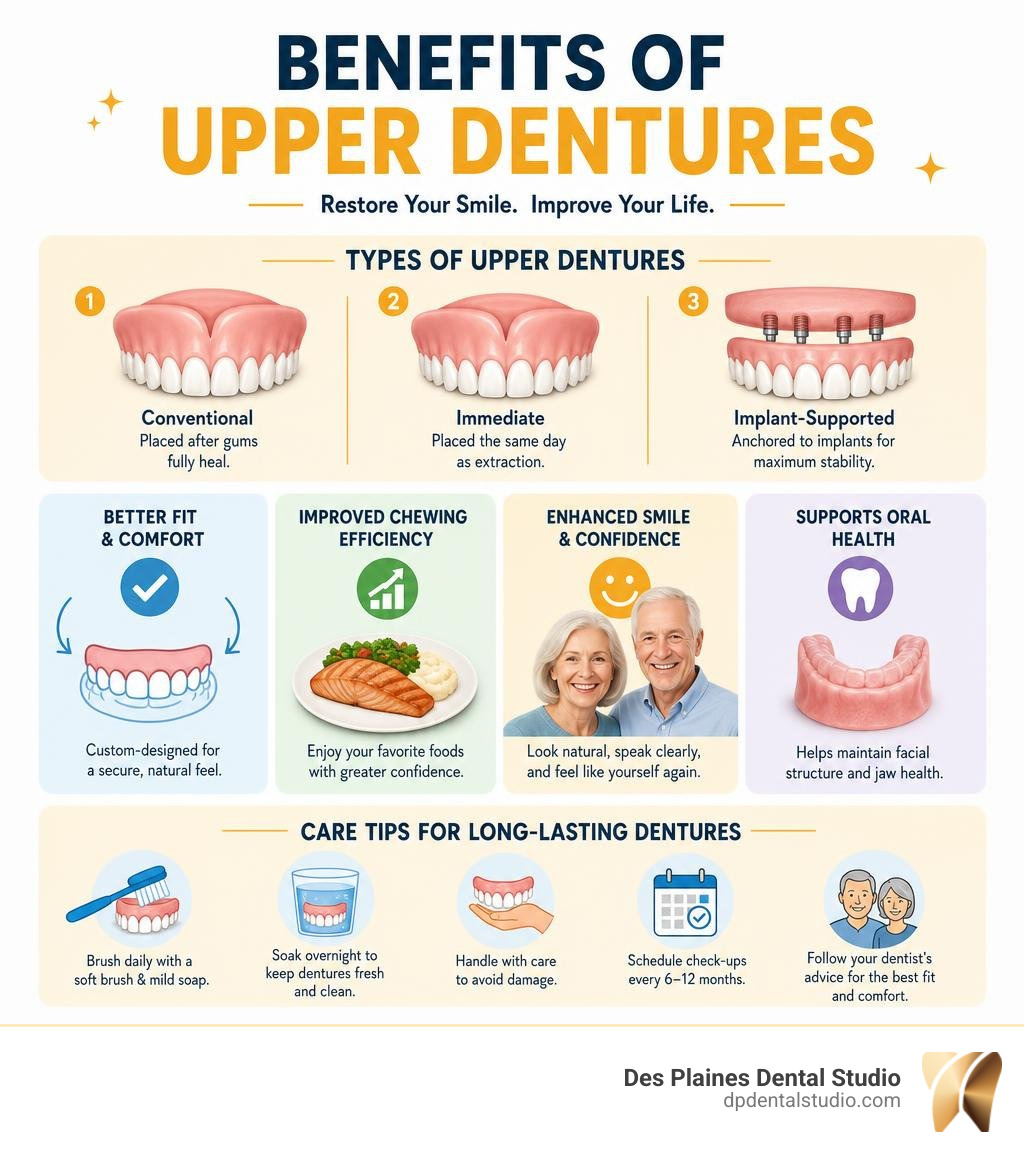
- Conventional upper dentures — placed after gums fully heal (about 8 weeks post-extraction); best long-term fit
- Immediate upper dentures — placed the same day as extraction; temporary while gums heal
- Implant-supported upper dentures — anchored to implants for maximum stability; preserves jawbone
- The process — consultation to impressions to trial fitting to final placement to follow-up adjustments
- Ongoing care — daily brushing, overnight soaking, and check-ins every 6–12 months
More than 36 million Americans are missing all of their teeth, and roughly 90% of those patients rely on dentures. Yet not all denture experiences are equal — patients with well-fitted dentures report up to a 70% improvement in chewing efficiency compared to those with poor-fitting ones. The difference often comes down to one thing: the skill and experience of your dentist.
Partial or full tooth loss doesn’t just affect how you eat — it can quietly impact your jawbone, your nutrition, and your self-confidence over time.
I’m Dr. Marta Milejczyk, and I’ve been providing upper dentures as an experienced dentist serving Des Plaines and the surrounding northwest suburbs since 1997. My training includes a General Practice Residency at Loyola University Medical Center and advanced clinical coursework in full mouth rehabilitation — completed by only 3% of dentists nationwide — giving me the foundation to craft dentures that truly fit your face, your bite, and your life.
Types of Upper Dentures: Fit, Comfort, and Longevity
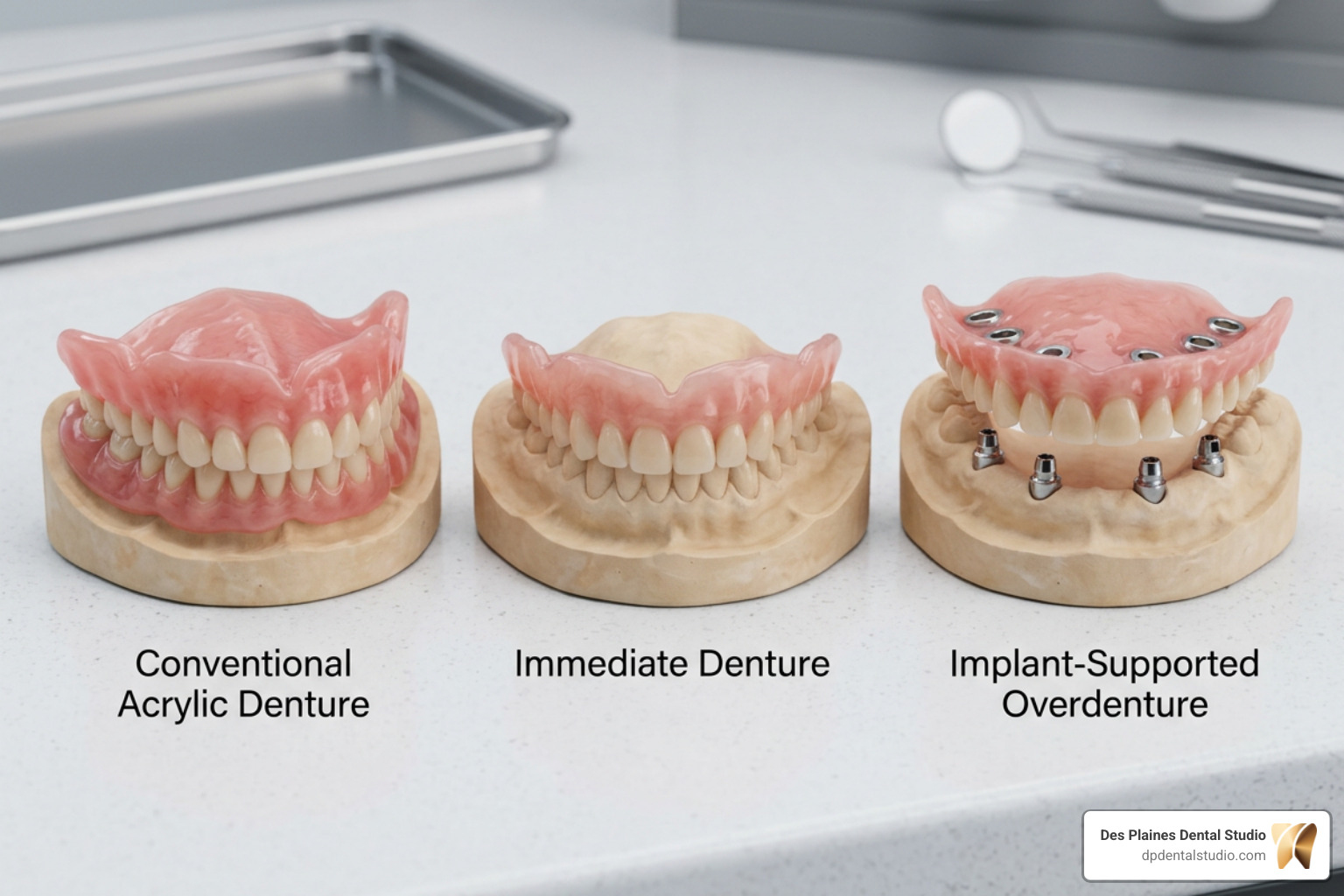
When you begin looking into tooth replacement options, you will quickly discover that upper dentures are not a one-size-fits-all solution. Depending on your current oral health, bone structure, and lifestyle goals, we can help you choose a style that optimizes your bite and comfort.
If you are missing only a few teeth, you might be looking into partial restorations. You can learn more about how these differ from full sets by reading What You Should Know About Partial Dentures. However, if you are missing all teeth along your upper arch, a complete upper denture is required to repair your smile with dentures.
| Denture Type | Healing Period Required | Primary Fit Mechanism | Average Longevity | Key Advantage |
|---|---|---|---|---|
| Conventional Upper Denture | 8 to 12 weeks post-extraction | Natural suction against the palate | 5 to 10 years | Highly stable natural suction; lower initial cost |
| Immediate Upper Denture | None (placed immediately) | Temporary tissue fit (requires relines) | Temporary (months) | Never spend a single day without teeth |
| Implant-Supported Denture | 2 to 6 months for osseointegration | Snapped or screwed onto titanium posts | 15+ years (implants can last a lifetime) | Eliminates slipping; preserves jawbone density |
To explore all your restorative options, you can read about the differences between standard removable appliances and fixed alternatives like dentures in Des Plaines.
Conventional Upper Dentures
Conventional upper dentures are fabricated and placed after your remaining upper teeth have been extracted and your gum tissues have had time to fully heal. This healing window typically takes about eight weeks.
Because the jawbone and gums shrink and reshape significantly after tooth loss, waiting for this healing period ensures that your conventional appliance is modeled after the permanent, stable shape of your mouth.
The upper denture has a distinct advantage over a lower denture: it features a wide, flesh-colored acrylic base that covers the entire roof of your mouth (the palate). This coverage creates a natural seal. When crafted by an experienced hand, this suction effect is incredibly strong, often eliminating the need for messy denture adhesives.
Immediate Upper Dentures
No one wants to go about their daily life in Des Plaines without teeth while waiting eight weeks for their gums to heal. That is where immediate upper dentures come in.
We take impressions of your mouth before your extractions. On the day your teeth are removed, we immediately place this pre-fabricated temporary denture over the surgical sites. It acts like a protective bandage, controlling bleeding and allowing you to smile, speak, and chew soft foods immediately.
However, because your gums and bone will shrink rapidly over the next several months, immediate dentures will quickly become loose. They require frequent temporary relines to stay in place and are generally transitioned into a conventional denture or a permanent implant-supported system once healing is complete.
If you are trying to decide between traditional tissue-supported dentures and fixed bridges, you may want to read about what to expect from dental bridges to understand how different appliances distribute biting forces.
Customizing Your Upper Dentures: Experienced Dentist Des Plaines
A common complaint about cheap, “one-size-fits-all” economy dentures is that they can make your face look sunken, or cause painful clicking sounds when you speak. This happens because the dentures were made without considering your natural jaw alignment or facial muscle dynamics.
At Des Plaines Dental Studio, we focus on custom-tailored dentures in Des Plaines, IL. We use precise clinical techniques to locate your jaw’s natural resting position. By aligning the height and shape of the denture teeth with your facial muscles, we can:
- Prevent the “collapsed” look that ages your face.
- Ensure your teeth meet evenly when you bite, reducing sore spots.
- Select tooth shades, shapes, and textures that match your skin tone, age, and personality for a completely natural look.
Why Choose Upper Dentures: Experienced Dentist Des Plaines

Choosing to restore your smile is a major step. When you visit an upper dentures experienced dentist in Des Plaines, you are not just getting a set of replacement teeth — you are getting a comprehensive care plan designed around your long-term health.
Our patient-centered approach ensures that you never feel rushed or ignored. We take the time to evaluate your overall systemic health, understand your lifestyle preferences, and design a customized treatment plan that fits your budget.
Your Consultation for Upper Dentures: Experienced Dentist Des Plaines
Your journey begins with an in-depth consultation with our team. As a trusted Des Plaines dentist, we perform a thorough examination of your oral cavity, using digital imaging to assess your remaining teeth, gum health, and jawbone density.
We discuss your personal treatment goals. Do you want the convenience of a removable denture, or are you looking for the absolute stability of dental implants in Des Plaines? By working closely with an experienced Des Plaines IL dentist, you can weigh the pros and cons of each path in a warm, pressure-free environment.
The Step-by-Step Denture Process
Getting custom upper dentures is a journey of collaboration. We want to make sure your final smile fits perfectly, which is why we break the process down into clear, comfortable steps:

- Initial Consultation & Diagnostics: We assess your bone structure, take digital X-rays, and map out your custom treatment plan.
- Detailed Impressions: We take highly accurate impressions of your upper arch and palate to ensure the acrylic base mirrors every contour of your mouth.
- The “Try-In” Phase: We create a wax mock-up of your denture. This allows us to temporarily place the teeth in your mouth so you can look in the mirror and approve the color, shape, and overall appearance before the final denture is fabricated.
- Final Placement: We deliver your finished, medical-grade acrylic denture, checking the suction, bite alignment, and comfort.
- Follow-Up & Adjustments: Over the first few weeks, we schedule quick check-ins to smooth out any minor sore spots as your mouth adjusts.
Living with and Caring for Upper Dentures
Adjusting to life with new upper dentures is a process of physical adaptation. Because the acrylic base covers your upper palate, your brain has to build new muscle memory for chewing and speaking.
If you are looking for a tooth replacement option that does not cover the roof of your mouth, you might want to look into fixed implant alternatives. Read The Ultimate Guide to Full Mouth Bridges to learn how implant-supported bridges compare to traditional palate-covering dentures.
For additional general guidance on denture hygiene and daily habits, the American Dental Association’s denture care guidance is also a helpful patient education resource.
What to Expect During the Adjustment Period
When you first put in your new upper dentures, they may feel bulky. This is completely normal! Here is what you should expect during the first few weeks:
- Increased Saliva: Your brain initially mistakes your new dentures for food, triggering temporary excess saliva production. This will settle down within a few days.
- Sore Spots: As the denture settles against your gums, minor pressure points can develop. We can easily adjust these during your follow-up visits.
- Learning to Eat: Start with a soft food diet (eggs, fish, cooked vegetables, and yogurt). Chew slowly, using both sides of your mouth simultaneously to prevent the denture from tipping.
- Learning to Speak: Certain sounds (like “S” and “F”) might sound slightly whistled at first. Practice reading aloud to your reflection in a mirror to help your tongue adjust to the new shape of your palate.
Daily Care and Maintenance Best Practices
To keep your gums healthy and extend the lifespan of your appliance, proper hygiene is essential. If you have ever wondered, “Do I really need to clean my false teeth?“, the answer is a resounding yes! Plaque, bacteria, and food particles can accumulate on acrylic just like they do on natural teeth, leading to bad breath and gum infections.
- Brush Your Dentures Daily: Use a soft-bristled denture brush and a non-abrasive denture cleanser. Regular toothpaste is too abrasive and can create microscopic scratches that harbor bacteria.
- Rinse After Meals: Take your denture out after eating and rinse it under warm water to remove loose food debris.
- Soak Overnight: Never let your dentures dry out, as they can warp and lose their shape. Keep them soaking in a cup of clean water or an ADA-approved denture cleaning solution overnight.
- Clean Your Gums and Tongue: Even if you have no remaining upper teeth, brush your gums, tongue, and the roof of your mouth daily with a soft toothbrush to stimulate circulation and remove plaque.
Signs Your Dentures Need Adjustment or Relining
Your mouth is constantly changing. Without natural tooth roots to stimulate the jawbone, the bone slowly resorbs (shrinks) over time. This means that a denture that fit perfectly three years ago may begin to slip today.
Watch out for these common signs that it is time to visit us for an adjustment or reline:
- The Denture Falls Out: If your upper denture slips when you laugh, speak, or yawn, the natural suction seal has been lost.
- Chronic Soreness or Irritation: Constant rubbing can lead to painful gum sores or infections like denture stomatitis.
- Changes in Facial Structure: If your lips look thinner or your cheeks appear sunken even with your dentures in, the height of the denture teeth may have worn down.
- Cracks or Chips: Never try to repair a broken denture at home with store-bought glue. These glues often contain toxic chemicals and can ruin the alignment of the appliance beyond repair.
We recommend professional hard relines every 2 to 3 years to update the fit of your denture to your changing jawline, and a complete replacement every 5 to 10 years.
Frequently Asked Questions About Upper Dentures
If you are considering restoring your smile, you likely have a few questions. As an experienced dentist in Des Plaines, IL, we believe that well-informed patients make the best decisions for their health.
How long do upper dentures typically last?
On average, a high-quality upper denture lasts between 5 to 10 years. Over this time, the acrylic teeth will naturally wear down from chewing, and your jawbone will gradually reshape.
To maintain a secure fit and a youthful facial appearance, your denture will need to be professionally relined or replaced periodically.
Do upper dentures require adhesive to stay in place?
Ideally, a well-made conventional upper denture should not require adhesives. The natural suction created against your upper palate is usually strong enough to keep the denture stable during normal eating and speaking.
However, if you have experienced significant jawbone loss, or if your denture has become loose over time, a small amount of dental adhesive can provide extra confidence. If you find yourself using large amounts of adhesive daily, it is a sign that your denture needs to be relined or replaced.
Can I sleep with my upper dentures in?
We strongly advise against sleeping with your dentures in. Your gum tissues need a break from the constant pressure of supporting the appliance.
Leaving your dentures in 24/7 deprives your gums of oxygen and blood flow, increasing your risk of developing painful fungal infections like oral thrush. Take your dentures out before bed, clean them thoroughly, and let them soak overnight while your gums rest.
Conclusion
At Des Plaines Dental Studio, we believe that everyone deserves a healthy, comfortable, and beautiful smile. We understand that getting dentures can feel like a major life transition, which is why we focus on delivering a warm, welcoming, and completely pain-free experience.
From navigating your dental insurance coverage to designing custom-fit restorations that look and feel like natural teeth, we are here to support you at every step of the journey.
If you are ready to take the first step toward a restored smile, we invite you to explore the average cost for dentures and schedule your personalized consultation with our team today!