


The Cost of Dental Bonding: With and Without Insurance
What You Need to Know Before Your Next Dental Appointment
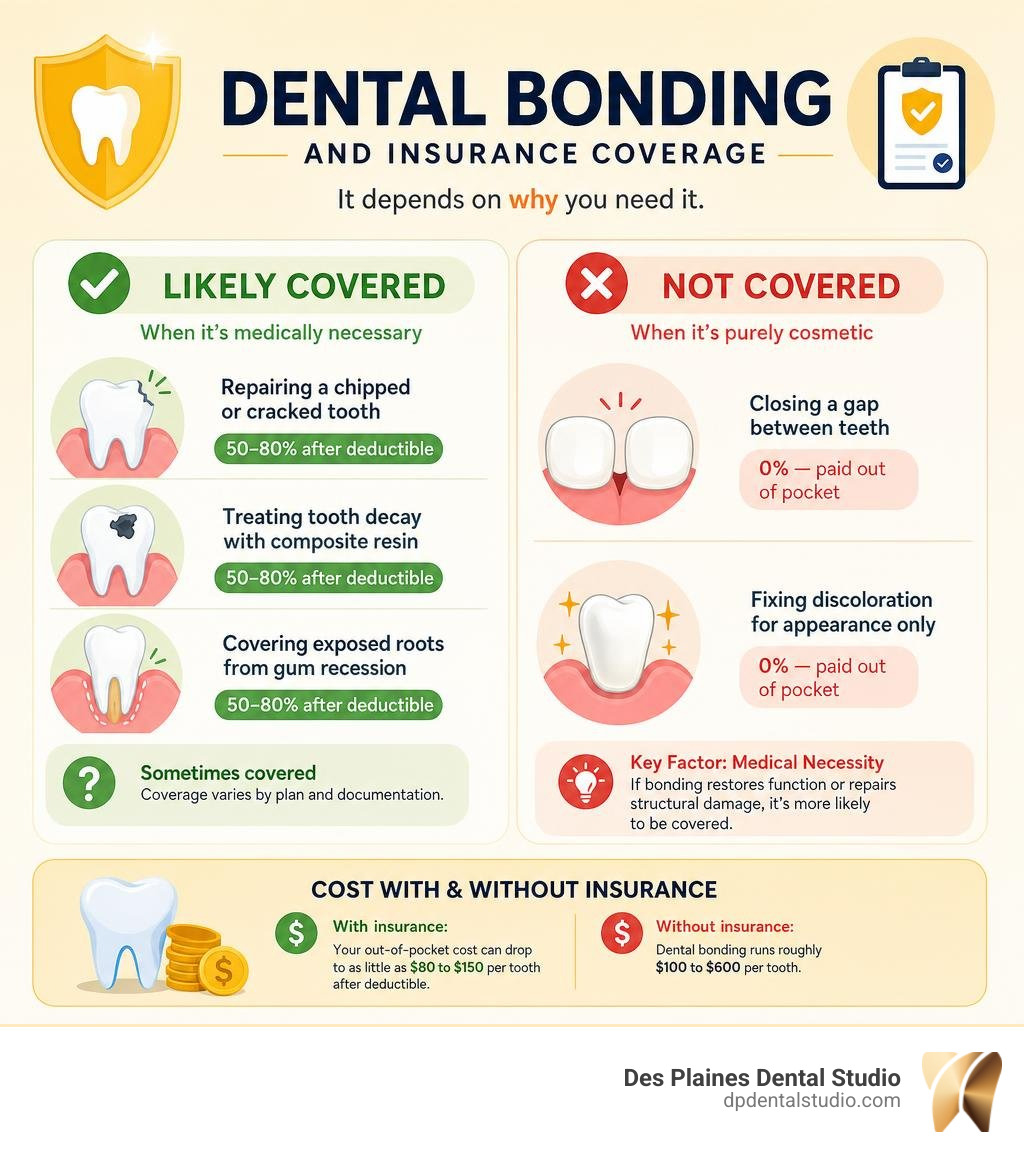
Is dental bonding covered by insurance? The short answer: it depends on why you need it.
| Situation | Likely Covered? | Typical Coverage |
|---|---|---|
| Repairing a chipped or cracked tooth | Yes | 50–80% after deductible |
| Treating tooth decay with composite resin | Yes | 50–80% after deductible |
| Covering exposed roots from gum recession | Sometimes | 50–80% after deductible |
| Closing a gap between teeth (cosmetic) | No | 0% — paid out of pocket |
| Fixing discoloration for appearance only | No | 0% — paid out of pocket |
The key word insurers look for is medical necessity. If your dentist can document that bonding restores function or repairs structural damage, most plans will cover a meaningful portion of the cost. If it’s purely about aesthetics, you’re typically paying the full bill yourself.
Without insurance, dental bonding runs roughly $100 to $600 per tooth — with the national average sitting around $431. With coverage, your out-of-pocket cost can drop to as little as $80 to $150 on a single tooth after your deductible is met.
This guide walks you through exactly how coverage works, what different insurance plans pay, and how to avoid surprises at checkout.
I’m Dr. Marta Milejczyk, and with nearly three decades of restorative and cosmetic dentistry experience — including advanced clinical training in full-mouth rehabilitation — I’ve helped hundreds of patients at Des Plaines Dental Studio navigate the question of is dental bonding covered by insurance before they ever sit in the chair. Understanding your coverage upfront is one of the simplest ways to make confident, stress-free decisions about your smile.
What Is Dental Bonding and How Does It Work?
Dental bonding (sometimes called teeth bonding) is an incredibly versatile, conservative treatment used to resolve both functional and aesthetic dental issues. The process involves using a biocompatible composite resin—which is essentially a high-grade, tooth-colored plastic. In fact, around 72% of restorations in modern dentistry use composite resin because it blends seamlessly with your natural enamel.
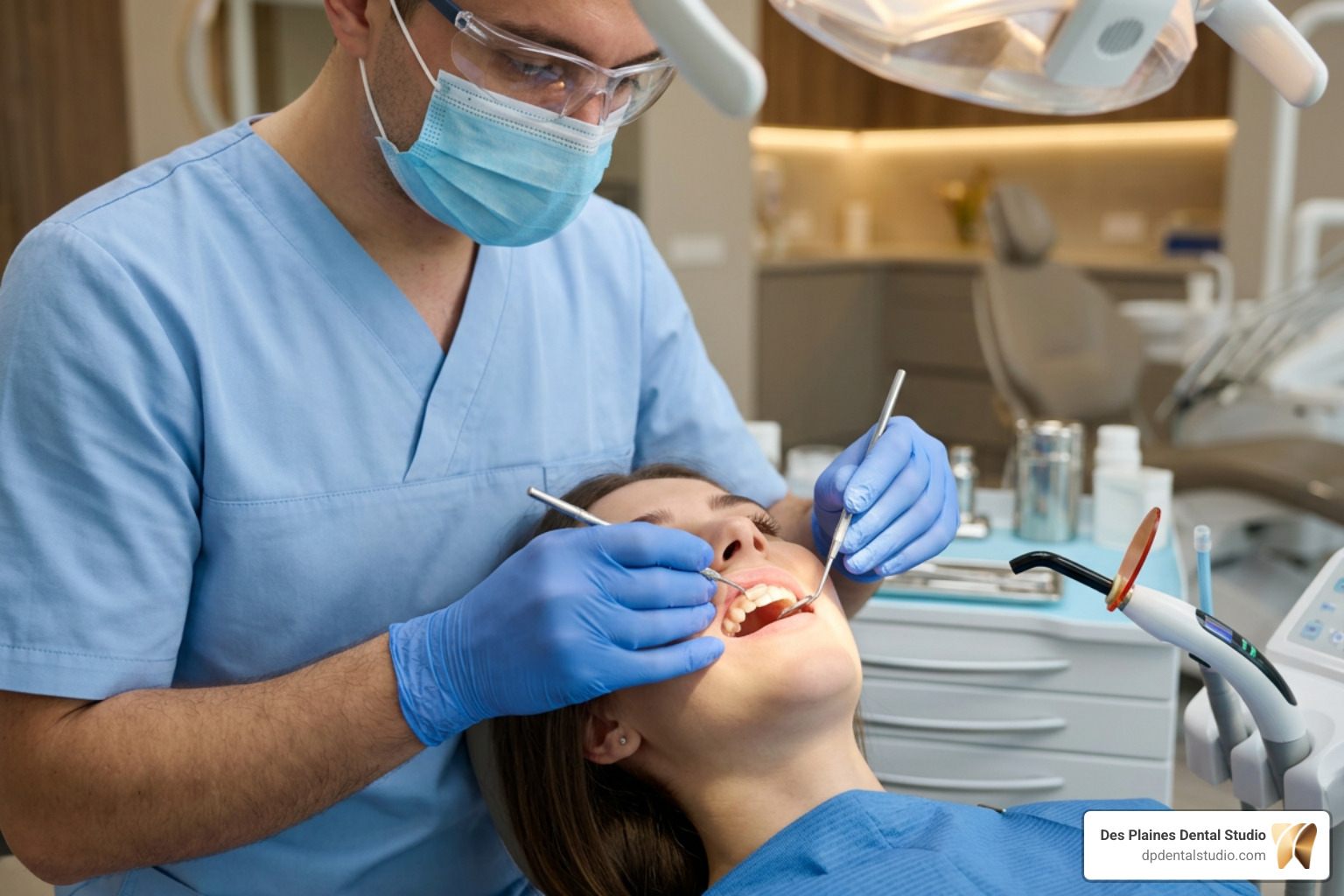
When you undergo dental bonding, we gently prepare the tooth surface. We apply a mild conditioning liquid that microscopically roughens the enamel, opening up tiny pores. This step is entirely safe and ensures the composite resin forms an incredibly strong physical bond with your natural tooth.
We then apply the resin, shape it meticulously to match your surrounding teeth, and use a specialized high-intensity curing light to harden the material in a matter of seconds. Finally, we trim, smooth, and polish the restoration so it feels completely natural to your tongue. The entire process is quick and minimally invasive, usually taking only 30 to 60 minutes per tooth.
There are two primary types of bonding:
- Direct Composite Bonding: This is the most common approach. We apply the soft resin directly to your tooth during a single visit, sculpt it, and cure it right in the chair.
- Indirect Bonding: For larger structural restorations, we might take an impression or digital mold of your tooth and have a dental laboratory fabricate a custom composite inlay or onlay. Once returned, we bond this custom-made piece to your tooth.
With proper care, dental bonding typically lasts between 3 to 10 years (and sometimes up to 15 years with meticulous oral hygiene) before needing a minor touch-up or replacement.
Dental Bonding for Front Teeth vs. Molars
Where your tooth is located in your mouth plays a major role in whether dental bonding is the right choice.
If you need bonding on your front teeth (anterior teeth), composite resin is usually an excellent option. Front teeth do not experience the heavy grinding forces that back teeth do, meaning the bonding material can easily withstand daily biting.
Molars, however, are a different story. Your back teeth are responsible for the heavy lifting of chewing and grinding, which exerts intense biting pressure. Because composite resin is slightly more flexible and less durable than porcelain or metal, most dentists do not recommend using standard bonding to rebuild large portions of a molar. Over time, the constant pressure can cause the material to fracture or wear down prematurely. For molars, we often recommend more robust restorative dentistry procedures like porcelain crowns, inlays, or onlays.
Is Dental Bonding Covered by Insurance?
The big question: is dental bonding covered by insurance when you go to pay?
Yes, but the insurance company’s decision rests almost entirely on how the treatment is classified. Dental insurance plans typically categorize procedures using the “100/80/50” payment structure:
- 100% Coverage: Preventive and diagnostic care (cleanings, routine exams, and X-rays).
- 80% Coverage: Basic restorative procedures (such as simple composite fillings and basic dental bonding).
- 50% Coverage: Major restorative procedures (such as crowns, bridges, and dental implants).
Because restorative dental bonding is usually classified as a basic restorative service, many plans will cover 50% to 80% of the cost once you have met your annual deductible. However, this coverage only applies if the procedure is deemed medically necessary. If your insurer determines the procedure is purely elective (cosmetic), they will cover 0% of the bill.

Restorative vs. Cosmetic: When Is Dental Bonding Covered by Insurance?
To understand how your insurance provider will view your claim, it helps to look at the exact clinical reason for the bonding:
- When it is covered (Restorative): If you have a cracked tooth, a deep cavity, a fractured tooth from an accident, or exposed roots due to severe gum recession, the bonding is restorative. In these cases, the treatment is medically necessary to prevent further decay, relieve pain, or restore basic chewing function. Your insurance will typically pay its standard basic restorative percentage (50% to 80%).
- When it is NOT covered (Cosmetic): If you want to close a small gap between two perfectly healthy teeth (a diastema), reshape slightly misshapen teeth, or cover minor tetracycline staining, the procedure is classified as cosmetic. Even though the physical process is identical, the intent is purely aesthetic. Because cosmetic work is elective, you will be responsible for 100% of the cost.
Insurance Plan Variations: Delta Dental, Cigna, and Humana
Different insurance carriers handle bonding claims in their own unique ways. Let’s look at how some of the major providers typically structure their benefits:
- Delta Dental: Under most Delta Dental PPO and Premier plans, medically necessary bonding is covered as a basic restorative service at 50% to 80%. There is typically a 0 to 6-month waiting period depending on your specific employer plan. DeltaCare USA (their DHMO-style plan) generally has no waiting periods but requires you to see a designated primary care dentist.
- Cigna: Cigna PPO plans generally cover restorative composite bonding under their basic category, often paying up to 80% after your deductible. They strictly exclude cosmetic bonding.
- Humana: Humana offers a wide array of plans. For a detailed breakdown of their pricing structures, you can review the guide on How Much Does Dental Bonding Cost? . Their plans usually cover restorative bonding at 50% to 80%, but they enforce strict frequency limitations (e.g., they may only pay to replace bonding on the same tooth surface once every few years).
For a comprehensive look at how modern insurance plans structure their deductibles, maximums, and waiting periods, check out our dental insurance guide 2026. You can also read more about general coverage criteria in this helpful resource on Is Dental Bonding Covered by Insurance .
The Cost of Dental Bonding: With and Without Insurance
Understanding the financial side of your care helps you plan your budget without any unexpected surprises.

Without insurance, the out-of-pocket cost for dental bonding typically ranges from $100 to $600 per tooth, depending heavily on the complexity of the restoration and how many tooth surfaces are involved. According to national data, the average cost of teeth bonding sits at $431, with most patients paying somewhere between $288 and $915 for a complete treatment plan.
If your procedure is medically necessary and you have met your annual deductible, your insurance will typically cover 50% to 80% of the negotiated in-network fee. This means your out-of-pocket cost with insurance could be as low as $50 to $150 per tooth surface.
To explore third-party financing options that can help break these costs down into manageable monthly payments, you can read the How Much Does Teeth Bonding Cost? Price and … guide.
Factors Affecting the Out-of-Pocket Cost of Dental Bonding
Several key variables will influence your final bill:
- Geographic Location: Dental fees naturally reflect the local cost of living. For example, while the national average for a single bonded tooth is $431, the average cost in Illinois is slightly higher at $447. If you are looking at services across the local region, you can compare local pricing trends by checking Dental Bonding Glenview IL – Fixing Gaps Between Your … or Teeth Bonding Chicago Loop, IL .
- Number of Tooth Surfaces: Bonding a small chip on a single corner of a front tooth is much less expensive than rebuilding three surfaces of a tooth damaged by decay.
- In-Network vs. Out-of-Network Dentists: Visiting an in-network dentist ensures you receive the insurance company’s pre-negotiated, discounted rates. If you visit an out-of-network provider, you may be responsible for the difference between the dentist’s standard fee and the maximum allowed amount set by your insurer. You can read more about navigating local networks on Dental Insurance Des Plaines, IL .
Dental Bonding vs. Veneers: Cost and Coverage Comparison
When patients want to improve the appearance of their front teeth, they often weigh the pros and cons of dental bonding versus porcelain veneers. While both treatments can deliver a stunning, confident smile, they are very different in terms of cost, durability, and insurance coverage.
| Feature | Dental Bonding | Porcelain Veneers |
|---|---|---|
| Primary Material | Composite Resin | Dental Porcelain |
| Average Cost (No Insurance) | $100 – $600 per tooth | $1,000 – $2,500+ per tooth |
| Average Lifespan | 3 – 10 years | 10 – 20 years |
| Stain Resistance | Moderate (can stain over time) | High (highly stain-resistant) |
| Enamel Removal | Minimal to none (reversible) | Moderate (irreversible) |
| Typical Insurance Coverage | 50% – 80% (if medically necessary) | 0% (almost always classified as cosmetic) |
Because veneers are almost exclusively elective, insurance plans will virtually never cover them. Dental bonding, on the other hand, is frequently covered because it is so often used to repair active damage or decay.
To learn more about how cosmetic treatments can transform your smile, explore our guide on how cosmetic dentistry can improve your smile dentist near me. If you are still exploring your options, you might also find it helpful to read about what is a cosmetic dentist des plaines il dentist or browse our des plaines dentist cosmetic dentistry common questions answered page.
How to Maximize Your Benefits and Navigate Denials
Navigating dental insurance can sometimes feel like a second job, but a few strategic moves can save you hundreds of dollars on your dental bonding treatment.
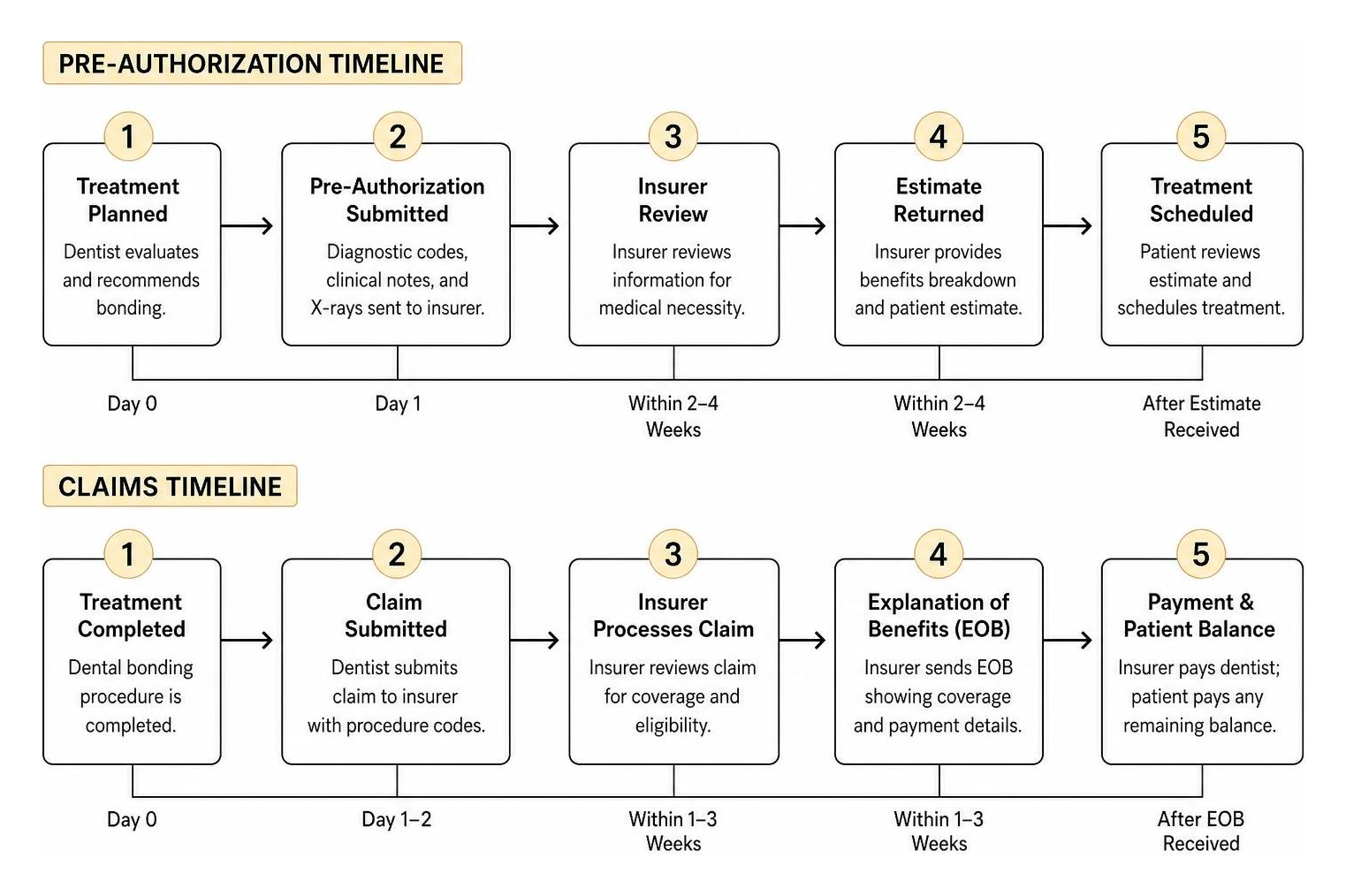
First, always request a pre-treatment estimate (also called a pre-authorization) before scheduling your procedure. We will submit the diagnostic codes, clinical notes, and digital X-rays directly to your insurance company. Within 2 to 4 weeks, the insurer will send back an official document detailing exactly what they will pay and what your out-of-pocket balance will be. This completely eliminates any guesswork at the front desk. For more on how major carriers handle this process, you can read about Discover UnitedHealthcare Dental Coverage for Tooth Bonding | Carolina Complete Dentistry .
Second, practice strategic timing. Most dental insurance plans operate on a calendar year with an annual maximum benefit (usually between $1,000 and $2,000) that resets on January 1st. If you need multiple teeth bonded, we can often phase your treatment. By performing half of the work in November or December and the other half in January, you can utilize two years of annual maximums and prevent paying out of pocket for exceeding your yearly limit.
How to Appeal If Your Dental Bonding Covered by Insurance Claim Is Denied
It is incredibly common for insurance companies to automatically deny borderline claims on the first pass, hoping you simply won’t challenge the decision. If your claim is denied, do not panic—approximately 35% of initial claim denials are successfully overturned on appeal.
To file a successful appeal:
- Gather Detailed Clinical Evidence: We can provide high-resolution intraoral photographs showing the structural damage, sharp edges, or exposed roots that make the treatment medically necessary.
- Submit a Dentist’s Support Letter: A formal letter from our office explaining that the bonding was required to restore chewing function, eliminate pain, or protect the tooth from further decay is highly influential.
- Follow Up Promptly: Most insurers require appeals to be filed within 90 to 180 days of the initial denial.
You can read more about navigating the appeals process and understanding policy guidelines in this guide on Is Dental Bonding Covered by Insurance? | PolicyMe .
Frequently Asked Questions About Dental Bonding
How long does dental bonding last and does that affect coverage?
Dental bonding material typically lasts between 3 to 10 years depending on your oral hygiene, diet, and whether you grind your teeth. Because bonding is not permanent, it will eventually need to be touched up or replaced. Most insurance plans have “frequency limitations” on restorations, meaning they may only cover a replacement on the exact same tooth surface once every 3 to 5 years. If your bonding chips or wears down before that limit has passed, you may have to pay for the replacement out of pocket.
Does medical insurance ever cover dental bonding?
It is rare, but not impossible. Your dental bonding must be directly tied to a primary medical diagnosis rather than a dental one. For example, if you require dental bonding to reconstruct teeth damaged during major facial trauma from a car accident, or as part of reconstructive surgery for a congenital defect, we can sometimes cross-bill your medical insurance for the procedure.
Are there waiting periods for dental bonding coverage?
Yes, many individual and employer-sponsored PPO plans enforce a waiting period—typically 6 months—before they will pay for “basic restorative services” like bonding or fillings. Preventive care is usually covered immediately, but you may need to wait out this period before your bonding benefits kick in. If you have a DHMO plan or a plan with no waiting periods, coverage may be immediate.
Conclusion
At Des Plaines Dental Studio, we believe that achieving a healthy, beautiful smile should never be a stressful or confusing financial burden. Our warm, patient-centered team is dedicated to providing a welcoming, pain-free experience, and we are always here to help you navigate the complexities of your dental insurance.
Whether you are looking to repair a chipped tooth, treat decay, or explore cosmetic options to boost your confidence, we will work closely with you to maximize your insurance benefits and design a treatment plan that fits your budget.
Ready to restore your smile? Explore our patient resources to learn more about our financial policies, check out our services to see how we can assist you, or read more about the affordable dental care act.
To take the next step, schedule your consultation for dental bonding des plaines il with us today!