


The Sneaky Guide to Getting Medical Insurance for Dental Implants
Dental vs. Medical Insurance: Is Dental Implants Covered by Medical Insurance?
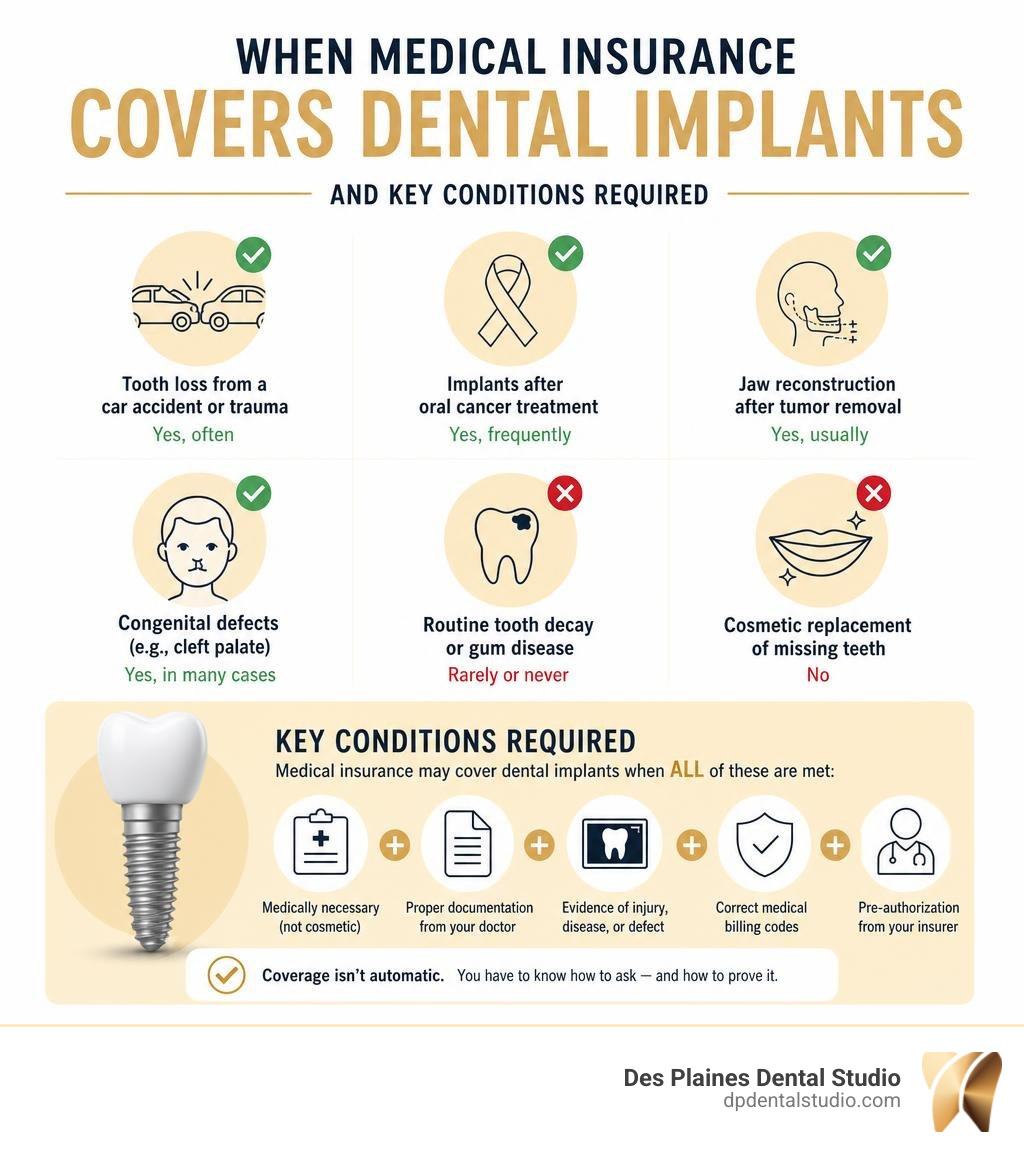
Is dental implants covered by medical insurance? The short answer: sometimes — but only under specific conditions that most patients don’t know about.
Here’s a quick breakdown:
| Situation | Medical Insurance Likely to Cover? |
|---|---|
| Tooth loss from a car accident or trauma | Yes, often |
| Implants after oral cancer treatment | Yes, frequently |
| Jaw reconstruction after tumor removal | Yes, usually |
| Congenital defects (e.g., cleft palate) | Yes, in many cases |
| Routine tooth decay or gum disease | Rarely or never |
| Cosmetic replacement of missing teeth | No |
The catch? Even when coverage is possible, it doesn’t happen automatically. You have to know how to ask — and how to prove it.
Dental implants are the gold standard for replacing missing teeth. But a single implant can cost $3,000 to $5,000 or more, and most dental plans cap annual benefits at just $1,000 to $2,000. That gap leaves most patients paying thousands out of pocket — unless their medical insurance steps in.
Most people don’t realize medical insurance can cover implants at all. Insurers don’t advertise it. And without the right documentation, the right billing codes, and the right framing, claims get denied — often automatically.
This guide walks you through exactly how to change that.
I’m Dr. Marta Milejczyk, and through my clinical training in oral surgery, restorative dentistry, and comprehensive patient care — including my residency at Loyola University Medical Center — I’ve helped many patients navigate the complex question of is dental implants covered by medical insurance and find a path forward. Understanding both the clinical and financial sides of implant care is something I’m deeply committed to at Des Plaines Dental Studio.
To understand how to get coverage, we have to look at how insurance companies view your mouth.
Dental insurance and medical insurance operate in completely different worlds. Traditional dental plans were built around a “maintenance” model. They are designed to cover preventive care—like cleanings, X-rays, and basic fillings—at high percentages. However, when it comes to major reconstructive work like dental implants, they place them in the lowest reimbursement tier (usually covering only 50% or less) and cap your benefits with an annual maximum. Shockingly, most dental plan annual limits ($1,000 to $1,500) have not been adjusted for inflation since they were first established roughly 40 years ago!
Medical insurance, on the other hand, is built for catastrophes, reconstructive surgeries, and medically necessary interventions. It doesn’t have a low annual cap. Once you meet your deductible, your medical plan can cover major reconstructive procedures at a much higher rate.
If you want to know more about standard dental policies, you can read the ToothCostGuide on Dental Implant Insurance for a detailed look at typical dental PPO and DHMO mechanics.
The fundamental trick to getting your health insurance to pay is shifting the classification of your implant procedure from “routine dental maintenance” to “medically necessary reconstructive surgery.”
| Feature | Dental Insurance | Medical Insurance |
|---|---|---|
| Primary Goal | Routine maintenance & prevention | Treatment of illness, injury, & system dysfunction |
| Annual Maximum | Low ($1,000 – $2,000) | No annual maximum (under ACA rules) |
| Coverage Focus | Teeth and immediate gums | Skeletal structures, joints, and systemic health |
| Pre-authorization | Recommended, but often simple | Mandatory and highly complex |
| Billing Codes | CDT Codes (D-codes) | CPT Codes (5-digit numbers) & ICD-10 Diagnosis Codes |
The Core Differences in Coverage Goals
Because dental insurance plans cap their annual payouts so tightly, they are rarely enough to cover a full implant procedure. A single implant consists of three separate components: the surgical titanium post, the abutment (connector), and the custom crown.
Many dental plans will use “Least Expensive Alternative Treatment” (LEAT) or “Least Costly Alternative” (LCA) clauses. If you have a missing tooth, these clauses allow the insurer to only pay the rate for a removable partial denture or a dental bridge, leaving you to pay the massive difference for the implant out of pocket.
Furthermore, about 30% to 40% of dental plans now include some form of implant coverage, but they almost always impose a 6 to 12-month waiting period before major restorative benefits activate. If you want to dive deeper into how these dental caps and waiting periods operate, check out our Dental Implants Insurance Guide 2026.
Medical insurance does not use LEAT clauses for reconstructive needs. If a medical doctor and an oral surgeon can prove that an implant is the only viable clinical solution to restore your ability to chew, speak, or prevent severe jawbone atrophy, your medical insurance is designed to cover it as reconstructive surgery.
When Is Dental Implants Covered by Medical Insurance as a Medical Necessity?
Medical insurance will not pay for implants if you simply want to replace a tooth lost to routine decay or cosmetic preferences. To trigger medical coverage, the procedure must meet strict “medical necessity” guidelines.
The most common scenarios where medical insurance covers dental implants include:
- Severe Physical Trauma: If you lost teeth and suffered jaw fractures in a car accident, sports injury, or physical fall, medical insurance treats the implant placement as part of reconstructive skeletal surgery.
- Oral Cancer and Tumor Resection: When a patient undergoes surgery to remove a tumor in the jaw or oral cavity, they often lose significant bone structure and teeth. Medical insurance routinely covers dental implants as part of post-oncology oral rehabilitation.
- Congenital Defects: Genetic conditions like a cleft palate, cleft lip, or ectodermal dysplasia (where teeth fail to develop) qualify for medical coverage because they are developmental anomalies.
- Severe Systemic Health Complications: If severe tooth loss has directly caused extreme malnutrition, severe digestive disorders (like GERD), or joint dysfunction (like severe TMJ/TMD), medical insurance may cover implants to restore basic bodily functions.
- Severe Atrophy of the Jawbone: If long-term tooth loss has caused the jawbone to shrink so severely that a patient cannot wear traditional dentures without nerve pain or jaw instability, reconstruction with implants can be deemed medically necessary.
The 6-Step Playbook to Get Medical Insurance to Pay
Navigating the medical insurance system requires a highly strategic approach. You cannot simply submit a dental bill and hope for reimbursement. You must follow a precise, clinical protocol to establish medical necessity before any surgery begins.
To help you visualize this administrative journey, here is how the process flows from your initial visit to the final claim approval:
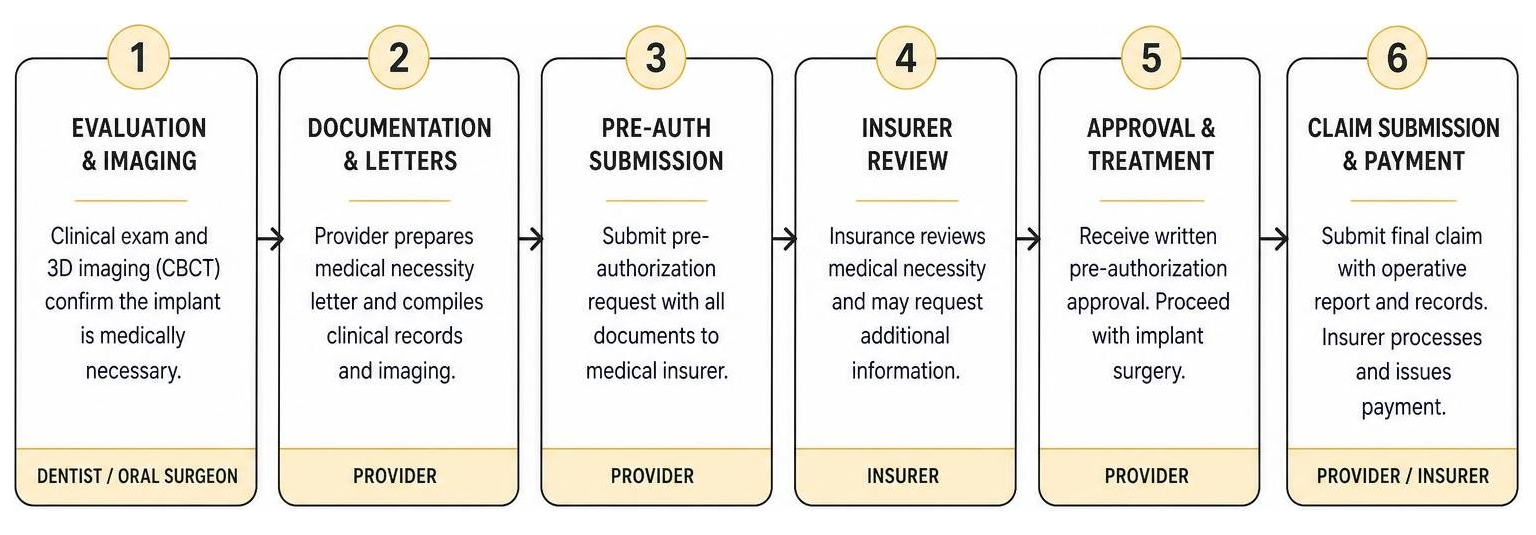
Here is your step-by-step playbook to make it happen.
Step 1: Comprehensive Evaluation and Imaging
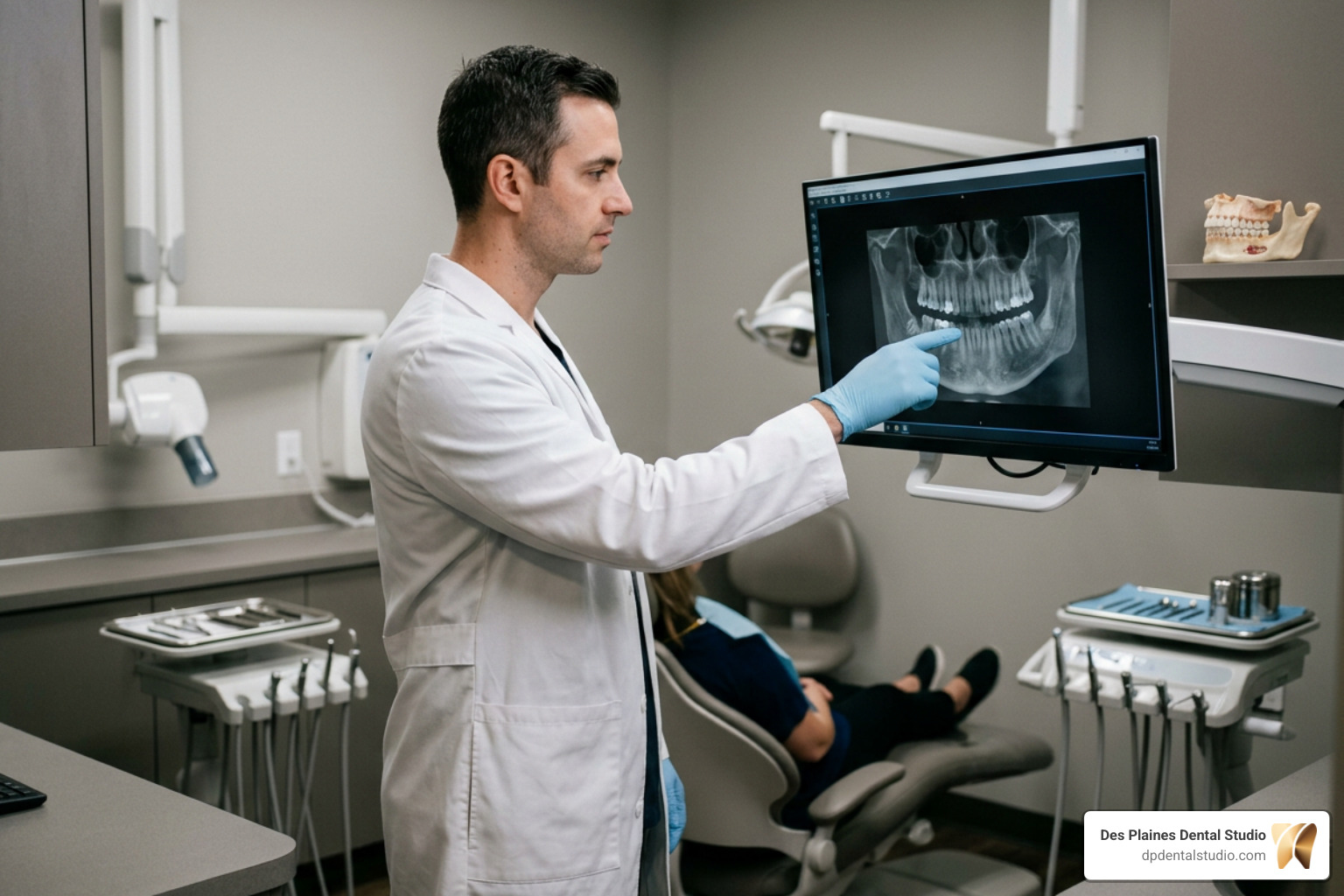
Before anything else, we must establish the physical and anatomical reality of your mouth. This requires advanced 3D Cone Beam CT (CBCT) scans.
These 3D scans do more than help us plan your surgery; they provide the undeniable visual proof of bone density, nerve paths, and structural defects that medical insurance directors demand. For instance, major medical insurers like UnitedHealthcare look at precise anatomical spacing. Under the UnitedHealthcare Dental Clinical Policy, they evaluate whether the implant site is free of active infection and if there is adequate bone structure.
This initial evaluation also establishes the baseline health of your mouth. If you want to understand the typical starting costs of these diagnostics, read our guide on the Average Cost Of Dental Implants.
Step 2: Proving Medical Necessity with Documentation
Your clinical records must tell a compelling story. We must document not just what we are doing, but why it is medically vital to your overall health.
If your jawbone has degraded, you may need preparatory procedures. A bone graft can cost anywhere from $300 to $4,000 depending on the severity of the bone loss. We must document that this bone graft is a necessary foundation to rebuild your skeletal structure, not just a cosmetic enhancement. You can learn more about how we rebuild this bone structure in our guide to Bone Grafting For Dental Implants.
Your clinical file must include:
- Detailed progress notes describing your inability to chew, swallow, or speak properly.
- Diagnostic photos showing the structural collapse of the lower face.
- Radiographs and CBCT reports proving bone atrophy.
- ICD-10-CM diagnosis codes that link your dental state to a systemic medical condition (e.g., severe dysphagia or jaw joint degeneration).
Step 3: Physician Collaboration and Letters
Medical insurance companies like to see dental professionals collaborating with medical doctors. A letter of support from your primary care physician, oncologist, or gastroenterologist carries massive weight.
For example, if you lost teeth due to chemotherapy or radiation treatments for oral cancer, a letter from your oncologist stating that dental implants are a mandatory part of your post-cancer reconstructive rehabilitation is crucial. If you suffer from severe gastrointestinal issues because you cannot chew solid food, a letter from your gastroenterologist linking your digestive issues to your lack of dentition can help bridge the gap.
Step 4: Navigating Pre-Authorization and CPT Codes
Never start an implant procedure before obtaining written pre-authorization from your medical insurance provider.
Medical billing does not use the standard dental “D-codes” (CDT codes). Instead, we must translate the dental procedures into medical CPT (Current Procedural Terminology) codes.
Some of the most common CPT codes used to bill medical insurance for dental implant-related surgeries include:
- CPT 21248: Reconstruction of mandible or maxilla, subtotal oligodontia (used for reconstructing a partially toothless jaw).
- CPT 21249: Reconstruction of mandible or maxilla, complete (used for a completely toothless jaw).
- CPT 41899: Unlisted procedure, dentoalveolar structures (often used for the surgical placement of the implant body itself).
- CPT 21299: Unlisted craniofacial and maxillofacial procedure.
Step 5: Filing the Claim and Coordinating Benefits
If you have both dental and medical insurance, you must coordinate benefits. In cases of trauma, accidents, or severe medical conditions, your medical insurance is billed as the primary insurer.
Once the medical insurance processes the claim and pays its portion, any remaining balance can be submitted to your dental insurance as the secondary insurer. This dual-billing strategy is the ultimate way to minimize your out-of-pocket costs, using medical insurance to cover the heavy surgical lifting and dental insurance to help pay for the final prosthetic crown.
Overcoming Denials and Navigating Government Programs
Even with perfect paperwork, medical insurers frequently issue an initial denial. They often automatically label any procedure involving teeth as “cosmetic” or “routine dental.”

Common Denial Reasons and How to Appeal
The most common reasons for medical denials are “lack of documented medical necessity” or the presence of a “missing tooth clause” (which excludes coverage if the tooth was lost before you joined the plan).
If your claim is denied, you have legal protections under federal ERISA regulations. You have at least 180 days from the date of the denial to file a formal appeal.
When appealing:
- Request a Peer-to-Peer Review: Have your oral surgeon or dentist speak directly with the medical director of the insurance company. A five-minute doctor-to-doctor conversation can often overturn a denial that an administrative clerk wrote.
- Provide Additional Evidence: Submit further clinical notes, weight-loss charts (to prove nutritional deficiency), or letters from medical specialists.
- Check for ERISA Compliance: Under ERISA, the person reviewing your appeal cannot be the same person who issued the initial denial, ensuring a fair, secondary look at your case.
Medicare, Medicaid, and State-Specific Rules
Government-sponsored health programs have very strict boundaries when it comes to dental implants.
- Original Medicare (Parts A and B): Medicare explicitly excludes routine dental care and dental implants. However, it will cover dental services if they are a direct, mandatory prerequisite to a covered medical procedure. For example, if you need an extraction or oral clearance to eliminate infection before a heart valve replacement or chemotherapy, Medicare Part B may cover it.
- Medicare Advantage (Part C): Many private Medicare Advantage plans offer supplemental dental benefits that may cover a portion of dental implants, though they still cap annual maximums.
- Illinois Medicaid: For our patients here in Des Plaines and the greater Chicago area, Illinois Medicaid rules are highly restrictive. Medicaid in Illinois rarely covers dental implants for adults unless there is an extreme, life-threatening, or highly reconstructive medical necessity, such as jaw reconstruction following oral cancer surgery. Routine tooth replacement is not covered under these state-specific limitations.
Using HSAs, FSAs, and Tax-Advantaged Accounts
If your insurance still leaves you with a balance, you can use tax-advantaged accounts to save up to 30% or more on your out-of-pocket costs by using pre-tax dollars. The IRS classifies dental implants as a qualified medical expense under IRC Section 213(d).
For the year 2026, the contribution limits are:
- Health Savings Account (HSA): Up to $4,400 for self-only coverage or $8,750 for family coverage.
- Flexible Spending Account (FSA): Up to $3,400, with a maximum carryover limit of $640 into the next year.
Using these accounts allows you to pay your deductibles, co-pays, or non-covered surgical fees completely tax-free.
Frequently Asked Questions About Implant Coverage
Navigating the financial side of dental implants can feel overwhelming. Here are answers to some of the most common questions we hear from patients in our Des Plaines community.
Is dental implants covered by medical insurance after an accident?
Yes, this is one of the most common scenarios where medical insurance pays. If you suffer physical trauma to your face—such as from a car crash, a sports injury, or a severe fall—and lose teeth or damage your jawbone, your medical insurance or auto insurance medical rider will typically cover the dental implants. This is because the treatment is classified as reconstructive surgery to restore your facial skeleton to its pre-accident state.
What CPT codes are used to bill medical insurance for implants?
Medical billing requires CPT codes rather than dental CDT codes. The most common codes include:
- CPT 21248: Reconstruction of the jaw for partial tooth loss (oligodontia).
- CPT 21249: Complete reconstruction of the jaw.
- CPT 41899: Unlisted procedure for dentoalveolar structures (used for surgical implant placement).
- CPT 21299: Unlisted craniofacial or maxillofacial procedure.
What is a missing tooth clause in insurance policies?
A missing tooth clause is a common exclusion in dental and some medical policies. It states that if a tooth was already missing before your insurance policy became active, the insurance company will not pay to replace that tooth. This is why it is vital to review your policy’s fine print before switching plans or scheduling your surgery.
Conclusion
At Des Plaines Dental Studio, we believe that financial barriers shouldn’t keep you from getting the life-changing dental care you need. Navigating the intersection of medical and dental insurance is highly complex, but you do not have to do it alone.
Our patient-centered team is dedicated to helping you maximize every single dollar of your benefits. From utilizing advanced 3D imaging to compile your medical necessity documentation to helping you navigate pre-authorizations and complex medical codes, we are here to support you at every step.
If you are ready to explore your options and find out how to make your treatment affordable, read our detailed guide on How To Get Dental Implants Covered By Medical Insurance or contact us today to schedule your comprehensive evaluation. Let’s work together to restore your smile, your health, and your confidence!