Comprehensive Breakdown of the Total Cost of Titanium Dental Implants
When you look at a treatment plan for tooth replacement, the final figure often surprises people. That is because replacing a missing tooth is not a single transaction; it is a multi-step surgical and restorative process. The national average cost for an entire single tooth dental implant sits around $2,143 to $4,175, though the comprehensive price tag typically spans $2,500 to $6,000 depending on the clinical variables involved.
To understand what you are paying for, you have to look at how a complete implant restoration is built:
- The Diagnostic Phase: Advanced 3D imaging, digital scans, and treatment planning.
- The Surgical Phase: The sterile surgical placement of the titanium post into the jawbone.
- The Restorative Phase: Connecting the custom connector (abutment) and securing the permanent prosthetic tooth (crown).
Here is a look at the standard component pricing you can expect for a standard single-tooth restoration:
| Component / Step | Average Cost Range | Purpose |
|---|---|---|
| Comprehensive Exam & 3D CBCT Imaging | $150 – $600 | Evaluates bone density, nerve pathways, and precise placement angles |
| Titanium Implant Fixture (Post) | $400 – $1,200 | Serves as the artificial tooth root anchored into the bone |
| Surgical Placement Fee | $1,000 – $2,500 | Covers surgical expertise, sterile surgical suite setup, and local anesthesia |
| Abutment (Standard or Custom CAD/CAM) | $300 – $800 | The titanium or zirconia post that connects the fixture to the crown |
| Custom Dental Crown | $800 – $2,500 | The visible porcelain, ceramic, or zirconia tooth |
| Total Standard Estimate | $2,500 – $6,000 | Complete single-tooth replacement without bone grafting |
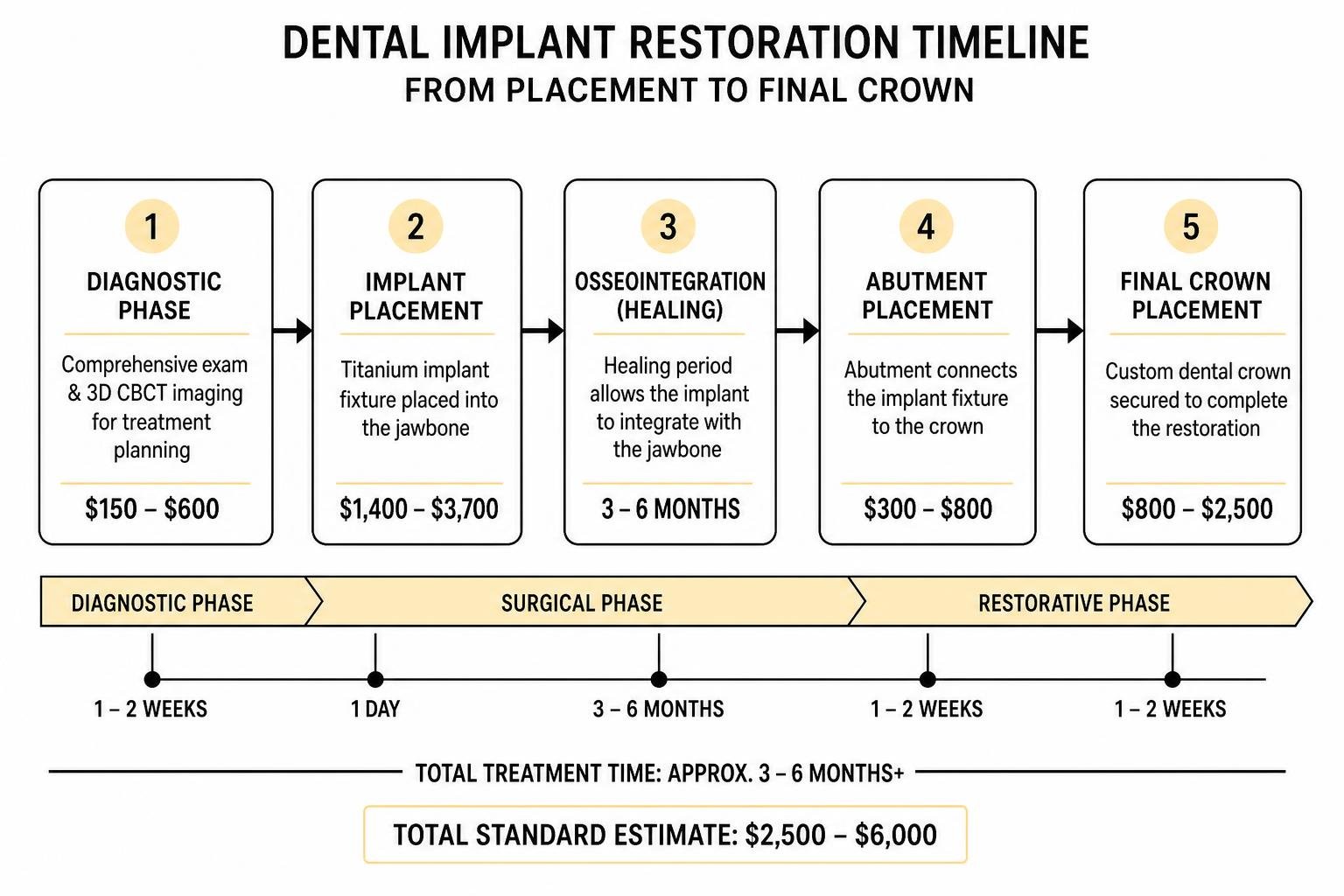
Average Cost of Titanium Dental Implants by Component
The implant fixture itself—the biocompatible screw placed into your jawbone—represents only one segment of your total investment. The raw fixture cost to the dental practice typically ranges between $100 and $800, depending on the manufacturing brand and patented surface technology. When looking at a single tooth implant, the fixture body alone usually accounts for $1,000 to $4,000 of your total surgical invoice once surgical equipment, surgeon time, and clinical overhead are factored in.
Next comes the abutment, which links the hidden fixture to the visible crown. While pre-manufactured stock abutments sit at the lower end of the $300 to $800 range, custom-milled CAD/CAM abutments offer superior gum-tissue shaping and emergence profiles, ensuring your new tooth looks natural at the gumline.
Finally, the custom crown completes the restoration. High-translucency zirconia or porcelain-fused-to-metal crowns range between $800 and $2,500. Highly aesthetic front-tooth crowns often demand greater laboratory customization, placing them toward the higher end of that price spectrum.
Preparatory Treatments and Additional Surgical Fees
Not every jaw is immediately ready for an implant post. If a tooth has been missing for several months or years, the surrounding jawbone naturally resorbs (shrinks). In these situations, preparatory procedures become necessary to build a stable foundation.
- Tooth Extraction: If the failing tooth is still present, a surgical or simple extraction costs between $150 and $500 per tooth.
- Bone Augmentation: Performing bone grafting for dental implants adds $300 to $1,200+ per site, depending on whether synthetic, bovine, or donor bone material is utilized.
- Sinus Lift (Upper Arch): When replacing upper molars beneath thin sinus cavities, a sinus lift elevates the sinus membrane to place bone grafting material, adding $1,500 to $3,500 per side.
- IV Sedation / Dental Anesthesia: While local numbing is included in standard surgical fees, conscious IV sedation for high-anxiety cases runs $500 to $1,500 depending on duration.
When these preparatory treatments are necessary, a straightforward $3,000 case can transition into a $5,000 to $7,000+ investment.
Key Factors That Influence Titanium Implant Pricing
No two dental anatomies are identical, which means implant treatment costs vary based on individual physiological needs. A patient replacing a lower front tooth with dense bone requires fewer clinical resources than a patient requiring complex posterior restoration with a molar implants procedure where nerve canal proximity presents surgical hurdles.
Clinical complexity, anatomical variations, and general health directly impact total chair time and surgical material requirements, as highlighted in this comprehensive GoodRx overview of dental implant costs.
How Geographic Location Affects the Cost of Titanium Dental Implants
Where you receive treatment directly impacts what you pay. Dental practices face operational overhead costs—including commercial rent, clinical staff compensation, diagnostic equipment investments, and regional laboratory fees—which vary across the country.
When analyzing the average cost of dental implants across markets:
- Midwest Region: Typically ranges between $2,500 and $4,000 for standard single-tooth procedures.
- Northeast & Coastal Urban Metros: Often range from $4,000 to $6,500 due to higher facility real estate costs and local labor expenses.
- Urban vs. Rural Differences: Major metropolitan areas often have fees 15% to 25% higher than rural clinics, though urban practices more frequently offer advanced in-house 3D cone-beam scanners and dynamic surgical navigation systems.
Implant Materials, Surface Technologies, and Brand Grades
The engineering behind titanium implants has evolved significantly over the past six decades. Implants are primarily manufactured using commercially pure Grade 4 titanium or Grade 5 titanium alloy (containing trace amounts of aluminum and vanadium for higher tensile strength).
The outer micro-texture of the implant post also affects cost. High-grade implant manufacturers use patented surface treatments—such as Sand-blasted, Large-grit, Acid-etched (SLA) surfaces or chemically modified SLActive surfaces—that attract blood proteins and speed up osseointegration (bone fusion). Premium brands like Straumann and Nobel Biocare cost the dentist $400 to $800 per raw fixture, backed by decades of peer-reviewed clinical data, international warranties, and readily available replacement components. Discount generic systems cost less upfront but may lack long-term component availability if maintenance is needed years later.
Titanium vs. Zirconia Implants: Cost and Performance Comparison
Modern implant dentistry relies on two primary materials: medical-grade titanium and zirconia (ceramic). Titanium has served as the surgical benchmark since 1965, while zirconia has gained popularity among patients looking for metal-free dental solutions.
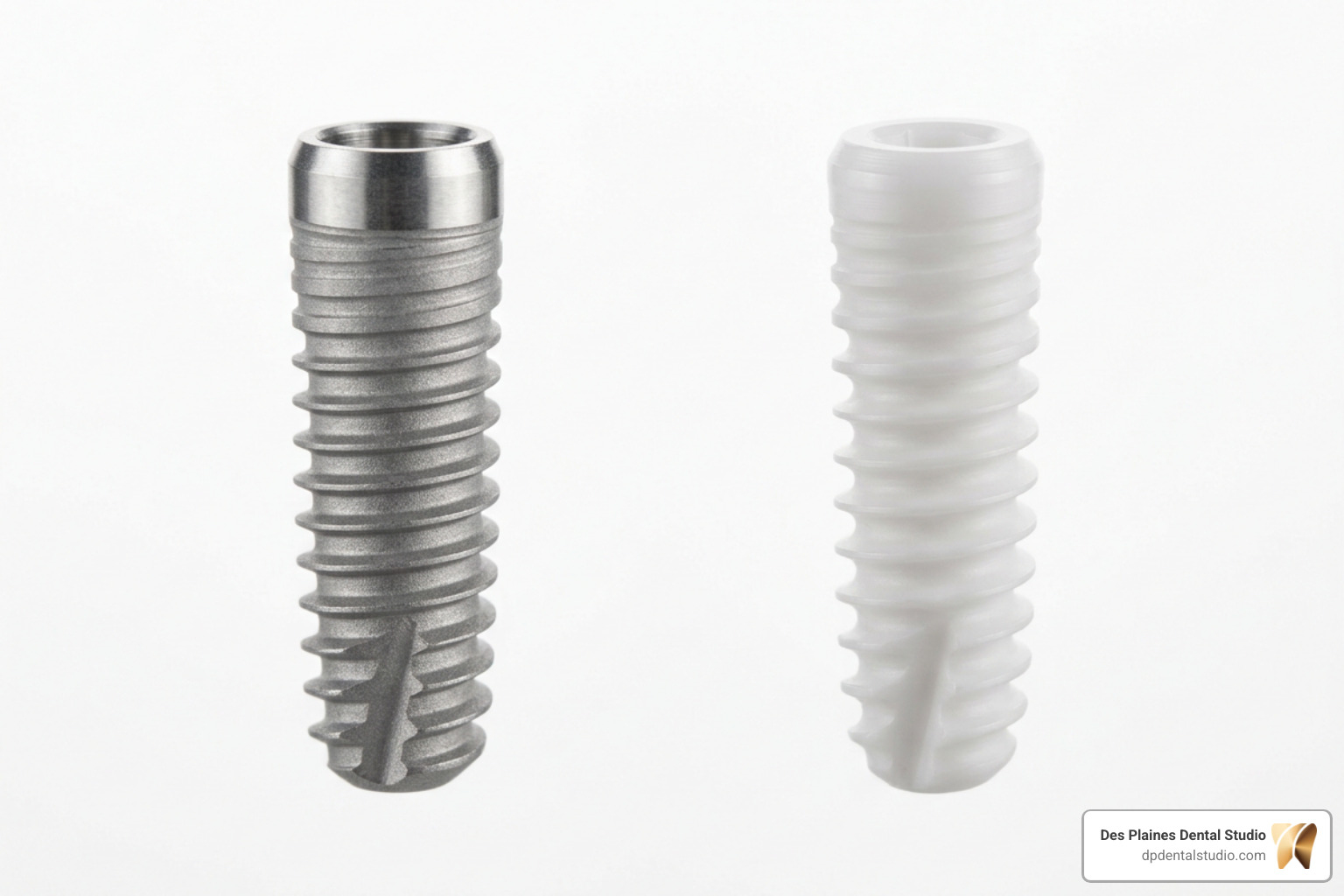
Upfront Material and Laboratory Price Differences
Titanium implants are consistently more cost-effective than zirconia alternatives, typically costing 20% to 40% less. For a detailed breakdown of these two materials, see this analysis of zirconia and titanium pricing.
- Raw Processing: Titanium is abundant, domestically sourced, and straightforward to machine via automated precision lathes.
- Zirconia Milling Complexity: Zirconia (zirconium dioxide) requires complex CAD/CAM milling and high-temperature thermal sintering, which creates wear on laboratory tooling and increases lab technician fabrication time.
- Supply Chain: A large portion of ceramic implant components relies on foreign imports subject to international tariffs and freight fees, adding 10% to 15% to material overhead.
While a complete single titanium implant restoration averages $2,500 to $5,000, an equivalent zirconia implant case frequently ranges between $3,500 and $7,000.
Durability, Failure Rates, and Long-Term Value
When evaluating return on investment, material longevity is just as important as the initial invoice:
- 10-Year Survival Rates: Titanium demonstrates a documented 98.8% survival rate over 10 years, compared to approximately 95% over 5 to 7 years for zirconia.
- Fracture Resistance: Titanium possesses higher elastic flexibility and tensile strength, making it ideal for posterior molars subjected to heavy chewing and grinding (bruxism). Zirconia is exceptionally hard but more brittle under off-axis lateral forces.
- Two-Piece Versatility: Titanium systems utilize a versatile two-piece design (separate fixture and abutment), allowing dentists to adjust angles for optimal crown alignment. Many zirconia implants are single-piece systems that require precise initial surgical angles.
For an extensive look at how material performance impacts lifetime value, consult our dental implant costs complete guide.
Insurance, Financing, and Strategies to Reduce Out-of-Pocket Costs
Paying for dental implants rarely involves a single out-of-pocket check. Most patients use a combination of dental benefits, pre-tax health funds, and low-interest monthly financing.
Navigating Dental and Medical Insurance Benefits
Historically, traditional dental insurance categorized implants as elective cosmetic procedures. Today, many insurance carriers provide partial coverage for the restorative crown or preparatory bone work under major restorative benefits (typically covering 10% to 50% up to your plan’s annual maximum limit, which generally ranges from $1,000 to $2,500).
To maximize your coverage:
- Request a formal pre-treatment estimate to confirm covered billing codes (such as code D6010 for surgical placement and D6058 for custom abutments).
- Check whether your plan has a “missing tooth clause,” which may exclude teeth lost prior to your policy start date.
- Review our dedicated dental implants insurance guide to understand how to maximize employer-sponsored benefits.
In cases involving severe facial trauma, congenital tooth agenesis, or systemic bone loss, medical insurance policies may occasionally cover a portion of the surgical extraction and grafting fees.
Alternative Payment and Cost-Reduction Strategies
If your insurance coverage is limited, several strategies can help make treatment manageable:
- Health Savings Accounts (HSA) & Flexible Spending Accounts (FSA): Using pre-tax dollars to pay for implant surgery saves you 20% to 35% depending on your income tax bracket.
- Third-Party Medical Financing: Services like CareCredit or Proceed Finance offer 6- to 24-month zero-percent interest promotional terms, spreading a $3,500 procedure into predictable monthly payments.
- Dental Tourism Considerations: While clinics in Mexico or Costa Rica advertise single implants for $900 to $1,300, travel costs, absence of follow-up care for post-operative infections, and lack of domestic malpractice protections often outweigh the initial savings if complications arise.
Full-Arch and Multi-Tooth Replacement Options
If you are missing multiple teeth or an entire dental arch, individual implants for every tooth are neither practical nor cost-effective. Instead, strategically angled implants can support an entire fixed bridge:
- Implant-Supported Bridges: Using two titanium implants to replace a gap of 3 to 4 teeth averages $5,000 to $9,000.
- All-on-4 / Full-Arch Fixed Prostheses: Placing four to six titanium posts per arch to support a complete, non-removable hybrid bridge typically costs $15,000 to $30,000+ per arch.
- Implant-Retained Overdentures: Removable dentures that snap onto two to four mini or standard titanium implants provide stability for $7,000 to $15,000.
To see full breakdown figures for arch-level restorations, review our comprehensive full mouth implants cost guide.
Frequently Asked Questions about Titanium Dental Implant Costs
How much does a single titanium dental implant cost on average in 2026?
A complete single titanium dental implant—including the 3D CBCT scan, surgical placement of the titanium fixture, custom abutment, and porcelain/zirconia crown—typically costs between $2,500 and $6,000 in the United States. If the tooth site requires an extraction and socket bone preservation graft, the overall cost generally averages between $3,500 and $7,000.
Why are titanium implants less expensive than zirconia implants?
Titanium implants are roughly 20% to 40% less expensive than zirconia implants due to mature domestic manufacturing supply chains, efficient machining processes, and lower laboratory fabrication overhead. Zirconia requires precision ceramic milling and extended high-temperature oven sintering, which significantly increases custom dental lab fees.
How long do titanium dental implants last before needing replacement?
The titanium fixture itself is biologically designed to fuse permanently with your jawbone through osseointegration and can last a lifetime with proper oral hygiene and routine check-ups. The visible dental crown attached to the post undergoes everyday biting forces and typically has a lifespan of 10 to 15+ years before minor maintenance or replacement is required.
Conclusion
A missing tooth impacts more than just the appearance of your smile—it affects your ability to chew, causes adjacent teeth to shift, and leads to gradual jawbone loss over time. While traditional bridges and removable partial dentures present lower initial price tags, their recurring need for replacement every 5 to 10 years makes them more expensive over a lifetime.
Titanium implants deliver proven structural longevity, a 98.8% ten-year success rate, and reliable preservation of your natural bone structure. When evaluated on a cost-per-year basis over 20 to 30 years, an implant costs roughly $150 to $200 annually, making it one of the most reliable and cost-effective investments in modern restorative dentistry.
At Des Plaines Dental Studio, we believe financial surprises should never stand between you and a healthy smile. We take pride in delivering patient-centered care with complete insurance support, transparent cost breakdowns, and a welcoming, pain-free clinical experience. To explore whether you are a candidate for Titanium Bone Implants and receive a customized treatment estimate, contact our team today to schedule your comprehensive consultation.