


The Complete Guide to Dental Implant Costs
What Do Dental Implants Actually Cost? Here’s the Short Answer
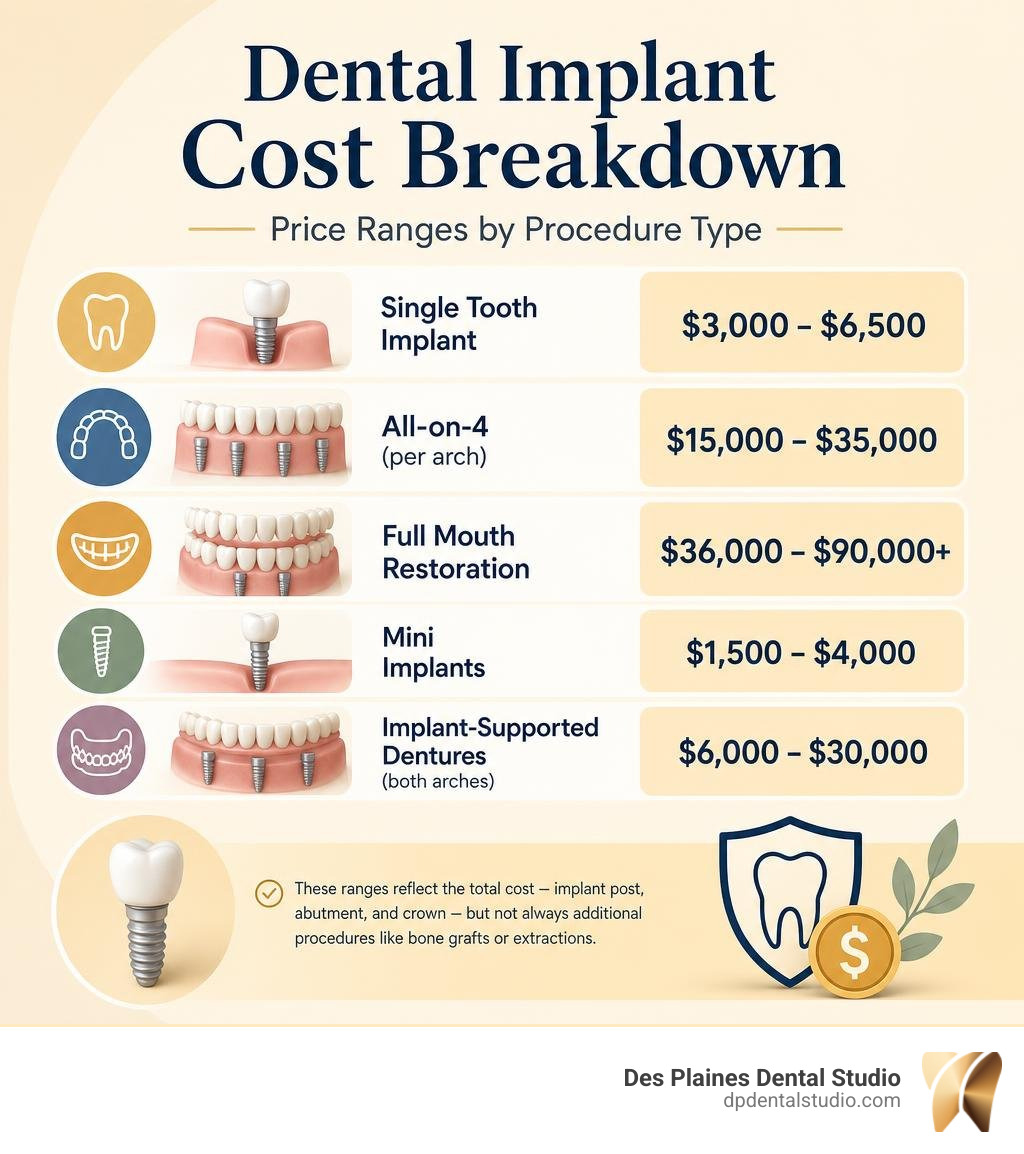
How much do dental implants cost is one of the most common questions patients ask before starting treatment — and the answer depends on several factors. Here’s a quick breakdown to get you oriented fast:
| Procedure | Typical Cost Range (2026) |
|---|---|
| Single tooth implant | $3,000 – $6,500 |
| All-on-4 (per arch) | $15,000 – $35,000 |
| Full mouth restoration | $36,000 – $90,000+ |
| Mini implants | $1,500 – $4,000 |
| Implant-supported dentures (both arches) | $6,000 – $30,000 |
These ranges reflect the total cost — implant post, abutment, and crown — but not always additional procedures like bone grafts or extractions. More on that below.
Prices vary based on where you live, which provider you choose, what materials are used, and whether you need preparatory work before the implant can be placed. Some patients pay closer to $3,000. Others pay $6,500 or more for a single tooth. It’s a wide range, and that can feel overwhelming when you’re already dealing with a missing or damaged tooth.
I’m Dr. Marta Milejczyk, and after nearly three decades of restorative and implant dentistry — including advanced clinical training in full-mouth rehabilitation — I’ve helped hundreds of patients navigate exactly this question of how much do dental implants cost and what they can realistically expect to pay. In this guide, I’ll walk you through every cost factor, financing option, and money-saving strategy so you can make a confident, informed decision.
How Much Do Dental Implants Cost in 2026?
When researching how much do dental implants cost, you will quickly notice that “average” prices vary wildly depending on which study or database you consult. According to national dental surveys, the average cost for a single tooth dental implant is $2,143, with a general range of $1,646 to $4,175. However, this figure often only covers the surgical placement of the implant post itself.
When you factor in the abutment (the connector piece) and the custom porcelain crown, the average out-of-pocket patient payment sits closer to $4,259 per implant, with a total price range spanning from $3,158 to $6,533. For an individual dental implant to replace a single tooth completely without dental benefits, patients typically pay between $2,800 and $5,600.
To help put these numbers in perspective, we can look at how costs break down across different restoration types. You can also explore localized estimates using the Dental Implant Cost Calculator (2026) | CostFigure. At Des Plaines Dental Studio, we believe in complete financial transparency, which is why we help our Illinois patients understand the true average cost of dental implants before they ever sit in the chair.
Here is a comparative look at estimated costs for different restoration options in 2026:
| Treatment Type | Low-End Estimate | National Average | High-End Estimate |
|---|---|---|---|
| Single Tooth Implant (Post, Abutment, Crown) | $3,100 | $4,259 | $5,800 |
| Implant-Supported Bridge (3 Teeth on 2 Implants) | $5,000 | $8,500 | $16,000 |
| All-on-4 Dental Implants (Per Arch) | $14,000 | $23,500 | $32,000 |
| Snap-On Dentures (Implant-Supported, Per Arch) | $6,000 | $8,500 | $15,000 |
| Full Mouth Restoration (Both Arches, Fixed) | $36,000 | $47,000 | $90,000+ |
How Much Do Dental Implants Cost for a Single Tooth?
To understand the cost of a single tooth replacement, it helps to look at it as a three-part system rather than a single object. Your final bill is the sum of these individual components:
- The Implant Post ($1,500 – $3,000): This is the medical-grade titanium screw that acts as your new tooth root. It is surgically placed into your jawbone.
- The Abutment ($300 – $1,000): The metal collar that screws into the implant post and keeps the crown secure.
- The Custom Crown ($1,000 – $3,000): The beautiful, tooth-colored porcelain or zirconia tooth that everyone actually sees.
When you add these components together, the total cost of an implant, abutment, crown, and necessary surgical procedures typically ranges from $3,100 to $5,800.
Geography also plays a major role in what you pay. For instance, the average cost for a single-tooth implant in Illinois is approximately $2,207 for the surgical post alone, with total restoration costs aligning closely with the national average. If you are curious about how Illinois stacks up against other regions, you can check out the Cheapest States for Dental Implants & Costs by State 2026 index. To learn more about our local single-tooth options, visit our dedicated page on getting a single tooth implant.
How Much Do Dental Implants Cost for Full-Mouth Restorations?
For patients missing most or all of their teeth, replacing each individual tooth with its own implant is neither surgically practical nor financially sensible. Instead, we use full-mouth or full-arch restorations, which utilize a few strategically placed implants to support an entire bridge of teeth.
The most common approach is the All-on-4 system, which has an average cost of $15,176 on the lower end, though premium materials and complex cases can push the national average to $23,500 per arch. All-on-6 systems, which use six implants for added stability (often recommended for patients with higher bite forces or lower bone density), typically range from $20,000 to $35,000+ per arch.
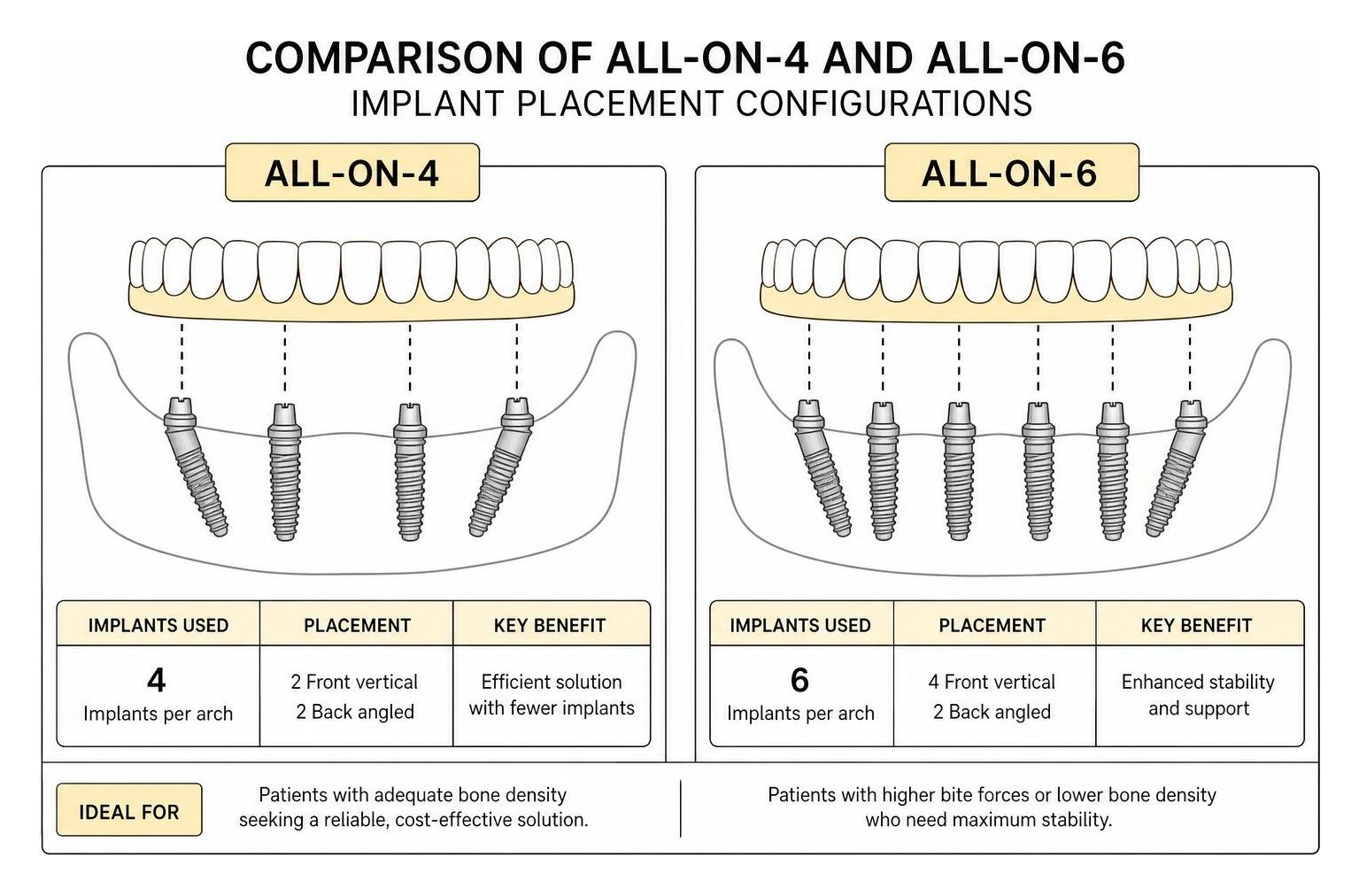
Another highly popular option is implant-supported dentures (or snap-on dentures). This option uses two to six implants to anchor a removable denture, costing between $6,000 and $15,000 per arch.
While the upfront cost of full-mouth restorations is high, the per-tooth price is actually much lower than single implants. If you are trying to replace 28 teeth individually at $4,000 each, you would look at a bill of $112,000. A full-mouth All-on-4 restoration replaces all your teeth for a fraction of that cost.
For a complete breakdown of full-arch pricing, check out the Dental Implant Cost By State 2026 registry, or read our in-depth guides on the price of full mouth dental implants and How Much Does a One Day Full Mouth Dental Implant Actually Cost?.
Key Factors That Influence Dental Implant Pricing
Why is there no single standard price for a dental implant? The truth is that dental implant surgery is a highly customized medical procedure. No two mouths are exactly alike, and several variables will shift your final estimate.
- Implant Materials: Medical-grade titanium remains the gold standard because of its incredible strength and ability to fuse with bone. However, some patients prefer zirconia (ceramic) implants for aesthetic reasons or metal sensitivities. Zirconia implants and custom crowns can increase the cost by 10% to 30%. To learn more about the science behind these materials, read about titanium bone implants.
- Brand Tiers: Just like cars, there are premium implant brands (such as Straumann and Nobel Biocare) and high-quality value brands (like Hiossen or MegaGen). Premium brands have decades of clinical research backing their success rates, which can add a 30% premium to the cost of the hardware.
- Provider Expertise: A board-certified oral surgeon or a periodontist with decades of experience will naturally charge more than a general dentist who has only taken a weekend course on implants. When it comes to surgical procedures in your jaw, experience is the best insurance against complications.
- Geographic Location: Dental practices in high-cost-of-living metropolitan areas face higher real estate, labor, and overhead costs, which are reflected in their pricing.
If you live in the Chicago metropolitan area and are looking for a trusted, local expert, we invite you to explore our services as a premier dental implants provider Des Plaines and see why patients search for us when looking for dental implants near me.
Preparatory Procedures and Hidden Costs
When patients receive a quote that seems “too good to be true,” it is often because the quote leaves out necessary preparatory work. Before an implant can be placed, your mouth must be healthy and have enough healthy bone to support the titanium post.
These preparatory steps can add to your budget:
- Tooth Extractions ($200 – $700): If a damaged or decaying tooth is still in the socket, it must be carefully extracted first.
- Bone Grafting ($500 – $3,500): If you have been missing a tooth for a while, the jawbone in that area naturally shrinks. A bone graft restores the bone depth so the implant has a stable foundation. You can read more about this essential step in our guide to bone grafting for dental implants.
- Sinus Lifts ($1,500 – $5,000): If you need an implant in your upper back jaw, your sinus cavity might be too close to the bone. A sinus lift gently pushes the sinus membrane upward and inserts bone graft material to create space.
- Dental Sedation ($500 – $2,500): While local anesthesia is included in the surgical cost, patients who prefer IV sedation or general anesthesia for a completely anxiety-free experience will pay an additional fee.
- Temporary Prosthetics ($300 – $1,500): You won’t want to walk around with a gap in your smile while your bone heals over 3 to 6 months. Temporary crowns or flippers keep your smile looking complete during the healing phase.
Long-Term Value: Implants vs. Bridges and Dentures
It is easy to look at the upfront cost of a dental bridge ($1,500 – $5,000) or traditional dentures ($1,000 – $3,000) and assume they are the more affordable choice. However, when you look at the lifetime cost over 15 to 20 years, dental implants are almost always the more economical investment.
Traditional bridges and dentures typically last only 5 to 10 years before they wear out, break, or no longer fit due to shifting jawbones. Each replacement cycle means paying those dental fees all over again.
Furthermore, when you lose a tooth, your jawbone naturally begins to resorb (shrink) because it no longer receives stimulation from the tooth root. This bone loss changes your facial structure, causing a sunken appearance. Dental implants are the only dental restoration that fuses directly with your bone, preserving your jaw health and natural face shape.
When you break down the cost of a dental implant over a 25-year lifespan, it is often the most affordable and health-preserving choice you can make. To compare alternative costs, read our breakdown of the average cost for dentures.
Insurance, Financing, and Ways to Save
Can you get help paying for your dental implants in 2026? Yes, but you have to navigate the system carefully.
Most private dental insurance policies classify dental implants as a “major” procedure. While many modern plans will cover up to 50% of the cost, they are strictly limited by their annual maximum benefit, which usually caps out between $1,000 and $2,500 per year. This means your insurance might cover the cost of the custom crown or a portion of the surgical placement, but you will still be responsible for the remaining balance.
Additionally, watch out for the “Missing Tooth Clause.” Some insurance policies will not pay to replace a tooth that was already missing before you purchased the policy. To help you navigate these complex rules, we have put together a comprehensive dental implants insurance guide 2026 and a helpful article on how to get dental implants covered by medical insurance.
If your insurance coverage is limited, here are the best strategies to make your treatment affordable:
- HSA and FSA Accounts: You can use pre-tax dollars from your Health Savings Account (HSA) or Flexible Spending Account (FSA) to pay for dental implants, saving you 20% to 30% depending on your tax bracket.
- Treatment Phasing: Because the implant process naturally takes several months, you can often split the treatment across two calendar years. For example, you can have the surgical post placed in December (using your 2026 insurance maximum) and receive the crown in February (using your 2027 maximum).
- Third-Party Financing: Healthcare credit cards like CareCredit and specialized medical loans through providers like LendingClub offer flexible monthly payment plans, often with 0% interest promotional periods.
- Dental Schools: If you live near a major university with a dental school, you can receive supervised implant care from dental students or residents at a 30% to 50% discount.
How To Get an Accurate, All-Inclusive Quote
The best way to avoid surprise fees is to request a comprehensive, itemized treatment plan during your initial consultation. A high-quality consultation should always include a 3D CBCT scan (cone-beam computed tomography). This advanced imaging allows your dentist to see the exact width, depth, and density of your bone, ensuring there are no surprises once the surgery begins.
When reviewing a quote, make sure it explicitly details the cost of the implant post, abutment, final crown, extraction fees, bone grafting materials, and follow-up care. For a practical guide on comparing dental office estimates, read our advice on how to find the cheapest dental implants without losing your mind.
Frequently Asked Questions About Dental Implant Costs
Does dental insurance cover the full cost of implants?
Almost never. While some premium dental plans may cover up to 50% of major restorative procedures, the annual maximum limit (typically $1,000 to $2,500) prevents the policy from covering the entire cost of a single implant, let alone a full-mouth restoration. You should expect some out-of-pocket expenses.
Who is an ideal candidate for dental implants?
An ideal candidate is an adult in good general health with healthy gums and sufficient jawbone density to support the titanium post. Chronic conditions like uncontrolled diabetes or lifestyle habits like heavy smoking can slow down bone healing and lower success rates, which is why a thorough pre-treatment evaluation is essential.
Is it cheaper to pay cash for dental implants?
Yes, many dental practices offer a 10% to 20% discount if you pay the entire balance upfront in cash or check. This is because cash payments eliminate the processing fees and administrative costs associated with insurance billing and third-party financing.
Conclusion
While the initial cost of dental implants can seem significant, they are a life-changing investment in your health, confidence, and quality of life. Unlike temporary alternatives, a properly maintained dental implant can easily last a lifetime, making it the most cost-effective and natural-feeling solution for tooth loss.
At Des Plaines Dental Studio, our mission is to provide patient-centered, welcoming, and completely pain-free care. We understand that navigating the financial aspects of dental care can be stressful, which is why our experienced team works closely with your insurance provider to maximize your benefits and design flexible payment plans that fit your budget.
If you are ready to take the next step toward a healthy, beautiful smile, we invite you to explore The Ultimate Guide to Dental Implants Costs and Benefits or contact our Des Plaines office today to schedule your personalized consultation.