


Dental Abutment Costs: What to Expect When You’re Connecting
Why Understanding Dental Abutment Costs Can Save You From Sticker Shock
How much does an abutment cost is one of the first questions patients ask once they realize a dental implant is made of more than just one piece. The short answer: it depends on the type.
| Abutment Type | Typical Patient Cost |
|---|---|
| Stock (prefabricated) | $300 – $500 |
| Custom titanium | $450 – $750 |
| Custom zirconia | $550 – $900 |
| Ti-base hybrid | $525 – $850 |
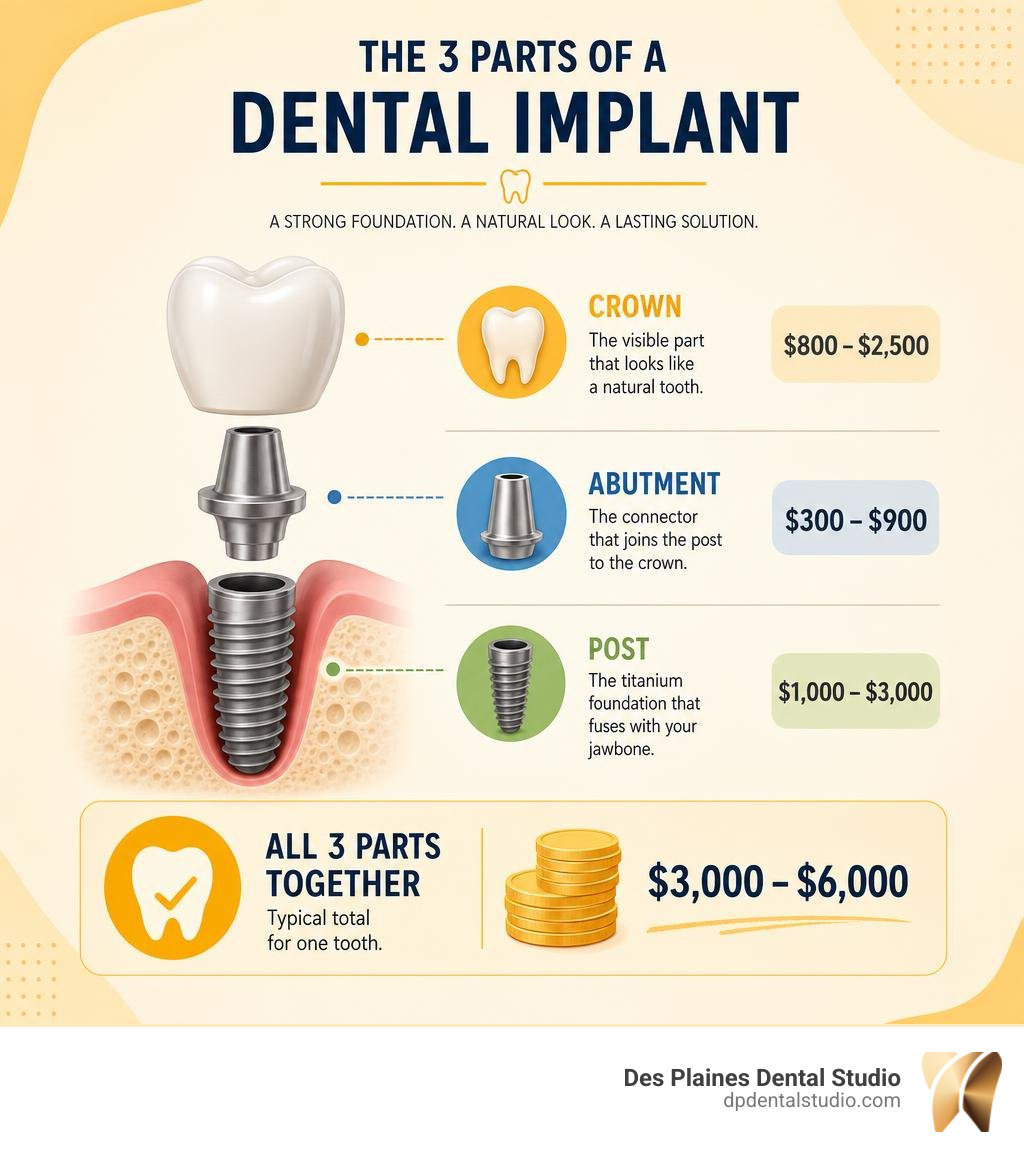
These are separate from the implant post ($1,000–$3,000) and the crown ($800–$2,500). All three together typically land between $3,000 and $6,000 for a single tooth.
Most patients don’t hear the word “abutment” until they’re already mid-treatment — and then they see it as a separate line item on the estimate and wonder what they’re actually paying for. That confusion is completely normal, and it’s exactly what this guide is here to clear up.
We’ll walk you through what an abutment does, what drives its cost, when a custom one is worth the extra money, and how insurance fits in.
I’m Dr. Marta Milejczyk, a general dentist practicing in Chicago’s northwest suburbs since 1997, with advanced training in restorative and implant dentistry — and questions about how much does an abutment cost come up in my chair more often than almost any other implant topic. In the sections below, I’ll give you the straightforward answers you need to go into treatment planning with confidence.
What is a Dental Implant Abutment and Why is It Necessary?
To understand why this small metal or ceramic connector commands its own price tag, we have to look at the anatomy of a dental implant. An implant is not a single artificial tooth that we simply twist into your jawbone like a wood screw. It is a highly engineered, three-part system designed to mimic nature.
The first part is the implant post (or fixture), which sits entirely below your gumline, acting as a replacement tooth root. The third part is the crown—the beautiful, custom-shaded porcelain tooth that everyone sees when you laugh.
The abutment is the unsung hero sitting quietly in the middle. It is the connector that bridges the gap. Without it, there is no physical way to attach your crown to the implant post.
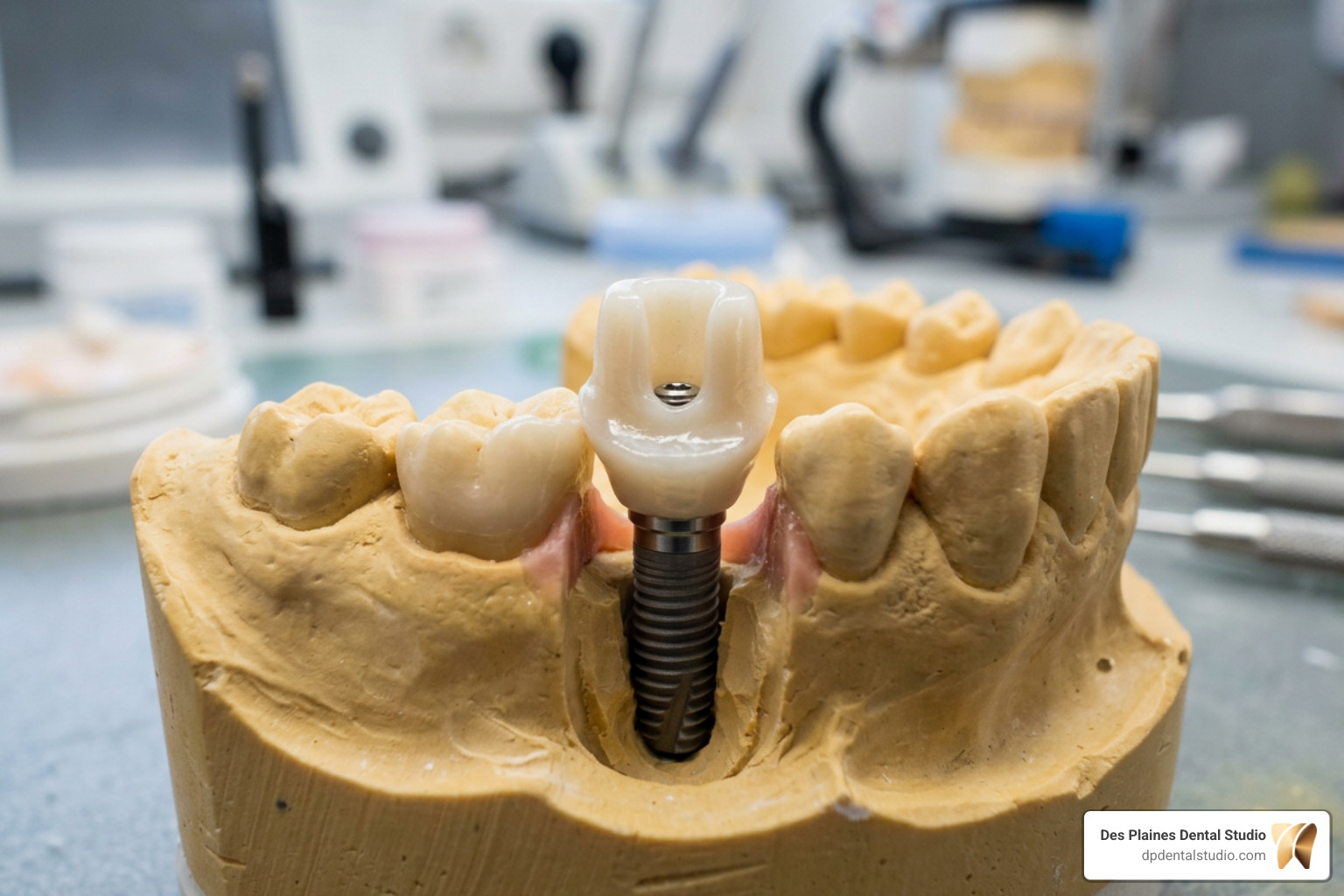
Think of it like hanging a heavy, expensive mirror on your drywall. The implant post is the heavy-duty anchor tucked safely inside the wall. The crown is the mirror. The abutment is the specialized bracket that screws into the anchor so you can securely mount the mirror.
Beyond acting as a physical bridge, the abutment plays a massive role in biological health. Once the implant post undergoes osseointegration—the process where your jawbone fuses with the titanium post—the gum tissue must heal around the neck of the restoration. The abutment shapes this tissue, creating a tight, hygienic seal that prevents bacteria from slipping down into the bone.
When we craft high-quality dental implant restorations, we aren’t just looking to fill a gap; we are engineering a biological seal to protect your jawbone and keep your new tooth stable for decades.
How Much Does an Abutment Cost in 2026?
When budgeting for your restoration in 2026, the specific type of connector used is the primary price driver. Generally, you will choose between a stock (prefabricated) abutment and a custom-designed abutment.
Stock abutments are mass-produced by implant manufacturers in standard sizes. They are highly economical but offer no customization for your specific gum shape. Custom abutments, on the other hand, are designed using computer-aided design and manufacturing (CAD/CAM) technology to match the exact contours of your mouth.
While a stock abutment might carry a lab fee of $50 to $175, the final patient-facing cost usually ranges from $300 to $500. A custom abutment requires highly precise laboratory fabrication, pushing the patient’s out-of-pocket cost to anywhere between $450 and $1,500 depending on the materials used and the complexity of the case.
To help you compare your options, here is a detailed breakdown of the average fees you can expect:
| Abutment Category | Average Lab Fee | Average Patient Cost (2026) | Best Suited For |
|---|---|---|---|
| Stock Titanium | $0 – $80 | $300 – $500 | Posterior teeth, thick gum tissue, ideal implant angles |
| Custom Titanium | $95 – $245 | $450 – $750 | Posterior teeth, high chewing forces, non-ideal angles |
| Custom Zirconia | $185 – $325 | $550 – $900 | Anterior “smile zone,” thin gum tissue, premium aesthetics |
| Ti-Base Hybrid | $165 – $295 | $525 – $850 | Front or side teeth requiring both metal strength and ceramic aesthetics |
For a broader perspective on how these individual parts scale up, you can review this comprehensive Dental Implant Abutment Cost Guide.
CDT Code D6056 vs. D6057: How Much Does an Abutment Cost Under Insurance?
If you have dental insurance, your out-of-pocket cost will heavily depend on the specific Code on Dental Procedures and Nomenclature (CDT) code we submit on your claim form. Insurance companies treat stock and custom connectors differently:
- CDT Code D6056 (Prefabricated Abutment): This code is used for stock abutments. Because these parts are mass-produced, insurance companies often have lower “allowable fees” for this code, meaning they will pay their percentage based on a lower maximum price.
- CDT Code D6057 (Custom Fabricated Abutment): This code is reserved for custom-milled titanium or zirconia connectors.
The good news is that most PPO dental plans in Illinois cover both codes as “Major Restorative” procedures, typically paying about 50% of the allowable fee once you have met your deductible. However, you must always keep your plan’s annual maximum in mind. Most plans cap their total annual payout between $1,000 and $2,500.
If your implant surgery, bone graft, abutment, and crown are all billed in the same calendar year, you will likely hit that maximum quickly. To optimize your benefits, we often recommend staging your treatment. For example, placing the implant post in November or December of one year, and then billing the custom abutment and crown in January of the following year. This allows you to tap into two separate annual insurance maximums.
To plan your budget and see how to structure your treatment timeline, check out our dental implants insurance guide 2026.
Lab Pricing Models and How Much Does an Abutment Cost to Fabricate
Behind the scenes, the relationship between your dentist and the dental laboratory plays a silent role in what you ultimately pay. Labs generally operate on one of two financial models:
- Pay-Per-Case Model: The dentist pays a flat fee for every individual custom abutment designed and milled. This is highly economical for low-to-mid-volume dental practices and ensures that the lab technician dedicates focused, individual time to designing the perfect emergence profile for your tooth.
- Subscription Model: Some high-volume clinics pay a flat monthly subscription fee to a lab for unlimited restorations. While this can lower costs for the clinic, if the clinic doesn’t hit a high volume of implant cases each month, the effective cost per abutment actually goes up, which can inflate patient fees.
Furthermore, high-quality domestic labs boast remake rates of under 1% because they use authentic, licensed implant manufacturer libraries. Cheaper, offshore assembly-line labs often use generic or bootlegged digital libraries to design custom parts. This can result in tiny microscopic gaps (tolerance mismatches) at the implant interface, which can lead to screw loosening or implant failure down the road.
For an in-depth look at what goes into high-quality laboratory fabrication, you can read this industry breakdown on Custom Abutment Cost: What to Expect in 2026.
Key Factors That Influence the Price of a Custom Abutment
A custom abutment is a highly personalized medical device. Because no two human mouths are identical, a team of specialized dental technicians must design and manufacture your connector from scratch.

Several variables dictate the final price of a custom-designed connector:
- Design Complexity and CAD/CAM Engineering: We capture a precise 3D digital scan of your mouth using an intraoral scanner. This scan is sent to the lab, where a technician spends 15 to 30 minutes using advanced software to design your abutment’s “emergence profile”—the exact pathway the crown takes as it rises through your gumline.
- Implant Library Licensing: To ensure a perfect fit, the design software must use the official digital “library” provided by your specific implant manufacturer. Licensing these official libraries is expensive for labs, but it guarantees that the physical parts will fit together with zero micro-movement.
- Material Choice: Milled zirconia and hybrid materials cost more to source and process than standard titanium blanks, which naturally increases the final cost.
While stock abutments are excellent for straightforward cases, we almost always recommend a custom abutment under the following clinical circumstances:
- The implant is placed at an angle: If your jawbone structure required the surgeon to place the implant post at a slight tilt, a stock abutment cannot correct the angle. A custom abutment is milled to compensate for the tilt, ensuring your final crown sits perfectly straight.
- You have thin gum tissue (thin biotype): If your gums are thin or translucent, a standard gray titanium connector will shine through, leaving a dark, metallic shadow at your gumline. A custom zirconia abutment matches your natural tooth color, keeping your smile bright.
- You are replacing a front tooth: The teeth in your “smile zone” require highly precise, natural-looking gum contours. Only a custom abutment can shape the surrounding gum tissue to look like a natural tooth emerging from the root.
For a deeper dive into how these design choices influence the overall success of your restoration, refer to Peak Dental Studio’s guide on Custom Abutment Cost & Options for Implant Restorations (2026).
Material Choices: Titanium vs. Zirconia Abutments
The material you choose for your custom connector represents a direct balance between physical strength and aesthetic performance.
- Titanium Abutments: Titanium is the gold standard for implant dentistry. It is incredibly strong, biocompatible, and virtually impervious to fracture under heavy chewing forces. It is the ideal choice for molars and premolars where strength is the primary concern. To learn more about how this material integrates with your body, you can read about titanium bone implants.
- Zirconia Abutments: Zirconia is a high-strength, tooth-colored ceramic. It is highly biocompatible and offers unmatched aesthetics. Because it is white, there is zero risk of a dark metallic collar showing near the gums. It is the premier choice for front teeth.
- Ti-Base Hybrids: This modern design combines the best of both worlds. It features a tiny titanium base that screws directly into the implant post (ensuring a perfect, high-strength metal-on-metal connection), with a custom zirconia coping bonded to the top (ensuring a beautiful, tooth-colored foundation for your crown).
The Role of the Abutment in the Total Cost of a Single Dental Implant
To keep your expectations realistic, it is vital to view the abutment not as a standalone expense, but as one piece of a larger puzzle. A single-tooth replacement is a multi-step journey that involves several components and potential preparatory procedures.
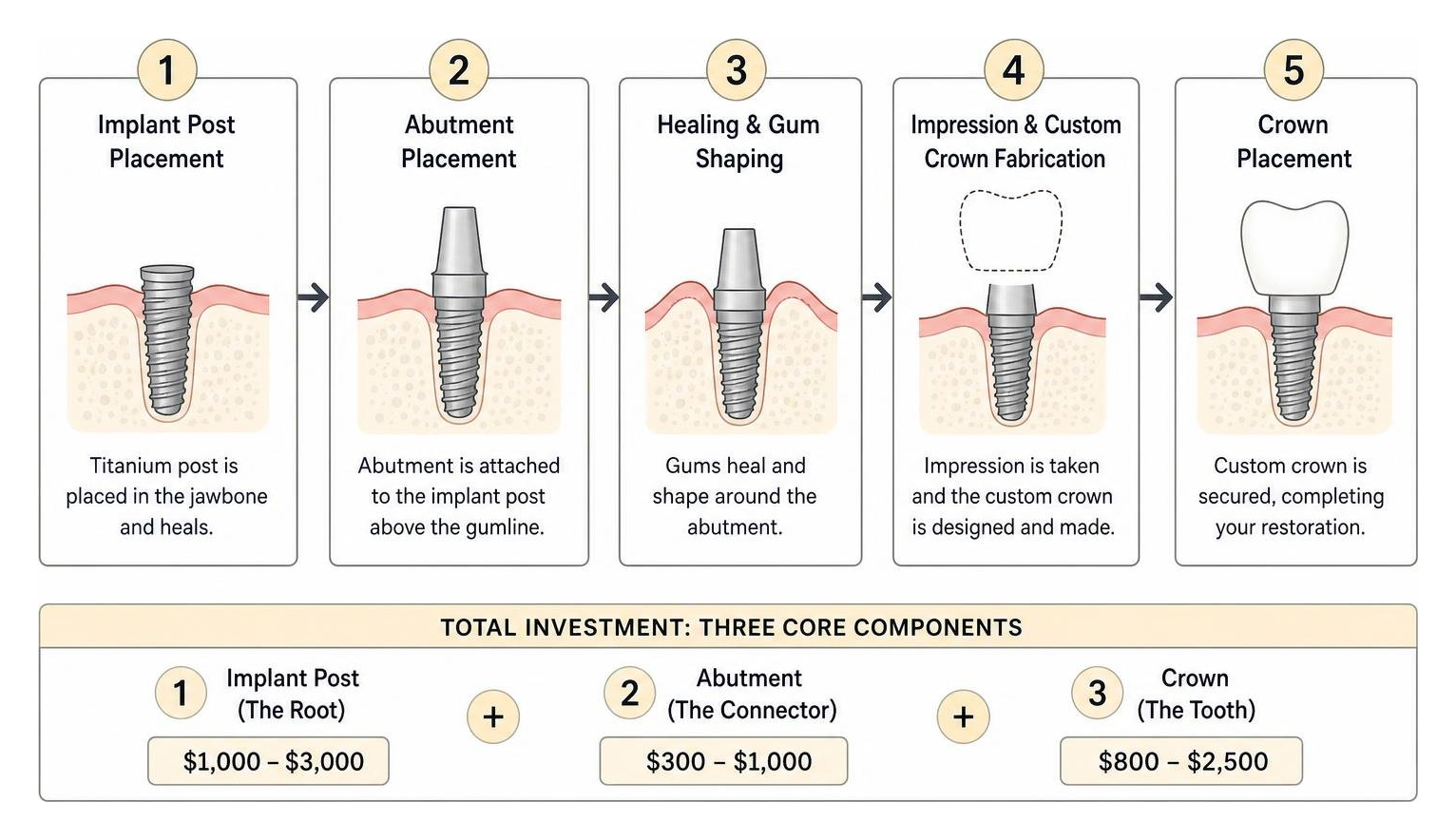
When calculating your total investment, you must account for all three core components:
- The Implant Post (The Root): $1,000 – $3,000
- The Abutment (The Connector): $300 – $1,000
- The Crown (The Tooth): $800 – $2,500
This brings the total cost for a single-tooth restoration to an average range of $3,000 to $6,000.
Additionally, many patients require preparatory steps before the implant can be safely placed. If you have been missing a tooth for a while, your jawbone may have begun to shrink (a process called resorption). To rebuild the site and ensure there is enough bone to anchor the post, we may need to perform a bone graft, which typically adds $400 to $1,600 to the total cost.
For a complete breakdown of all potential fees, you can read our detailed guide on the average cost of dental implants or explore this national pricing analysis: Dental Implant Cost Breakdown 2026: Post, Abutment & Crown.
When is a Custom Abutment Clinically Necessary?
While some discount dental clinics try to save money by using stock abutments for every case, there are times when a custom-milled connector is absolutely essential for a successful clinical outcome.
We consider a custom abutment a non-negotiable requirement if you are replacing a tooth in the “anterior zone” (your front six teeth) or if your gum tissue is highly visible when you smile. It is also necessary if your implant post had to be angled to avoid nerves or sinus cavities, as a stock part simply cannot correct the path of draw for the final crown.
If you are planning to replace a missing front tooth, you can learn more about our specific approach to crafting beautiful, seamless restorations by visiting our single tooth implant Des Plaines IL page.
Long-Term Risks and Hidden Costs of Choosing a Cheaper Stock Abutment
It can be tempting to choose a cheaper stock abutment to save a few hundred dollars upfront. However, cutting corners on this critical connector can lead to severe, expensive complications down the road.
Because stock abutments are not designed to match the unique shape of your gums, they often leave tiny gaps or “food traps” at the gumline. These traps are incredibly difficult to clean, leading to a build-up of harmful bacteria. Over time, this bacteria can cause peri-implantitis—an infectious disease that causes inflammation in the gums and progressive bone loss around the implant. If left untreated, peri-implantitis can cause the entire implant to fail, requiring a costly removal and replacement process.
Additionally, if a stock connector does not fit the internal connection of your implant post perfectly, the tiny tolerance mismatch can cause the screw to loosen over time. This micro-movement can lead to bone loss, bacterial leakage, or even a fractured implant screw deep inside your jawbone.
Investing in a custom-milled, high-quality connector is the best way to safeguard your health and protect your financial investment. For practical advice on how to navigate dental quotes safely, read our guide on how to find the cheapest dental implants without losing your mind.
Frequently Asked Questions about Dental Abutment Costs
Is the abutment always included in the advertised price of a dental implant?
No, and this is one of the most common marketing tricks in the dental industry. You might see a billboard or an online ad promising a “complete dental implant for $999.” In almost every case, that price only covers the surgical placement of the titanium post. The abutment and the final crown are billed as separate, additional fees, which can quickly double or triple the final bill.
At our practice, we believe in complete financial transparency. We provide our patients with fully itemized treatment plans that break down every single fee—from the initial 3D scans and surgical placement to the custom abutment and final crown—so you never have to worry about surprise costs.
If you are looking for a trustworthy partner to guide you through this process, you can learn more about our philosophy on our dental implants provider Des Plaines page.
Can a dental abutment be replaced if it gets damaged?
Yes. One of the greatest benefits of the three-part implant system is its retrievability. If your crown or abutment is damaged by a hard impact or wear over time, we do not have to remove the implant post from your jawbone.
If your restoration is screw-retained (where the crown and abutment are held together by a tiny screw), we can simply access the screw channel, remove the damaged parts, take a new digital scan, and have our lab fabricate a replacement.
How much does a dental implant crown cost compared to the abutment?
The final crown is typically the most expensive component of the restoration, ranging from $800 to $2,500. This is because the crown must be crafted from highly aesthetic, durable materials like solid zirconia or layered porcelain-fused-to-metal (PFM) to withstand constant chewing forces while looking completely natural.
While a custom abutment provides the perfect foundation, the crown is the highly visible “art piece” that completes your smile. For an honest look at lab fees and patient costs for the crown portion, explore this Dental Implant Crown Cost in 2026 resource.
Conclusion
At the end of the day, a dental implant is not just a cosmetic fix—it is a long-term investment in your health, your confidence, and your ability to enjoy your favorite foods without pain or worry. While understanding how much does an abutment cost can feel overwhelming at first, knowing the difference between stock and custom options allows you to make informed decisions for your smile.
At Des Plaines Dental Studio, we are proud to offer patient-centered, high-quality care to our community in Des Plaines, IL, and the surrounding Chicago northwest suburbs. We work closely with premier local dental laboratories to design custom restorations that fit your unique anatomy perfectly, and we accept a wide variety of insurance plans to help make your treatment as affordable as possible.
If you are ready to take the next step on your journey to a complete, healthy smile, we invite you to explore The Ultimate Guide to Dental Implants Costs and Benefits or call our office today to schedule a personalized consultation. We will sit down with you, answer all your questions, and build an honest, transparent treatment plan tailored just for you.