


Smiling on a Budget: How Much Do Veneers Actually Cost With Insurance?
What You’ll Actually Pay for Veneers With Insurance (The Short Answer)
How much do veneers cost with insurance is one of the most common questions patients ask before committing to a smile makeover — and the answer isn’t always straightforward.
Here’s a quick breakdown to get you oriented:
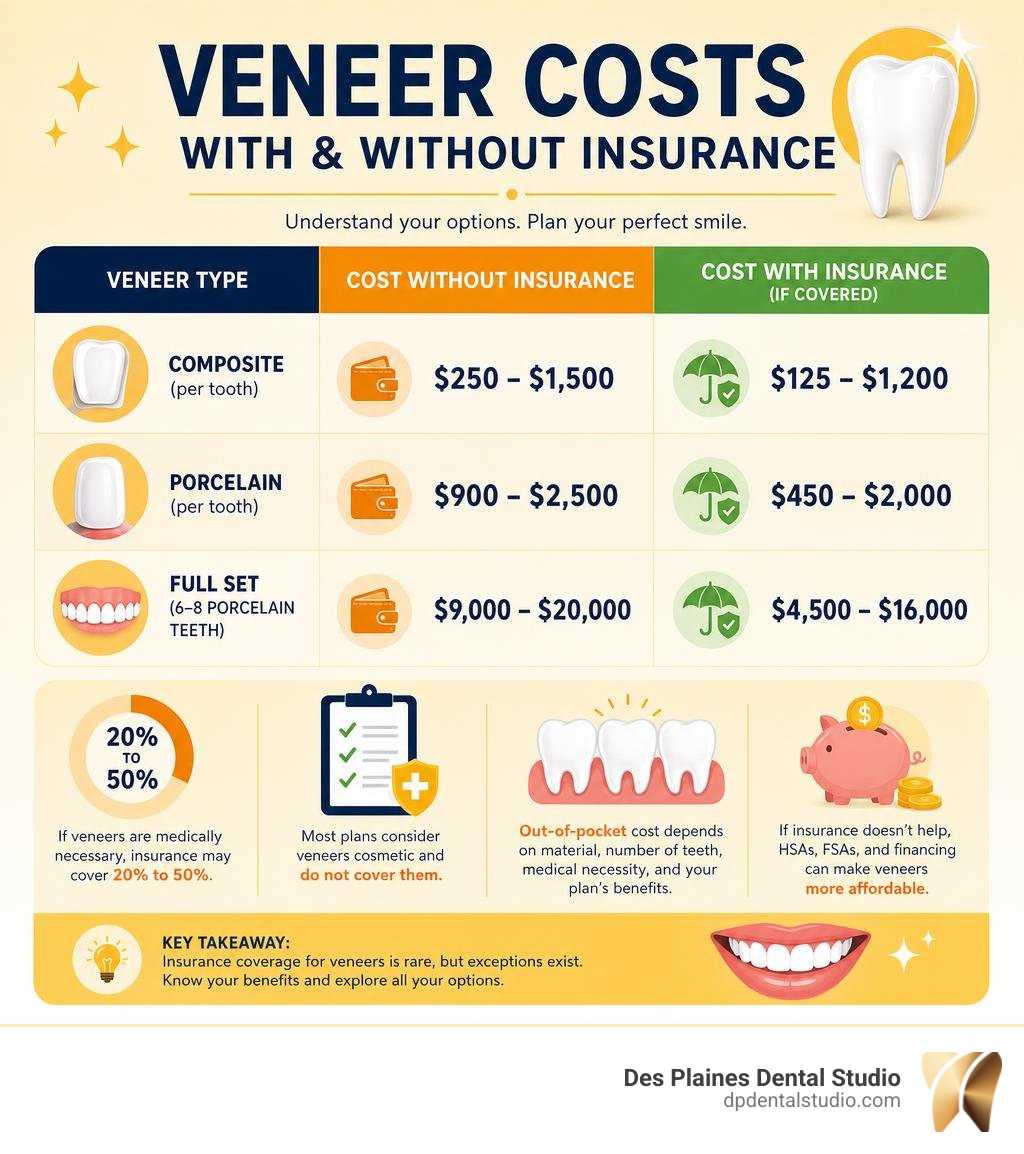
| Veneer Type | Cost Without Insurance | Cost With Insurance (if covered) |
|---|---|---|
| Composite (per tooth) | $250 – $1,500 | $125 – $1,200 |
| Porcelain (per tooth) | $900 – $2,500 | $450 – $2,000 |
| Full set (6–8 porcelain teeth) | $9,000 – $20,000 | $4,500 – $16,000 |
The key thing to know: Most dental insurance plans classify veneers as cosmetic and don’t cover them at all. But there are real exceptions — and knowing them can save you thousands.
If your veneers are needed to restore a tooth damaged by trauma, severe decay, or a congenital condition, your insurer may cover 20% to 50% of the cost. You’ll still pay something out of pocket, but the bill can shrink significantly.
For most patients, the realistic out-of-pocket cost depends on:
- The material chosen (porcelain vs. composite)
- The number of teeth treated
- Whether your case qualifies as medically necessary
- Your plan’s annual maximum and deductible
If insurance doesn’t help, options like HSAs, FSAs, and third-party financing can still make veneers affordable. We’ll cover all of that in detail below.
I’m Dr. Marta Milejczyk, and I’ve been helping patients navigate both the clinical and financial sides of cosmetic dentistry in the Chicago northwest suburbs since 1997, including guiding them through the often-confusing question of how much veneers cost with insurance. With advanced training in full-mouth rehabilitation and esthetic smile restoration — a program only 3% of dentists nationwide complete — I’ll walk you through everything you need to know to make a confident, budget-smart decision.
Do Dental Insurance Plans Ever Cover Veneers?
To understand how dental insurance handles veneers, we have to look at how plans are structured. Standard dental insurance in the United States operates on a three-tier model: preventive care (covered at 100%), basic procedures (covered around 80%), and major restorative services (covered around 50%).
Purely cosmetic dentistry sits entirely outside this standard framework. Because traditional veneers are designed to improve the aesthetic appearance of your teeth rather than cure a disease, insurance providers almost universally exclude them from standard coverage.
However, there is a gray area where cosmetic meets restorative. Insurance companies may provide partial coverage if a veneer is deemed a clinical necessity rather than an elective beauty treatment. If you are Restoring Smiles with Veneers to address structural damage, a severe fracture, or a tooth compromised by physical trauma, your insurer might cover a portion of the procedure up to the cost of a standard crown. To explore how these policies work across different carriers, you can read more about Veneers: Cost and Insurance Coverage to see how standard exclusions apply.
Cosmetic vs. Medically Necessary Veneers for Insurance Purposes
The line between “I want my teeth to look whiter” and “I need this tooth repaired so I can chew” is what determines your coverage. Insurance companies require strict proof of medical necessity before they will authorize any payment.
Here are the primary scenarios where a veneer might cross over into the medically necessary category:
- Physical Trauma or Accidents: If you chipped or cracked a front tooth in a sports injury or a car accident, the veneer is restoring the tooth’s physical integrity.
- Severe Enamel Erosion: Acid reflux, chronic teeth grinding (bruxism), or medical conditions that strip away natural protective enamel can leave teeth structurally vulnerable.
- Significant Structural Loss from Decay: When a cavity is too large for a standard composite filling but the tooth structure can still support a veneer instead of a full crown, a veneer is often the most conservative, tooth-preserving restoration.
- Congenital or Developmental Conditions: Genetic conditions like Amelogenesis imperfecta or severe dental fluorosis can severely compromise tooth development, qualifying the patient for restorative coverage.
When these clinical conditions are met, your dentist can submit a detailed case to show that the treatment is restorative. To understand the exact documentation required and how it affects what you pay, you can review this guide on the Real Veneers Cost Per Tooth With Insurance.
How Much Do Veneers Cost with Insurance?
When navigating the financial side of a smile makeover, it helps to compare the baseline national averages against what you might pay if you qualify for restorative coverage. The final cost of your treatment is heavily influenced by the material you select.
To help you compare, you can reference Dental Veneers: Cost, Procedure, and Results to see how national averages are calculated, or explore our specialized services for Porcelain Veneers Des Plaines IL to see how local pricing works in our practice.
Porcelain vs. Composite: How Much Do Veneers Cost with Insurance Per Tooth?
The two primary materials used for veneers are porcelain and composite resin. Each has distinct advantages in terms of cost, longevity, and appearance.
Porcelain Veneers
Porcelain is considered the gold standard of cosmetic dentistry. It mimics the natural light-reflecting properties and translucency of real tooth enamel and is highly stain-resistant.
- Lifespan: 10 to 20 years with proper care.
- Cost per tooth (no insurance): $900 to $2,500.
- Cost per tooth (with restorative insurance): $450 to $1,250 (assuming a 50% coverage rate).
- The catch: Porcelain veneers are fabricated in a professional dental laboratory, which contributes to the higher upfront cost.
Composite Veneers
Composite veneers are made from a tooth-colored resin that is applied directly to the tooth and sculpted by the dentist.
- Lifespan: 5 to 7 years.
- Cost per tooth (no insurance): $250 to $1,500.
- Cost per tooth (with restorative insurance): $125 to $750.
- The catch: While more budget-friendly, composite resin is more prone to chipping and staining over time.
When calculating the true value of your investment, it is helpful to look at the “cost per year of use.” A porcelain veneer costing $1,800 that lasts 15 years costs about $120 per year. A composite veneer costing $800 that needs replacement after 5 years costs $160 per year. For a deeper clinical comparison of these materials, you can check out Humana’s guide on How Much Do Dental Veneers Cost?.
Full Set vs. Single Tooth: How Much Do Veneers Cost with Insurance for a Complete Smile?
Most patients do not get veneers on every single tooth. Instead, they focus on the “smile zone” — the teeth that are visible when you talk and laugh. This is often referred to as the “Social Six” (the six upper front teeth) or “Social Eight.”
If you are replacing a single tooth damaged by trauma, insurance is much more likely to cover it because the medical necessity is clear. However, if you are getting a full set of 6 to 8 veneers to close gaps or redesign your smile, the insurance company will view the overall treatment as cosmetic.
To help manage the total cost of a full smile makeover, some practices offer bundled pricing or multi-tooth discounts. If you are looking to address specific issues, such as using Veneers to Close Gaps, we can target only the necessary teeth to keep your treatment highly efficient. You can also read more about managing the costs of multiple restorations in this guide to Full Mouth Veneers Cost With Insurance Per Tooth.
Navigating Major Insurance Providers and Policy Coverage
If you are hoping to secure partial coverage for your veneers, navigating the specific policies of major insurance carriers is your first step. Providers like Delta Dental, Cigna, and Aetna all have highly specific guidelines regarding cosmetic exclusions.
For example, Delta Dental PPO plans may cover 30% to 50% of the cost of a veneer only if it is part of a restorative treatment plan and a pre-treatment estimate is approved. Cigna and Aetna have similarly strict criteria, often classifying veneers under “major services,” which are subject to waiting periods and deductibles.
To understand how waiting periods, deductibles, and annual maximums impact your out-of-pocket costs, you can read our comprehensive Dental Insurance Guide 2026.

Required Documentation for Restorative Veneer Claims
To give your restorative veneer claim the best chance of success, your dental team must submit a comprehensive clinical package. You cannot simply submit a bill and hope for the best; the insurance company’s dental consultants will review the case thoroughly.
To build a strong claim, we submit:
- Diagnostic Digital X-rays: To show the underlying health of the tooth and prove there is no active infection.
- High-Resolution Intraoral Photographs: To clearly document physical fractures, structural enamel loss, or severe decay that cannot be fully captured on an X-ray.
- A Detailed Clinical Narrative: A written statement from the dentist explaining why a veneer is the most conservative and clinically appropriate restoration to preserve the natural tooth structure (as opposed to a more invasive crown).
- Specific CDT Dental Codes: Using the correct codes for laboratory-fabricated veneers or chairside resin restorations.
For more information on standard veneer procedures and clinical guidelines, you can visit the American Dental Association’s resource on Veneers.
How to Verify Your Specific Plan Benefits
Before committing to any treatment plan, you must verify your specific plan benefits. Because employer-sponsored group plans vary wildly, two people with “Delta Dental” could have completely different levels of coverage.
To avoid unexpected bills, we recommend following this step-by-step predetermination process:
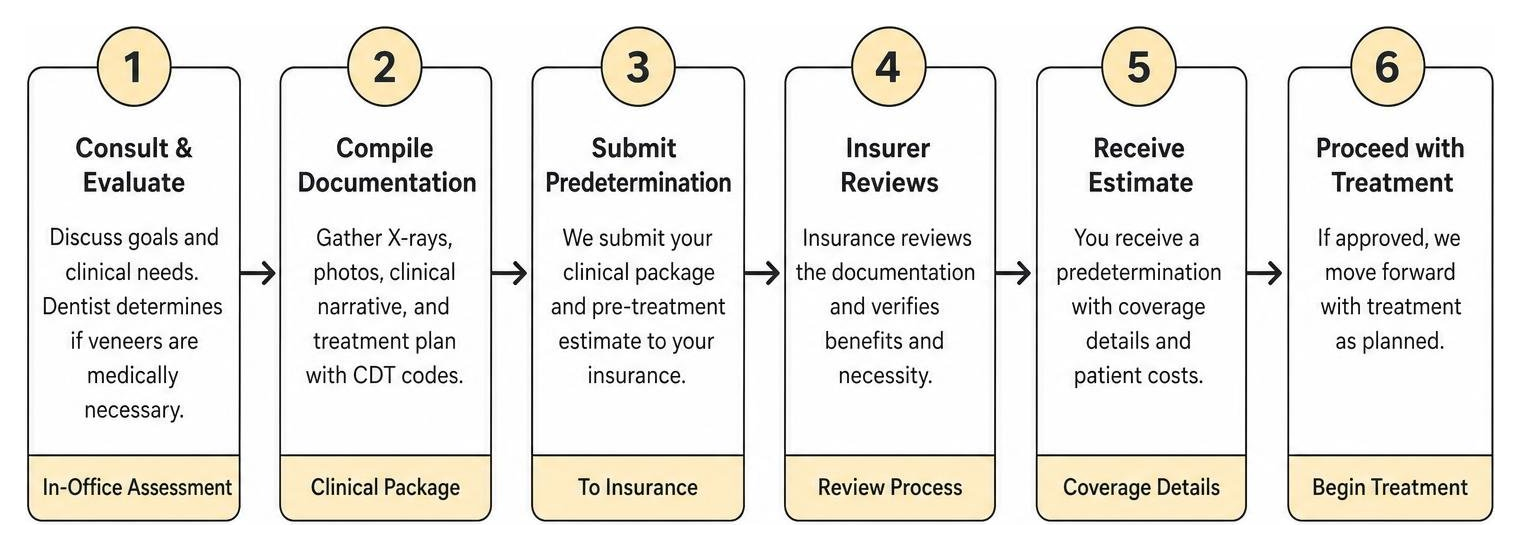
- Ask for a Pre-Treatment Estimate: We will submit your treatment plan and clinical documentation to your insurer before starting any work.
- Check Your Annual Maximum: Most dental plans have an annual maximum limit of $1,000 to $2,000. If your plan covers 50% of a $1,500 veneer, but you have already used $1,500 of your benefits for the year, your actual coverage will be limited.
- Identify Your Deductible: Ensure you know how much you must pay out of pocket before your major services coverage kicks in.
For a helpful checklist on evaluating dental plan structures, you can read Cigna’s guide on Dental Insurance: How to Choose the Right Plan.
Alternative Financing: HSAs, FSAs, and Payment Plans
If your insurance provider denies your claim because the procedure is deemed cosmetic, you still have several highly effective ways to manage the cost without breaking the bank.

Tax-Advantaged Accounts (HSAs and FSAs)
Health Savings Accounts (HSAs) and Flexible Spending Accounts (FSAs) allow you to use pre-tax dollars to pay for eligible medical and dental expenses. This can effectively save you 20% to 30% on the cost of your treatment, depending on your tax bracket.
- The Rule: Under IRS guidelines, purely cosmetic procedures (like teeth whitening or elective veneers) are not eligible for HSA or FSA funds.
- The Exception: If your dentist documents that the veneers are medically necessary to restore function or repair a damaged tooth, you can legally use your HSA or FSA funds to cover the balance.
Third-Party Financing and Payment Plans
Many patients choose to spread the cost of their treatment over time using healthcare-focused credit cards like CareCredit or LendingClub. These providers often offer promotional 0% interest financing for 6 to 24 months, allowing you to fit the cost of your veneers into a comfortable monthly budget.
Additionally, some practices offer in-house membership plans or loyalty discounts that can save you a flat percentage on cosmetic treatments. To learn more about how to navigate dental financing and structural costs, you can read the How Much Do Veneers Cost? Pricing and Coverage Guide or explore how policy frameworks impact care in our article on the Affordable Dental Care Act.
Frequently Asked Questions about Veneer Costs
Can I use my HSA or FSA to pay for cosmetic veneers?
No, purely cosmetic procedures do not qualify for HSA or FSA funds under IRS guidelines. However, if the veneers are used to restore a tooth damaged by an accident, trauma, or severe decay, they are classified as restorative. In these cases, you can use your pre-tax funds. Always obtain a detailed, itemized invoice from your dentist showing the restorative nature of the treatment for your tax records. For more general details on the clinical process, you can read WebMD’s guide on What to Know About Dental Veneers.
What factors influence the final out-of-pocket cost for veneers?
Several variables drive the price of veneers up or down:
- Dentist’s Expertise: Highly trained cosmetic dentists who specialize in advanced smile design typically charge higher fees for their artistic precision.
- Geographic Location: Dental care in major metropolitan areas or high-cost-of-living regions like the Chicago suburbs reflects higher local overhead costs.
- Lab Quality: Premium porcelain veneers handcrafted by master ceramists in top-tier dental laboratories cost more than mass-produced restorations.
- Preparatory Work: If you require additional procedures before veneer placement, such as gum contouring, treatment for active decay, or a nightguard to prevent teeth grinding, these will add to the overall cost.
To see how cosmetic treatments can be tailored to your budget, you can read about how Cosmetic Dentistry Can Improve Your Smile Dentist Near Me.
Are there cheaper alternatives to veneers if my insurance denies coverage?
Yes! If veneers do not fit your current budget, there are excellent alternatives that can still transform your smile:
- Dental Bonding: This involves applying a tooth-colored composite resin directly to the tooth to fix minor chips or close small gaps. It typically costs $300 to $600 per tooth and can be completed in a single visit, though it is less durable than porcelain.
- Professional Teeth Whitening: If your primary concern is discoloration, professional in-office whitening can brighten your smile by up to eight shades for $300 to $800.
- Dental Crowns: If a tooth has significant structural damage, a full crown may be covered at a higher rate (often 50% to 80%) by your insurance, making it a more affordable restorative option.
For answers to common questions about choosing the right cosmetic procedure, read our guide on Des Plaines Dentist Cosmetic Dentistry Common Questions Answered.
Conclusion
At Des Plaines Dental Studio, we believe that a confident, beautiful smile should be within reach for everyone. While navigating dental insurance for cosmetic and restorative treatments can feel overwhelming, you don’t have to figure it out alone.
Our team is dedicated to providing patient-centered care in a welcoming, pain-free environment. We will work directly with your insurance provider to submit detailed predeterminations, maximize your benefits, and help you find flexible financing options that fit your budget.
If you are ready to explore your options and get a personalized, transparent cost estimate, book your consultation for Veneers Des Plaines IL with us today. We look forward to helping you achieve the smile of your dreams!