


How Much Are Overdentures? A Quick Answer Before We Dive In
How much are overdentures is one of the most common questions we hear from patients exploring tooth replacement. Here is a fast answer:
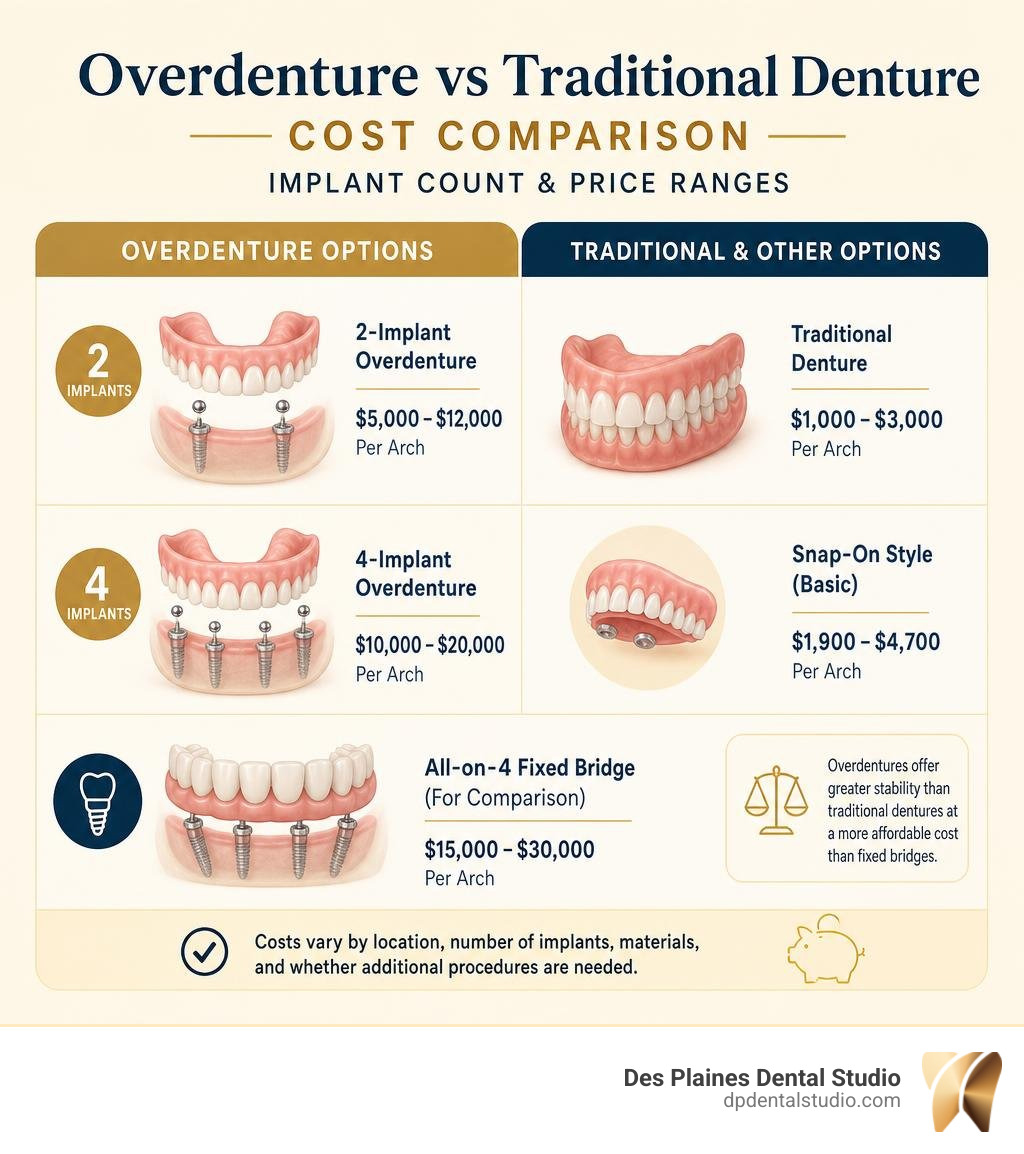
| Overdenture Type | Typical Cost Per Arch |
|---|---|
| 2-implant overdenture | $5,000 – $12,000 |
| 4-implant overdenture | $10,000 – $20,000 |
| Snap-on style (basic) | $1,900 – $4,700 |
| Traditional denture (for comparison) | $1,000 – $3,000 |
| All-on-4 fixed bridge (for comparison) | $15,000 – $30,000 |
Costs vary by location, number of implants, materials, and whether preparatory work like extractions or bone grafting is needed.
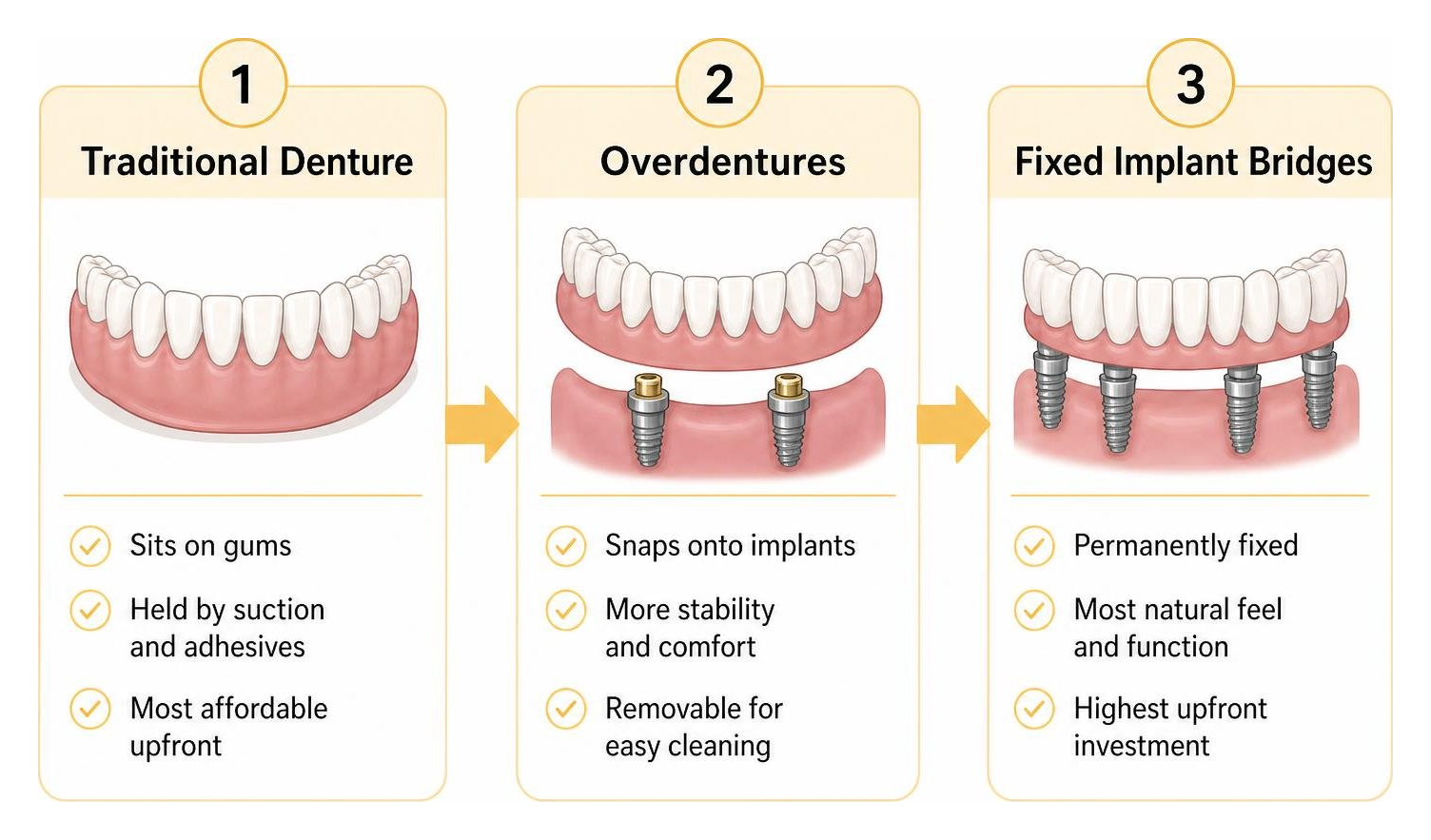
Overdentures sit in a middle range — more stable than traditional dentures, and significantly less expensive than fixed implant bridges. They snap onto implants (or in some cases, existing natural teeth) and can be removed at home for cleaning.
If you are weighing your options and trying to figure out what fits your budget and your lifestyle, this guide walks through everything — from base costs to hidden fees to insurance coverage.
I’m Dr. Marta Milejczyk, and after nearly three decades of restorative and implant dentistry practice in Chicago’s northwest suburbs — including advanced clinical training in full mouth rehabilitation — I answer questions about how much are overdentures almost every week. Understanding these costs clearly is the first step toward making a confident decision, so let’s break it all down together.
What is an Overdenture and How Does It Work?
To understand why overdentures are priced the way they are, we first have to look at what they actually do. An overdenture is a removable prosthetic that fits directly “over” either your natural teeth or, more commonly, titanium dental implants.
Unlike a standard denture that simply rests on your gums, an overdenture is implant-retained. It connects to the implants using specialized attachments (often called locators, snaps, or bars). This design gives you the stability of dental implants while keeping the prosthetic removable.
One of the greatest clinical benefits of this approach is jawbone preservation. When you lose teeth, the underlying jawbone begins to resorb (shrink) over time because it no longer receives stimulation from tooth roots. Titanium implants act as artificial roots, fusing with your bone in a process called osseointegration. This keeps your jawbone strong, preserves your facial structure, and prevents that “sunken” look often associated with tooth loss.
If you are looking for a reliable way to restore your smile, choosing dentures in Des Plaines, IL with implant support is one of the most effective restorative dentistry procedures available today.
Overdentures vs. Traditional Dentures
Traditional dentures are held in place by natural suction, muscle control, and often a fair amount of messy dental adhesive. While they are the most budget-friendly upfront option, they are prone to slipping, clicking, and sliding when you chew or speak. This movement can lead to painful sore spots on your gums.
Overdentures eliminate the need for adhesives entirely. They snap firmly into place, which means no more worrying about your teeth slipping out during a dinner party or a lively conversation. When comparing the average cost for dentures, traditional dentures are cheaper initially, but many patients find that the lifestyle upgrade of a secure snap-in fit is worth the investment to repair your smile with dentures that actually stay put.
Overdentures vs. Fixed Implant Bridges
On the other end of the spectrum are fixed implant bridges, such as the popular All-on-4 system. These are permanently screwed into your implants and can only be removed by a dentist.
While fixed bridges feel the most like natural teeth, they require a higher upfront investment and excellent manual dexterity to clean underneath the bridge with specialized floss threaders or water flossers. Overdentures, being removable, are much easier to keep clean. You simply snap them off at night, brush them, and place them in a denture bath.
If you are torn between these options, exploring All-on-4 dental implants in Des Plaines, IL can help you weigh the ultimate stability of a fixed bridge against the affordability and easy maintenance of an overdenture.
How Much Are Overdentures? Average Costs and Price Ranges
When exploring how much are overdentures, it helps to look at both national benchmarks and local realities. On average, a standard overdenture plate itself costs $3,136, but the total treatment range typically spans from $2,436 to $6,014 per arch for the prosthetic alone.
However, because overdentures require surgical implant placement, the all-inclusive cost (implants, abutments, and the denture) usually ranges from $8,000 to $15,000 per arch. For a comprehensive breakdown of these surgical fees, you can read more in this Implant Overdenture Cost Explained guide.
To put this in perspective, let’s compare the typical costs of your restorative options side-by-side:
| Treatment Type | Average Cost Per Arch | Lifespan | Main Benefit |
|---|---|---|---|
| Traditional Denture | $1,500 – $2,500 | 5 – 8 Years | Lowest upfront cost |
| 2-Implant Overdenture | $5,000 – $12,000 | 10 – 15 Years* | Great lower jaw stability |
| 4-Implant Overdenture | $10,000 – $20,000 | 10 – 15 Years* | Maximum support, open palate |
| All-on-4 Fixed Bridge | $15,000 – $30,000 | 15 – 20+ Years | Permanent, non-removable |
*Note: While the titanium implants themselves can last a lifetime, the removable acrylic overdenture plate typically needs replacement every 5 to 10 years due to normal wear.
Understanding How Much Are Overdentures with 2 Implants
A 2-implant overdenture is widely considered the minimum standard of care for patients struggling with a loose lower denture.
By placing just two implants in the front of the lower jaw and attaching locator snaps, we can keep the denture from rocking and sliding. This option typically costs between $5,000 and $12,000 total per arch. It is an incredibly cost-effective way to transition from slipping teeth to a secure, confident bite without the expense of a full mouth of implants.
Calculating How Much Are Overdentures with 4 Implants
While two implants work wonderfully for the lower jaw, the upper jaw is a different story. The bone in your upper jaw is naturally softer and less dense than the lower jaw. Because of this, and because of the way chewing forces are distributed, we almost always recommend a minimum of four implants for an upper overdenture.
A 4-implant overdenture typically costs between $10,000 and $20,000 per arch. The extra implants allow us to design a denture that does not cover the palate (the roof of your mouth). This is a massive benefit for our patients, as keeping the palate open allows you to taste your food fully and speak much more naturally.
Key Factors That Influence the Cost of Overdentures
The total price of your smile restoration isn’t a random number; it is shaped by several distinct clinical and material decisions:
- Number of Implants: Each titanium post adds to the surgical fee. A 4-implant system will naturally cost more than a 2-implant system.
- Denture Materials: Acrylic teeth on an acrylic base are the most affordable. High-impact acrylics, composite teeth, or porcelain teeth mounted on a CAD/CAM milled titanium bar framework will increase the cost but offer vastly superior durability and realism.
- Geographic Location: Dental fees vary by region due to overhead costs.
- Provider Expertise: Prosthodontists and dentists with advanced implant training may charge higher fees reflecting their specialized skill sets.
For a broader look at how material quality and denture types intersect, check out the independent benchmarks in How Much Do Dentures Cost in 2026? Full, Partial & Implant. (For an international perspective on how these pricing models compare to Canadian quote-based systems, you can also reference How Much Do Dentures Cost in Canada?).
Preparatory Procedures and Hidden Costs
When budgeting for overdentures, many patients only look at the cost of the implants and the denture plate. However, there are several preparatory procedures that may be necessary before we can safely place your implants:
- Comprehensive Exams & 3D Imaging: 3D Cone-Beam CT (CBCT) scans are essential to evaluate your bone density and map your nerves. These typically cost $150 to $500.
- Tooth Extractions: If you have failing teeth that need to be removed, simple extractions cost $137 to $335 per tooth, while surgical extractions can run $281 to $702.
- Bone Grafting: If you have experienced bone loss, we must perform a bone graft to build up the ridge so it can securely hold an implant. To learn more about this process, read our guide on bone grafting for dental implants.
- Abutments: These are the connector pieces that screw into the implants and stick out through your gums to snap into the denture. You can learn more about these components in our breakdown of dental abutment costs.
Ongoing Maintenance and Long-Term Costs
Investing in overdentures also means planning for their long-term upkeep. Because these are mechanical systems that snap in and out daily, parts will wear down over time:
- Nylon Insert Replacements: The tiny nylon caps (O-rings or locator inserts) inside the denture base that grip the implants will gradually lose their hold. These need to be replaced every 6 to 18 months to keep the snap tight. This simple office visit typically costs $50 to $200 per set.
- Denture Relines: Your gums and bone will still undergo subtle changes over time. To keep the denture fitting snugly against your tissue, you will need a professional hard or soft reline every 1 to 2 years, which costs $300 to $600.
- Denture Replacement: While your implants can last a lifetime, the acrylic teeth on the overdenture will wear down from chewing. You should plan to replace the prosthetic plate every 5 to 10 years.
Will Dental Insurance or Medicare Help Pay for Overdentures?
Navigating dental insurance can feel like trying to solve a puzzle in the dark, but we are here to help you make sense of it.
Most traditional dental insurance plans classify overdentures as a “major restorative service.” This means that if your plan covers them, they will typically pay about 40% to 50% of the cost of the denture plate itself, up to your annual maximum (which usually caps out between $1,000 and $2,500 per year).
Unfortunately, many basic insurance policies still classify the surgical placement of dental implants as a “cosmetic” or elective procedure and may not cover the implants themselves. However, some progressive plans are beginning to offer implant coverage. We always recommend submitting a detailed pre-treatment estimate to your carrier before starting. To learn more about navigating these policies, read our Dental Implants Insurance Guide 2026.
As for Original Medicare (Parts A and B), dental care is generally not covered unless it is deemed medically necessary during a hospital stay. However, many Medicare Advantage (Part C) plans do offer comprehensive dental benefits that may cover a portion of your extractions, dentures, or even implants.
Financing Options and Dental Savings Plans
Because the out-of-pocket cost for overdentures can still be significant, we offer several ways to help make your treatment fits comfortably into your family budget:
- Healthcare Credit Cards: Programs like CareCredit allow you to break your total cost into manageable monthly payments, often with 0% interest promotional periods.
- HSA and FSA Accounts: You can use pre-tax dollars from your Health Savings Account or Flexible Spending Account to pay for your implants and overdentures, saving you significantly on taxes.
- In-House Financing: We work with our patients to structure payment phases, allowing you to pay for your preparatory work, implant surgery, and final dentures as you complete each step of the journey.
Frequently Asked Questions About Overdentures
Who is a good candidate for overdentures versus fixed implant dentures?
Overdentures are an excellent choice for patients who have moderate bone loss (as they require fewer implants and can use shorter posts) and those who want an easy-to-clean option. They are also ideal for individuals with limited manual dexterity, as removing the denture makes hygiene straightforward. Fixed implant dentures are better suited for patients with abundant bone density who want a permanent, non-removable solution and have the dexterity to clean thoroughly beneath a fixed bridge.
Can you sleep with overdentures in your mouth?
While overdentures are securely snapped in and technically safe to wear overnight, we strongly advise taking them out before you go to sleep. Leaving them in 24/7 deprives your gum tissue of oxygen and blood flow, which can lead to bacterial infections, thrush, and accelerated bone loss. Giving your gums a 6-to-8-hour break in a clean denture bath at night is essential for long-term oral health.
How long do overdentures typically last?
The titanium dental implants placed in your jawbone can easily last decades—and often a lifetime—with proper care and routine dental cleanings. The removable overdenture prosthetic itself is made of acrylic and will show wear from daily chewing. You should expect to replace or rebuild the denture plate every 5 to 10 years, and replace the small nylon locator inserts every 6 to 18 months.
Conclusion
Determining how much are overdentures is about more than just looking at a price tag—it is about investing in your ability to eat, speak, laugh, and smile with absolute confidence.
At Des Plaines Dental Studio, we believe in patient-centered, welcoming, and pain-free care. We will work closely with you to design a customized treatment plan that respects both your clinical needs and your financial boundaries, helping you maximize your insurance benefits every step of the way.
If you are ready to take the next step toward a stable, beautiful smile, we invite you to explore the average cost of dental implants and schedule a consultation with us today. Let’s work together to restore your smile and your quality of life!