


Average Cost to Replace All Teeth with Implants or Dentures
What It Really Costs to Replace All Your Teeth in 2026
How much is it to replace all your teeth? The short answer: it depends on the method, but here’s a quick overview of what most patients pay in 2026:
| Treatment Type | Cost Per Arch | Full Mouth (Both Arches) |
|---|---|---|
| Traditional removable dentures | $500 – $3,600 | $1,000 – $7,200 |
| Implant-supported snap-in dentures | $3,000 – $7,300 | $6,000 – $30,000 |
| All-on-4 fixed full-arch implants | $15,000 – $30,000 | $30,000 – $60,000 |
| Individual implants (per tooth) | $3,000 – $7,000 each | $60,000+ |
These are national averages. Your actual cost will vary based on your jawbone health, location, materials chosen, and whether you need preparatory work like extractions or bone grafting.
Most patients are surprised to learn that replacing all your teeth doesn’t have to mean an implant for every single tooth. Modern full-arch solutions like All-on-4 can restore a complete smile using as few as four strategically placed titanium posts per arch — at a fraction of the cost of individual implants.
The challenge is that quotes can vary wildly between providers, and the lowest advertised price rarely tells the whole story.
I’m Dr. Marta Milejczyk, a general dentist with advanced training in full mouth rehabilitation, cosmetic dentistry, and implant restorations — including a General Practice Residency at Loyola University Medical Center and hands-on experience with complex full-mouth cases under general anesthesia. I’ve helped patients in the Des Plaines area navigate how much it is to replace all your teeth and find a treatment path that fits both their clinical needs and their budget. In this guide, I’ll walk you through every cost factor, option, and hidden fee so you can make a confident, informed decision.
How Much Is It to Replace All Your Teeth?
When you are facing complete tooth loss, it affects more than just your appearance. It impacts your speech, your nutrition, and your self-esteem. Thankfully, modern restorative dentistry has evolved past the point where clicking, slipping plastic plates are your only option. Today, we look at full-mouth reconstruction as a highly customized, clinical art form designed to restore both form and function.
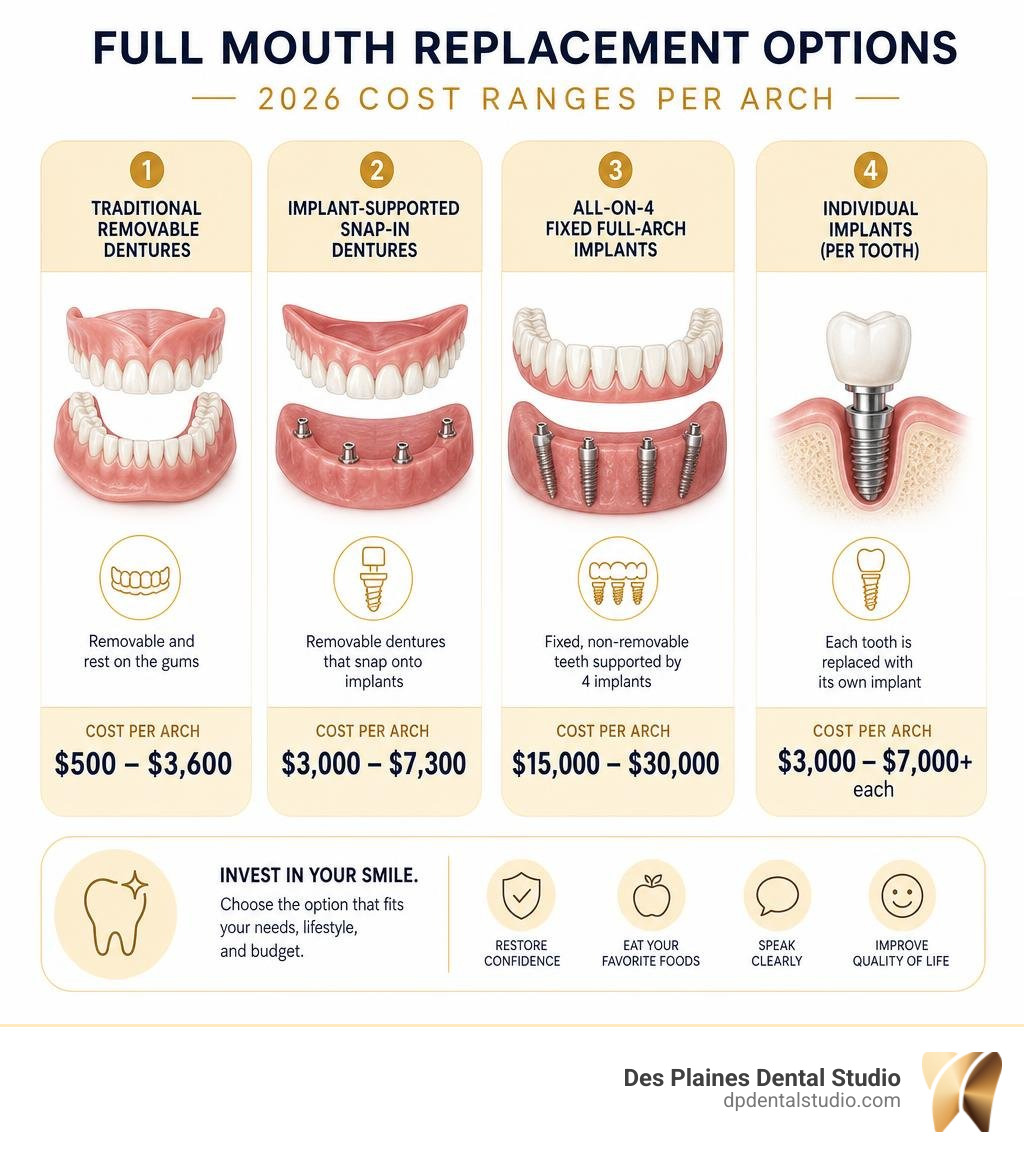
However, when you start researching how much is it to replace all your teeth, the numbers can feel dizzying. The total financial commitment depends heavily on the technology used to secure your new teeth. To help you visual the landscape, let’s map out the primary treatment pathways:
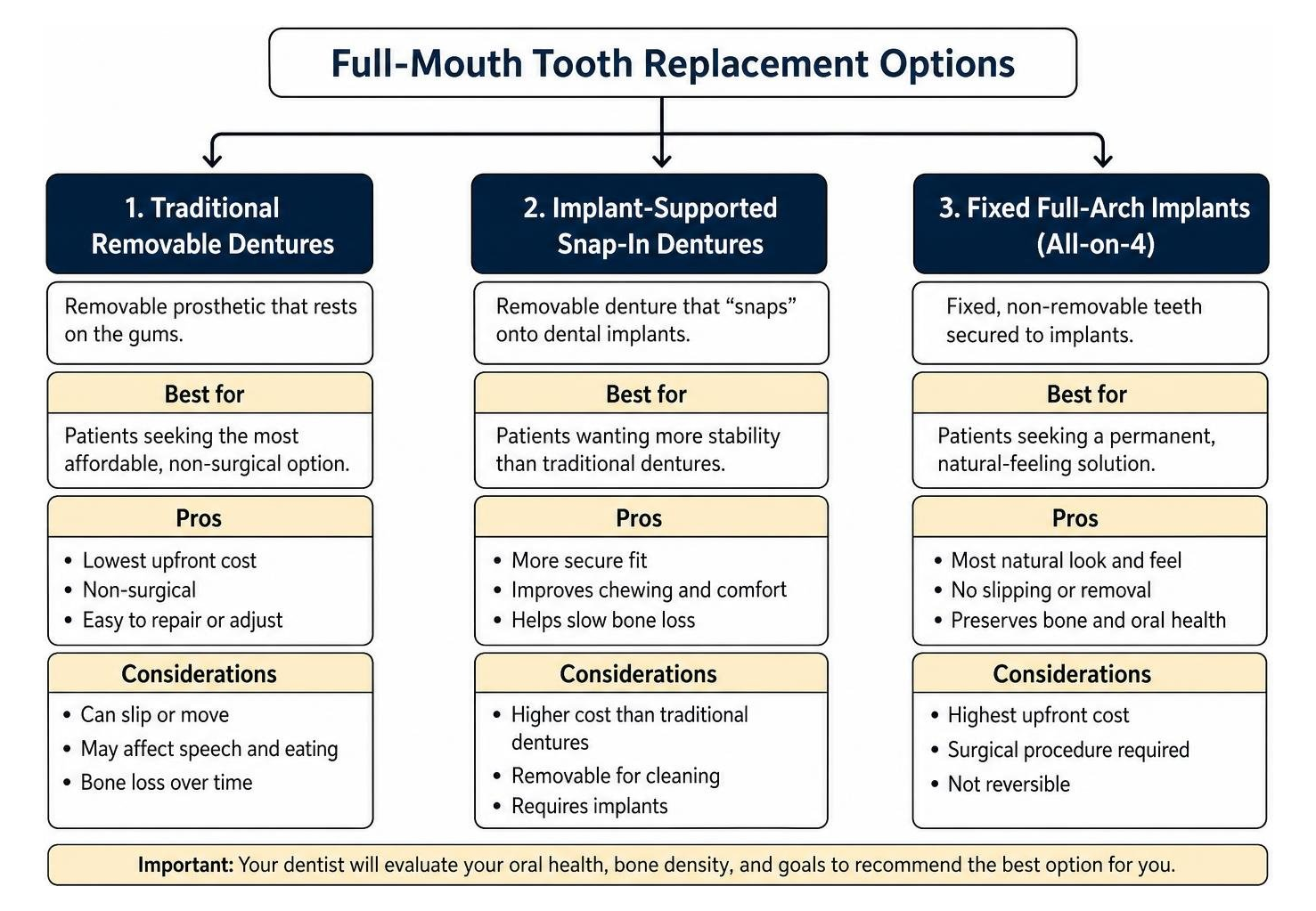
To get a comprehensive understanding of the financial commitment involved in rebuilding your smile, it is helpful to look at the Full Mouth Reconstruction Cost — ToothCostGuide, which outlines how various dental disciplines compile a complete treatment plan.
Traditional Removable Dentures
Traditional dentures are the most familiar and historically common option for replacing a full arch of teeth. These are removable prosthetics that sit directly on your gum tissue, relying on natural suction or dental adhesives to stay in place.
The average cost for dentures is generally categorized into three tiers:
- Economy Dentures ($500 – $1,200 per arch): These are often cold-cured acrylics. While they are highly budget-friendly, they tend to look less natural and are more prone to warping or cracking over time.
- Standard Dentures ($1,500 – $2,500 per arch): Heat-cured and customized to fit your mouth, these offer a much more realistic appearance and improved comfort.
- Premium Dentures ($2,000 – $3,600 per arch): Crafted using ultra-durable, high-impact materials and premium prosthetic teeth, these offer the highest level of realism and resistance to wear.
If you are looking for reliable, beautifully crafted traditional dentures locally, we design custom-fit dentures des plaines il to ensure your smile looks natural and feels secure.
Implant-Supported Overdentures (Snap-In Dentures)
If you want more security than traditional adhesives can offer but aren’t ready for the investment of a completely fixed bridge, snap-in dentures are an excellent middle ground.
Also known as implant overdentures, this system uses two to four surgically placed dental implants per arch. The underside of the denture features specialized attachments that “snap” onto corresponding abutments on the implants. This configuration prevents the embarrassing slips and clicks of traditional plates while still allowing you to remove the denture at night for cleaning.
Beyond stability, the physical implants stimulate the underlying bone tissue, aiding in jawbone preservation and halting the facial sagging that naturally occurs with long-term tooth loss. If you are tired of loose plates, you can easily repair your smile with dentures anchored securely by dental implants.
All-on-4 and Fixed Full-Arch Bridges
For the ultimate in realism, convenience, and chewing power, fixed full-arch bridges are the gold standard. The most popular version of this treatment is the All-on-4 system.
Instead of replacing every tooth with an individual implant, All-on-4 utilizes exactly four strategically angled titanium posts per arch. Because the rear implants are placed at a 45-degree angle, they maximize the use of your existing bone, often bypassing the need for expensive bone grafts.
Once healed, a customized, non-removable bridge is permanently screwed onto these posts. You brush them just like natural teeth, eat whatever you want (yes, even apples and steak), and never have to take them out. To learn more about how this life-changing system works right here in our neighborhood, check out our guide on all-on-4 dental implants des plaines il.
Cost Breakdown by Treatment Type and Per Arch
To budget effectively, you must understand how dental pricing is structured. Almost all dental offices quote prices per arch (either the upper or lower jaw). If you need to replace all your teeth, you will need a double-arch restoration, which essentially doubles the single-arch price.
According to the comprehensive Full Mouth Dental Implants Cost: $55,000 Avg in 2026 ($30,000–$90,000), patients requiring complete reconstruction typically face a national average investment of $55,000 for a full mouth of implants. However, this number fluctuates significantly based on the specific system you choose.
Understanding How Much Is It to Replace All Your Teeth with All-on-4
Because of its efficiency and predictability, the All-on-4 protocol is the most sought-after full-mouth implant option. In the United States, All-on-4 dental implants typically range from $15,000 to $30,000 per arch.
If you are replacing both the upper and lower arches, the cost generally lands between $30,000 and $60,000. To get a clear picture of what goes into this pricing, you can read about the price of full mouth dental implants and how the surgical and restorative phases are combined.
For a detailed breakdown of what to expect per jaw, you can also review the All-on-4 Cost per Arch in 2026 guide, which highlights how material choices and surgical planning influence the final invoice.
Comparing How Much Is It to Replace All Your Teeth with Snap-In Dentures vs. Individual Implants
If you are weighing your options, the financial contrast between snap-in dentures and individual implants is stark.
Implant-supported snap-in dentures generally range from $3,000 to $7,300 per arch (averaging around $5,000 per arch, or $10,000 to $25,000 for a full mouth). This is highly cost-effective because it uses fewer implants and a simpler prosthetic design.
On the other hand, attempting to replace a full mouth of teeth using individual implants (placing a single implant and crown for every single missing tooth) is highly inefficient and rarely recommended. With individual implants costing $3,000 to $7,000 per tooth, a full mouth of 28 teeth would cost upwards of $84,000 to $196,000!
To understand why full-arch systems are so much more practical, take a look at our breakdown of the average cost of full dental implants.
Key Factors That Influence the Total Cost of Full-Mouth Restoration
No two mouths are identical, which is why we cannot give a single, flat price over the phone. During your initial consultation, we use advanced 3D imaging to map out a customized treatment plan. Several key variables will drive the cost of your reconstruction up or down.
Material Choices: Zirconia vs. Acrylic
The material used to fabricate your final teeth plays a massive role in both the upfront cost and the long-term durability of your smile.
- PMMA Acrylic: This is the most affordable option. While lightweight and easy to repair, acrylic is porous. Over time, it is prone to staining, absorbing odors, and chipping under heavy chewing forces. Acrylic arches typically require replacement every 5 to 10 years.
- Zirconia: Zirconia is a premium monolithic ceramic material. It is virtually indestructible, completely stain-resistant, and possesses a natural translucency that mimics real tooth enamel. Opting for zirconia can add $5,000 to $15,000 per arch to your treatment, but because it can last a lifetime, it is often the most economical choice over time.
To explore how these material choices affect the look and longevity of your smile, read our clinical overview of dental implant restorations.
Preparatory Procedures: Extractions, Bone Grafting, and Sinus Lifts
Many patients who need a full mouth of replacement teeth have remaining teeth that are severely decayed or compromised by periodontal disease. These teeth must be extracted before implants can be placed.
- Tooth Extractions: Simple extractions cost $150 to $600 per tooth. Full-mouth extractions can add $1,500 to $3,000+ to the total bill.
- Alveoloplasty: Often performed alongside extractions, this procedure smooths and reshapes the jawbone to ensure a comfortable fit for your new prosthetic.
- Bone Grafting: If you have been missing teeth for a long time, your jawbone may have resorbed (shrunk). Implants require strong bone support. A bone graft builds up the bone density and costs $300 to $800 per site.
- Sinus Lifts: If you need implants in your upper back jaw where bone is naturally thin, we may need to perform a sinus lift ($1,500 to $3,000 per side) to create enough room for the implant posts without penetrating the sinus cavity.
If you are wondering what steps your unique smile might require, you can read about our approach to des plaines dentist filling in the gaps your options for missing teeth.
Geographic Location and Provider Expertise
Where you have your surgery performed—and who performs it—will heavily influence your final estimate.
In Illinois, the average cost for a single implant is approximately $2,207, making full-mouth reconstruction in our state slightly higher than the national average. Within the Chicago metropolitan area, prices can vary significantly between downtown clinics and suburban practices. Factors such as local overhead costs, the complexity of the clinical setting, and regional demand all play a role in the final pricing structure.
When seeking care, it is vital to work with a highly qualified team. While you might find a general dentist offering heavily discounted rates, complex full-mouth cases are best handled by providers with advanced, hospital-level surgical training. To find a trusted specialist close to home, search for dental implants near me or partner with an experienced dental implants provider des plaines.
Hidden Costs, Insurance Coverage, and Financing Options
One of the biggest frustrations patients face is receiving a “low-ball” quote, only to discover later that essential steps were billed as unbundled “add-ons.” To protect your wallet, you should always request a fully itemized treatment plan.
To understand how these unbundled fees can accumulate, the independent guide How Much Do Dentures Cost in 2026? Full, Partial & Implant offers a transparent look at the “hidden” fees—such as diagnostics and relines—that marketing campaigns often leave out.
What is Typically Included in a Quoted Price?
A comprehensive, honest quote for full-mouth implants should include:
- Initial diagnostic imaging: 3D CBCT scans and digital planning.
- Surgical fees: The physical placement of the implants.
- Sedation or anesthesia: To ensure a completely pain-free experience.
- The provisional (temporary) teeth: Attached on the day of surgery so you don’t leave toothless.
- The final permanent prosthesis: Fabricated and delivered after your jaw has fully healed.
If a clinic advertises an unbelievably low price, ask them if it includes the final zirconia arch or if that is billed separately. To help you decode these pricing structures, read our guide on how much does a one day full mouth dental implant actually cost.
Navigating Dental Insurance and Medical Coverage
Let’s address the elephant in the room: standard dental insurance rarely covers the full cost of dental implants. Most traditional plans view implants as “elective” or “cosmetic” and cap their annual maximum benefits at $1,000 to $2,500.
However, your insurance is still incredibly valuable. It can often be used to cover preparatory work, such as:
- Initial consultations and 3D CBCT scans.
- Tooth extractions (often covered at 70% to 80%).
- Sedation or IV general anesthesia.
- A portion of the final crown or bridge.
Additionally, in some cases involving severe trauma, oral cancer, or congenital conditions, your medical insurance may cover a portion of the surgical reconstruction. To learn how to maximize your benefits, read our dental implants insurance guide 2026 and find out how to get dental implants covered by medical insurance.
Flexible Financing and Payment Plans
Because replacing all your teeth is a significant life investment, very few patients pay the entire balance out of pocket on day one. We offer several flexible payment strategies to make treatment highly accessible:
- Third-Party Financing: We partner with reputable healthcare lenders like CareCredit, LendingClub, and Proceed Finance to offer low-interest and 0% promotional interest payment plans.
- HSA and FSA Funds: Because dental reconstruction is a medically necessary procedure, you can use your pre-tax Health Savings Account (HSA) or Flexible Spending Account (FSA) dollars, saving you up to 30% depending on your tax bracket.
- Phased Treatment: In some cases, we can phase your treatment across calendar years to maximize two years of insurance resets.
For more practical tips on navigating these options without stress, check out our guide on how to find the cheapest dental implants without losing your mind.
Long-Term Value: Implants vs. Traditional Dentures
When evaluating how much is it to replace all your teeth, it is easy to focus solely on the upfront cost. However, looking at the 20-year lifetime cost of your options reveals a very different financial picture. To help you weigh the true cost of each path, read the ultimate guide to dental implants costs and benefits.
Lifespan and Maintenance Costs
While traditional dentures are much cheaper initially, they carry significant ongoing maintenance costs:
- Frequent Relines: Your jawbone naturally shrinks when teeth are missing, causing dentures to become loose. They must be professionally relined every 1 to 2 years ($200 to $500 per visit).
- Replacement Cycles: Traditional dentures typically wear out and must be completely replaced every 5 to 7 years.
- Adhesives and Cleaners: Specialty creams, adhesives, and soaking tablets can cost hundreds of dollars annually.
In contrast, the titanium posts of dental implants are designed to last a lifetime. While the prosthetic teeth (especially acrylic ones) may need maintenance, a zirconia bridge can easily last 20+ years with proper care. To understand the long-term wear and maintenance of full-arch restorations, explore the ultimate guide to full mouth bridges dont let missing teeth get you down.
Biological Benefits and Jawbone Preservation
The most critical difference between dentures and implants is biological. When you lose teeth, your jawbone no longer receives the chewing stimulation it needs to stay healthy. As a result, the bone begins to resorb (melt away), losing up to 25% of its width in the first year alone. This resorption leads to:
- A collapsed facial appearance and premature aging.
- Chronic gum irritation and painful sore spots.
- Difficulty speaking clearly and a severely weakened bite force.
Dental implants are the only tooth replacement option that actively prevents bone loss through osseointegration—the biological process where titanium fuses directly with your living bone. To understand how preserving your bone structure protects your overall health, read what you should know about partial dentures dentist in des plaines il 60016.
Frequently Asked Questions about Full-Mouth Tooth Replacement
We know that committing to full-mouth restoration is a major decision. Here are the most common questions our patients ask during their initial consultations. If you would like to discuss your specific case, you can easily schedule a personalized dental consultation des plaines il.
Is the full-mouth dental implant procedure painful?
No. The actual surgical procedure is completely pain-free. We perform the surgery under local anesthesia combined with deep IV sedation or general anesthesia, meaning you will sleep comfortably through the entire process.
After the anesthesia wears off, you can expect some swelling, bruising, and minor discomfort, which most patients rate as a 3 to 5 out of 10. This is easily managed with prescribed or over-the-counter pain medications and typically subsides within 3 to 5 days.
How long does the entire process take from start to finish?
The entire process typically takes 3 to 9 months, depending on your body’s natural healing rate.
- Phase 1 (Day of Surgery): Any failing teeth are extracted, implants are placed, and a temporary bridge is attached.
- Phase 2 (Osseointegration): You will wear the temporary bridge for 3 to 6 months while the titanium implants fuse with your jawbone. You will stick to a soft-food diet during this time.
- Phase 3 (Final Delivery): Once fully healed, we take digital impressions and fabricate your final, ultra-durable permanent bridge.
Can I get temporary teeth on the same day as my surgery?
Yes! Thanks to immediate loading protocols (often called “Teeth in a Day”), we can almost always attach a beautiful, fully functional temporary bridge to your implants on the very same day as your surgery. You will never have to walk out of our office without a smile. To see if you are a candidate for this immediate-load technology, read can you really get a brand new smile in just one day.
Conclusion
Replacing all of your teeth is a deeply personal journey. Whether you decide that custom traditional dentures, a secure snap-in overdenture, or a permanent All-on-4 bridge is the right fit for your lifestyle and budget, the team at Des Plaines Dental Studio is here to support you every step of the way.
We pride ourselves on providing patient-centered care in a warm, welcoming, and completely pain-free environment. We will work closely with your insurance provider, help you navigate flexible financing, and craft a gorgeous, durable smile that restores your confidence and quality of life.
Ready to take the first step toward your new smile? Check out our comprehensive guide on the average cost of dental implants and contact our Des Plaines office today to schedule your consultation!