


Molar Implants 101: What It Costs to Replace Your Back Teeth
What Does It Cost to Replace a Missing Molar?
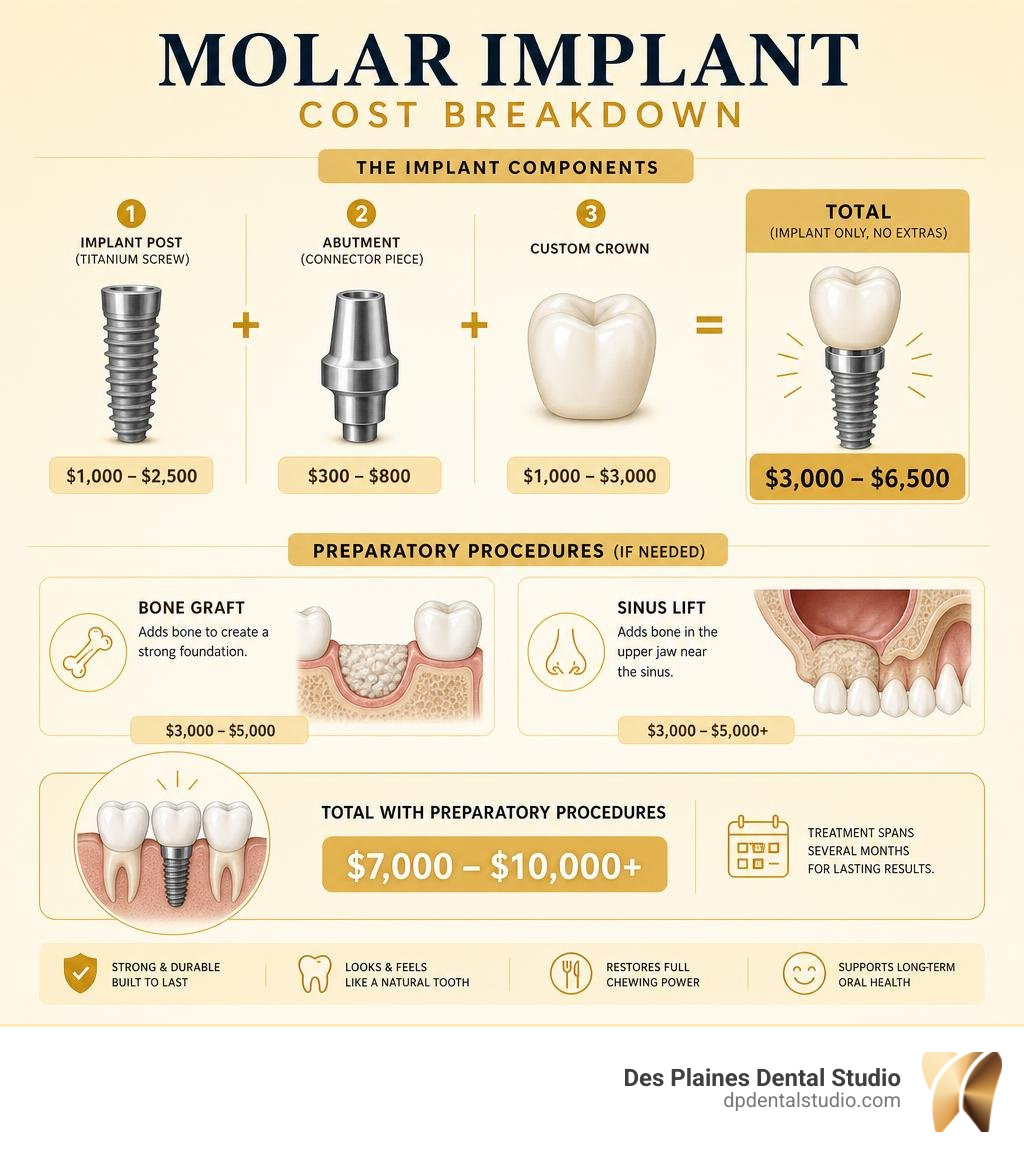
The replacement molar cost in the United States typically falls in this range:
| What You’re Paying For | Typical Cost |
|---|---|
| Implant post (titanium screw) | $1,000 – $2,500 |
| Abutment (connector piece) | $300 – $800 |
| Custom crown | $1,000 – $3,000 |
| Total (implant only, no extras) | $3,000 – $6,500 |
| With bone graft or sinus lift | $7,000 – $10,000+ |
These are national averages for 2026. Your actual cost depends on your jawbone health, which tooth is being replaced, and your location.
Losing a back tooth is easy to ignore at first. It’s not visible when you smile. But molars do the heaviest lifting in your mouth — grinding food under 150 to 200+ pounds of pressure with every bite. When one goes missing, neighboring teeth start to shift, the jawbone begins to shrink, and chewing becomes harder over time.
That’s why so many people eventually start asking: how much does it actually cost to fix this?
The honest answer is that the price varies — sometimes by thousands of dollars — depending on your specific situation. This guide breaks down every cost involved so you can walk into a consultation knowing exactly what to expect.
I’m Dr. Marta Milejczyk, and with over 25 years of experience in restorative and implant dentistry in Chicago’s northwest suburbs — including a General Practice Residency at Loyola University Medical Center — I’ve helped hundreds of patients navigate the replacement molar cost conversation with clarity and confidence. Let’s walk through everything you need to know.
Understanding the Average Replacement Molar Cost in 2026
When we talk about the overall replacement molar cost, we are looking at a multi-stage process. Unlike a simple filling, an implant is a surgical and restorative journey that spans several months.
In Illinois, and specifically around the Chicago metropolitan area, the baseline cost for a single-tooth implant typically sits slightly above the national average. Industry data shows that the baseline surgical placement of a single implant in Illinois averages around $2,207, which does not include the essential prosthetic crown or any preliminary treatments like extractions and bone preservation.
When you add up all the necessary components — the post, the connector, and the final custom back-tooth crown — the total out-of-pocket replacement molar cost for a straightforward case in 2026 generally ranges from $3,000 to $6,500.
If you want to understand how these numbers fit into the broader landscape of dental restorations, you can read our detailed breakdown on the Average Cost of Dental Implants.
What is Included in the Total Replacement Molar Cost?
To understand why the price is what it is, it helps to look at the implant as three separate parts working together:
- The Implant Post (Fixture): This is the medical-grade titanium screw that acts as your new tooth root. It is surgically inserted directly into your jawbone. Because titanium is highly biocompatible, your bone will naturally fuse to it over time. To learn more about how these posts work, check out our guide on Titanium Bone Implants. This component typically costs between $1,000 and $2,500.
- The Abutment: This is a small connector piece that screws into the implant post and sits just above the gumline. It serves as the anchor for your new crown. You can read about what to expect financially for this step in our article on Dental Abutment Costs What to Expect When Youre Connecting. An abutment generally runs between $300 and $800.
- The Custom Molar Crown: This is the only part of the implant you will actually see. It is custom-designed to match your bite and the color of your surrounding teeth. Because molars handle extreme chewing forces, these crowns must be made of highly durable materials like monolithic zirconia or porcelain-fused-to-metal. For a deeper look at back-tooth restoration pricing, check out Molar Crown Cost: What a Back-Tooth Crown Really Runs. A molar crown typically ranges from $1,000 to $3,000.
Why Molar Implants Cost More Than Front Teeth
It might seem counterintuitive that a tooth hidden in the back of your mouth costs as much as — and sometimes more than — a highly visible front tooth. While front teeth require meticulous cosmetic detailing, molars present unique structural and mechanical challenges:
- Extreme Biting Forces: Your back teeth endure up to 200 pounds of pressure per square inch when you chew. To survive this daily pounding, molar implants require wider diameters (typically 5 to 6 millimeters, compared to 3 to 4 millimeters for front teeth) and incredibly robust materials.
- Complex Anatomy: Upper molars sit directly beneath the maxillary sinuses, while lower molars sit just above the inferior alveolar nerve. Navigating these delicate spaces requires advanced 3D imaging (CBCT scans) and highly precise surgical placement.
- Premium Materials: For back teeth, we frequently utilize monolithic zirconia or high-noble metals. These materials are exceptionally strong but come with higher laboratory fabrication costs. To see how these restorations are crafted, explore our page on Dental Implant Restorations.
Key Factors and Preparatory Procedures Influencing Price
No two mouths are identical, which means no two implant bills are identical. Several key variables will push your final replacement molar cost toward either the lower or higher end of the spectrum.
- Geographic Location: Dental fees reflect the local cost of living and running a practice. In the Chicago metropolitan area, including Des Plaines, IL, operating overhead, laboratory fees, and specialized equipment costs mean prices are generally higher than in rural areas, but they also reflect a high standard of clinical care.
- Dentist Expertise and Specialization: A general dentist with basic implant training may charge less than a board-certified prosthodontist or oral surgeon who has completed years of residency training specifically in complex reconstructive cases.
- Type of Anesthesia: Simple local anesthesia is highly cost-effective and included in the base surgical fee. However, if you experience dental anxiety and opt for nitrous oxide, oral conscious sedation, or IV deep sedation, this will add anywhere from $150 to $1,500+ to your total.
The Impact of Preparatory Procedures on Replacement Molar Cost
The health of your mouth before the implant is placed is the biggest “wild card” in pricing. If you have been missing a molar for several years, or if the tooth was lost to severe periodontal disease, your jawbone may not be strong enough to support an implant right away.
- Simple Tooth Extraction: If the failing molar is still in your mouth, it must be removed. A simple extraction costs between $150 and $450, while a complex surgical extraction can run higher.
- Bone Grafting: When a tooth is lost, the surrounding bone naturally begins to resorb (shrink). A bone graft places specialized bone material into the socket to rebuild the volume and density needed to anchor the titanium post. You can read about this crucial preparatory step in Bone Grafting for Dental Implants. A localized bone graft typically adds $500 to $1,500 to your treatment plan.
- Sinus Lift: The upper jaw has less bone density than the lower jaw, and the sinus cavities sit directly above your upper molars. If the bone is too thin, we must perform a sinus lift — gently raising the sinus floor and packing bone graft material underneath — to create a safe foundation. A sinus lift is a delicate surgical procedure that typically costs between $1,500 and $3,000.
If you require both a sinus lift and a bone graft alongside your extraction, your total replacement molar cost can easily climb to $7,000 to $10,000+.
Molar Implants vs. Alternatives: Cost, Longevity, and Timeline
If you are hesitating at the upfront cost of a molar implant, you might be considering alternative treatments like a dental bridge or a removable partial denture. Let’s look at how these options compare in terms of initial price, long-term value, and treatment timelines.
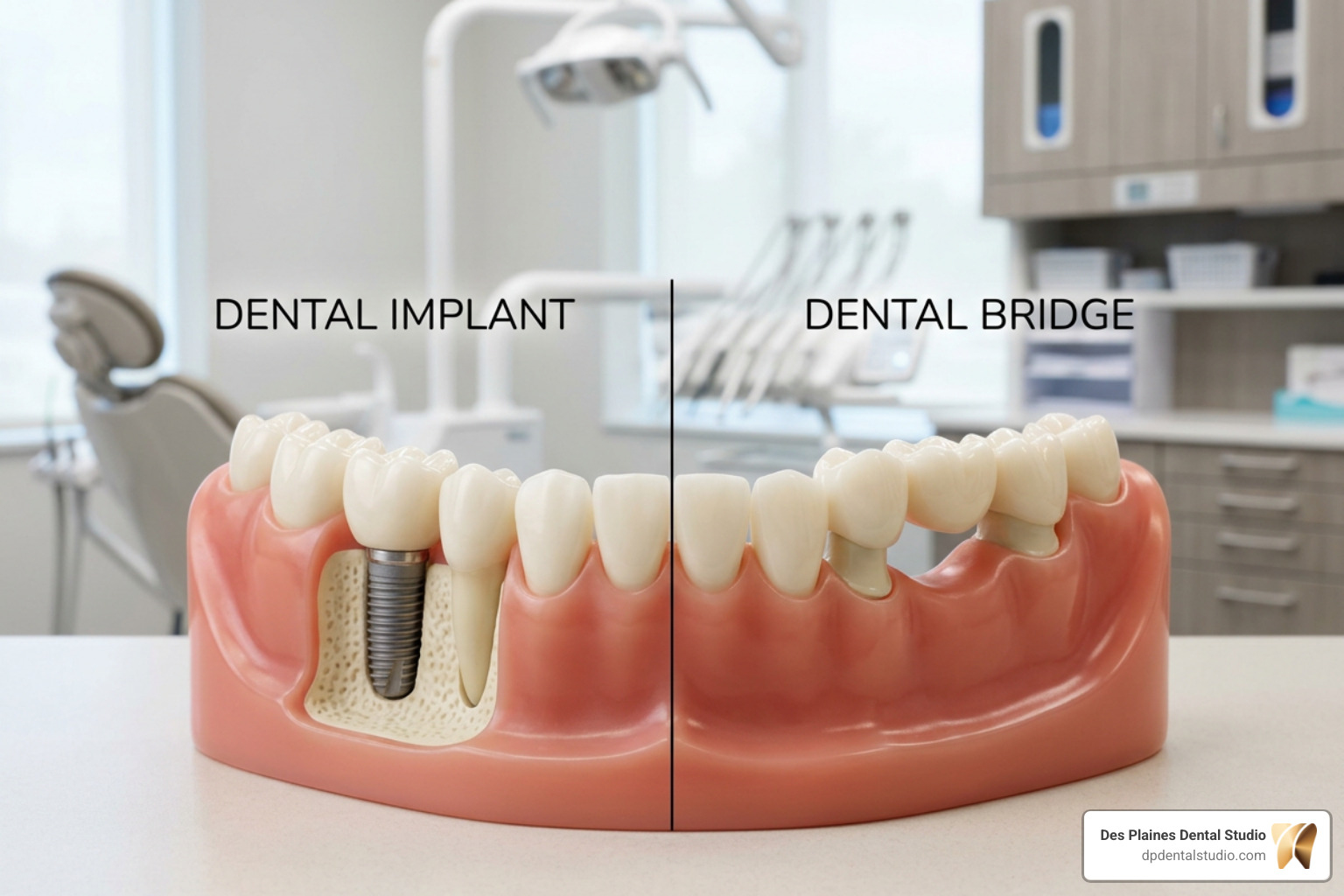
Here is a quick look at how the three primary molar replacement options stack up:
Dental Bridges
- Initial Cost: $1,500 – $3,500
- Lifespan: 10 – 15 years
- Pros: Faster timeline (completed in a few weeks); no surgery required.
- Cons: Requires grinding down the healthy adjacent teeth to act as anchors; does not stimulate the jawbone, leading to bone loss over time; higher risk of decay on anchor teeth.
Removable Partial Dentures
- Initial Cost: $700 – $1,800
- Lifespan: 5 – 10 years
- Pros: Most affordable upfront cost; non-invasive.
- Cons: Can feel bulky or slip while eating; must be removed nightly; does not prevent bone loss; requires ongoing adjustments. You can learn more about general denture pricing in our guide on the Average Cost for Dentures.
Molar Dental Implants
- Initial Cost: $3,000 – $6,500 (simple case)
- Lifespan: 25+ years to a lifetime
- Pros: Completely standalone (no damage to neighboring teeth); preserves jawbone density; functions exactly like a natural tooth.
- Cons: Higher initial cost; requires minor surgery; longer treatment timeline.
While a bridge or partial denture is cheaper today, they often require repair, relining, or complete replacement within 10 to 15 years. Over a 20- to 30-year span, a single molar implant is almost always the most cost-effective financial decision because it is designed to be a one-time, lifetime investment.
The Treatment Timeline: What to Expect
Getting a molar implant is a marathon, not a sprint. The biology of bone healing cannot be rushed. Here is what the typical journey looks like:
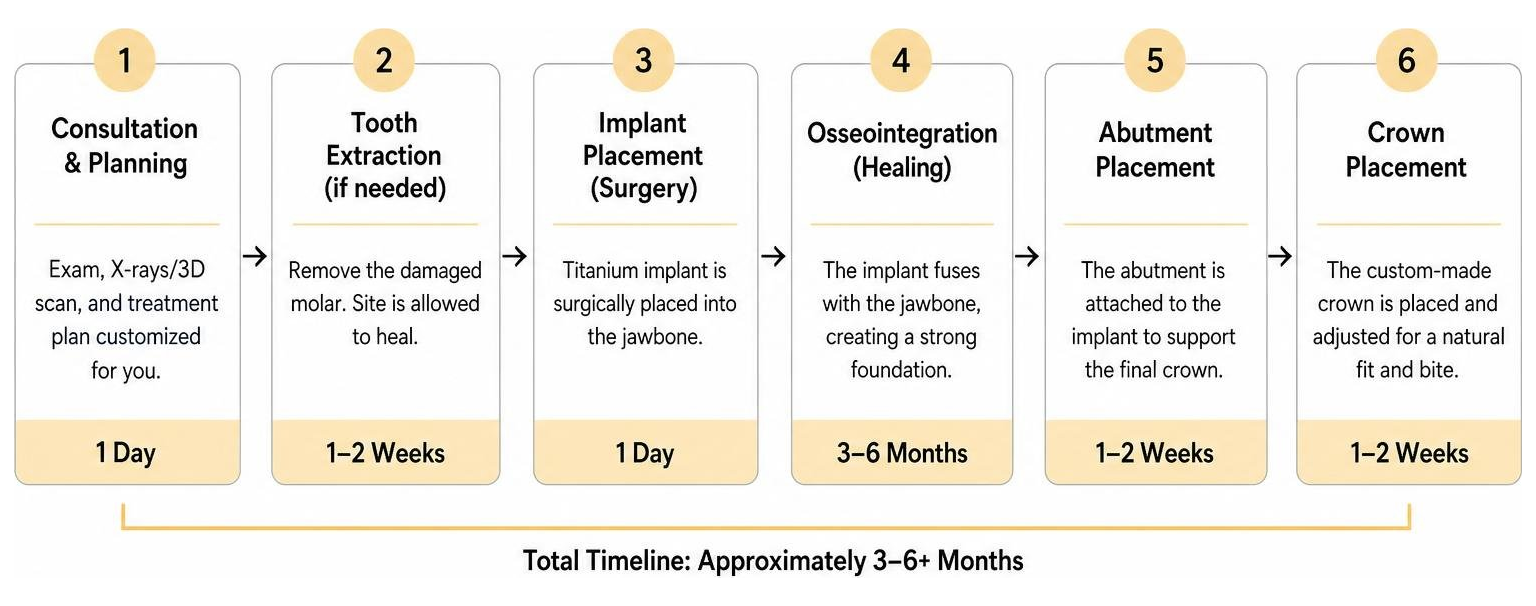
The longest phase of this process is osseointegration — the biological magic where your living jawbone cells grow around and permanently fuse with the titanium implant post. This typically takes 3 to 6 months. If you try to place the heavy molar crown too early, the chewing pressure will cause the implant to fail. Patience is key to protecting your financial investment!
Insurance, Financing, and Finding Affordable Care
One of the most common questions we hear is: Will my insurance help cover this?
Historically, dental insurance plans labeled implants as “cosmetic” and refused to pay a dime. Fortunately, that has changed. In 2026, many modern dental insurance plans will cover a portion of the treatment — typically between $1,000 and $2,000 of your annual maximum. They are especially likely to cover the diagnostic steps (like 3D scans), the extraction, or the final custom crown, even if they consider the titanium post itself to be elective.
To navigate these complex policies, check out our comprehensive Dental Implants Insurance Guide 2026. In rare cases where tooth loss is linked to a severe medical condition or traumatic accident, you might even find relief through medical insurance; see our guide on How to Get Dental Implants Covered by Medical Insurance.
Smart Ways to Manage the Out-of-Pocket Cost
If you are paying for your molar replacement out of pocket, you do not have to let the cost hold you back from a healthy smile. Here are several practical strategies to make care affordable:
- Utilize Tax-Advantaged Accounts (FSA/HSA): You can use pre-tax dollars from your Flexible Spending Account (FSA) or Health Savings Account (HSA) to pay for dental implants, saving you up to 30% depending on your tax bracket.
- Phased Treatment Planning: Because the implant process naturally takes several months, you do not have to pay the entire bill upfront. You can pay for the extraction and bone graft in month one, the implant surgery in month four, and the custom crown in month seven. This spreads the financial impact across two calendar years, allowing you to maximize two years of insurance benefits.
- Flexible Monthly Financing: We work with reputable third-party healthcare lenders like CareCredit or Cherry, which offer low-interest or interest-free payment plans. This allows you to break down a $4,000 treatment plan into manageable monthly payments.
For more creative and realistic ideas on keeping your bills low, read our practical guide on How to Find the Cheapest Dental Implants Without Losing Your Mind.
Frequently Asked Questions About Molar Implants
How painful is getting a molar dental implant?
Most patients are pleasantly surprised to find that getting an implant hurts significantly less than a standard tooth extraction. The procedure is performed under local anesthesia, meaning you will feel some pressure but absolutely no sharp pain. Afterward, any mild soreness or swelling is easily managed with over-the-counter ibuprofen or acetaminophen for 2 to 4 days.
Can I get a molar implant years after my tooth was extracted?
Yes, absolutely! However, because the jawbone naturally resorbs over time when a tooth root is missing, waiting several years means you will almost certainly require a bone graft before the implant can be placed. If you are replacing an upper molar that was lost years ago, you may also require a sinus lift because the sinus cavity tends to expand downward into the empty space.
Are molar implants worth the investment for long-term oral health?
They are absolutely worth it. While a missing back tooth might not affect your smile’s appearance, it has massive functional consequences. Without a molar, your remaining teeth must absorb double the chewing forces, leading to cracked teeth, uneven wear, and TMJ (jaw joint) pain. Furthermore, an implant is the only option that preserves your natural jawbone structure and prevents the collapse of your bite’s vertical height.
To explore the clinical and lifestyle benefits in depth, read The Ultimate Guide to Dental Implants Costs and Benefits.
Conclusion
Replacing a missing molar is one of the most important decisions you can make for your long-term oral health, digestion, and overall quality of life. While the upfront replacement molar cost requires a financial commitment, the lifetime durability, natural function, and jawbone protection make dental implants the gold standard of modern dentistry.
At Des Plaines Dental Studio, we believe that high-quality restorative care should be transparent, comfortable, and accessible. We pride ourselves on offering patient-centered care, navigating insurance policies on your behalf, and providing a welcoming, pain-free clinical experience right here in Des Plaines, IL.
If you are ready to restore your chewing power and protect your smile, we invite you to take the first step. Visit our Dental Implants Provider Des Plaines page to learn more about our approach, or explore our comprehensive guide on the Average Cost of Dental Implants to plan your next steps with confidence. Let’s work together to bring back your complete, healthy smile!