


Are Teeth Implants Expensive? The Short Answer
Yes, dental implants are expensive upfront. In the U.S., a complete single-tooth implant commonly costs about $3,000 to $7,000, including the implant post, abutment, and crown. The 2026 average is around $4,500.
That price can rise if you need an extraction, 3D imaging, bone grafting, a sinus lift, or sedation. But an implant is also built to last: the post can last decades or longer with good care, while the crown often lasts 10 to 15 years before replacement may be needed.
The key is not to compare an implant’s price with a denture or bridge on day one. Compare the total cost, replacements, comfort, and impact on nearby teeth and jawbone over time. A clear, itemized treatment plan helps you see what is included before you commit.
I am Marta Milejczyk, a dentist with advanced training in restorative, cosmetic, and implant dentistry, plus clinical rotations in oral surgery and anesthesiology. If you are asking, “are teeth implants expensive,” my goal is to help you understand the real costs and options without confusing jargon or surprise fees.
Glossary for are teeth implants expensive:
- full mouth implants cost guide
- what you will actually pay for a full mouth restoration
- the real cost of a dental bridge with and without insurance
2026 Dental Implant Pricing: Single Tooth to Full Arch
When patients walk into Des Plaines Dental Studio asking about treatment pricing, they are often caught off guard by the wide range of numbers floating around online. You might see an advertisement offering an implant for $899, while an in-depth dental implant costs complete guide lists numbers starting at several thousand dollars.
The variance exists because a finished dental restoration is not a single off-the-shelf product. It is a comprehensive medical process requiring precision surgical placement, custom laboratory fabrication, and personalized healing protocols. In 2026, baseline pricing across the United States reflects these distinct tiers of treatment.
Single-Tooth Implant Cost Breakdown
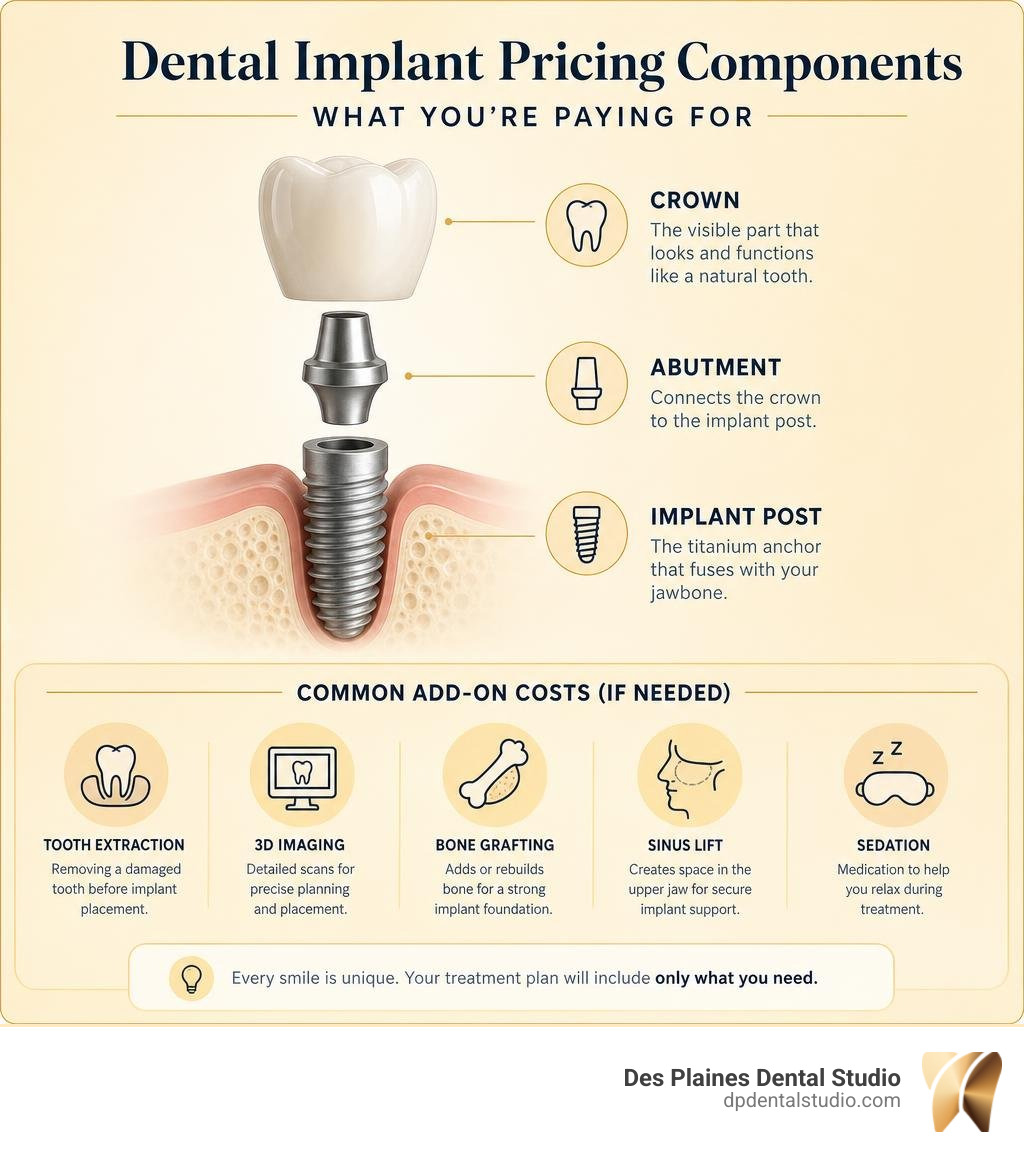
For a single missing tooth, the national average out-of-pocket investment runs approximately $4,500, with a normal range between $3,000 and $7,000. When reviewing a detailed dental implant cost guide, you will find that this total is divided into three primary anatomical components:
- The Implant Post (Fixture): $1,500 to $2,500. This is the medical-grade titanium or ceramic screw placed directly into the jawbone to act as an artificial tooth root.
- The Abutment: $300 to $1,000. This connector piece attaches securely to the implant post and emerges through the gumline to anchor the final restoration.
- The Custom Crown: $1,000 to $3,000. This is the visible, tooth-colored porcelain or zirconia ceramic tooth customized to match your natural smile in color, shape, and bite alignment.
When evaluating a quote, verify whether the fee is all-inclusive or covers only the surgical post. Low teaser rates frequently omit the abutment and crown, leaving patients with unexpected bills later in treatment.
Multi-Tooth Bridges and Full-Arch Restorations
Replacing several missing teeth or an entire arch involves different prosthetic configurations:
- Implant-Supported Bridge (3 to 4 Teeth): $6,000 to $10,000. Instead of placing an individual implant post for every missing tooth, two implants can anchor a solid three- or four-unit bridge, lowering per-tooth replacement expenses.
- All-on-4 Full-Arch Systems: $15,000 to $30,000 per arch. Utilizing four strategically placed implants, a complete arch of fixed, non-removable teeth is secured to restore full chewing function. For local patients seeking comprehensive restoration, our all-on-4 dental implants des plaines il solutions provide permanent, full-arch stability.
- Full-Mouth Rehabilitation (Both Arches): $30,000 to $90,000+. When extensive tooth loss, severe decay, or periodontal disease affects both the upper and lower jaws, full-mouth restoration re-establishes facial structure, proper occlusion, and long-term oral function.
Why Are Teeth Implants Expensive? The True Anatomy of the Cost
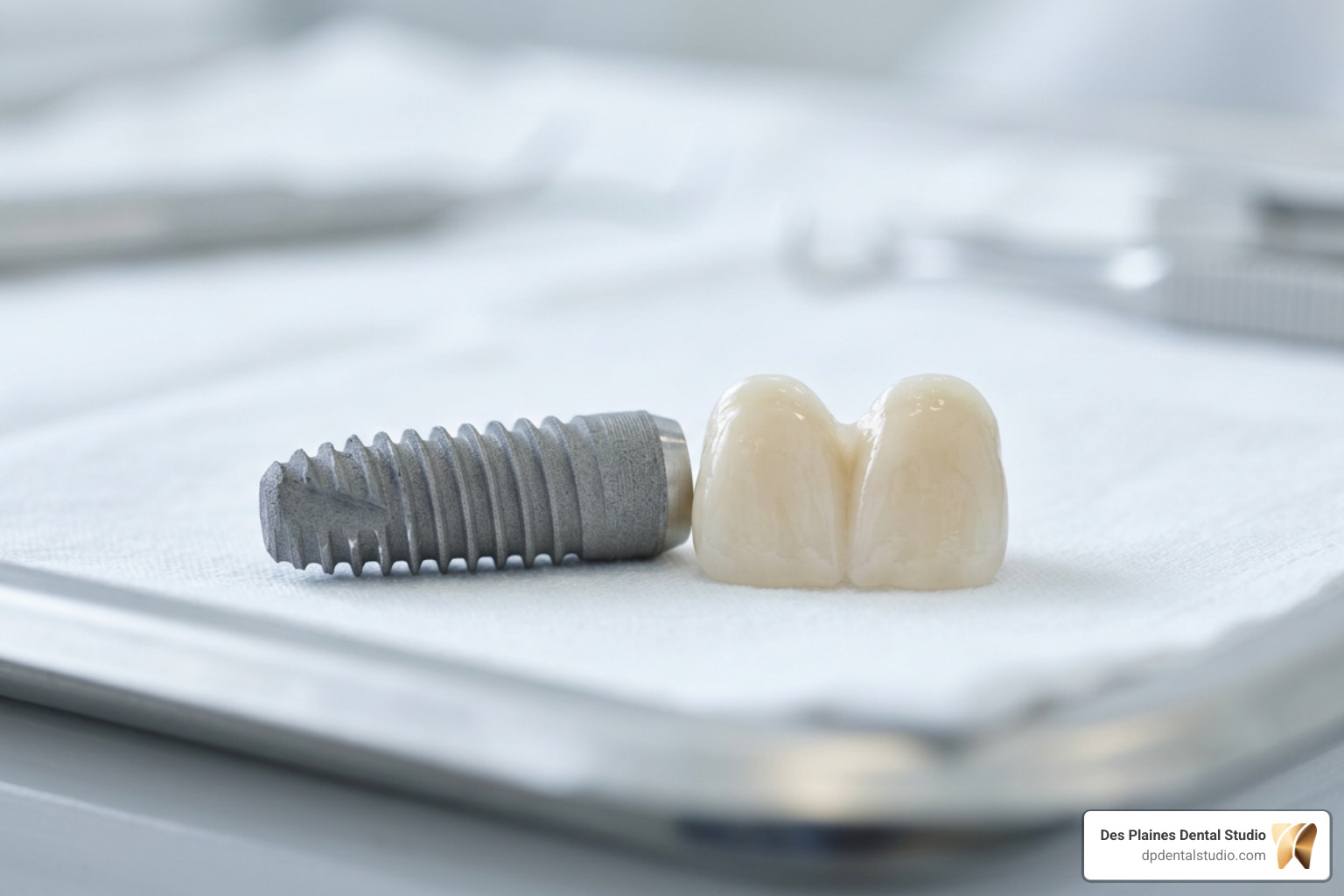
Patients frequently ask why replacing a single tooth costs more than many major consumer purchases. The expense is rooted in specialized surgical training, premium bio-compatible components, custom laboratory engineering, and the extended clinical time required for safe cost breakdown of dental implant procedures.
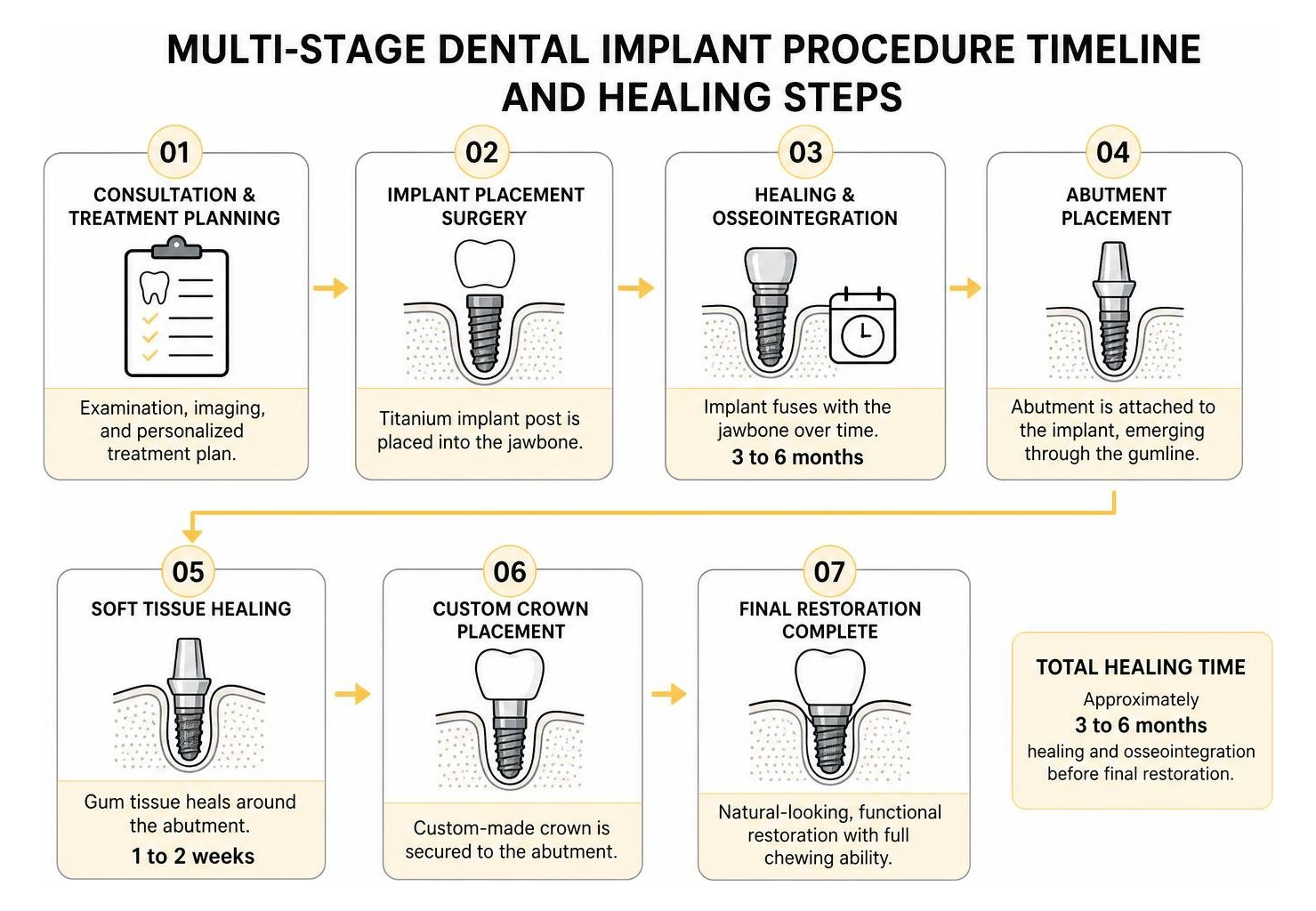
Unlike traditional dental work completed in a single afternoon, implant therapy is an intricate multi-month process. It requires digital surgical mapping, sterile operating protocols, and careful monitoring as the living bone fuses with the titanium post (osseointegration).
Medical-Grade Materials and Custom Laboratory Engineering
The raw materials used in implant dentistry must withstand decades of intense biting force without corroding or causing biological rejection. High-purity grade 4 or grade 5 titanium alloys and medical-grade zirconia ceramics undergo rigorous quality controls.
Furthermore, every crown is custom-milled using advanced CAD/CAM software and detailed by experienced dental lab technicians to recreate natural translucency, marginal integrity, and functional contact points. To explore the value of these materials, read the ultimate guide to dental implants costs and benefits.
Necessary Adjunctive Procedures and Diagnostic Imaging
Many patients require preparatory treatments before an implant can be safely integrated into the jaw. These adjunctive procedures ensure a stable foundation but contribute to the overall investment:
- 3D CBCT Imaging ($300 – $600): High-resolution 3D volumetric scans map bone density, nerve pathways, and sinus cavities for precise surgical placement.
- Tooth Extractions ($150 – $650 per tooth): Removing damaged or non-restorable natural teeth prior to fixture placement.
- Bone Grafting ($300 – $3,000): Adding donor or synthetic bone matrix when the jaw lacks sufficient thickness or height to anchor an implant fixture. Roughly 40% of implant recipients require bone augmentation.
- Sinus Lifts ($1,500 – $5,000): Elevating the sinus membrane in the upper molar region to make room for bone grafting and secure upper implant anchors.
- Sedation Options ($50 – $800+): Nitrous oxide, oral conscious sedation, or IV sedation to deliver a relaxed, pain-free patient experience.
Long-Term Cost Comparison: Implants vs. Bridges vs. Dentures
When calculating the economics of tooth replacement, looking strictly at the day-one price tag creates a misleading impression. Traditional options like dental bridges and removable dentures carry lower initial costs, but they involve recurring maintenance, biological trade-offs, and routine replacement cycles.
| Restoration Option | Initial Upfront Cost | Average Lifespan | 20-Year Maintenance & Replacement Costs | 20-Year Total Projected Cost |
|---|---|---|---|---|
| Single Dental Implant | $3,000 – $7,000 | 25+ Years (Post) / 10–15 Years (Crown) | $1,000 – $2,500 (One Crown Replacement) | $4,000 – $9,500 |
| Traditional 3-Unit Bridge | $2,000 – $5,000 | 5 – 10 Years | $4,000 – $10,000 (1 to 2 Full Replacements) | $6,000 – $15,000 |
| Conventional Denture (Per Arch) | $1,000 – $3,100 | 5 – 8 Years | $3,000 – $6,000 (Relines, Adjustments, Replacements) | $4,000 – $9,100 |
Detailed independent analyses from a dental implant cost analysis confirm that an implant frequently proves to be the more economical choice over decades of use.
Are Teeth Implants Expensive Long-Term Compared to Bridges and Dentures?
A conventional dental bridge requires grinding down healthy adjacent teeth to serve as anchor abutments, irreversibly altering enamel and placing structural strain on natural teeth. Over time, recurring decay beneath the crown margins or structural fracture often necessitates bridge replacement.
Similarly, removable dentures rest on top of gum tissue without stimulating the underlying alveolar jawbone. Without mechanical stimulation from natural tooth roots, the jawbone progressively resorbs (shrinks). This causes dentures to loosen, requiring regular relines ($200 to $500 each) and full remakes every few years.
Because dental implants boast a 10-year clinical success rate near 97%, they prevent progressive bone atrophy and protect adjacent dentition. Over a 20- to 25-year timeline, the upfront investment in an implant avoids the continuous cycle of remakes, adjustments, and repairs common to bridge and denture wearers.
Geographic and Provider Factors That Influence the Bill
Dental fees are not uniform across the United States. Overhead expenses, real estate, malpractice insurance, dental laboratory fees, and local economic factors create distinct regional pricing tiers.
Knowing how to find a dentist near you who does dental implants involves understanding how provider credentials, clinic technology, and local market trends shape your estimate.
Are Teeth Implants Expensive Across Different US Metro Markets?
Urban areas with elevated operating costs feature higher treatment fees than rural or suburban markets. According to a landmark Dental Economics pricing study covering major US metropolitan areas:
- Chicago Metro Area (including Des Plaines): The median total cost for a complete dental implant sits at $4,500.
- Minneapolis: High regional averages push median prices up to $5,505.
- San Francisco: Premium metro costs often range from $4,000 to $6,100+.
- Houston: Greater practitioner density yields a median cost of $3,665.
Within the Greater Chicago and Des Plaines region, clinics with in-house 3D diagnostics and digital planning can often offer competitive, transparent package pricing compared to practices that outsource imaging and laboratory milling to separate facilities.
Specialist Fees vs. General Dentist Pricing
Implant placement can be performed by experienced general dentists with advanced surgical training, or by dental specialists such as oral and maxillofacial surgeons and periodontists.
Interestingly, industry surveys reveal that high-volume surgical specialists maintain a national median complete cost of approximately $3,400 for the surgical phase, compared to $4,800 among general practices that handle lower surgical volume and outsource diagnostic stages.
At Des Plaines Dental Studio, we integrate surgical placement and custom restorative crown design within our modern facility. This streamlined workflow eliminates unnecessary referral markups while maintaining rigorous surgical standards.
Insurance Coverage and Strategies to Make Implants Affordable

Navigating dental insurance for major restorative treatments can be challenging. Historically, insurers classified dental implants as elective cosmetic procedures. Today, many private dental plans recognize the health benefits of implants and provide partial coverage, typically reimbursing 25% to 50% of eligible treatment costs up to your plan’s annual maximum limit.
Navigating Dental and Medical Insurance Benefits
Most dental insurance plans feature an annual maximum benefit cap between $1,000 and $2,500 per calendar year. While this rarely covers an entire implant from start to finish, our comprehensive dental implants insurance guide 2026 highlights proven methods to maximize your policy benefits:
- Pre-Treatment Estimates: We submit detailed diagnostic coding and 3D imaging to your insurer prior to surgery to confirm exact covered line items and reduce surprise fees.
- Calendar-Year Splitting: Because implant placement requires several months of osseointegration before placing the permanent crown, you can place the implant post in November or December (using Year 1 benefits) and attach the custom abutment and crown in January (accessing a renewed Year 2 maximum).
- Medical Insurance Cross-Billing: If tooth loss is caused by severe facial trauma, congenital defects, or systemic medical conditions, medical coverage may help offset surgical expenses. For details on this process, see our guide on how to get dental implants covered by medical insurance.
Practical Ways to Reduce Out-of-Pocket Expenses
Even with insurance limitations, several financial strategies help keep treatment manageable:
- HSA and FSA Pre-Tax Accounts: Using funds from a Health Savings Account (HSA) or Flexible Spending Account (FSA) allows you to pay for treatment using pre-tax income, saving roughly 20% to 35% depending on your tax bracket.
- Third-Party Healthcare Financing: Programs like CareCredit and low-interest monthly financing break large totals into predictable monthly payments. Always ensure promotional zero-percent APR periods are cleared on schedule to prevent deferred interest charges.
- In-House Dental Membership Plans: For patients without traditional dental insurance, our internal plans provide negotiated discounts on restorative and cosmetic procedures without claim denials, deductibles, or waiting periods.
- Prompt Tooth Replacement: Replacing a compromised tooth immediately prevents progressive bone loss, eliminating the need for costly future bone grafting or sinus augmentation.
If you are searching for trusted dental implants near me, working with an experienced local clinic ensures you receive an itemized, transparent estimate backed by attentive follow-up care.
Frequently Asked Questions About Dental Implant Costs
Can I get a full dental implant for under $1,000?
No complete, quality dental implant procedure in the United States costs under $1,000. Advertisements promoting sub-$1,000 pricing almost always quote only the titanium post, excluding the abutment ($300–$1,000), custom crown ($1,000–$3,000), diagnostic 3D imaging, and surgical fees. Highly discounted procedures may also reflect treatment performed at university dental schools or clinics outside the country.
Why do dental implants cost more than dental bridges upfront?
Dental implants involve surgical placement of a biocompatible titanium fixture into the jawbone, a customized precision connector, and a tailored ceramic crown designed to function independently for decades. A traditional bridge simply suspends a false tooth between two natural teeth crowned for support. While a bridge requires less upfront surgical labor, it permanently alters adjacent natural teeth and often requires replacement every 5 to 10 years.
What happens if I delay getting an implant due to cost?
When a natural tooth is missing, the surrounding alveolar bone begins to resorb within months due to the lack of chewing stimulation. Delaying treatment causes adjacent natural teeth to shift, destabilizes your bite, and increases the likelihood that you will require bone grafting ($300–$3,000) or sinus lift surgery ($1,500–$5,000) when you eventually proceed with placement.
Conclusion: Making Smart Decisions for Your Long-Term Smile
While the initial price of dental implants represents a notable health investment, their exceptional durability, 97% long-term success rate, and ability to preserve surrounding bone make them one of the most cost-effective restorations available today.
At Des Plaines Dental Studio, we believe financial transparency and patient comfort go hand in hand. We take the time to evaluate your bone health, explain all available treatment pathways, and design a customized, pain-free treatment plan tailored to your lifestyle and budget.
Ready to restore your smile with clear, straightforward pricing? Contact our welcoming team at Des Plaines Dental Studio today to schedule your consultation and explore the average cost of dental implants for your specific smile goals.