


How Much Does a Bridge in Your Mouth Cost? Here’s What to Expect
If you’re wondering how much does a bridge in your mouth cost, here’s the short answer:
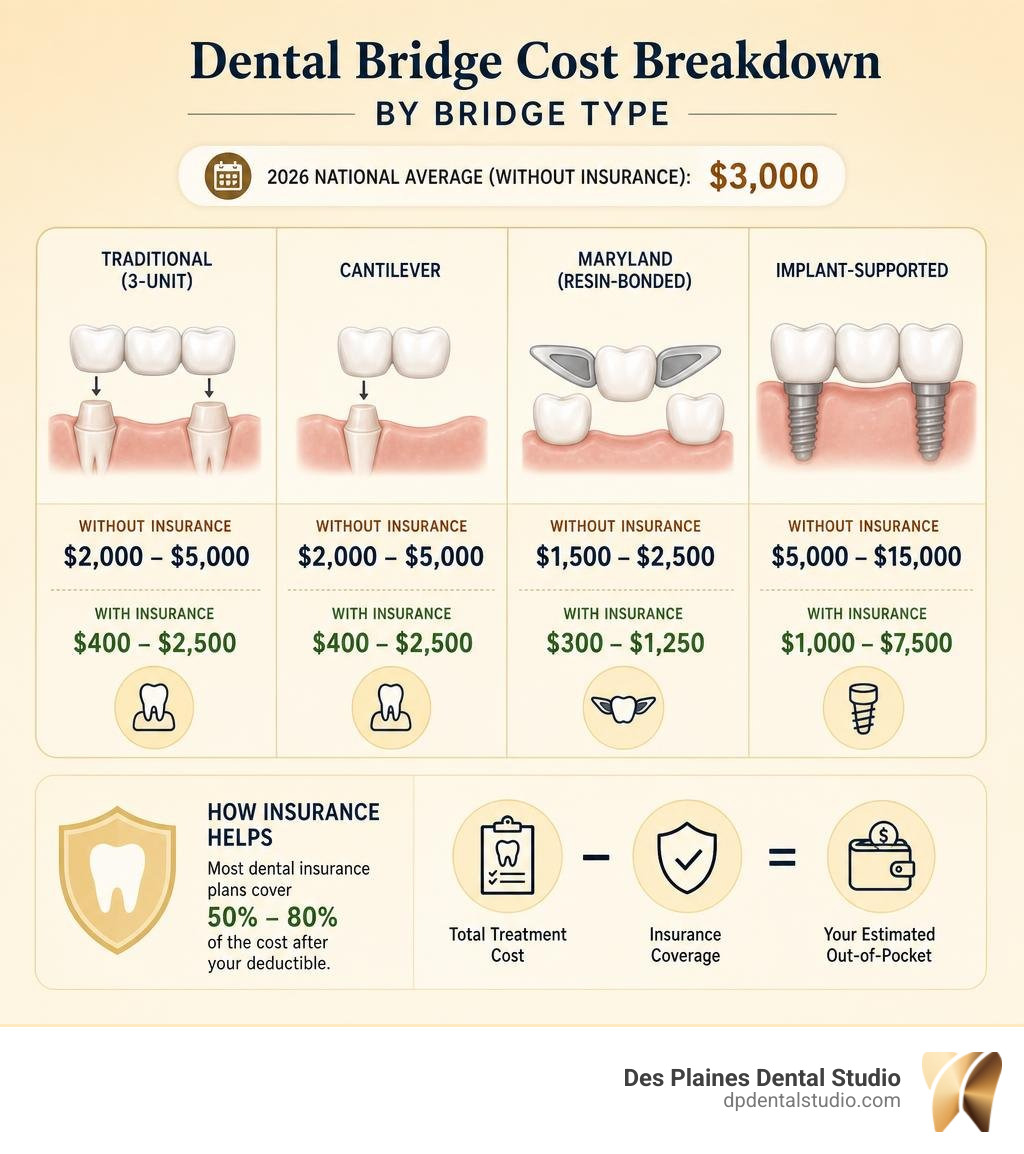
| Bridge Type | Average Cost (Without Insurance) |
|---|---|
| Traditional (3-unit) | $2,000 – $5,000 |
| Cantilever | $2,000 – $5,000 |
| Maryland (resin-bonded) | $1,500 – $2,500 |
| Implant-supported | $5,000 – $15,000 |
The national average in 2026 is around $3,000, with most patients paying between $1,500 and $5,000 depending on bridge type, materials, and location. With dental insurance, that number can drop significantly — most plans cover 50% to 80% of the cost after your deductible.
Costs have also risen over time. Dental bridge prices are up 17.7% since 2022, so getting a clear estimate sooner rather than later makes financial sense.
A missing tooth can feel like a small problem — until it isn’t. Gaps left by missing teeth cause neighboring teeth to shift, make chewing harder, and can even affect how you speak. More than 120 million Americans are missing at least one tooth, and a dental bridge is one of the most common ways to fix that. But the cost varies widely, and the sticker price doesn’t always tell the full story — especially once insurance, materials, and your specific dental situation come into play.
I’m Dr. Marta Milejczyk, a general dentist with over 25 years of experience in restorative and cosmetic dentistry in Chicago’s northwest suburbs, including extensive clinical training in restorative dentistry at Loyola University Medical Center. Helping patients understand exactly how much a bridge in your mouth costs — and how to make it affordable — is something I walk patients through every day at Des Plaines Dental Studio.
What Is a Dental Bridge and How Does It Work?
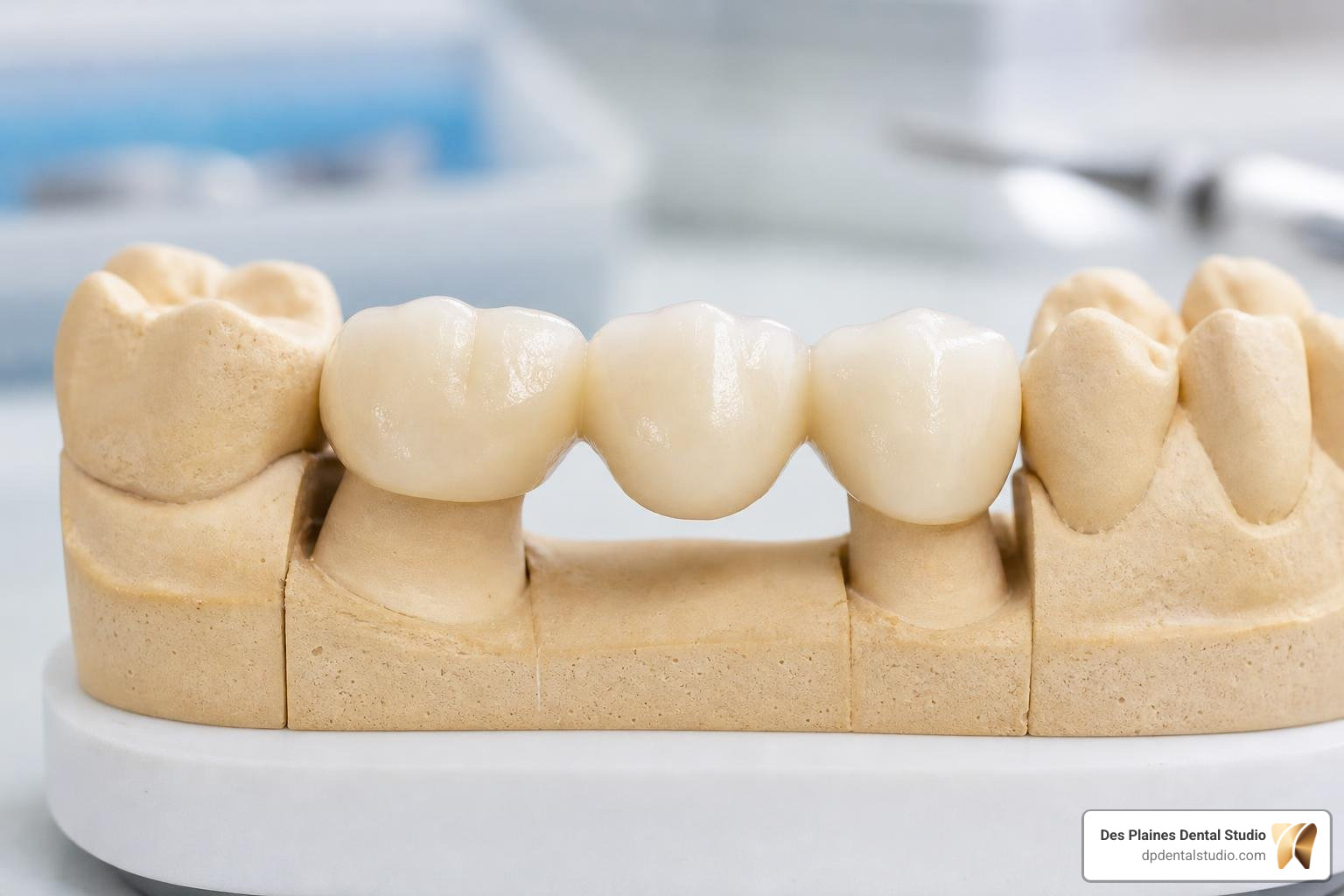
At its core, a dental bridge is a custom-made oral appliance designed to “bridge” the gap left by one or more missing teeth. It is a time-tested, highly effective way to restore both the function and appearance of your smile.
To understand how a bridge works, it helps to understand its anatomy:
- The Abutments: These are the anchor points. They can be your existing natural teeth on either side of the gap, or they can be dental implants.
- The Pontic: This is the artificial replacement tooth (or teeth) that sits in the gap.
Historically, pontics can be crafted from various materials, including gold, metal alloys, porcelain, or zirconia. Most patients today prefer porcelain or ceramic options because they can be color-matched to blend seamlessly with your natural teeth.
To secure a traditional bridge, the dentist must place dental crowns on the abutment teeth. This means the teeth on either side of the gap serve as the structural foundation, holding the fake tooth (pontic) securely in place. If you want to learn more about the structural options, you can read our detailed guide on bridges for teeth.
Understanding Bridges for Teeth
When you lose a tooth, the consequences go far beyond a cosmetic gap in your smile. Your teeth rely on one another to stay in alignment. When a tooth is missing, the neighboring teeth gradually begin to tip and shift into the open space. This shifting can disrupt your bite, lead to jaw pain (TMJ issues), make chewing difficult, and create hard-to-clean pockets that increase your risk of gum disease and tooth decay.
Furthermore, missing teeth can alter your speech, causing minor lisps or difficulty pronouncing certain words. By filling the gap, a dental bridge prevents this shifting, restores your chewing power, and keeps your facial structure supported. If you are curious about what to expect during this process, our local guide from a 60016 dentist what to expect from dental bridges explains the patient experience in detail.
The Dental Bridge Procedure Step-by-Step
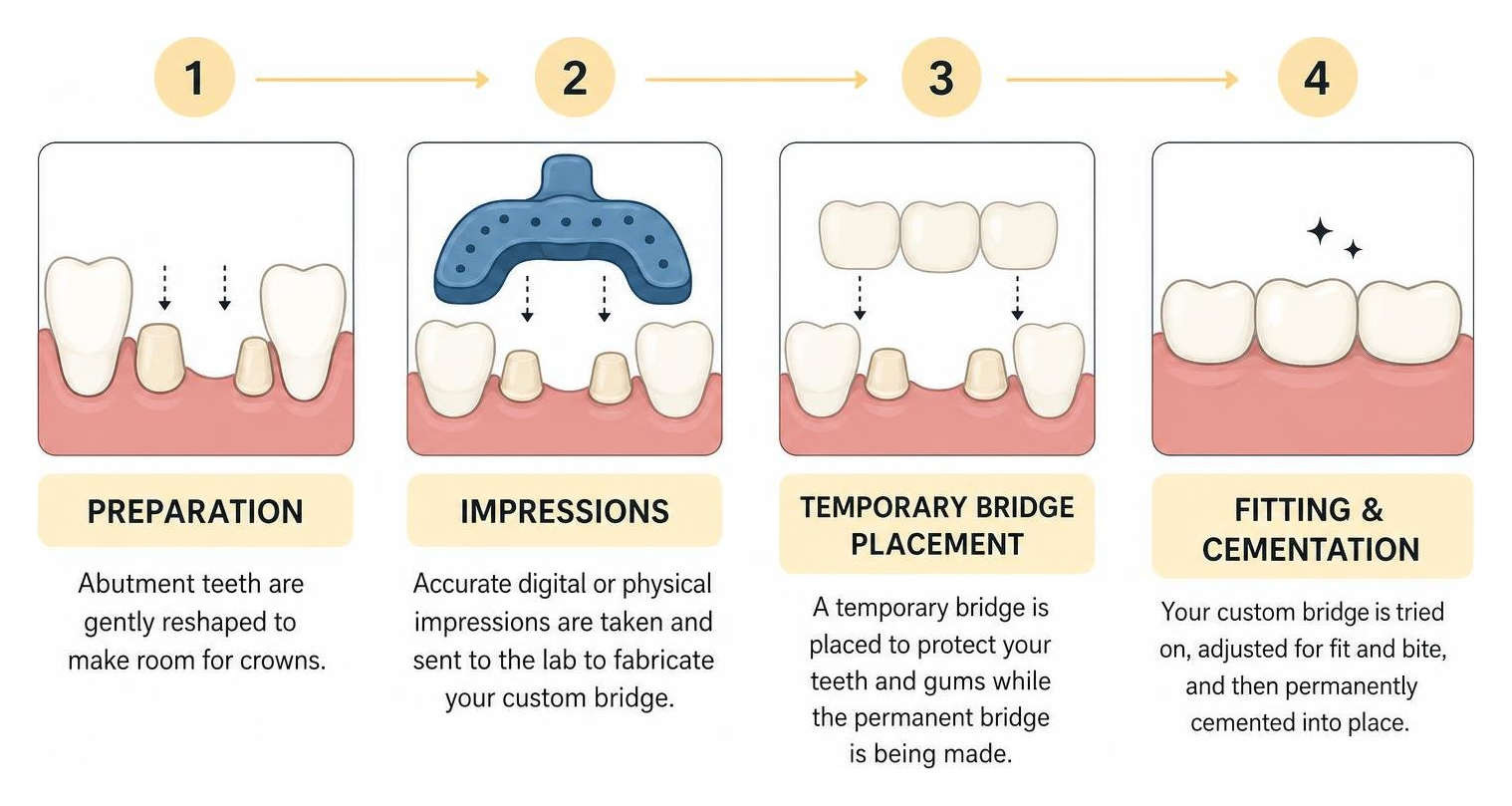
Getting a dental bridge is a precise process that typically takes place over two to three weeks and requires two primary appointments. Here is what the step-by-step journey looks like:
- Preparation of Abutment Teeth: During your first visit, we numb the area with local anesthesia. We then gently reshape the anchor teeth on either side of the gap, removing a small portion of enamel to make room for the crowns that will support the bridge.
- Impressions: Once the teeth are prepared, we take highly accurate digital or physical impressions. These models are sent to a specialized dental laboratory, where your custom bridge is fabricated to match your natural bite and tooth shade.
- Temporary Bridge Placement: While the lab crafts your permanent restoration, we place a temporary bridge to protect your prepared teeth and gums.
- Fitting and Cementation: At your second appointment, we remove the temporary bridge and try on your custom permanent bridge. We check the fit, make any necessary bite adjustments, and permanently cement the bridge into place.
This process is one of the most reliable restorative dentistry procedures available today, designed to be completely comfortable and stress-free.
How Much Does a Bridge in Your Mouth Cost?
When researching how much does a bridge in your mouth cost, it is important to realize that pricing is not one-size-fits-all. The final number on your bill is influenced by the type of bridge, the materials selected, the location of the missing tooth, and your geographic area.
In Illinois, dental costs align closely with or slightly exceed national averages. For instance, the average cost of a traditional dental bridge in Illinois is $5,406, but prices can range from $1,575 to $5,250 per bridge depending on the complexity of the case. Locally, patients in Chicago and Naperville see average costs sit around $3,450.
If you want to dive deeper into multi-tooth pricing structures, you can check out the Dental Bridge Cost in 2026: 3-Unit and Multi-Tooth Pricing — ToothCostGuide .
How Much Does a Bridge in Your Mouth Cost Without Insurance?
If you do not have dental insurance, you will be paying for the procedure entirely out-of-pocket. In this scenario, the choice of materials plays a massive role in your total cost.
- Porcelain-Fused-to-Metal (PFM) Bridges: These offer a great balance of strength and aesthetics. The core of the bridge is metal for durability, while the outer layer is porcelain to match your teeth. A 3-unit PFM bridge typically costs between $2,500 and $4,500 out-of-pocket.
- All-Ceramic or Zirconia Bridges: These are highly aesthetic, metal-free options that offer superior translucency and look incredibly natural. They are ideal for front teeth but are more expensive, ranging from $3,000 to $6,000 for a 3-unit bridge.
Below is a detailed breakdown of estimated out-of-pocket costs without insurance:
| Bridge Type / Material | Low-End Cost | Average Cost | High-End Cost |
|---|---|---|---|
| Traditional 3-Unit (PFM) | $2,500 | $3,500 | $4,500 |
| Traditional 3-Unit (Zirconia) | $3,000 | $4,500 | $6,000 |
| Cantilever Bridge | $2,000 | $3,500 | $5,000 |
| Maryland Bonded Bridge | $1,500 | $2,000 | $2,500 |
| Implant-Supported Bridge (3-4 teeth) | $5,000 | $10,000 | $15,000 |
How Much Does a Bridge in Your Mouth Cost With Insurance?
Fortunately, because dental bridges are restorative and medically necessary to maintain oral health, most dental insurance plans cover them. Typically, insurance companies classify bridges under “major restorative services” and cover 50% to 80% of the cost after you meet your deductible.
However, you must keep two critical factors in mind:
- The Annual Maximum: Most dental insurance plans have an annual maximum limit of $1,000 to $2,000. If your 3-unit bridge costs $4,000 and your insurance covers 50%, they will only pay up to your annual maximum (e.g., $1,500), leaving you to pay the remaining $2,500 out-of-pocket.
- Timing Strategies: If you need significant dental work, we can sometimes split the treatment across two calendar years. For example, we can prepare the teeth and place the temporary bridge in December (using your current year’s benefits) and cement the permanent bridge in January (utilizing the next year’s benefits).
To better understand how insurance handles these types of restorative crowns and bridges, read our guide on being royally covered a guide to dental insurance for crowns.
Cost Breakdown by Dental Bridge Type
The style of bridge your dentist recommends will have the largest impact on your final quote. For a broad national overview of these costs, you can reference How Much Does Dental Bridge Cost? (2026 Guide) | CostWhale . Let’s look closely at how the four main types compare.
Traditional and Cantilever Bridges
A traditional bridge is the most common option. It consists of a pontic held in place by dental crowns cemented onto the two adjacent natural teeth. These typically cost $2,000 to $5,000 for a single pontic and two crowns.
A cantilever bridge is used when there is an adjacent tooth on only one side of the missing tooth gap. The pontic is supported by a single crown on just one anchor tooth. These also cost between $2,000 and $5,000, but they are less common today and are generally not recommended for back teeth where biting forces are too high.
Maryland Bonded Bridges
A Maryland bridge (or resin-bonded bridge) is a conservative alternative. Instead of using crowns that require grinding down your adjacent teeth, a Maryland bridge uses a metal or porcelain framework with “wings” that are bonded directly to the backs of your adjacent teeth.
These cost between $1,500 and $2,500. While they are more affordable and preserve your natural tooth structure, they do not have the same biting strength as traditional bridges and are almost exclusively used for missing front teeth.
Implant-Supported Bridges
An implant-supported bridge is the gold standard for replacing multiple missing teeth in a row. Instead of anchoring to natural teeth, this bridge is anchored to dental implants surgically placed in your jawbone.
This option typically costs $5,000 to $15,000 for a bridge supported by two implants spanning three or four teeth. While the upfront cost is higher, it does not require altering your healthy adjacent teeth, and it helps preserve your jawbone. To learn more about full-arch and multi-tooth options, read the ultimate guide to full mouth bridges dont let missing teeth get you down.
Dental Bridges vs. Dental Implants: A Lifetime Cost Comparison
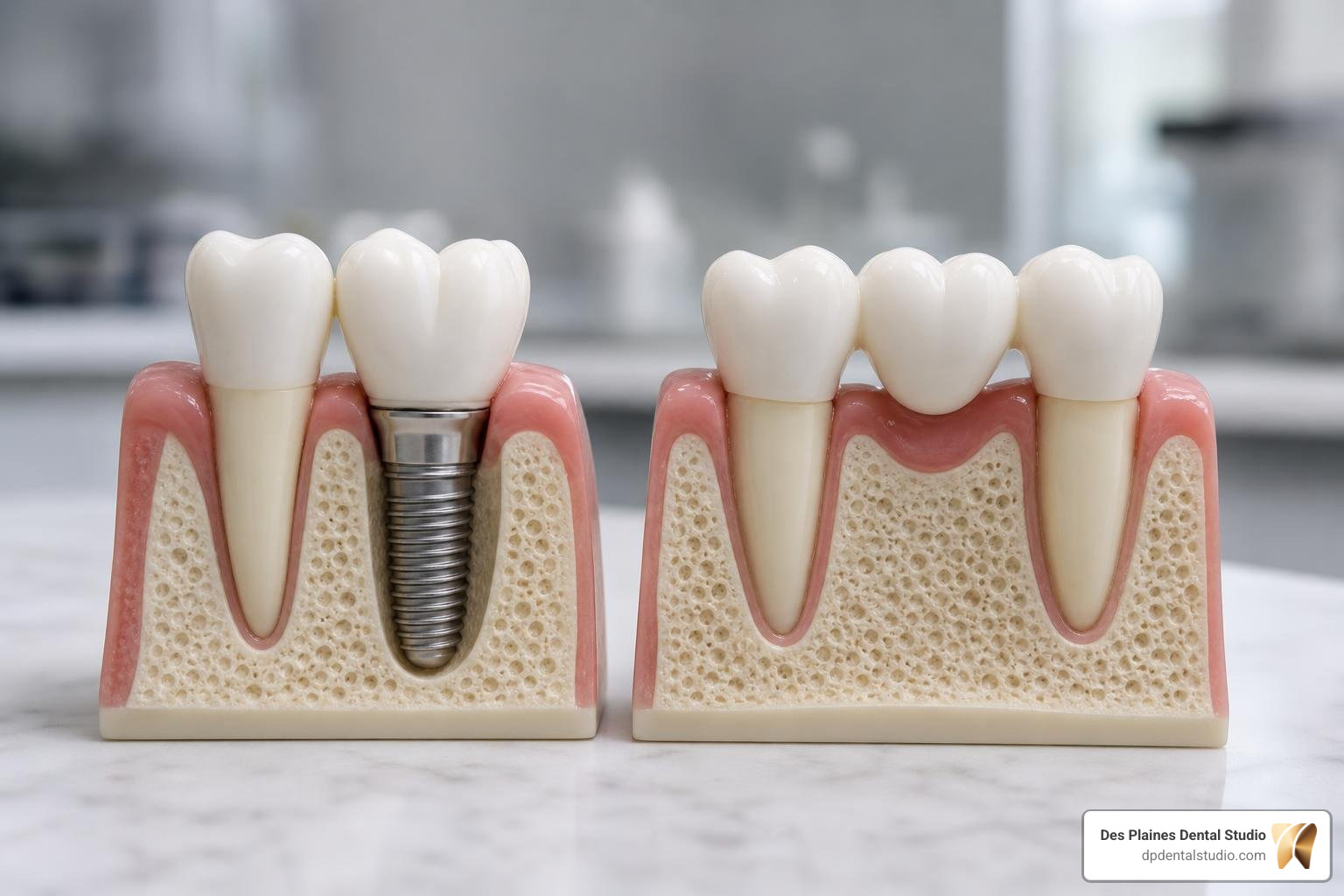
If you are trying to decide between a dental bridge and a dental implant, you aren’t just choosing between two dental devices — you are choosing between two entirely different long-term financial and biological pathways.
While a bridge is faster and has a lower upfront cost, a dental implant behaves like a natural tooth root. For a breakdown of full-arch implant pricing, you can read How Much Do All-on-4 Dental Implants Cost? .
Upfront Costs vs. Long-Term Value
To truly understand how much does a bridge in your mouth cost, you have to look at the “20-year math.”
A traditional dental bridge typically lasts 10 to 15 years before it needs to be replaced due to natural wear, or because the teeth supporting it develop decay. When a bridge fails, you must pay to have a new one fabricated. Furthermore, because a bridge doesn’t stimulate the underlying jawbone, the bone in the empty gap will slowly deteriorate over time.
A dental implant, on the other hand, can easily last 25 years to a lifetime with proper care.
Let’s look at a 20-year cost comparison:
- The Bridge Path: You pay $3,500 for a traditional bridge today. In 10 years, it needs to be replaced, costing another $4,000 (accounting for inflation). Your total 20-year cost is $7,500, plus you have permanently ground down two healthy adjacent teeth.
- The Implant Path: You pay $4,500 upfront for a single dental implant. It lasts your entire life. Your total 20-year cost is $4,500, and your adjacent teeth remain completely untouched.
When you look at the long-term value, implants often emerge as the more cost-effective and conservative choice. You can explore this further in our dental implant costs complete guide.
Frequently Asked Questions About Dental Bridge Costs
How long does a dental bridge last?
On average, dental bridges last between 5 and 15 years. Some can last over 20 years with exceptional oral hygiene and regular professional cleanings. The primary causes of bridge failure are cavities forming under the supporting crowns and gum disease around the anchor teeth.
Does dental insurance cover dental bridges?
Yes, most dental insurance plans cover bridges at 50% to 80% because they are considered medically necessary restorative treatments. However, be aware of the “missing tooth clause,” which prevents coverage if the tooth was lost before you signed up for your current insurance policy. Always ask your provider for a pre-determination of benefits before starting treatment.
Is getting a dental bridge painful?
Not at all! The preparation and placement process is entirely pain-free because we use local anesthesia to numb the area. After the anesthesia wears off, you may experience mild tooth sensitivity or gum soreness for a few days, which can be easily managed with over-the-counter pain relievers.
Conclusion
At Des Plaines Dental Studio, we believe that restoring your smile shouldn’t come with financial stress. Whether you decide a dental bridge is the right choice for your budget, or you want to invest in the long-term benefits of implants, we are here to provide a warm, welcoming, and completely pain-free experience.
We work closely with your dental insurance to maximize your benefits and offer flexible payment plans to keep your out-of-pocket costs manageable. If you want to compare your options, read about the average cost of dental implants or contact our office today to schedule your personalized consultation!