


What Does a Full Mouth Restoration Actually Cost?
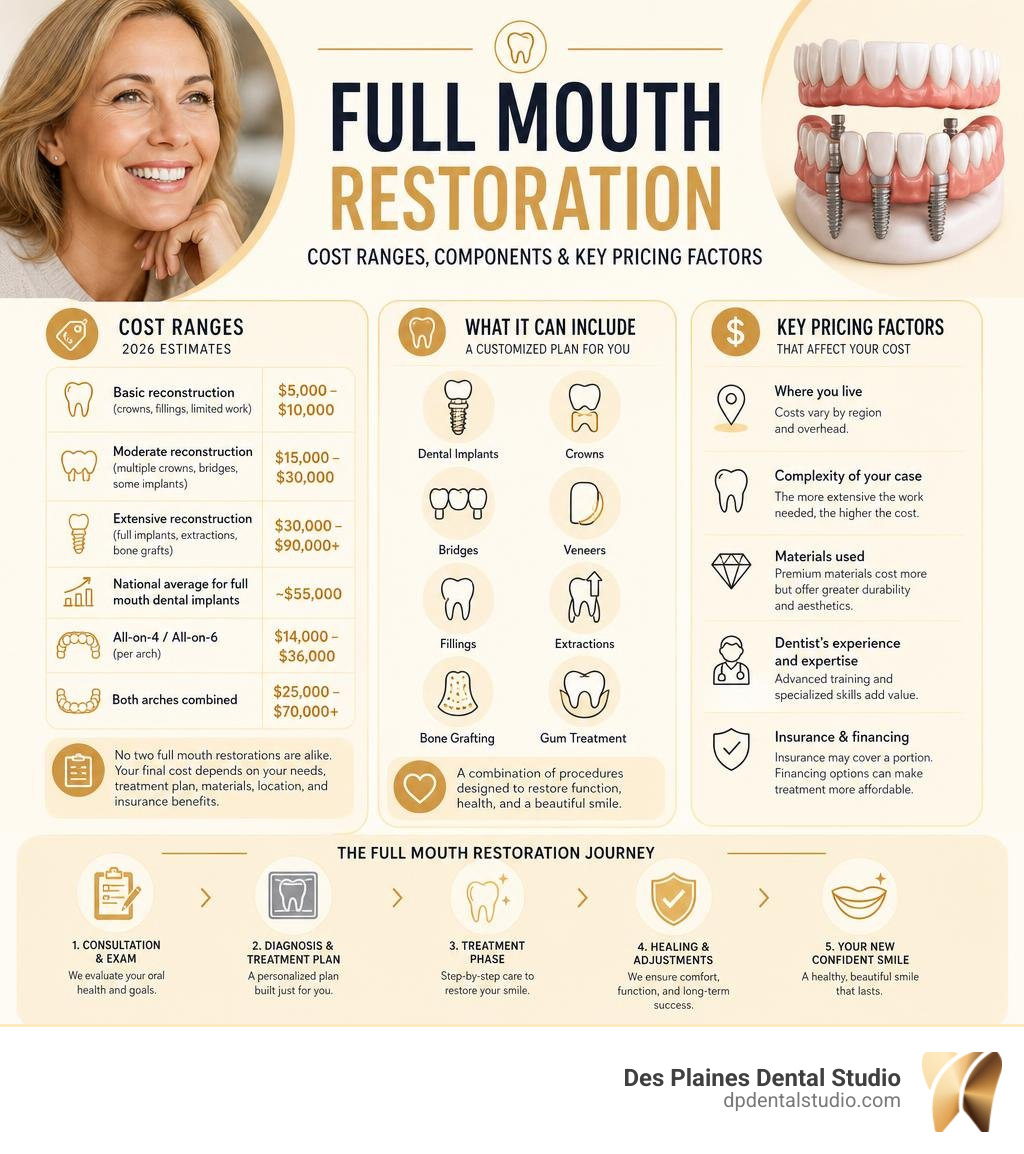
How much does a full mouth restoration cost depends heavily on what your mouth needs — but here are the numbers most patients are looking at in 2026:
| Scenario | Estimated Cost |
|---|---|
| Basic reconstruction (crowns, fillings, limited work) | $5,000 – $10,000 |
| Moderate reconstruction (multiple crowns, bridges, some implants) | $15,000 – $30,000 |
| Extensive reconstruction (full implants, extractions, bone grafts) | $30,000 – $90,000+ |
| National average for full mouth dental implants | ~$55,000 |
| All-on-4 / All-on-6 (per arch) | $14,000 – $36,000 |
| Both arches combined | $25,000 – $70,000+ |
These are real ranges — not worst-case scare numbers. One patient reported spending around $32,000 over 15 months for a full restoration that included extractions and eight implants. Another might spend far less with a simpler treatment plan.
The truth is, no two full mouth restorations are alike. Your final cost depends on which procedures you need, where you live, what materials are used, and whether insurance chips in.
I’m Dr. Marta Milejczyk, and having trained extensively in full mouth rehabilitation — including advanced clinical work under general anesthesia and a national cosmetic dentistry program that only 3% of dentists complete — I’ve guided many patients through exactly this question of how much does a full mouth restoration cost in real, practical terms. In this guide, I’ll walk you through every cost factor so you can plan with confidence.
What is a Full Mouth Restoration and What Does It Include?
When we talk about a full mouth restoration (sometimes called a full mouth reconstruction), we are not talking about a single, off-the-shelf procedure. Instead, it is a highly customized, master-planned combination of restorative dentistry procedures and cosmetic dentistry techniques designed to rebuild every single tooth in your mouth.
Imagine trying to remodel a historic home. You wouldn’t just slap a fresh coat of paint on a crumbling wall. You would stabilize the foundation, repair the framing, and then focus on the beautiful finishes. A full mouth restoration works the exact same way. We look at your bite, your jaw joint, your gums, and your teeth to build a smile that is both structurally sound and beautiful.
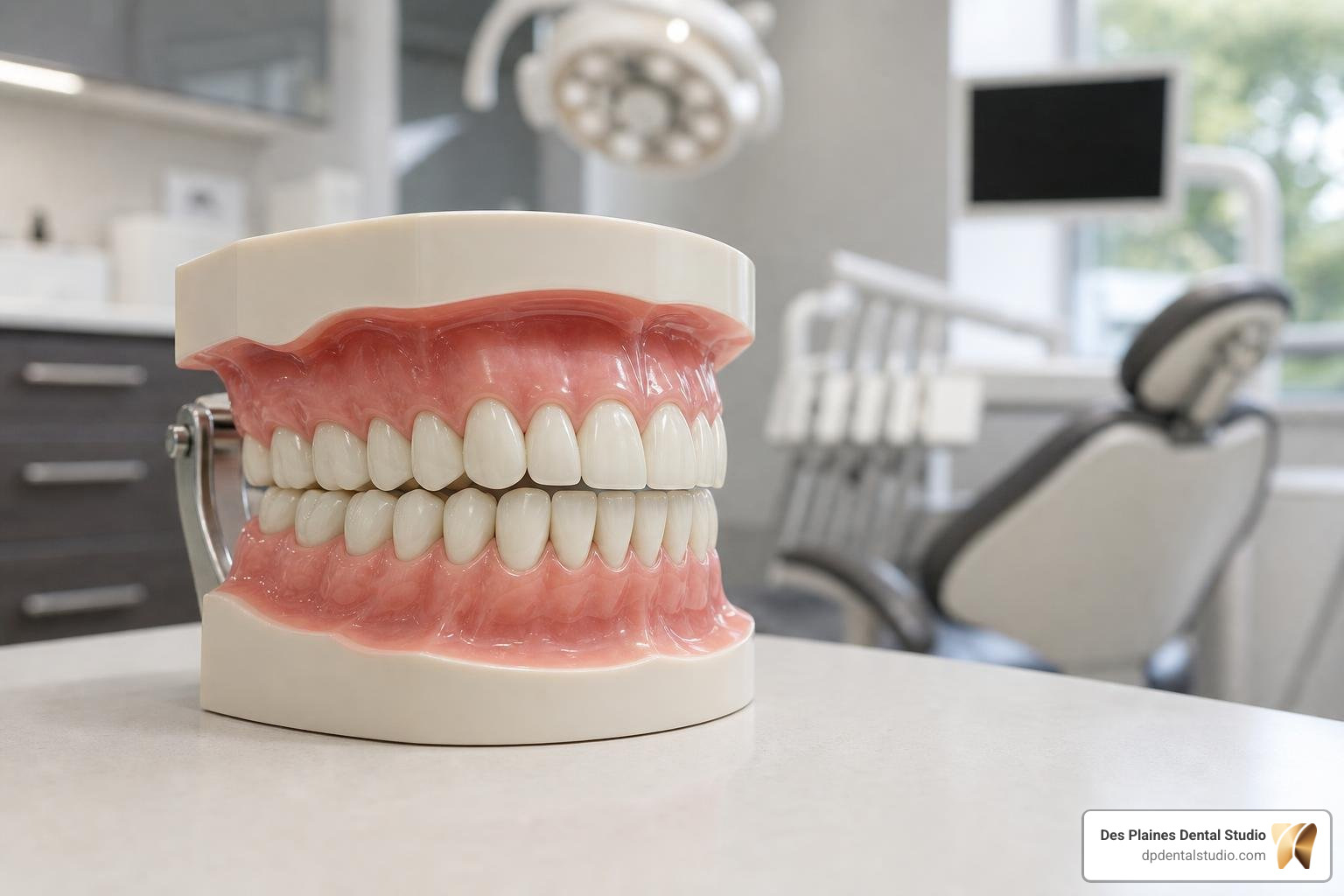
Depending on your specific needs, your personalized treatment plan may include a mix of the following treatments:
- Dental Implants: Small titanium posts surgically placed into the jawbone to act as artificial tooth roots. These provide the ultimate foundation for replacing missing teeth.
- Dental Crowns: Custom-made porcelain caps that cover damaged or decayed teeth, restoring their original strength, size, and appearance. You can learn more about how we use dental crowns to save compromised teeth.
- Dental Bridges: Fixed prosthetics used to bridge the gap created by one or more missing teeth. To understand how these work, read our guide on bridges for teeth.
- Veneers: Thin shells of medical-grade ceramic attached to the front of your teeth to instantly correct chips, gaps, and severe discoloration. If you are exploring this option, you can learn more about veneers or explore the differences between standard and porcelain veneers.
- Composite Fillings: Tooth-colored restorations used to treat decay while blending seamlessly with your natural enamel. We utilize composite fillings to keep your smile looking entirely natural.
- Smile Makeover: While a restoration focuses heavily on health and function, we often integrate a smile makeover to ensure the final aesthetic result looks youthful, bright, and completely natural.
By combining these treatments, we can address severe tooth decay, worn-down enamel from teeth grinding, multiple missing teeth, and structural jaw misalignment all at once.
How Much Does a Full Mouth Restoration Cost in 2026?
Let’s look at the financial realities of this treatment in 2026. The Full Mouth Dental Implants Cost: $55,000 Avg in 2026 ($30,000–$90,000) reflects the national average for a comprehensive implant-based restoration. Here in Illinois, the average sits slightly higher at approximately $55,660 due to local overhead and the high concentration of specialized laboratory facilities in the Midwest.
To help you visualize where you might fall on the pricing spectrum, here is a breakdown comparing basic, moderate, and extensive reconstructions:
| Reconstruction Level | Typical Procedures Included | Estimated Cost Range |
|---|---|---|
| Basic | Deep cleanings, composite fillings, 2-4 dental crowns, minor dental bonding. | $5,000 – $10,000 |
| Moderate | Several extractions, multiple crowns, dental bridges, and 1-2 single dental implants. | $15,000 – $30,000 |
| Extensive | Full-mouth extractions, bone grafting, and full-arch dental implants (such as All-on-4). | $30,000 – $90,000+ |
How much does a full mouth restoration cost with implants?
If your restoration requires replacing all of your teeth with implant-supported options, the overall investment will depend heavily on the specific implant system and the materials you select.
When researching the Price of Full Mouth Dental Implants, you will find that full-arch implant options are generally priced per arch (upper or lower jaw). According to the pricing guide on Full-Mouth Dental Implants Cost in 2026: All-on-4, All-on-6 & Overdenture Pricing, a single arch of permanent, fixed teeth supported by implants costs between $14,000 and $36,000 in the United States. If you need both arches restored, the combined cost typically ranges from $25,000 to $70,000+.
The primary systems used for full-arch implant restorations include:
- All-on-4 and All-on-6: These protocols involve strategically placing 4 or 6 implants per arch to support a full, permanent bridge of teeth. This is a highly stable, non-removable solution that feels and functions exactly like natural teeth. You can read more about how we perform this procedure by visiting our page on All-on-4 dental implants.
- Prosthetic Materials (Zirconia vs. Acrylic): The material you choose for your final set of teeth has a major impact on both the cost and durability. Choosing a premium zirconia prosthesis will typically add $3,000 to $8,000 per arch over traditional acrylic. However, zirconia is incredibly strong, highly resistant to chipping, and looks exceptionally lifelike.
For those curious about the Average Cost of Full Dental Implants, it is also important to consider the timeline of the procedure. While some clinics advertise “Teeth in a Day,” you should understand How Much Does a One Day Full Mouth Dental Implant Actually Cost and ask yourself, Can You Really Get a Brand New Smile in Just One Day? (Spoiler: While you can walk out with temporary teeth on day one, the final, permanent teeth are placed after several months of healing).
How much does a full mouth restoration cost with alternative treatments?
If a full set of dental implants does not fit your current budget, there are excellent, highly functional alternative treatments available that cost significantly less.
The most common budget-friendly options include:
- Traditional Dentures: These are completely removable prosthetics that sit directly on your gums. While they lack the absolute stability of implants, they are a time-tested way to restore your smile. The Average Cost for Dentures ranges from $1,500 to $5,000 for a full set. To explore the various tiers of dentures, you can read our Full Set Dentures Cost Guide Economy to Premium Options or look specifically at The Complete Guide to Upper Dentures Cost.
- Snap-In Overdentures: This is a hybrid option that represents the middle ground between traditional dentures and permanent implants. Your new teeth will snap onto 2 to 6 dental implants, providing much better stability than traditional dentures without the higher price tag of a fixed All-on-4 bridge. Snap-in overdentures typically cost $8,000 to $25,000 per arch.
- Comparing Your Choices: When deciding between these routes, it helps to weigh the Average Cost to Replace All Teeth with Implants or Dentures to see which balance of cost, comfort, and stability makes the most sense for you. If you are currently wearing traditional dentures, we can also help you repair your smile with dentures that fit better and look more natural, or guide you through The Real Price for Dentures and How to Find Affordable Options Near You.
Key Factors That Drive the Cost of Full Mouth Reconstruction
If you obtain quotes from three different dental offices, you will likely see three different prices. This is because several behind-the-scenes factors directly influence the final cost of your care:
- Geographic Location: Dental practices in areas with a higher cost of living or higher state regulations face greater overhead costs. For instance, the average cost of full mouth implants in Illinois ($55,660) is slightly above the national average of $55,000.
- Choice of Materials: Premium materials like solid zirconia or hand-layered porcelain cost more to manufacture than acrylic or composite resins, but they offer vastly superior aesthetics and longevity.
- Provider Type and Expertise: Having your restoration completed by a general dentist who does occasional implant work may cost less upfront, but complex cases are best handled by providers with specialized, advanced training in reconstructive dentistry.
- Number of Implants: The more implants required to stabilize your new teeth, the higher the cost of surgical fees and implant components.
To get a complete picture of these variables, you can read our Dental Implant Costs Complete Guide.
Additional Procedures That Increase the Final Bill
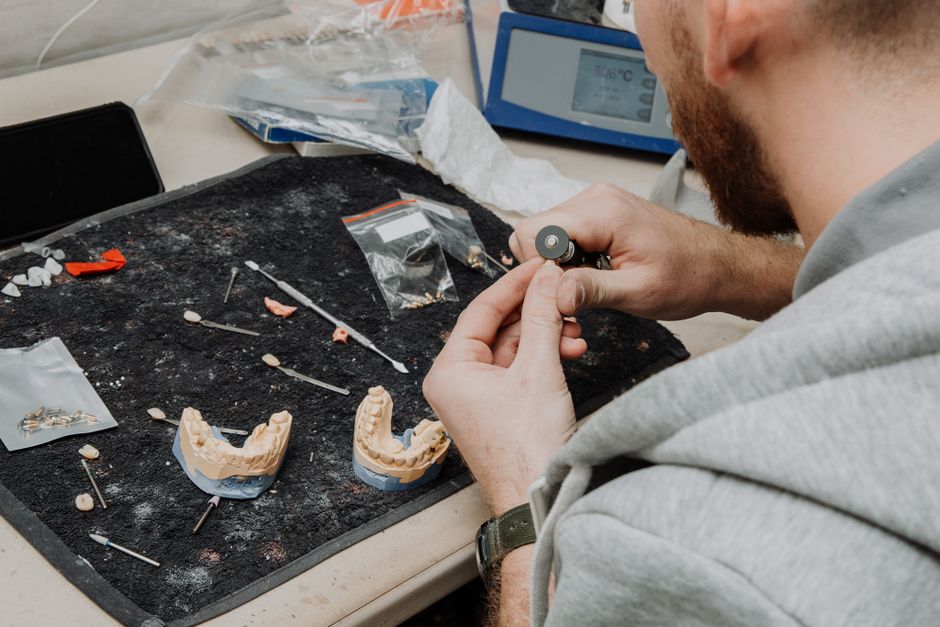
Before we can place crowns, bridges, or implants, we must ensure your gums and jawbone are perfectly healthy. If you have active gum disease, severe bone loss, or failing teeth, you will need preparatory procedures that will add to your final bill:
- Bone Grafting: If you have been missing teeth for a while, your jawbone may have shrunk. Bone Grafting for Dental Implants rebuilds this bone foundation so it can securely hold an implant. This typically adds $2,000 to $5,000+ to the total cost.
- Sinus Lift: If we are placing implants in your upper jaw and there isn’t enough bone depth, a sinus lift is performed to gently raise the sinus floor and add bone graft material. This costs between $1,500 and $3,000.
- Tooth Extractions: If you have remaining teeth that are severely decayed or loose, they must be removed first. To understand these costs, you can look at What is the Average Cost for Dental Extractions, read our guides on extractions and affordable tooth pulling, or learn about emergency tooth extractions and painless wisdom teeth removal.
Navigating Dental Insurance and Financing Options
Because full mouth reconstruction is a significant financial investment, navigating your payment options is a crucial step in the planning process.
Most traditional dental insurance plans categorize full mouth restorations as a “Major Procedure.” This means they will typically cover around 50% of the cost of individual components (like crowns or extractions), but they cap their payouts at an annual maximum. These annual maximums usually range from $1,000 to $2,500 per year — which means insurance may only cover 3% to 8% of a major $30,000+ reconstruction.
To make the most of your policy, we highly recommend reading our Dental Implant Costs Complete Guide and our specialized Dental Implants Insurance Guide 2026. In some unique cases, such as reconstructive jaw surgery or severe trauma, you might even be able to secure partial coverage through your medical policy. For tips on this, read How to Get Dental Implants Covered by Medical Insurance and The Sneaky Guide to Getting Medical Insurance for Dental Implants.
Smart Ways to Save on Your Restoration
If you want to reduce your out-of-pocket costs without sacrificing the quality of your care, consider these smart strategies:
- Use HSA or FSA Dollars: If you have a Health Savings Account (HSA) or Flexible Spending Account (FSA), you can pay for your dental treatments using pre-tax dollars. This can save you anywhere from 20% to 35% depending on your tax bracket.
- Third-Party Financing: Companies like CareCredit offer low-interest or deferred-interest payment plans. However, be careful with deferred-interest plans — if you do not pay the balance in full by the end of the promotional period, you may face retroactive interest charges. Many patients prefer using 0% APR credit cards as a safer alternative if they can pay off the balance within the introductory period.
- Stage Your Treatment: If you need to spread out the costs over time, you can start by having your extractions and bone grafts completed, and wear a traditional denture temporarily. This preserves your jawbone while allowing you to save up and upgrade to implants later.
- Dental Discount Plans: These membership programs can offer 15% to 25% off standard private practice rates. For more practical advice on budgeting, see our guide on How to Find the Cheapest Dental Implants Without Losing Your Mind.
Timeline, Recovery, and Long-Term Maintenance
A full mouth restoration is a journey, not a quick fix. For extensive cases involving dental implants and bone grafting, the entire process can take anywhere from 6 to 15 months to fully complete.
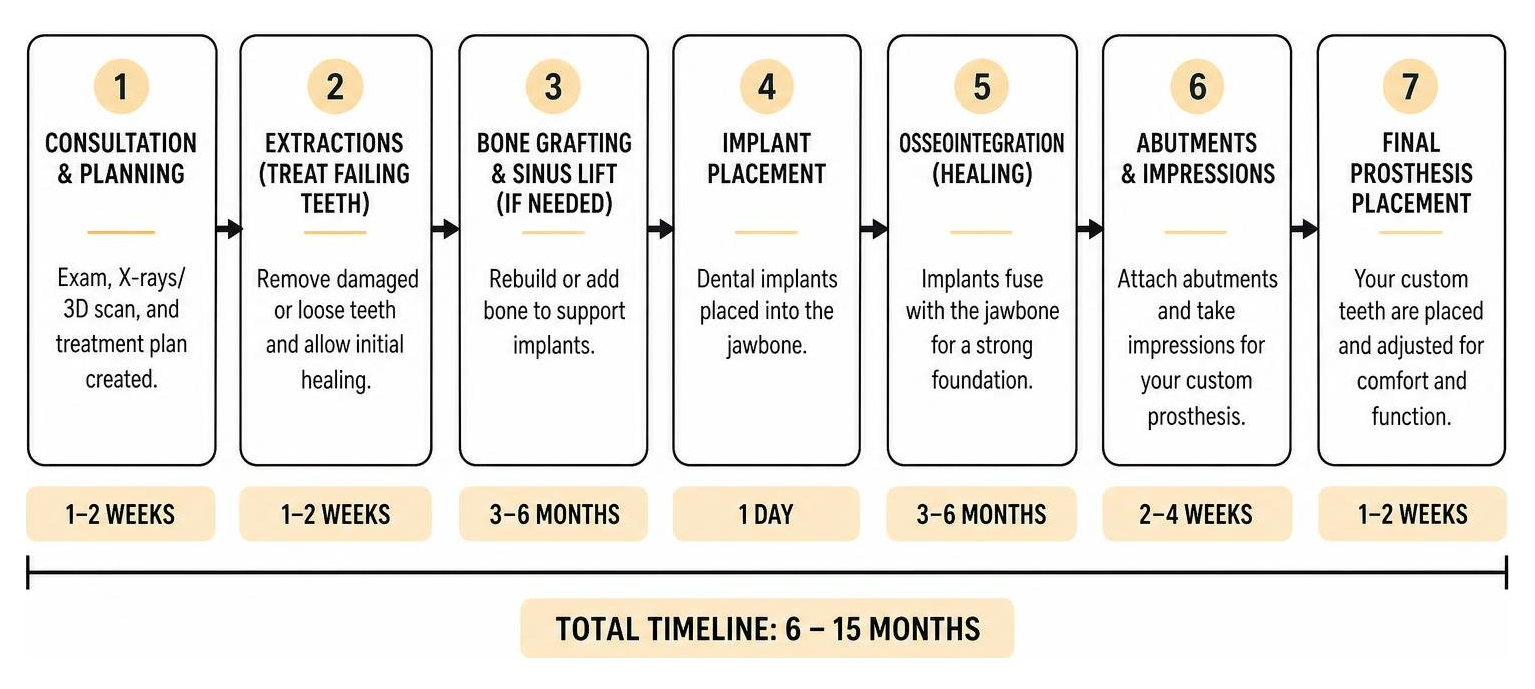
During this time, you will transition through several phases:
- Initial Healing: After extractions or implant surgery, you will experience some swelling and mild discomfort for the first 3 to 7 days.
- Soft-Food Diet: While your implants are fusing with your jawbone (a process called osseointegration), you will need to stick to a soft-food diet for 3 to 6 months to avoid putting excessive pressure on the healing implants.
- Emotional Adjustment: Transitioning from natural teeth to a custom prosthetic is a significant emotional adjustment. It takes a few weeks for your tongue and facial muscles to adapt to speaking and chewing with your new teeth.
Once your restoration is complete, protecting your investment is vital. While implant posts can last a lifetime, the attached prosthesis (your new teeth) will experience natural wear and tear. Acrylic prosthetics typically last 10 to 15 years, while premium zirconia prosthetics can last 15 to 25 years or more.
To ensure your new smile lasts as long as possible, you must maintain excellent oral hygiene, schedule professional cleanings at least twice a year, and wear a custom night guard to protect your new teeth from nighttime grinding. For a deeper look at these long-term benefits, check out The Ultimate Guide to Dental Implants Costs and Benefits.
Frequently Asked Questions about Full Mouth Restoration
Is dental tourism a safe way to save money on full mouth restoration?
While dental tourism in countries like Mexico or Costa Rica can save you 50% to 70% upfront, it comes with significant logistical and clinical risks. Because a full mouth restoration requires multiple appointments spread across several months, you would need to make multiple international trips. If a complication arises — such as an implant failing to integrate — managing follow-up care with a doctor in another country is incredibly difficult. Additionally, local dentists may not have the specific tools or parts required to service international implant systems.
Can I get traditional dentures now and upgrade to implants later?
Yes, absolutely. Many patients choose to start with traditional dentures to fit their current budget. If you plan to do this, we highly recommend getting bone grafts at the time of your tooth extractions. This preserves your jawbone structure, making it much easier (and less expensive) to place implants when you are ready to upgrade in the future.
How long do the results of a full mouth restoration last?
With proper care, the results of your restoration can last for decades. Dental implant posts are designed to be permanent and often last a lifetime. The crowns, bridges, or implant-supported dentures attached to them will eventually need to be replaced due to normal wear. Zirconia restorations offer the longest lifespan (15 to 25 years), while acrylic options generally need to be refreshed or replaced every 10 to 15 years.
Conclusion
Investing in a full mouth restoration is about far more than just fixing teeth — it is about reclaiming your ability to eat your favorite foods, speak clearly, and smile with absolute confidence.
At Des Plaines Dental Studio, we specialize in providing patient-centered care with robust insurance support and a welcoming, completely pain-free experience. If you are ready to take the first step toward a healthier, more beautiful smile, we invite you to explore the Average Cost of Dental Implants or Book an Appointment for a personalized consultation. You can also Contact Us directly at our Des Plaines, IL office to speak with our friendly team. We are here to help you navigate every step of your smile journey!