


Are Bridges for Teeth Expensive? The Short Answer
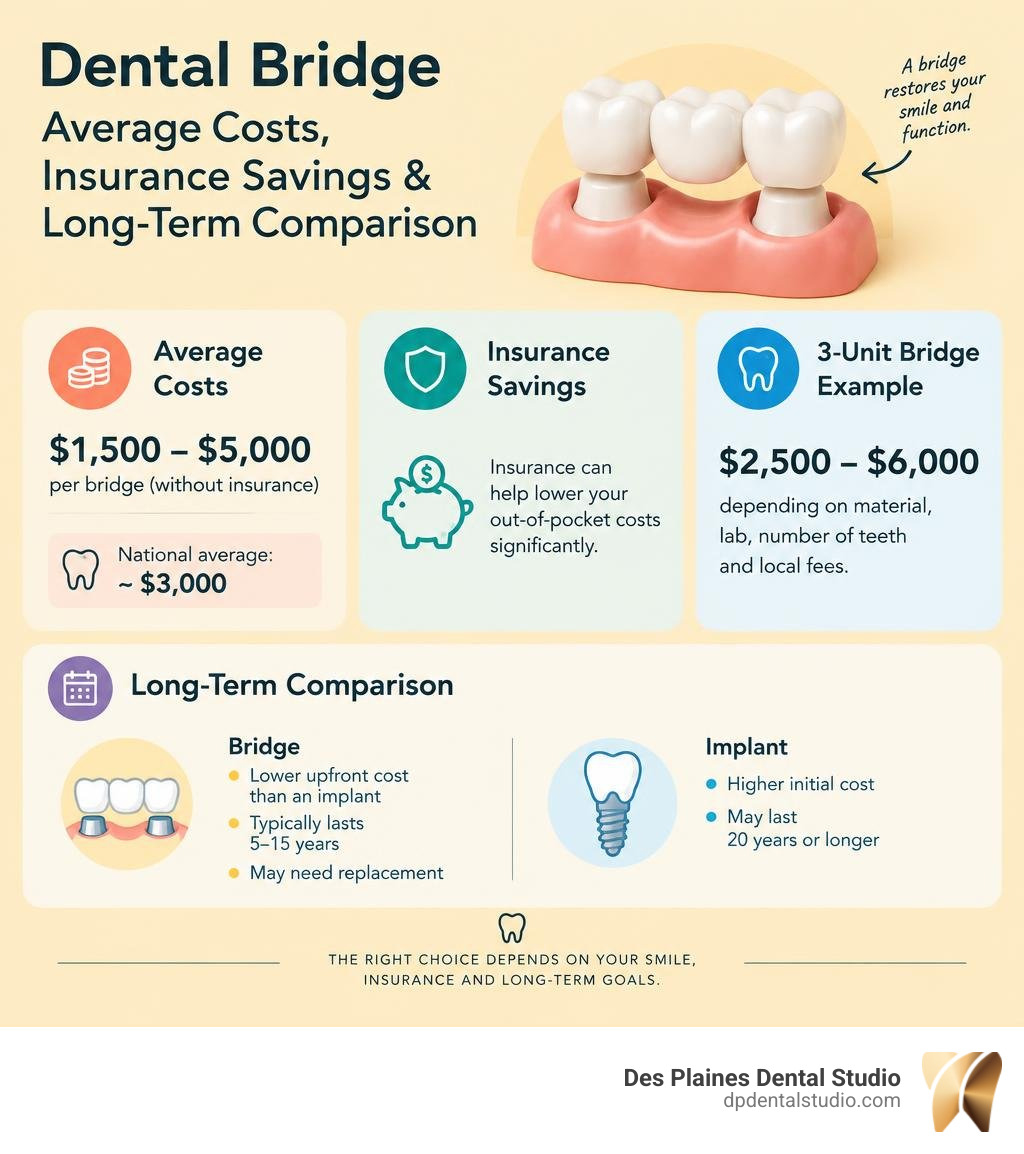
Dental bridges can be expensive, but they are often a lower-cost fixed option than an implant at the start. Without insurance, most patients pay about $1,500 to $5,000 per bridge, with a national average near $3,000. A common 3-unit bridge typically costs $2,500 to $6,000, depending on the material, dental lab, number of teeth replaced, and local fees.
The real question is not only, “Are bridges for teeth expensive?” It is whether the bridge fits your teeth, insurance benefits, and long-term budget. A bridge may save $500 to $1,500 upfront compared with a single implant, but bridges commonly need replacement after 5 to 15 years. An implant costs more initially but may last 20 years or longer.
Before deciding, ask for a written plan that shows:
- The bridge type and material
- Costs for exams, X-rays, temporary teeth, and any needed treatment
- Your insurance estimate, deductible, and annual maximum
- Expected maintenance and replacement costs
I am Dr. Marta Milejczyk, a general dentist with advanced training in restorative, cosmetic, and implant dentistry and nearly three decades of experience serving Chicago’s northwest suburbs. I help patients answer, “are bridges for teeth expensive?” by weighing the full cost, tooth health, comfort, and long-term value of every option.
Important are bridges for teeth expensive terms:
- how much does a bridge in your mouth cost
- how much does a full mouth restoration cost
- are dentist expensive
Dental Bridge Cost Breakdown: What You Will Actually Pay
When a gap opens in your smile, the toll to fill it depends on how the restoration is built. A dental bridge uses adjacent “abutment” teeth as anchor pillars to suspend a “pontic” (the artificial replacement tooth) across the gap. Because each anchor crown and replacement tooth counts as a separate unit, unit pricing drives the total fee. When learning what to expect from dental bridges, you will find that national dental bridge fees have risen by approximately 17.7% between 2022 and 2026 due to lab production costs, specialized materials, and skilled clinical labor.
Are Bridges for Teeth Expensive Without Dental Insurance?
For self-pay patients, out-of-pocket costs vary based on the span of the bridge. According to detailed pricing data in the Dental Bridge Cost in 2026: 3-Unit and Multi-Tooth Pricing — ToothCostGuide, a standard 3-unit bridge (replacing a single missing tooth flanked by two crowns) typically ranges between $2,500 and $6,000.
If you have two adjacent missing teeth, a 4-unit bridge is required, which pushes the out-of-pocket range to $4,000 to $8,000. Traditional bridges across multiple spans can range from $4,100 to $9,650, averaging roughly $5,197 across the United States. Without insurance assistance, this upfront investment requires careful planning.
How Bridge Types and Materials Impact the Total Price
The design configuration and raw materials dictate both your aesthetic outcome and the final bill:
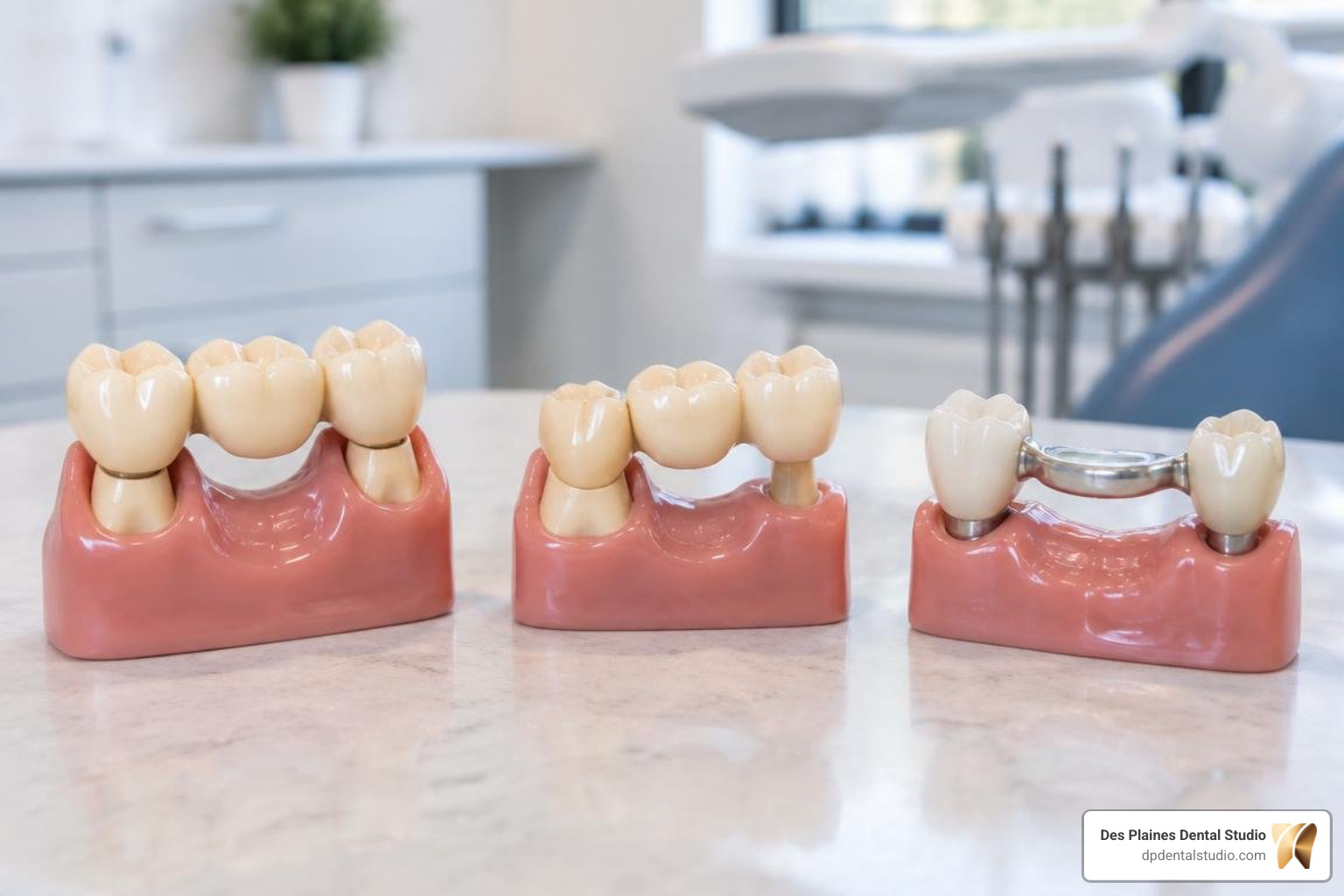
- Porcelain-Fused-to-Metal (PFM): Ranging from $2,500 to $4,500 for a 3-unit restoration, PFM bridges offer durable metal support covered by tooth-colored ceramic, making them a common balance between cost and strength for back teeth.
- All-Ceramic and Zirconia: Running $3,000 to $6,000, monolithic zirconia or lithium disilicate provides lifelike translucency and unmatched crack resistance without dark metal lines at the gumline.
- Maryland (Resin-Bonded) Bridges: Costing $1,500 to $2,500, Maryland dental bridges rely on metal or ceramic wings bonded behind adjacent teeth, eliminating the need to file down healthy enamel.
- Cantilever Bridges: Averaging around $1,041 to $2,500, these attach to an abutment on only one side of the gap, though they exert higher leverage on the anchor tooth.
- Implant-Supported Bridges: Ranging from $5,000 to $15,000+, these spans rest on surgically embedded titanium posts rather than natural teeth.
Custom lab artistry, precise margin milling, and shade matching also influence clinical fees, as detailed in the How Much Does Dental Bridge Cost? (2026 Guide) | CostWhale market analysis.
Are Bridges for Teeth Expensive Compared to Implants and Dentures?
Evaluating tooth replacement requires comparing initial costs against comfort, biological impact, and lifespan. Patients exploring options for missing teeth generally compare fixed bridges, dental implants, and removable partial dentures.
| Feature | Fixed Dental Bridge | Single Dental Implant | Removable Partial Denture |
|---|---|---|---|
| Initial Cost (No Insurance) | $2,500 – $6,000 | $3,000 – $6,000 | $600 – $1,800 |
| Average Lifespan | 5 – 15 years | 20+ years to lifetime | 5 – 8 years |
| 10-Year Survival Rate | ~89% | >95% to 96.8% | N/A (requires relines) |
| Impact on Neighboring Teeth | Requires permanent enamel removal | Zero impact on adjacent teeth | Clasps can wear down enamel |
| Bone Preservation | None (bone resorbs under pontic) | Excellent (stimulates jawbone) | None (accelerates bone loss) |
| Treatment Timeline | 2 – 3 weeks | 3 – 6 months | 2 – 4 weeks |
The 10-to-20-Year Financial Reality: Bridges vs. Dental Implants
A traditional bridge is often $500 to $1,500 cheaper upfront than a single implant. However, when evaluating dental implants near me, long-term clinical data tells a different financial story.
According to prosthodontic data in the Implant vs Bridge Cost Comparison, conventional bridges carry a 10-year survival rate of approximately 89%, whereas dental implants maintain a 96.8% success rate over a decade. Bridges often require complete replacement around year 10 or 15 due to recurrent decay under anchor crowns or structural fatigue.
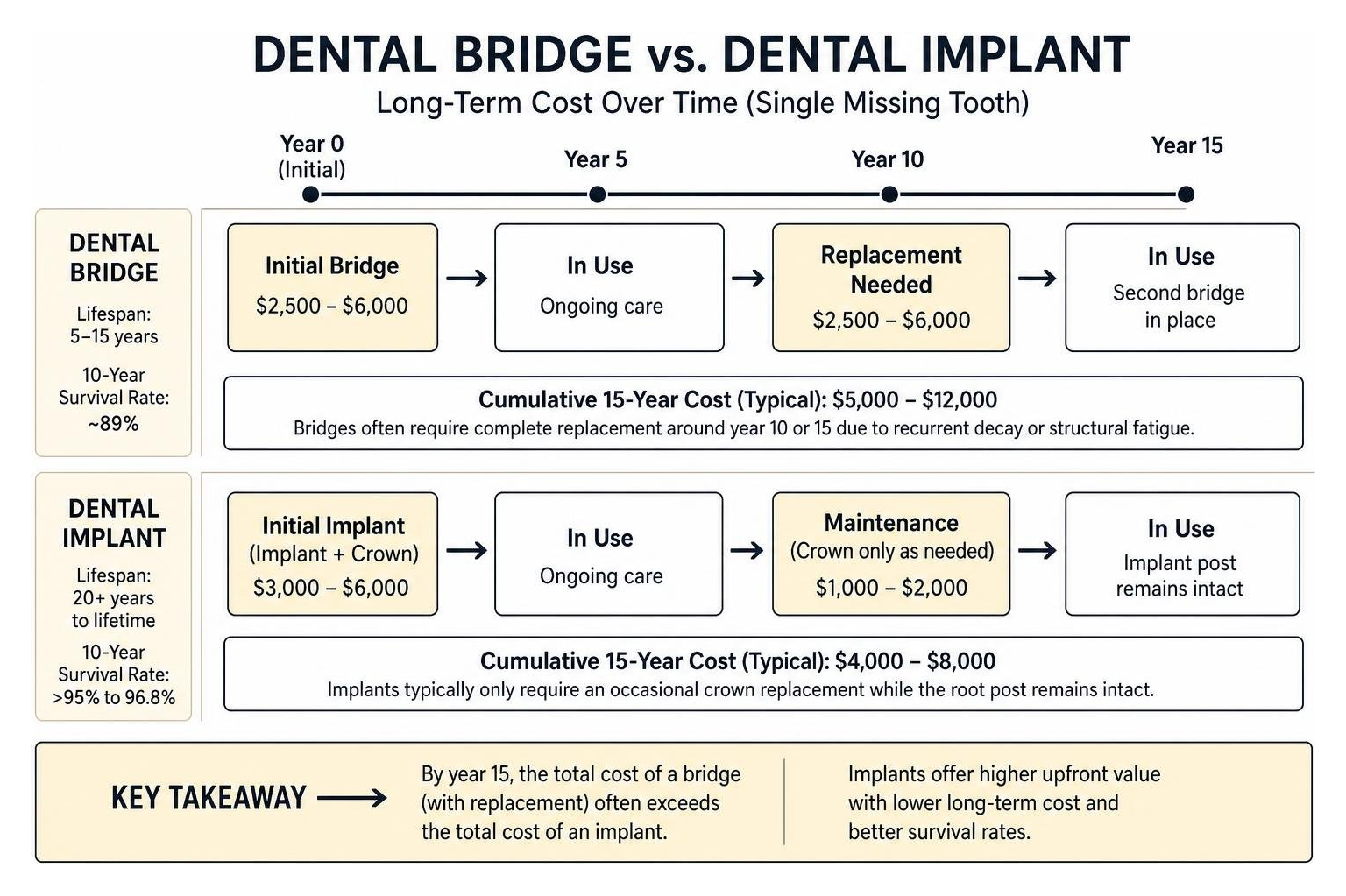
By year 15, the combined cost of the initial bridge plus its replacement (another $2,500 to $6,000) often exceeds the total lifetime cost of an implant, which typically only requires an occasional crown tightening or replacement ($1,000 to $2,000) while the root post remains intact.
Bridges vs. Partial Dentures: Value and Performance
A removable partial denture carries the lowest initial price tag, often between $600 and $1,800. However, when reviewing the average cost for dentures, ongoing maintenance factors heavily into the total cost.
Partial dentures require periodic relines ($300 to $500 every few years) to adjust for shifting tissue and bone loss. Removable appliances also deliver lower bite force and stability than fixed bridges. While partial dentures are an accessible short-term solution for multiple missing teeth, a fixed bridge provides continuous chewing comfort and aesthetic stability.
Hidden Expenses and Long-Term Value: Is a Bridge Worth It?
The true cost of a dental bridge involves more than the dental lab bill. Preparing natural teeth for anchor dental crowns permanently removes protective enamel, which can introduce secondary maintenance considerations over time.
When Are Bridges for Teeth Expensive Over the Long Run?
A bridge can accumulate unexpected expenses if oral hygiene slips or underlying teeth become compromised:
- Abutment Decay: Because the replacement tooth sits above the gumline, plaque can accumulate underneath the pontic. If decay forms at the crown margin, the entire multi-unit bridge must be removed to treat the tooth.
- Root Canal Treatment: Grinding down healthy teeth can cause pulp inflammation. Clinical studies show that 15% to 20% of teeth prepared as bridge abutments eventually require root canal therapy, adding $800 to $1,500 per tooth.
- Bone Resorption: Bridges replace the visible crown of a tooth but not the root beneath the gums. Over time, the underlying jawbone naturally shrinks, occasionally creating an aesthetic gap under the pontic that requires correction during future restorative dentistry procedures.
When a Dental Bridge Is Your Best Financial Choice
A bridge is not always more expensive in the grand scheme. Fixed bridges for teeth are often the smarter clinical and financial decision in several specific scenarios:
- Pre-Damaged Neighboring Teeth: If the teeth on either side of the gap already have large fillings, fractures, or require crowns, bridging them solves multiple problems under one restoration fee.
- Medical or Bone Limitations: Patients with uncontrolled diabetes, active smoking habits, or severe bone loss who wish to avoid extensive bone grafting surgery can achieve immediate stability with a bridge.
- Full-Arch Reconstructions: In complex rehabilitations, full mouth bridges can rapidly restore bite alignment and cosmetic balance within weeks rather than the 6 to 9 months required for implant integration.
Insurance Coverage, Financing, and Ways to Lower Your Bridge Toll
Navigating dental insurance can substantially ease out-of-pocket costs. Reviewing the real cost of a dental bridge with and without insurance shows that most policies classify bridges as “major restorative” care, typically covering 50% to 80% of allowable fees after your deductible.
Maximizing Dental Insurance Benefits and HSAs/FSAs
While insurance helps, most plans have an annual maximum benefit of $1,000 to $2,000. Because a bridge can exceed this limit, our team recommends asking for a pre-treatment estimate. As outlined by How Much Does a Dental Bridge Cost?, strategic scheduling can cut expenses. For example, if you schedule tooth preparation in December and bridge cementation in January, you can apply two separate benefit years toward a single restoration.
Paying remaining balances with Health Savings Accounts (HSA) or Flexible Spending Accounts (FSA) allows you to use pre-tax dollars, saving roughly 20% to 30% depending on your tax bracket.
Financing Plans and Affordable Care Options
If out-of-pocket costs remain outside your immediate budget, several practical paths make care accessible:
- Promotional Medical Financing: Providers like those detailed in What Is a Dental Bridge? Types, Benefits and Costs offer 6- to 24-month interest-free promotional terms for qualifying purchases over $200, letting you spread payments out predictably.
- In-House Payment Arrangements: Many private practices offer tailored internal payment structures to spread out treatment phases.
- Dental School Clinics: University-affiliated dental clinics provide treatment performed by supervised dental students at 50% to 70% of standard private practice rates, though appointments take longer.
Frequently Asked Questions About Dental Bridge Costs
How long does a traditional dental bridge last?
A well-maintained dental bridge typically lasts between 5 and 15 years, with many lasting 20 years or longer. Longevity depends on maintaining excellent oral hygiene, using floss threaders or water flossers under the pontic, and attending regular professional checkups.
Can I switch from a dental bridge to an implant later?
Yes. If your bridge fails or you decide to upgrade, you can transition to an implant. However, because the jawbone beneath the artificial tooth naturally resorbs over time, a minor bone grafting procedure is often necessary to rebuild bone volume before placing the implant.
What is cheaper for replacing a front tooth: a bridge or an implant?
Upfront, a resin-bonded Maryland bridge is usually the least expensive option ($1,500 to $2,500) because it preserves adjacent teeth. A traditional 3-unit bridge and a single implant have similar initial price tags ($3,000 to $5,000). For front teeth with completely healthy neighbors, an implant is often the most cost-effective long-term choice because it does not compromise adjacent enamel in the aesthetic zone.
Conclusion: Making the Right Investment for Your Smile
Are dental bridges expensive? While the upfront investment of $1,500 to $5,000 is significant, a dental bridge remains an accessible, rapid, and non-surgical way to restore your bite and smile. By weighing initial savings against long-term maintenance, you can choose the path that best protects your oral health and wallet.
At Des Plaines Dental Studio, we believe financial clarity is an essential part of quality dental care. We work closely with your insurance benefits, provide transparent treatment estimates, and ensure a gentle, welcoming experience.
Schedule a personalized consultation with our experienced team today to explore your restorative options, compare treatment pathways, and evaluate the overall investment by comparing tooth replacement and average cost of dental implants.