


Denture Pricing Breakdown: How Much a Denture Costs in 2026 by Type
How much a denture costs depends primarily on the prosthetic category, materials, and whether implants are involved. Traditional full dentures average about $1,500 to $3,600 per arch, while economy full dentures can start around $340 and premium full dentures can exceed $10,000. Partial dentures typically range from $1,296 to $2,500 per arch, and implant-supported overdentures often fall between $2,540 and $15,000 or more per arch. A comprehensive national guide on denture pricing shows how acrylic quality, base materials, and clinical techniques create these widely divergent tiers.
| Denture Type | Typical Material Framework | Average Cost Range (Per Arch) | Expected Lifespan | Primary Benefit |
|---|---|---|---|---|
| Economy Full Denture | Cold-cured, standard base acrylic | $340 – $760 | 3 – 5 years | Fast fabrication, lowest upfront fee |
| Traditional Full Denture | Heat-cured acrylic, layered composite | $1,493 – $3,309 | 5 – 8 years | Balanced aesthetics, custom fit |
| Premium Full Denture | High-impact resin, premium composite | $4,484 – $11,018 | 7 – 10 years | Superior lifelike appearance, durable |
| Resin Partial Denture | Acrylic base with wire clasps | $1,296 – $1,800 | 3 – 5 years | Cost-effective, easy to modify |
| Cast Metal Partial | Cobalt-chromium alloy framework | $1,800 – $2,500 | 8 – 10+ years | Ultra-thin, exceptional bite support |
| Flexible Nylon Partial | Thermoplastic resin (Valplast-style) | $1,500 – $2,200 | 5 – 8 years | Metal-free, gum-colored clasps |
| Implant Snap-In Denture | Acrylic over Locator attachments | $1,886 – $4,124* | 10 – 15+ years | High stability, eliminates slipping |
*Note: Snap-in per-arch costs reflect the overdenture prosthetic; underlying implant placement and abutments average $2,830 to $7,203 per implant.

Understanding How Much a Denture Costs for Full Arch Replacements
A complete denture restores an entire upper or lower arch when no natural teeth remain. Nationally, traditional full removable dentures average $2,022 per arch, while a full set (both upper and lower arches) averages $1,953 to $3,620 for standard fabrication.
Upper and lower prosthetics present distinct clinical challenges that directly influence long-term satisfaction. An upper denture creates an airtight seal against the broad surface of the hard palate, providing dependable natural suction. You can review our complete guide to upper dentures pricing to see how palate design and materials affect total costs.
Conversely, lower dentures must contend with tongue movement, muscle attachments, and a narrower jaw ridge, which makes them far more prone to shifting. Many patients balance their budget across tiers; our full set dentures cost guide across economy and premium tiers breaks down how combining material grades can optimize comfort without overspending.
Partial Denture Pricing and Framework Materials
If you still maintain healthy natural teeth, a partial denture fills the empty spaces while safeguarding your remaining bite alignment. Pricing for partials depends heavily on the framework material chosen:
- Cast Metal Partial Dentures: Built on a cast cobalt-chromium alloy base, these prosthetics rest securely on existing natural teeth via custom clasps. They are lightweight, rigid, and long-lasting. For a detailed breakdown of insurance coverage and materials, see our metal partial dentures cost analysis.
- Flexible Framework Partials: Fabricated from specialized thermoplastic nylon, flexible partials feature tissue-toned clasps that blend into your gumline. They offer comfort for patients with metal sensitivities.
- Transitional Acrylic Partials (Flippers): These basic resin units serve primarily as temporary placeholders during implant healing or extractions.
To explore which style fits your daily routine, review what patients should know about partial dentures.
Implant-Supported and Permanent Overdentures
Removable dentures rely exclusively on gum tissues and bone ridges for retention. By anchoring your prosthetic to titanium posts integrated into the jawbone, implant overdentures eliminate slippage and restore true chewing efficiency.
Implant-supported options fall into two categories:
- Snap-In Overdentures: Removable by the patient for cleaning, these snap onto two to four Locator attachments. They average $2,540 to $7,300 per arch for the prosthetic and attachments.
- Fixed Hybrid Bridges (All-on-4): Permanently screwed onto four or more implants, these non-removable full arches range from $8,000 to $15,000+ per arch.
To understand long-term implant viability, explore what overdentures cost and insurance coverage alongside strategies for affordable permanent dentures.
Hidden Fees, Extractions, and Full-Mouth Clearance Costs
Many patients look only at the quoted price for the prosthetic itself, only to be surprised by procedural and surgical preparation fees. In a clinical setting, your mouth requires thorough preparation before it can comfortably support a custom prosthetic.
Reviewing the entire spectrum of false teeth costs from flippers to full sets reveals how preparatory procedures affect the bottom line:
- Diagnostic Imaging & 3D Scans: Comprehensive panoramic or CBCT scans run $157 to $428.
- Simple Tooth Extractions: Removing compromised, non-impacted teeth costs $130 to $250 per tooth.
- Surgical Extractions: Extracting broken, decayed, or rooted teeth runs $250 to $600 per tooth.
- Alveoloplasty (Bone Smoothing): Recontouring sharp, uneven bone ridges after multiple extractions costs $150 to $800 per quadrant.
- Sedation: Nitrous oxide, oral conscious sedation, or IV sedation adds $494 to $1,253 to surgical appointments.
When calculating a complete full-mouth clearance—involving the removal of 15 to 25 failing teeth, surgical ridge contouring, immediate prosthetics, and tissue relines—the total investment typically reaches $8,000 to $13,000 without insurance.
Factors Determining How Much a Denture Costs Without Insurance
Beyond the direct clinical line items, several operational and material factors influence total out-of-pocket costs:
- Lab Technology and Design: Traditional hand-poured stone models with manual wax try-ins cost less upfront but require multiple appointments. Advances in computer-aided CAD/CAM manufacturing and innovations in digital denture design provide microscopic precision, monolithic milled strength, and easy digital file archiving for fast replacements if a prosthetic is ever lost or damaged.
- Clinical Expertise: Prosthodontists and skilled general dentists who specialize in complex full-mouth reconstructions charge fees reflecting their extensive postgraduate training and advanced diagnostic capabilities.
- Local Overhead: Operating expenses, commercial laboratory rates, and regional regulatory compliance impact final treatment fees in Illinois dental practices.
Immediate vs. Conventional Dentures: Cost and Procedure Differences
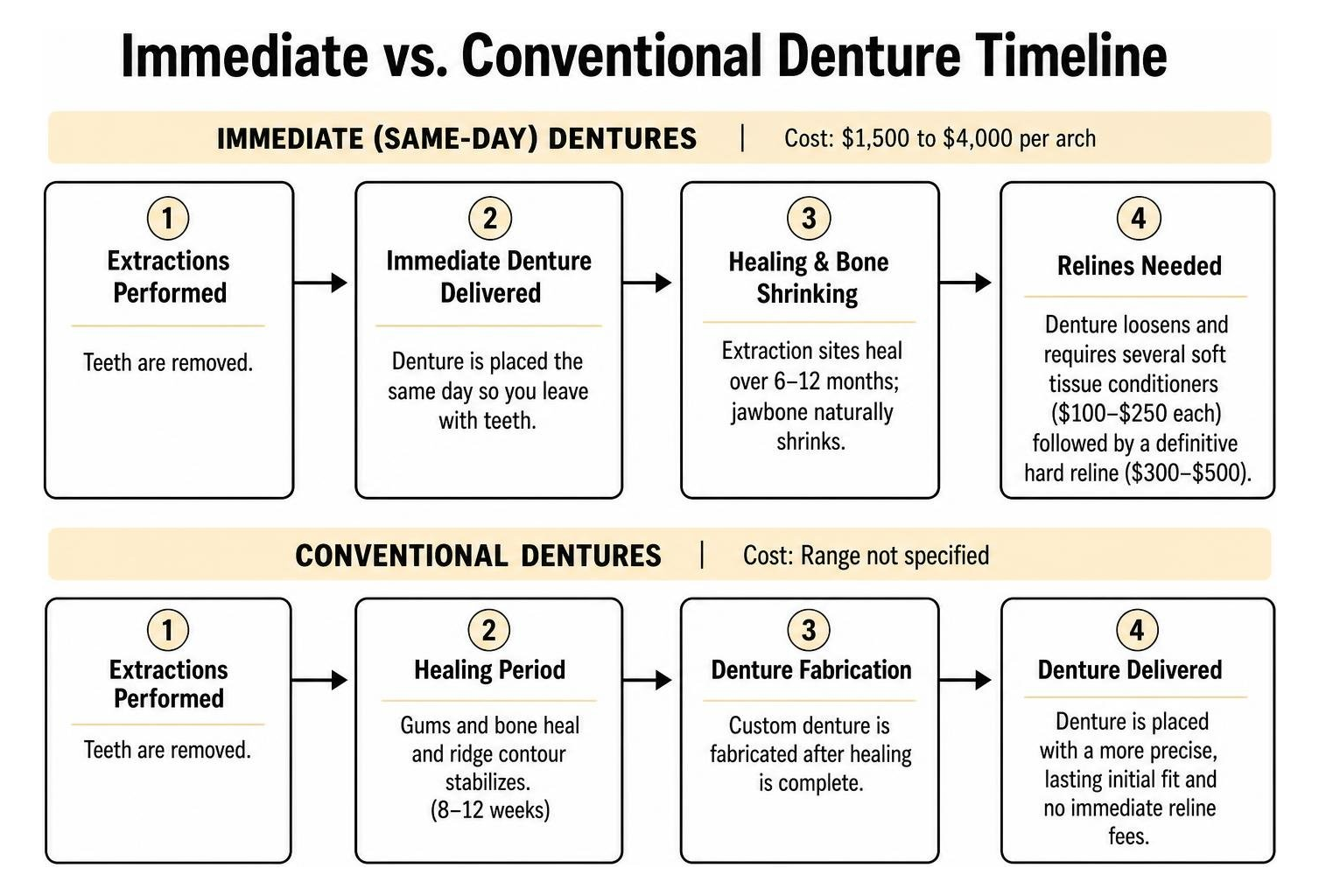
When teeth are extracted, patients choose between two primary treatment pathways:
- Immediate (Same-Day) Dentures: Delivered on the day of surgery so you never leave our office without teeth. However, as the underlying extraction sites heal over 6 to 12 months, the jawbone shrinks through natural bone remodeling. Because the immediate denture loosens, it requires several soft tissue conditioners ($100 to $250 each) followed by a definitive hard reline ($300 to $500). Immediate arches cost $1,500 to $4,000 per arch.
- Conventional Dentures: Fabricated 8 to 12 weeks after all extractions have fully healed and your ridge contour has stabilized. While this requires a short period without teeth, the resulting prosthetic provides a more precise, lasting initial fit that avoids immediate reline fees.
Over a 10-year period, regular wear necessitates professional denture maintenance and repair solutions to maintain structural integrity.
Insurance Coverage, Medicare, and Payment Alternatives

Navigating dental coverage requires understanding policy designations and exclusions. Most private PPO dental plans categorize dentures as a Major Restorative Service, covering 40% to 50% of allowable fees up to your plan’s annual maximum limit.
However, three primary coverage limitations apply:
- Annual Maximums: Most dental policies cap annual payouts at $1,000 to $2,000 per benefit year—a limit that has remained largely unchanged for decades.
- Waiting Periods: Many individual policies impose a 6- to 12-month waiting period on major prosthetics before benefits apply.
- Missing Tooth Clauses: If teeth were extracted before your current insurance policy took effect, some insurers deny coverage for replacing those specific teeth.
Original Medicare (Parts A & B) does not cover routine dental exams, extractions, or dentures. However, select Medicare Advantage (Part C) plans offer supplemental preventive and comprehensive dental allowances. Under state Medicaid programs, adult denture coverage varies; Illinois Medicaid provides specific fee-schedule allowances for qualifying complete dentures, though reimbursement rates sit substantially below average private fees.
For remaining balances, third-party healthcare financing through platforms like the CareCredit health and wellness credit card allows patients to divide treatment balances into manageable 6-, 12-, or 24-month zero-interest or fixed-rate payment schedules.
Maximizing Dental Benefits, HSAs, and FSAs
Smart scheduling can double your insurance benefits. If you need extensive surgical clearances alongside new prosthetics, we can split treatment phases across calendar years. Completing surgical extractions in November or December allows you to use your remaining annual insurance maximum, while fabricating the definitive dentures in January applies your new, refreshed annual maximum toward the prosthetic balance.
Furthermore, dentures, extractions, imaging, and relines qualify as medical expenses under Health Savings Accounts (HSA) and Flexible Spending Accounts (FSA). Using pre-tax HSA/FSA dollars reduces your net out-of-pocket expenses by 20% to 35%, depending on your income tax bracket. Reviewing the real price of dentures and affordable local care helps you combine these benefits effectively.
Affordable Alternatives: Dental Schools and Community Clinics
For patients facing severe financial hardship, low-cost alternatives can provide safe treatment:
- Accredited Dental School Clinics: Dental students provide care under direct faculty prosthodontist supervision for 40% to 60% less than standard private practice fees, often completing full sets for $800 to $2,000.
- Federally Qualified Health Centers (FQHCs): Community health clinics offer sliding-fee scales based on household income.
- Charitable Foundations: Programs like the Dental Lifeline Network provide donated dental services for qualifying seniors and medically compromised individuals.
Dentures vs. Implants vs. Bridges: Long-Term Value Comparison
Choosing a restorative pathway involves balancing immediate upfront fees against 10- and 20-year ownership costs:
| Factor | Traditional Removable Dentures | Fixed Dental Bridges | Implant-Supported Overdentures |
|---|---|---|---|
| Initial Cost (Full Arch) | $1,500 – $3,600 | N/A (Segmental only) | $6,000 – $15,000 |
| 10-Year Total Cost | $8,500 – $14,000 (with relines/replacement) | $4,000 – $8,000 (per 3-unit bridge) | $7,500 – $16,500 |
| Bone Preservation | None (bone resorbs over time) | None under pontic area | High (prevents bone shrinkage) |
| Chewing Efficiency | ~20% to 30% of natural teeth | ~80% of natural teeth | ~70% to 90% of natural teeth |
| Average Lifespan | 5 – 8 years | 10 – 15 years | 15 – 25+ years (posts) |
While traditional removable dentures have a low initial purchase price, the lack of root stimulation causes continuous jawbone resorption. Over a decade, patients require periodic relines and at least one complete replacement.
Comparing the cost to replace all teeth with implants versus dentures shows that stabilizing a lower denture with two to four implants yields better long-term chewing function and facial support. Evaluating anchored dentures cost vs savings helps determine which option fits your lifestyle and budget.
Frequently Asked Questions About Denture Costs
What is the average out-of-pocket price for a full set of dentures?
A complete set of traditional removable dentures (both upper and lower arches) averages $1,953, with most patients paying between $1,509 and $3,620 out-of-pocket for quality mid-range materials without insurance. Economy sets start near $700 to $1,500 for both arches, while premium custom prosthetics can exceed $8,000 to $14,000.
How much does it cost to extract all teeth and get dentures?
A full-mouth clearance involving the extraction of all remaining teeth, surgical alveoloplasty (bone smoothing), immediate healing dentures, and necessary post-operative relines costs between $8,000 and $13,000 without insurance. Spreading extractions across two calendar years can help maximize annual dental insurance benefits.
How often do dentures need to be relined or replaced?
Traditional removable dentures should receive a professional hard reline every 2 to 3 years ($300 to $500) to compensate for gradual jawbone changes. Due to acrylic wear and structural fatigue, the prosthetic base and teeth typically require complete replacement every 5 to 8 years.
Restoring Comfort and Confidence in Des Plaines
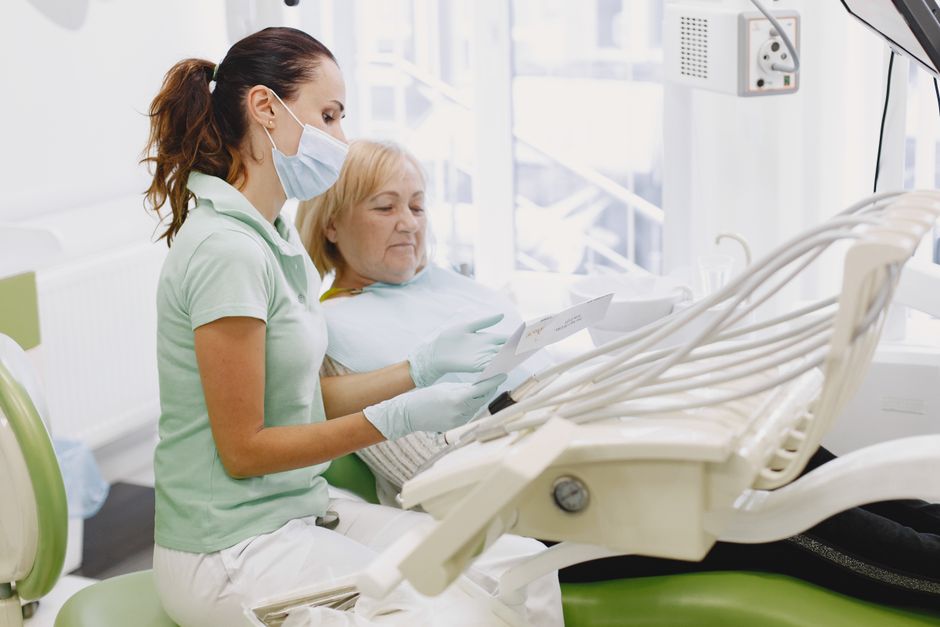
Rebuilding your smile is an investment in your nutrition, speech, and day-to-day confidence. While the wide range of denture options and surgical steps can feel overwhelming, understanding these costs upfront helps you avoid unexpected fees.
At Des Plaines Dental Studio, we provide clear, itemized treatment plans that break down every step—from diagnostic scans and gentle extractions to custom aesthetic fittings and long-term maintenance. We work closely with your dental insurance, review flexible financing solutions, and ensure your new smile looks natural, fits comfortably, and works within your budget.
If you are ready to explore your tooth replacement choices, schedule a consultation with our team to get an honest, customized treatment plan tailored to your smile.