


What Does the Cost of Fake Teeth Look Like in 2026?
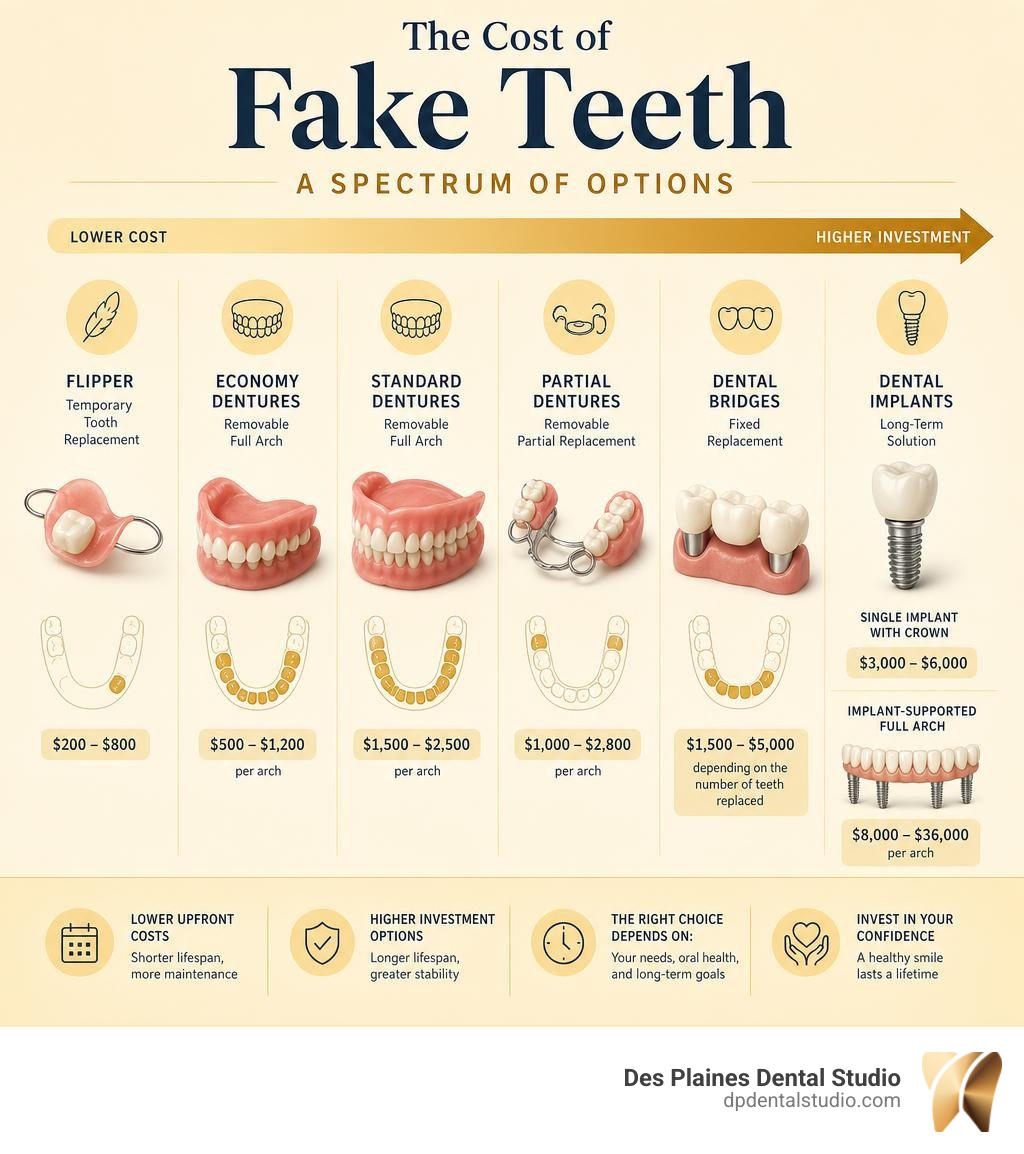
The cost of fake teeth can range from a few hundred dollars for a temporary flipper to $60,000 or more for a full-mouth implant restoration. In 2026, a practical starting point is:
- Economy removable dentures: about $500 to $1,200 per arch
- Standard full dentures: about $1,500 to $2,500 per arch
- Partial dentures: about $1,000 to $2,800 per arch
- Dental bridges: roughly $1,500 to $5,000, depending on the number of teeth replaced
- Single dental implant with crown: about $3,000 to $6,000
- Implant-supported full arches: about $8,000 to $36,000 per arch
The right option depends on how many teeth you are missing, your jawbone health, whether you need extractions or grafting, and how long you want the restoration to last. A low advertised price may cover only the appliance, not imaging, tooth removal, relines, or the final fitting.
More than 36 million Americans have lost all of their natural teeth, and dentures remain a common replacement. But modern choices now range from removable plates to stable snap-in dentures, fixed bridges, and implants that support the jawbone. This guide compares upfront fees, insurance limits, maintenance, and long-term value so you can plan with fewer surprises.
I am Marta Milejczyk, a dentist with clinical training in restorative, cosmetic, surgical, and implant dentistry, including full-mouth rehabilitation. I help patients understand the cost of fake teeth by connecting the treatment plan, material choices, insurance benefits, and long-term care needs.
Cost of fake teeth terms explained:
Comprehensive Breakdown of the Cost of Fake Teeth by Replacement Type
When evaluating tooth replacement, pricing is generally calculated either per tooth or per dental arch (upper or lower jaw). The total fee is heavily influenced by the restorative materials, the manufacturing process, and whether the prosthetic relies on the gums, natural teeth, or titanium root posts anchored in the jawbone.
| Replacement Type | Upfront Cost Range | Average Expected Lifespan | Chewing Efficiency Restored | Primary Material Options |
|---|---|---|---|---|
| Flipper Tooth (1–2 teeth) | $300 – $600 | 1 – 2 years (Temporary) | 15% – 25% | Basic Acrylic Resin |
| Traditional Removable Full Denture | $1,500 – $2,500 per arch | 5 – 8 years | 20% – 30% | Acrylic PMMA, Stock Resin Teeth |
| Premium Custom Denture | $2,000 – $3,600 per arch | 7 – 10 years | 30% – 40% | High-Impact Acrylic, Composite/Porcelain |
| Removable Partial Denture | $1,000 – $2,800 per arch | 5 – 10 years | 35% – 50% | Cast Metal Framework, Flexible Nylon |
| Fixed Dental Bridge (3 units) | $2,400 – $5,000 | 10 – 15 years | 65% – 75% | Porcelain-Fused-to-Metal, Solid Zirconia |
| Single Dental Implant (Post, Abutment, Crown) | $3,000 – $6,000 | 25+ years (Lifetime) | 90% – 98% | Titanium Post, Monolithic Zirconia |
| Implant Snap-In Overdenture (2–4 implants) | $8,000 – $16,000 per arch | 15 – 20+ years (Post); 5–7 yrs (Plate) | 60% – 75% | Titanium Fixtures, Locator Snaps, Acrylic |
| Fixed Full-Arch / All-on-4 | $14,000 – $36,000 per arch | 20+ years (Lifetime) | 90% – 95% | Titanium Posts, Custom Milled Zirconia Bridge |
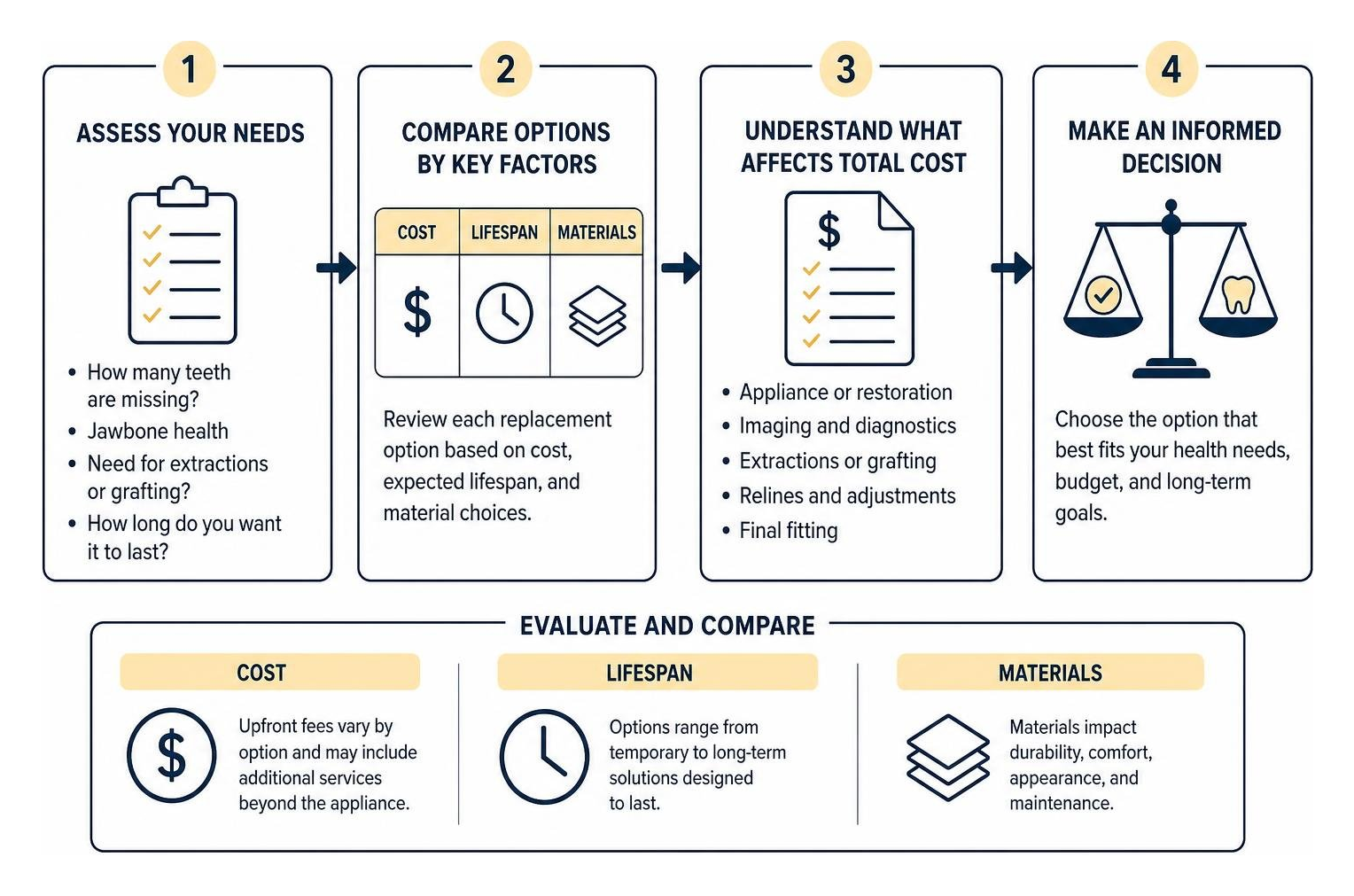
Removable Dentures and the True Cost of Fake Teeth per Arch
Removable dentures remain the most accessible entry point for widespread tooth restoration. The wide variation in pricing comes down to materials, fitting precision, and durability:
- Economy Dentures ($500 – $1,200 per arch): These entry-level plates use prefabricated acrylic bases and pre-molded teeth. While they serve as a functional immediate fix, they lack customization, wear down quickly, and often need frequent relining. For an in-depth breakdown of these tiers, check our Full Set Dentures Cost Guide: Economy to Premium Options.
- Conventional Standard Dentures ($1,500 – $2,500 per arch): Crafted using heat-cured acrylic that conforms precisely to impressions of your mouth, conventional plates offer a balance of comfort, natural aesthetics, and structural longevity.
- Premium Custom Dentures ($2,000 – $3,600 per arch): Utilizing high-density acrylic bases and hand-layered ceramic or composite teeth, premium models resist staining and abrasion while matching natural facial contours.
- Partial Dentures ($1,000 – $2,800 per arch): For patients missing scattered teeth, partial appliances utilize cast metal frameworks or flexible thermoplastic resins (such as Valplast) that latch securely around healthy teeth. You can explore full material details in our guide on How Much Do Metal Partial Dentures Cost With and Without Insurance.
- Immediate Dentures ($1,800 – $3,000 per arch): Inserted the moment natural teeth are extracted, immediate dentures ensure you never leave the office without a smile. Because gums shrink as they heal, immediate plates require soft relines and a subsequent hard reline within 6 to 12 months.
Fixed Bridges for Single and Multiple Missing Teeth
When one or two consecutive teeth are lost but adjacent natural teeth remain strong, a dental bridge provides a non-removable solution without requiring jaw surgery.
- Traditional Fixed Bridges ($2,400 – $5,000 for 3 units): The teeth on either side of the gap are reshaped to receive crowns, which support the artificial tooth (pontic) suspended between them.
- Cantilever Bridges ($1,500 – $3,500): Used primarily in low-stress front zones when only one anchor tooth is available.
- Maryland Bonded Bridges ($1,200 – $2,500): A conservative option featuring a composite or porcelain tooth secured to the back of neighboring teeth with metal or ceramic wings.
While bridges bypass oral surgery, reshaping healthy adjacent enamel permanently alters those anchor teeth. To understand how insurance handles these restorative appliances, review The Real Cost of a Dental Bridge With and Without Insurance.
Single Implants to Full-Arch Restorations: Cost of Fake Teeth with Implant Support
Dental implants replicate the entire biological architecture of a natural tooth—from root to chewing surface—preventing jawbone resorption over time.
- Single Tooth Implant ($3,000 – $6,000): This all-inclusive fee covers the titanium screw, the transmucosal connector abutment, and a custom-milled crown. If you are missing an individual front or back tooth, see our specialized options for a Single Tooth Implant Des Plaines IL.
- Snap-In Overdentures ($8,000 – $16,000 per arch): A hybrid option combining removable convenience with solid implant retention. Two to four implants are placed in the jaw, and a specialized denture snaps directly onto locator attachments. To learn more about coverage options, see What Do Overdentures Cost and Will Insurance Help.
- Full-Arch Fixed Restorations ($14,000 – $36,000 per arch): By placing four to six strategically angled implants, an entire bridge of teeth is permanently fixed into place. Learn how this procedure works with our All on 4 Dental Implants Des Plaines IL solutions.
Critical Hidden and Adjunct Costs Beyond the Base Appliance
Advertised prices often quote the base appliance alone, leaving out essential diagnostic and surgical procedures required to prepare your mouth:

- Comprehensive Diagnostics & 3D Imaging ($250 – $600): Modern restorative planning requires high-definition digital panoramic X-rays ($150–$250) or 3D Cone Beam Computed Tomography (CBCT) scans ($300–$600) to map bone density and locate nerve canals safely.
- Tooth Extractions ($150 – $700 per tooth): Non-restorable teeth must be cleared before fitting dentures or placing implants. Simple extractions range from $150 to $350, while complicated surgical extractions run $300 to $700. A full-mouth extraction can add $1,500 to $3,500+ to your total treatment plan.
- Bone Grafting and Site Preparation ($300 – $3,500): If missing teeth have caused jawbone loss, bone augmentation is necessary before placing implants. Learn more about preparation timelines in our guide to Bone Grafting for Dental Implants. In the upper jaw, a sinus lift may also be required ($1,500–$5,000).
- Sedation and Comfort Management ($250 – $1,200): Nitrous oxide, oral conscious sedation, or IV general anesthesia ensure comfortable surgical visits, with fees billed based on treatment time.
- Post-Placement Adjustments and Relines ($200 – $500): Removable prosthetics require routine soft relines during initial healing and periodic laboratory hard relines every 1 to 2 years to adapt to changing gum contours.
Regional Pricing Benchmarks and Geographic Variations in 2026
Where you receive dental care significantly impacts your out-of-pocket costs. Higher practice overhead, state licensing standards, and regional cost-of-living differences shape local procedural fees:
Across the country, procedural fees show wide variation. Restorative costs range from lower-cost southern markets up to higher-cost coastal regions like California, where single implants average $5,733. In the Midwest, Illinois restorative pricing closely matches balanced national benchmarks. For an in-depth look at state-by-state price data, review the State of U.S. Dental Costs 2026: Prices by State [Data Report].
For patients researching broader international benchmarks, standard full dentures in Canada run approximately $2,100 to $2,300 CAD before laboratory surcharges and preparatory clinical fees, as detailed in the How Much Do Dentures Cost in Canada? 2026 Price List | Aeva.
Insurance Coverage, Medicare, Medicaid, and Smart Financing Strategies
Navigating dental insurance can be confusing, but understanding your policy helps maximize your available benefits:
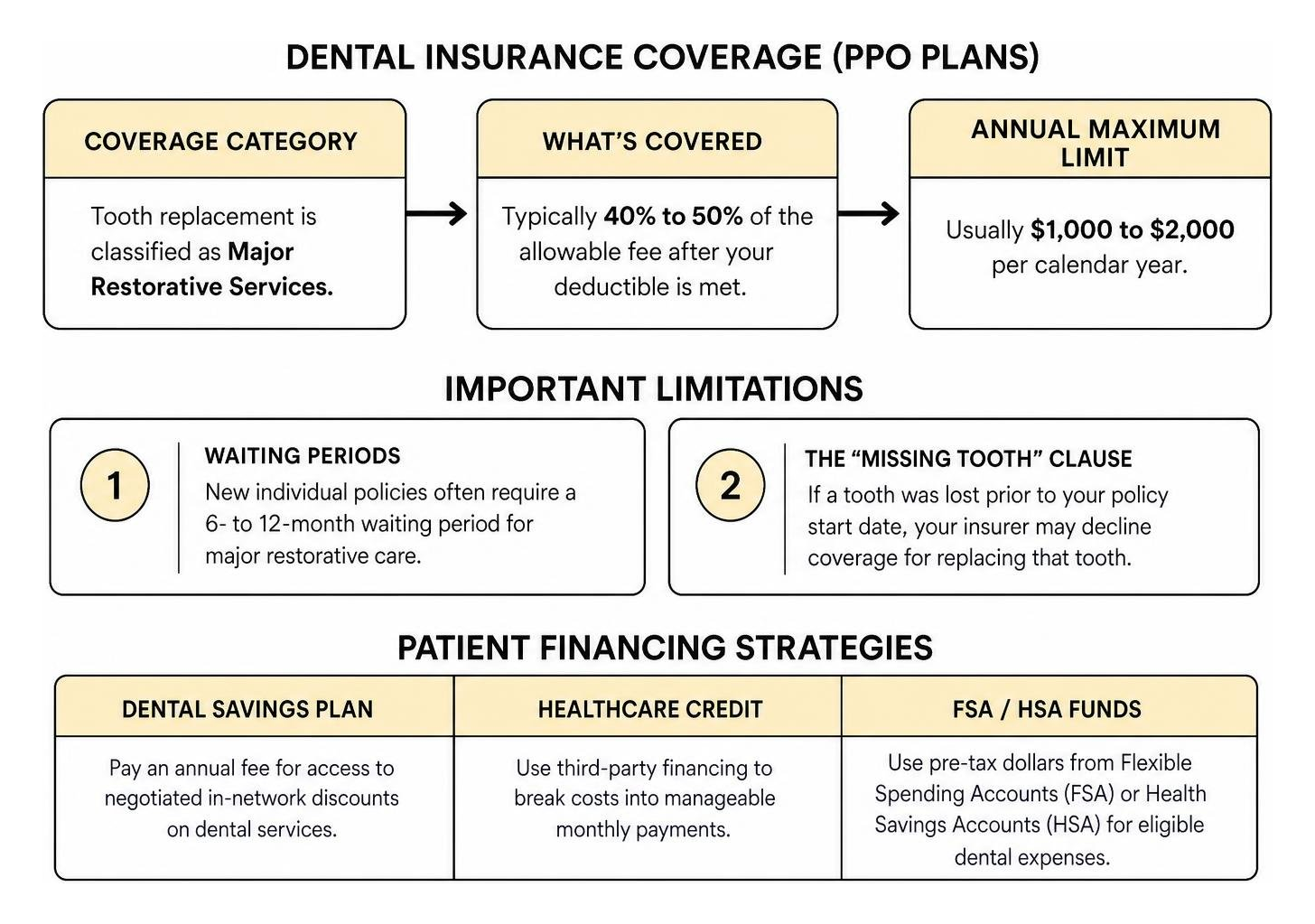
Private Dental Insurance (PPO Plans)
Most standard PPO plans categorize tooth replacement under Major Restorative Services, typically reimbursing 40% to 50% of the allowable fee after your deductible is met. However, annual maximum caps—usually between $1,000 and $2,000 per calendar year—can limit coverage for higher-end treatments.
- Waiting Periods: New individual policies often require a 6- to 12-month waiting period for major restorative care.
- The “Missing Tooth Clause”: If a tooth was lost prior to your policy start date, your insurer may decline coverage for replacing that specific tooth.
- Two-Year Staging: If you need an implant, staging treatment across calendar years (placing the implant in December and the final crown in January) lets you apply two consecutive annual maximums.
For detailed insurance navigation steps, check out our Dental Implants Insurance Guide 2026.
Medicare and Medicaid Realities
- Original Medicare (Parts A & B): Excludes coverage for routine restorative dentistry, bridges, and removable or fixed dentures.
- Medicare Advantage (Part C): Many Advantage plans provide supplemental dental benefits that contribute toward basic dentures, extractions, and select restorative treatments.
- Medicaid: Adult coverage varies widely by state. In Illinois, basic adult Medicaid covers necessary extractions and basic standard dentures, but excludes comprehensive implant restorations.
Pre-Tax Health Funds & Third-Party Financing
- HSA & FSA Accounts: Paying for out-of-pocket restorative treatments with pre-tax Health Savings Accounts or Flexible Spending Accounts can effectively reduce overall costs by 20% to 35%, depending on your tax bracket.
- Healthcare Financing: Programs like CareCredit and low-interest medical loans offer 6- to 24-month interest-free payment terms for qualifying plans.
- In-House Dental Membership Plans: For uninsured patients, local in-house plans provide flat discounts (often 15% to 30% off standard procedural fees) for a low annual membership fee, eliminating waiting periods and annual maximums.
Long-Term Value Comparison: Dentures vs. Bridges vs. Dental Implants
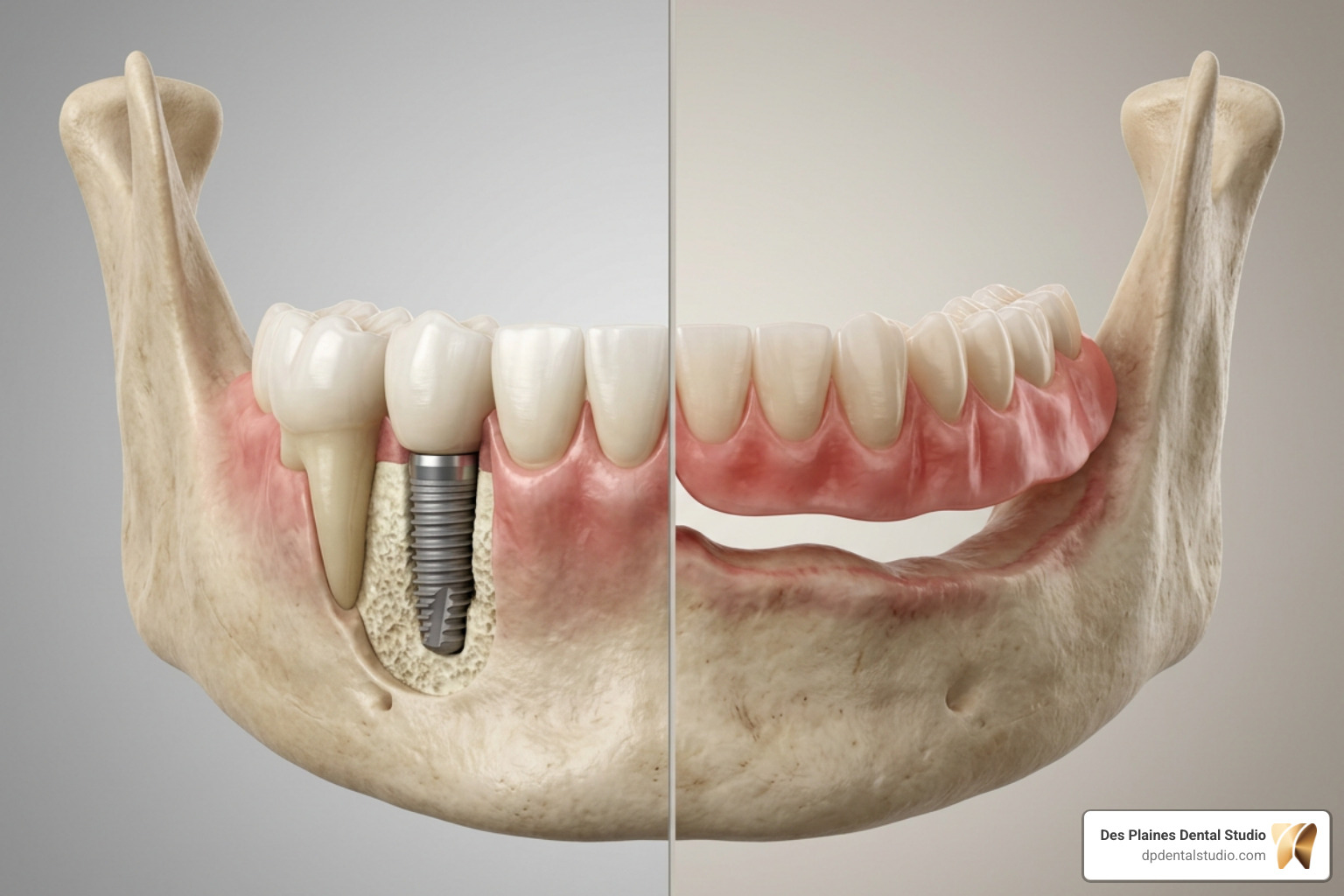
While conventional dentures carry lower upfront costs, the true financial picture looks very different over a 20-year horizon.
When natural tooth roots are missing, the surrounding jawbone loses stimulation and naturally resorbs over time. This gradual bone loss causes traditional dentures to loosen, leading to sore spots, reduced chewing power, and recurring laboratory reline costs ($200–$500 every 1–2 years) alongside full replacements every 5 to 7 years.
Over a 20-year period, maintaining traditional removable dentures often totals $7,000 to $14,000 per arch once relines and replacement plates are factored in. Fixed dental bridges, which last 10 to 15 years, similarly run $6,000 to $10,000+ per site over time if anchor teeth develop recurrent decay.
By contrast, dental implants fuse directly with your natural jawbone through osseointegration. By preserving bone density, they maintain facial contours, eliminate slipping, and restore up to 98% of natural chewing strength. Because the titanium post can last a lifetime, implants frequently provide the most cost-effective solution over your lifespan.
Frequently Asked Questions About the Cost of Fake Teeth
What is the cheapest option for replacing missing teeth?
The lowest upfront cost for replacing a single missing tooth is an acrylic temporary removable flipper tooth ($300 to $600). For full-arch replacement, an economy acrylic denture ($500 to $1,200 per arch) is the least expensive option. However, budget acrylics wear down quickly and require frequent relining and adjustments, often increasing cumulative long-term expenses.
Does dental insurance or Medicare cover the full cost of fake teeth?
No standard dental insurance policy covers 100% of the cost of fake teeth. PPO plans typically cover roughly 50% of major restorative services up to an annual maximum of $1,000 to $2,000. Original Medicare excludes dental restorations entirely, though select Medicare Advantage plans offer supplemental allowances for basic dentures and extractions.
How long do different types of fake teeth last before needing replacement?
- Temporary Acrylic Flippers: 1 to 2 years
- Traditional Removable Full Dentures: 5 to 8 years (with routine relines every 1–2 years)
- Fixed Dental Bridges: 10 to 15 years (dependent on anchor tooth health)
- Dental Implants: 25+ years to a lifetime for the titanium post (crowns may require replacement after 15–20 years)
Restore Your Confident Smile at Des Plaines Dental Studio
Rebuilding your smile is an investment in your daily nutrition, speech, and long-term health. At Des Plaines Dental Studio, our philosophy centers on transparent pricing, welcoming care, and a gentle, pain-free experience tailored to your personal goals and budget.
Whether you need a custom-milled partial denture, an immediate smile restoration, or advanced full-mouth implant rehabilitation, we take the time to evaluate your bone health, explain all available treatment paths, and help you maximize your insurance benefits.
To explore surgical and permanent tooth restoration options in detail, view our breakdown of the Average Cost of Dental Implants and schedule your one-on-one consultation with our clinical team today!