How Much Do Dental Implants Cost in 2026?
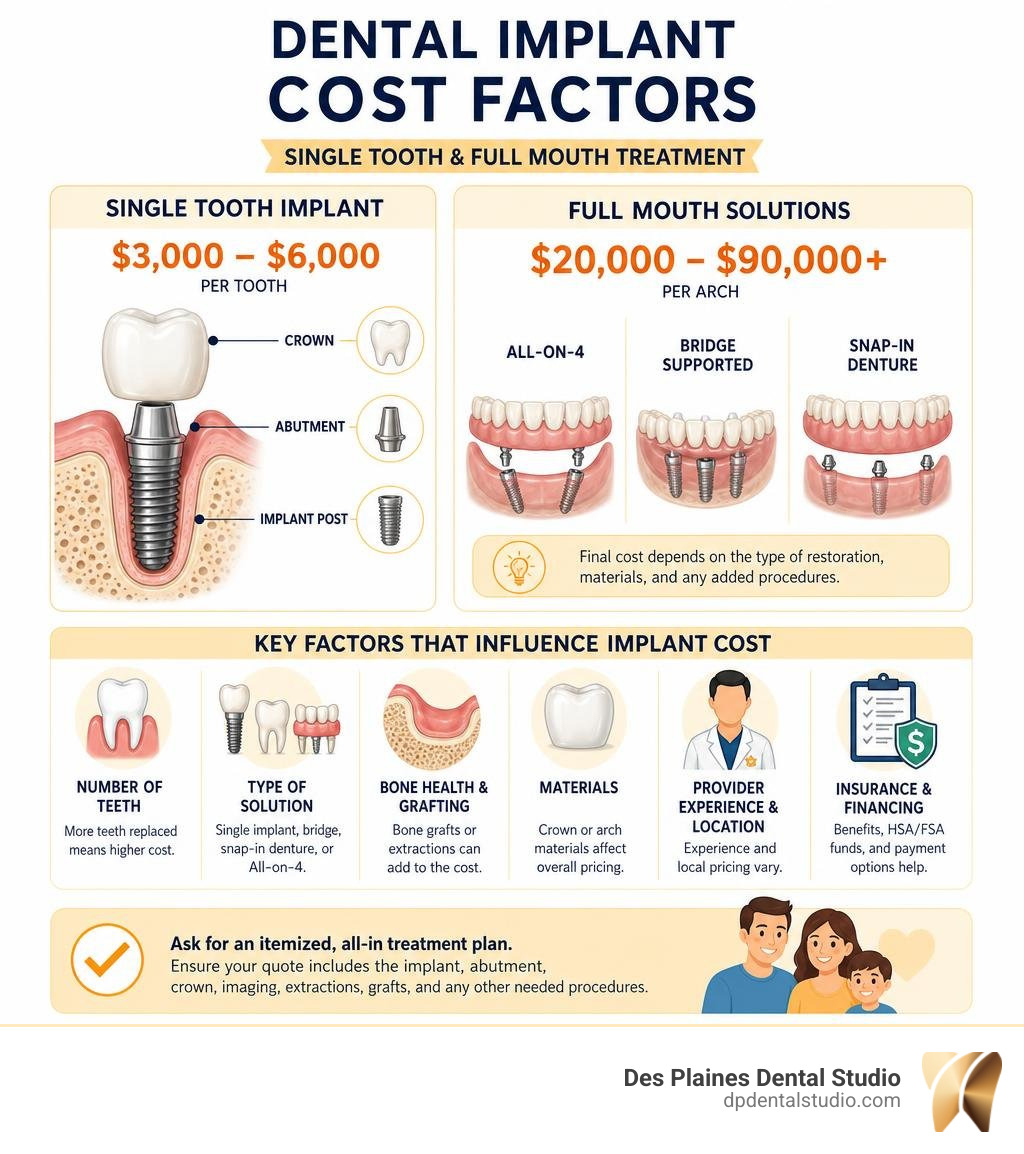
A complete single-tooth dental implant typically costs $3,000 to $6,000 in 2026. That price should include the implant post, connecting abutment, and final crown. A full-mouth solution can range from roughly $20,000 to $90,000 or more, based on the type of restoration, materials, and whether you need extra procedures.
Before comparing quotes, ask for an itemized, all-in treatment plan. Low advertised prices may cover only the implant post, not the crown, imaging, extraction, bone graft, or sedation.
Your cost depends on:
- How many teeth need replacement
- Whether you choose a single implant, bridge, snap-in denture, or All-on-4 treatment
- Your jawbone health and need for grafting
- Crown or full-arch material
- Provider experience and local pricing
- Insurance benefits, HSA/FSA funds, and financing options
I am Marta Milejczyk, a dentist with advanced training in full-mouth rehabilitation, restorative dentistry, and implant care, including hospital-based oral surgery experience. In this guide to how much implants cost, I will help you compare realistic prices, understand what each quote includes, and plan for lasting value.
Determining How Much Implants Cost: 2026 Breakdown by Tooth and Arch
Evaluating implant costs requires looking closely at how many teeth you need to restore and how those restorations are anchored to your jawbone. In our practice, we emphasize transparent treatment planning so you never face surprises at checkout.
Understanding general market pricing helps you evaluate the true scope of your investment. According to our dental implant costs complete guide, pricing structures are shaped by the number of prosthetic teeth, material choices, and surgical complexity. While national averages for a complete single tooth replacement range between $3,000 and $6,000, multi-tooth systems and full-arch rehabilitations involve different planning benchmarks.
Single-Tooth Pricing: How Much Implants Cost per Unit
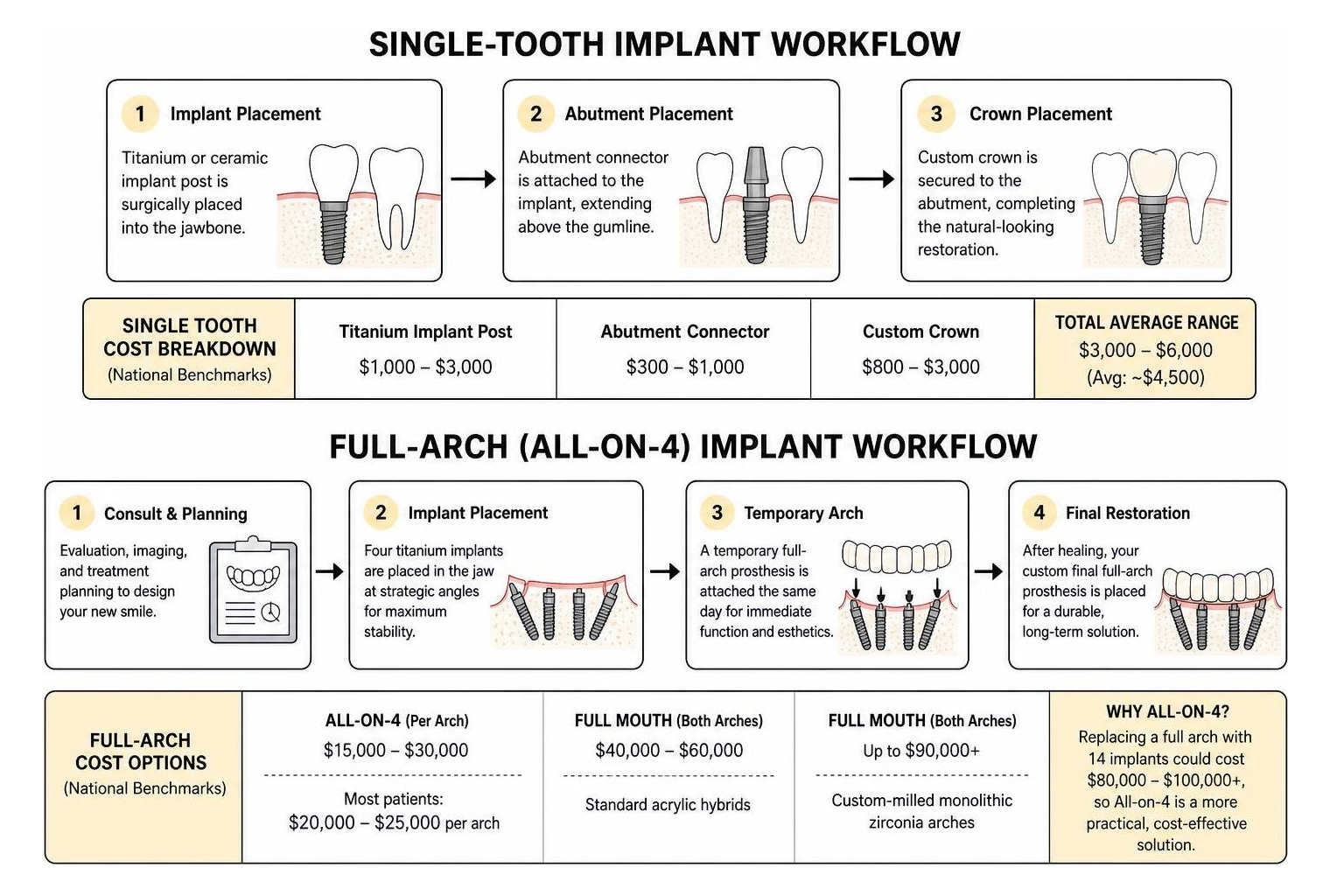
When replacing an individual missing tooth, the procedure requires three separate physical components: the titanium or ceramic fixture inserted into your jawbone, the abutment collar that extends above the gumline, and the custom crown matched to your natural smile.
Across the United States, an all-inclusive single implant ranges between $3,000 and $6,500, with a national average settling near $4,500. If you are missing a front tooth or need a durable molar replaced, our team provides focused care with a single tooth implant in Des Plaines IL. Rear molars experience massive bite pressures—sometimes exceeding 200 pounds of force—which means choosing strong, wear-resistant restorations is essential. You can discover more about these back-tooth dynamics in our guide to molar implants 101 and what it costs to replace your back teeth.
Full-Arch and All-on-4: How Much Implants Cost for a Full Mouth
When you need to replace an entire upper or lower arch of missing or failing teeth, placing 14 individual implants per jaw is rarely practical or cost-effective. Doing so could easily push total fees beyond $80,000 to $100,000+.
Instead, full-arch rehabilitation uses strategic engineering. The All-on-4 method secures a full fixed arch of teeth onto just four strategically angled titanium posts. Nationally, All-on-4 ranges between $15,000 and $30,000 per arch, with most patients spending between $20,000 and $25,000 per arch. Full-mouth rebuilds covering both upper and lower jaws generally range from $40,000 to $60,000 for standard acrylic hybrids, and up to $90,000+ for custom-milled monolithic zirconia arches.
To learn more about full-arch options in our area, review our approach to All-on-4 dental implants in Des Plaines IL as well as our detailed review of the overall price of full mouth dental implants.
Implant-Supported Bridges and Overdentures
If you are missing three or four adjacent teeth, an implant-supported bridge is a practical intermediate solution. Rather than placing an implant for every single missing root, your dentist places two implant fixtures to suspend a three- or four-unit bridge between them. These restorations typically cost between $6,000 and $10,000.
For edentulous patients seeking stability on a tighter budget, implant-supported overdentures (often called snap-in dentures) provide a secure, removable option. Anchored by two to four implants per arch, snap-on overdentures prevent the slipping and clicking of traditional dentures while costing between $8,000 and $20,000 per arch. To see how these compare to traditional restorations, explore our guide on the real cost of anchored dentures and how to save.
Anatomy of Dental Implant Pricing: Components and Preparatory Procedures
A primary reason dental quotes can seem confusing online is that some clinics advertise only the surgical placement fee while omitting the abutment, crown, and diagnostic imaging.

An all-inclusive quote should clearly separate the primary prosthetic components from any required preparatory surgery:
Implant Fixture, Abutment, and Crown Restorations
A complete dental implant consists of three separate items billed together or individually:
- The Implant Fixture (Post): The medical-grade titanium screw surgically placed into your jawbone to act as an artificial tooth root (CDT code D6010). This component alone runs $1,000 to $3,000.
- The Abutment: The custom or prefabricated titanium/zirconia connector screw that attaches to the post and sits just above the gumline (CDT code D6056). Learn more about connector mechanics in our overview of dental abutment costs and what to expect when connecting.
- The Final Crown: The visible porcelain, ceramic, or zirconia tooth custom-crafted by a dental laboratory to blend seamlessly with your smile (CDT code D6058 or D2740), ranging from $800 to $3,000. Discover our restorative standards under dental implant restorations.
Surgical Add-Ons: Bone Grafts, Sinus Lifts, and Extractions
Before placing an implant, your dentist must confirm you have enough healthy bone volume to support the post. When teeth have been missing for months or years, natural jawbone resorption begins almost immediately.
- 3D CBCT Imaging ($200–$500): High-resolution 3D imaging allows us to evaluate nerve pathways, sinus cavities, and bone density prior to surgery.
- Tooth Extractions ($150–$600): Removing a damaged tooth can range from a simple extraction to a complex surgical extraction.
- Bone Grafting ($300–$3,000): Approximately 40% to 50% of implant patients require site augmentation to build sufficient bone foundation. Read more about site preparation in our guide to bone grafting for dental implants.
- Sinus Lifts ($1,500–$5,000): Upper back molars often sit close to the maxillary sinus cavity. When bone height is shallow, a sinus lift gently elevates the sinus membrane to make room for bone grafting material.
Key Factors Influencing Total Implant Costs
No two mouths are identical, which means fees vary based on clinical complexity, surgical materials, and anesthesia choices.
Provider Credentials and Clinical Expertise
Roughly 70% of dental implants in the United States are placed by general dentists with postgraduate surgical training, while the remainder are placed by specialists such as oral and maxillofacial surgeons (OMS) or periodontists. Prosthodontists complete three additional years of American Dental Association-accredited training focused on complex restorations and full-mouth rehabilitation.
Specialist placement often carries a 15% to 30% fee premium. For standard single implants with healthy bone, a general dentist with comprehensive implant training can deliver excellent clinical outcomes at a lower overall cost.
Material Selections: Titanium vs. Zirconia
Material selection affects both the upfront bill and long-term durability:
- Titanium Implants: Titanium remains the gold standard in modern implant dentistry, boasting over 30 years of clinical research and a 10-year success rate exceeding 95% to 98%. Learn more about this biocompatible metal in our article on titanium bone implants.
- Zirconia (Ceramic) Implants: Zirconia offers a metal-free, tooth-colored alternative for patients with metal sensitivities or thin gum tissue where metal might show through. Zirconia fixtures generally cost $300 to $800 more per tooth.
- Prosthetic Materials: For full arches, high-strength monolithic zirconia resists chipping and staining and can last 15 to 20+ years, whereas standard PMMA acrylics require replacement or relining every 5 to 8 years.
Long-Term Cost Comparison: Dental Implants vs. Bridges and Dentures
When evaluating tooth replacement options, it is easy to focus only on upfront fees. However, looking at the 20-year total cost of ownership reveals a different picture.
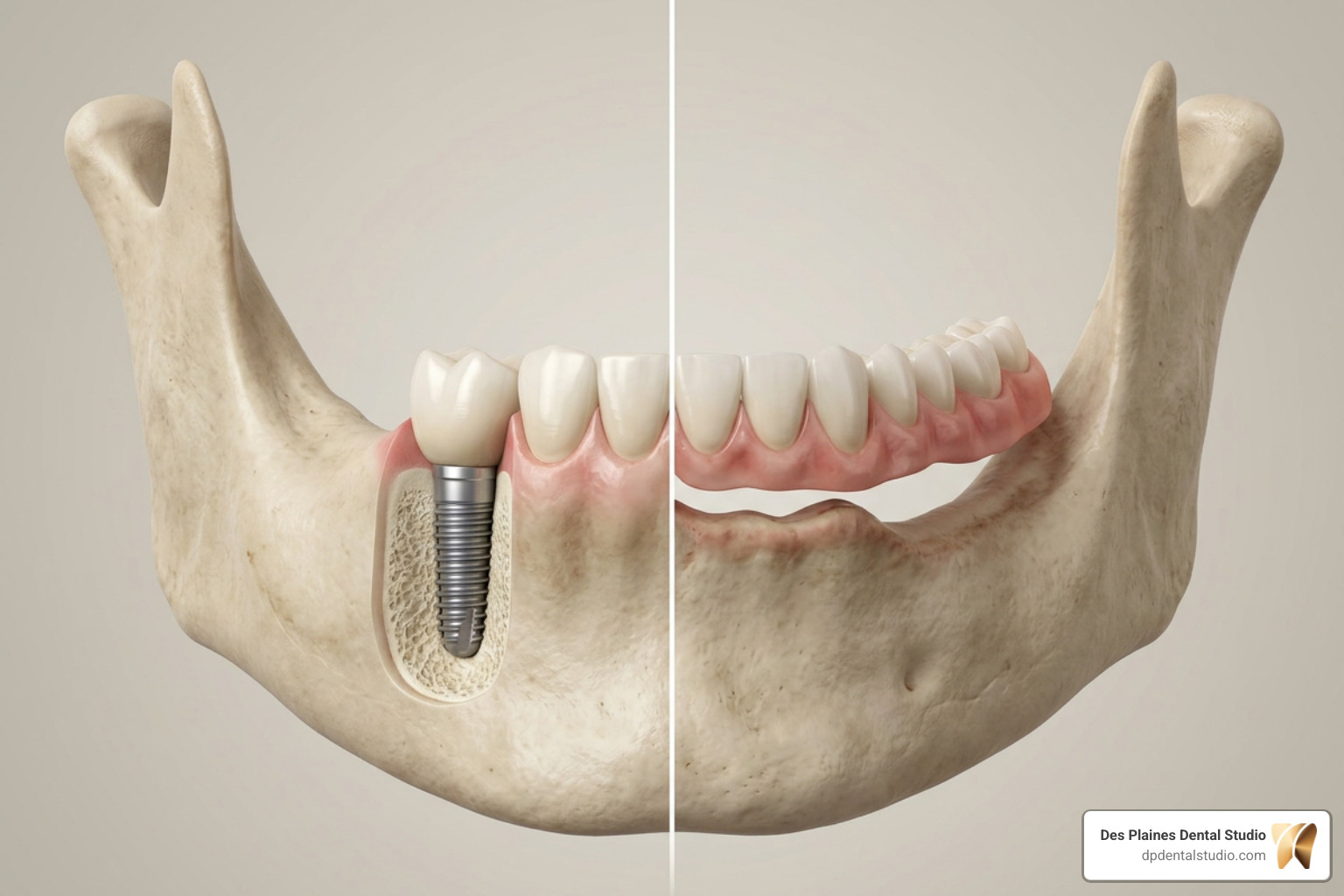
A traditional 3-unit dental bridge costs $3,000 to $5,000 upfront, but it requires cutting down two healthy neighboring teeth to serve as anchors. Bridges have an average lifespan of 10 to 15 years, meaning you will likely pay for replacement bridges over your lifetime.
Conventional dentures carry the lowest starting price ($1,500 to $3,500 per arch), but they do not stimulate underlying bone tissue. Over time, progressive bone loss causes dentures to loosen, requiring periodic relines ($200 to $500 each) and full remakes every 5 to 7 years. Over a 20-year span, traditional dentures can end up costing $15,000 to $25,000 per arch once you factor in ongoing adjustments, adhesive pastes, and replacements.
To see how full-arch replacements compare over time, explore our guide on the average cost to replace all teeth with implants or dentures.
| Feature / Metric | Single Dental Implant | 3-Unit Dental Bridge | Full Traditional Denture (Per Arch) |
|---|---|---|---|
| Initial Upfront Cost | $3,000 – $6,000 | $3,000 – $5,000 | $1,500 – $3,500 |
| Average Lifespan | Post: Lifetime; Crown: 15–25 yrs | 10–15 Years | 5–7 Years |
| Impact on Adjacent Teeth | Zero (Preserves natural teeth) | Requires shaving adjacent enamel | None (Rests directly on gums) |
| Preserves Jawbone Density? | Yes (Osseointegration prevents loss) | No (Bone resorbs under pontic) | No (Bone resorbs continuously) |
| 20-Year Cumulative Cost | $4,500 – $7,000 (1 crown refresh) | $6,000 – $12,000+ (1–2 replacements) | $15,000 – $25,000+ (Relines & remakes) |
Navigating Dental Insurance, Financing, and Affordable Alternatives
Dental benefits can help offset out-of-pocket expenses when applied strategically. Our administrative team works closely with insurance providers to maximize your available benefits.
For a deep dive into insurance planning, read our comprehensive dental implants insurance guide for 2026.
Maximizing Insurance Coverage and HSA/FSA Accounts
Most standard dental PPO plans categorize implants under major restorative services, covering up to 50% of allowable fees. However, traditional annual benefit maximums usually cap payouts between $1,000 and $2,000 per calendar year.
- Split-Year Strategy: Because dental implant placement involves a 3-to-6 month healing phase between surgical fixture placement and final crown attachment, you can schedule your surgery in November or December and place the final crown in January. This allows you to apply two consecutive annual maximums toward a single tooth replacement.
- HSA & FSA Accounts: Health Savings Accounts (HSA) and Flexible Spending Accounts (FSA) allow you to pay for your implant with pre-tax dollars, saving you roughly 20% to 35% depending on your tax bracket.
- Medical Insurance: In cases where tooth loss results from severe facial trauma, congenital defects, or oral pathology, your medical insurance policy may cover a portion of surgical placement. Learn the details in our guide on how to get dental implants covered by medical insurance.
Third-Party Financing and Payment Options
If you need treatment that exceeds your current insurance limits, several financing strategies can keep monthly payments manageable:
- Healthcare Credit Lines: Providers such as CareCredit offer 6- to 24-month promotional no-interest payment terms for qualified applicants.
- In-House Membership Plans & Installments: Many dental practices offer internal installment agreements or discount membership plans that reduce standard procedure fees by 10% to 20%.
- Upfront Cash Discounts: Asking your provider if they offer a 5% to 10% discount for paying your treatment plan in full via cash or check can save you hundreds of dollars upfront.
For more budget-friendly guidance, explore our practical recommendations on how to find affordable dental implants.
The Surgical Journey: Procedure Steps, Recovery Timeline, and Maintenance
Understanding each step of the treatment process helps alleviate dental anxiety and ensures a smooth, predictable recovery.
- Comprehensive Examination & 3D Imaging: We evaluate your jawbone architecture, bite alignment, and oral health using high-resolution digital scans.
- Preparatory Procedures (If Needed): Damaged teeth are extracted and bone grafting material is placed to build a stable foundation.
- Implant Placement Surgery: Under local anesthesia or IV sedation, the titanium fixture is placed into the jawbone. This appointment typically takes 45 to 90 minutes for a single tooth.
- Osseointegration (3 to 6 Months): Over several months, your jawbone naturally fuses with the titanium surface, creating a permanent root foundation.
- Abutment & Final Restoration: Once osseointegration is confirmed, your custom crown or full-arch bridge is secured in place.
Following surgery, stick to a cool liquid and soft-food diet (such as scrambled eggs, yogurt, and warm soups) for the first few days, avoiding crunchy, hard, or sticky items. Maintain clean oral hygiene by gently rinsing with warm salt water and brushing carefully around surgical sites.
Once healed, caring for your dental implant is simple: brush twice daily, floss daily using implant-safe floss or an interdental brush, and visit us for routine hygiene cleanings to prevent peri-implantitis and protect your smile for decades to come.
Frequently Asked Questions About Dental Implant Costs
Does dental insurance cover the full cost of dental implants?
Dental insurance rarely covers the entire cost of an implant. While many dental PPO policies cover 25% to 50% of the procedure as a major restorative benefit, annual policy caps ($1,000 to $2,000) limit total yearly payouts. Insurance may cover preparatory extractions, 3D imaging, or the final crown while excluding the surgical titanium post.
How long do dental implants realistically last?
The titanium implant post is engineered to integrate permanently with your jawbone and can last a lifetime with proper oral hygiene. The custom porcelain or zirconia crown experiences everyday chewing friction and typically lasts 15 to 25 years before needing a routine refresh or replacement.
Is All-on-4 cheaper than getting individual tooth implants?
Yes. Replacing an entire arch of 14 teeth with individual implants could cost $60,000 to $90,000+ per jaw and often requires extensive bone grafting. All-on-4 utilizes four angled implants to support a complete fixed arch, typically costing $15,000 to $30,000 per arch while reducing the need for costly bone augmentation.
Conclusion
Restoring missing teeth is one of the most beneficial investments you can make for your long-term oral health, chewing comfort, and confidence. While the upfront investment for dental implants is higher than removable dentures or traditional bridges, their lifetime durability, bone-preserving benefits, and natural aesthetics deliver unmatched value over time.
At Des Plaines Dental Studio, our mission is to deliver patient-centered care, full insurance coordination, and a welcoming, pain-free clinical experience. Whether you need a single tooth restored or are exploring full-mouth reconstruction, we provide transparent, itemized treatment plans tailored to your goals.
To learn more about your options or review standard pricing benchmarks, explore our complete breakdown of the average cost of dental implants and schedule your consultation with our team today!