


What Does Delta Dental Actually Cover for Dental Implants?
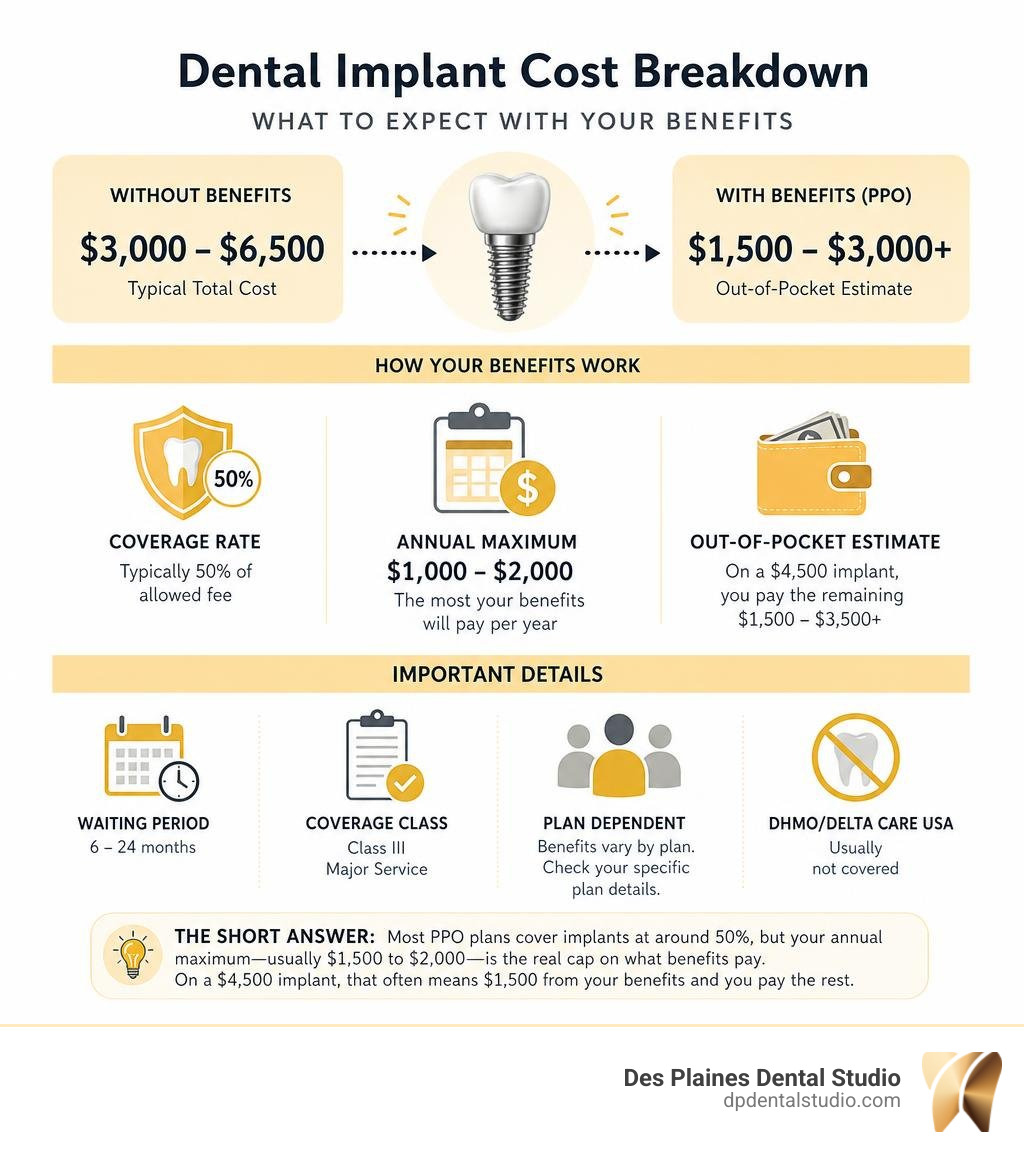
Understanding delta dental implant cost is the first step before booking any implant procedure. Here is a quick snapshot of what most patients can expect:
| Without Insurance | With Delta Dental PPO | |
|---|---|---|
| Single implant (post, abutment, crown) | $3,000 – $6,500 | $1,500 – $3,000+ out-of-pocket |
| Delta Dental coverage rate | — | Typically 50% of allowed fee |
| Annual maximum payout | — | $1,000 – $2,000 |
| Waiting period | — | 6 – 24 months |
| DHMO/DeltaCare USA coverage | — | Usually not covered |
The short answer: Most Delta Dental PPO plans cover implants at around 50%, but your annual maximum — usually $1,500 to $2,000 — is the real cap on what they pay. On a $4,500 implant, that often means Delta Dental pays $1,500 and you pay the rest.
A few important caveats up front:
- Not all Delta Dental plans are the same. Delta Dental is a network of roughly 39 independent regional companies, each with its own rules.
- PPO Premium plans typically cover implants. PPO Basic and DHMO plans often do not.
- Coverage depends on your specific employer or marketplace plan — two people with identical Delta Dental cards can have completely different benefits.
This guide walks you through exactly how to find your real numbers, avoid common coverage traps, and keep more money in your pocket.
I’m Dr. Marta Milejczyk, a general dentist with advanced training in restorative and implant dentistry who has been helping patients in Chicago’s northwest suburbs navigate delta dental implant cost since 1997. With hands-on experience in full-mouth rehabilitation and a General Practice Residency from Loyola University Medical Center, I will walk you through everything you need to know to make a confident, informed decision.
Does Delta Dental Cover Dental Implants?
Yes, Delta Dental does cover dental implants, but with some very important terms and conditions. In the dental insurance world, implants are almost always classified as a Class III Major Service. This means they are grouped with other complex procedures like crowns, bridges, and deep cleanings.
Because they are classified as major services, they do not receive the 80% to 100% coverage that preventive care (like cleanings and exams) enjoys. Instead, if your plan covers them at all, they are typically reimbursed at a lower percentage, and you must satisfy your annual deductible first. To understand how your specific policy handles these benefits, it helps to read through our dental implants insurance guide 2026 for a deeper look at the industry standards.
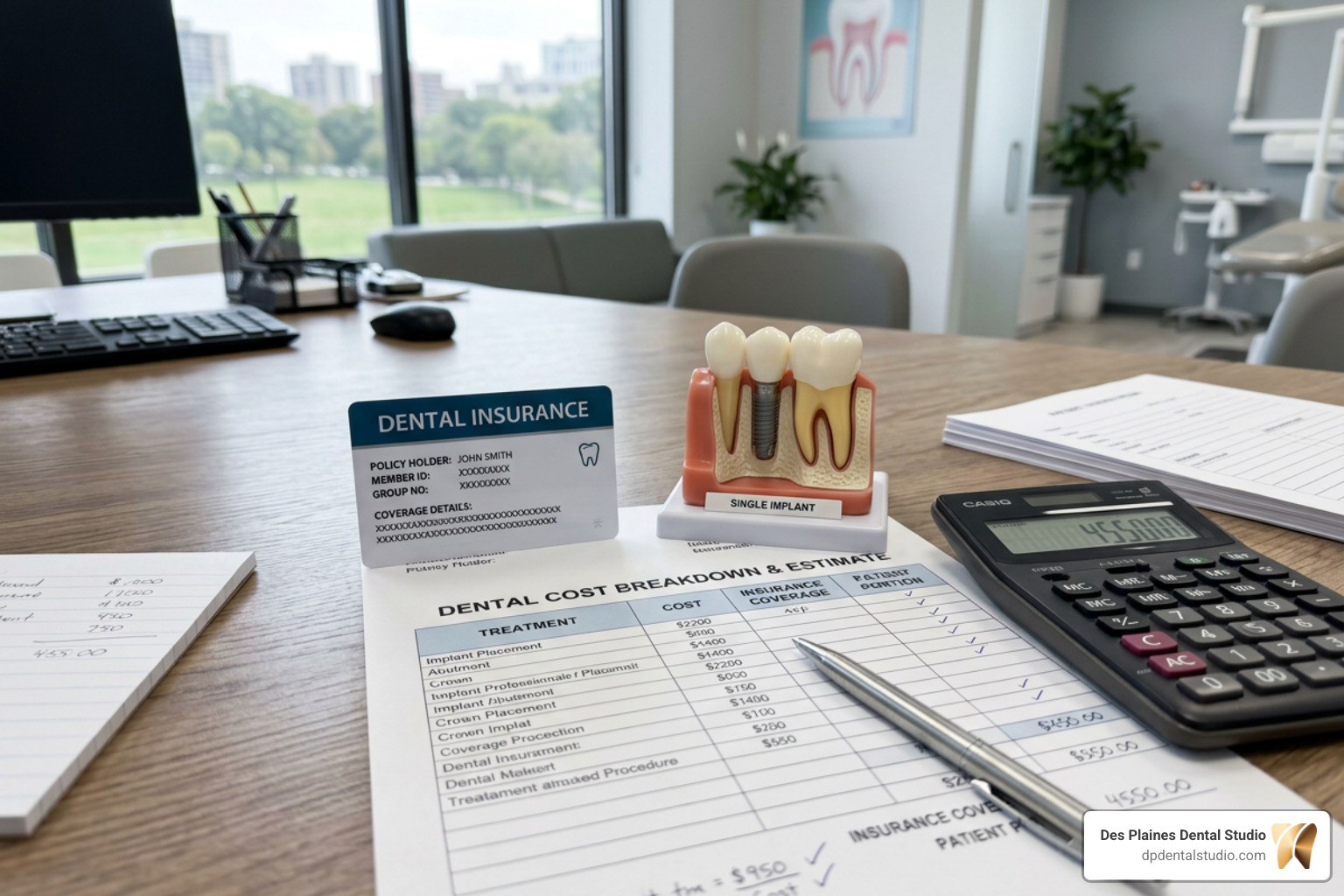
Delta Dental PPO vs. DHMO Plans
When looking at your delta dental implant cost, the type of plan you hold is the single biggest factor.
- Delta Dental PPO (Preferred Provider Organization): This is the most common and flexible plan type. Under a PPO plan (specifically the PPO Premium tier), implants are usually covered at 50% of the negotiated in-network fee, up to your annual maximum benefit. However, be aware that Delta Dental PPO Basic plans often exclude implant coverage entirely, leaving you with 0% coverage.
- Delta Dental DHMO (DeltaCare USA): DHMO plans rely on a closed network of co-primary care dentists. In almost all cases, DeltaCare USA and other DHMO plans exclude dental implants entirely. If you have a DHMO, you will likely have to pay 100% out-of-pocket for your implant procedure, though you may receive discounts on alternative treatments like traditional bridges or partial dentures.
The Regional Federation Structure of Delta Dental
One of the most confusing aspects of dental benefits is why two people holding identical-looking “Delta Dental” cards can have completely different coverage.
Delta Dental is not a single national insurance company. Rather, it is a federation of approximately 39 independent regional member companies. For our patients here in Des Plaines, IL, your plan is managed by Delta Dental of Illinois (or your employer’s regional equivalent if they are headquartered out of state).
Each regional company designs its own benefit schedules, sets its own in-network fee structures, and writes its own contract exclusions. This means a policy written by Delta Dental of Illinois may cover bone grafting, while a policy from Delta Dental of California might exclude it. Always verify your specific policy terms with your regional administrator rather than relying on general national guidelines.
Understanding Your Out-of-Pocket Delta Dental Implant Cost
Knowing what to expect financially helps eliminate the stress of dental care. When planning your budget, we recommend reading our dental implant costs complete guide to get a sense of how these fees are structured across the board.
Factors That Influence Your Delta Dental Implant Cost
No two mouths are exactly alike, which means the cost of your implant treatment is highly customized. Several factors drive the final price of your procedure:
- Geographic Location: Dental fees reflect the local cost of living. In the Chicago metropolitan area, including Des Plaines, IL, average fees are slightly higher than in rural areas, but they are highly competitive compared to downtown Chicago.
- Provider Expertise: Specialists (like oral surgeons or periodontists) often charge 15% to 25% more than general dentists with extensive implant training. At Des Plaines Dental Studio, we offer comprehensive, patient-centered implant care in-house, saving you the expense and hassle of visiting multiple offices.
- Implant Materials: High-quality titanium implants have a success rate of 97% and a 10-year survival rate of nearly 99%. While zirconia (ceramic) implants are available, titanium remains the gold standard for long-term durability.
- Preparatory Procedures: Do you need a tooth extracted first? Is your jawbone thick enough, or will you need a bone graft or sinus lift? These preliminary steps add to the overall fee.
To understand how these clinical decisions impact your benefits, you can review Dental Implants Cost and Insurance: What You Need to Know directly from Delta Dental’s resources.
How to Calculate Your Final Delta Dental Implant Cost
Calculating your out-of-pocket cost requires looking at the difference between “retail fees” (what a dentist charges without insurance) and “allowed fees” (the discounted rate in-network dentists agree to accept).
Let’s look at a hypothetical calculation for a single-tooth implant under a standard Delta Dental PPO plan with a $1,500 annual maximum, a 50% coinsurance rate for major services, and a $100 deductible:
| Procedure Component | Retail Fee (No Insurance) | Delta Dental Allowed Fee (In-Network) | Delta Dental Pays (50% after deductible) | Your Out-of-Pocket Cost |
|---|---|---|---|---|
| Implant Post & Surgery | $2,200 | $1,800 | $850 (minus $100 deductible) | $950 |
| Abutment | $800 | $600 | $300 | $300 |
| Implant Crown | $2,000 | $1,500 | $350 (remaining annual max) | $1,150 |
| Total | $5,000 | $3,900 | $1,500 (Maxed Out) | $2,400 |
In this scenario, even though Delta Dental covers major services at 50%, you hit your $1,500 annual maximum before the crown is fully paid for. Because we are an in-network provider, you still benefit from the discounted allowed fees, saving you $1,100 in write-offs before insurance even pays a dime.
Component-by-Component Cost Breakdown
An implant is not billed as a single “implant package” line item. Instead, it is billed using individual CDT (Current Dental Terminology) codes for each physical component and step:
- The Implant Post (CDT Code D6010): This is the titanium screw surgically placed into your jawbone. Retail costs range from $1,500 to $3,000.
- The Abutment (CDT Code D6056): This is the connector piece that screws into the post and supports the crown. To understand what goes into this component, check out our guide on dental abutment costs what to expect when youre connecting.
- The Implant Crown (CDT Code D6065): This is the custom-made porcelain tooth that sits on top.
- Bone Grafting (CDT Code D7953): If your jawbone has shrunk due to missing teeth, we must place bone graft material to create a secure foundation. You can read more about this essential preparatory step in our guide to bone grafting for dental implants.
Key Policy Clauses That Limit Your Implant Benefits
Dental insurance is fundamentally different from medical insurance. While medical insurance is designed to protect you from catastrophic financial loss, dental insurance acts more like a coupon book with a strict spending cap. Several common policy clauses can limit or even eliminate your implant benefits.
The Least Expensive Alternative Treatment (LEAT) Clause
The LEAT clause (often called the downgrade clause) is one of the most common hurdles patients face. Under this rule, if there are multiple ways to treat a dental issue, Delta Dental will only pay for the least expensive clinically acceptable option.
For example, if you are missing a single molar, the least expensive way to replace it is a traditional 3-unit dental bridge or a partial denture, not an implant. Under a LEAT clause, Delta Dental will calculate their 50% coverage based on the lower cost of a bridge. You are still allowed to get the implant, but you must pay the entire difference out-of-pocket.
Waiting Periods and Annual Maximums
Even if your plan includes premium implant coverage, you must navigate two major financial boundaries:
- Waiting Periods: Most individual and employer-sponsored plans require you to be enrolled for 6 to 24 months (typically 12 months for major services) before they will pay for an implant. If you have the procedure done during your waiting period, Delta Dental will deny the claim completely. Tip: If you had continuous prior dental coverage with no gap longer than 30 to 60 days, we can often submit a Certificate of Creditable Coverage to request that Delta Dental waive your waiting period.
- Annual Maximums: Most Delta Dental PPO plans cap your annual benefits between $1,000 and $2,000. Because a single implant typically runs $3,000 to $6,000 without insurance, the procedure will almost always exhaust your entire annual maximum in one go.
The Missing Tooth Clause and Claim Denials
The Missing Tooth Clause is a strict rule that catches many patients off guard. This clause states that if a tooth was lost or extracted before your current Delta Dental policy became active, the insurance company will not pay to replace it.
To help you prepare, here is a list of the most common reasons Delta Dental denies implant claims:
- Pre-existing Missing Tooth: The tooth was extracted prior to the policy’s effective date.
- Lack of Documented Medical Necessity: The claim was submitted without diagnostic X-rays, periodontal charting, or a written narrative.
- Waiting Period Active: The procedure was performed before the 12-month major services waiting period concluded.
- LEAT Clause Downgrade: The plan only paid out the value of a cheaper alternative bridge or partial denture.
Strategic Ways to Maximize Your Delta Dental Coverage
While dental insurance rules can feel restrictive, there are several highly effective, completely legal strategies we use to help our patients maximize their benefits and minimize their out-of-pocket delta dental implant cost.
Splitting Treatment Across Calendar Years
Because dental implants are a multi-stage process that naturally takes several months to heal, we can often split your treatment across two calendar years. This allows you to utilize two separate annual maximum benefits for a single tooth replacement.
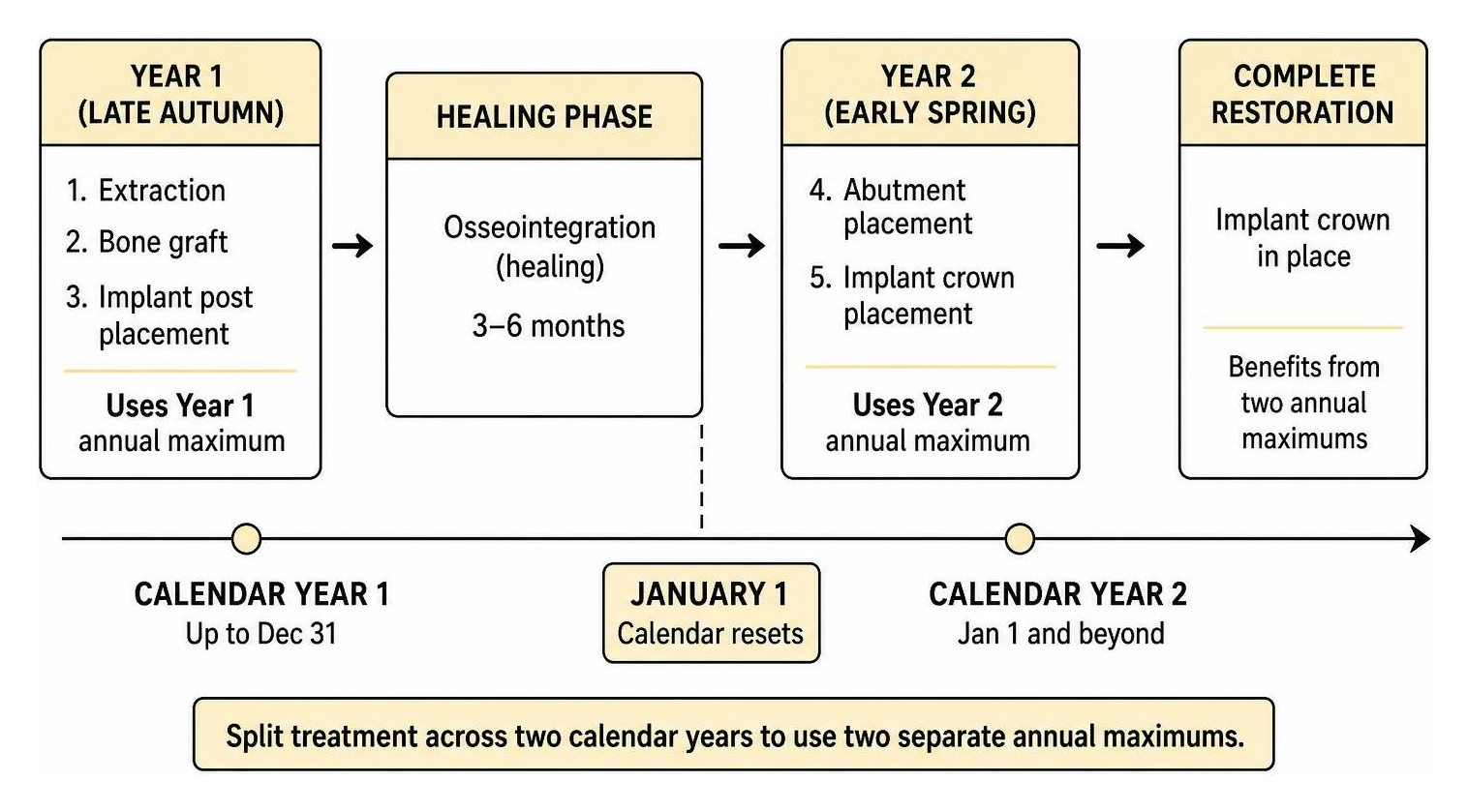
- Year 1 (Late Autumn): We perform the tooth extraction, place the bone graft, and place the titanium implant post. This utilizes your Year 1 annual maximum (e.g., $1,500).
- Healing Phase: The bone fuses with the implant post (osseointegration) over 3 to 6 months.
- Year 2 (Early Spring): Once the calendar resets on January 1st, you have a fresh annual maximum. We then place the abutment and attach your custom implant crown, utilizing your Year 2 benefits.
By timing your treatment strategically, you can effectively double your insurance payout from $1,500 to $3,000.
Utilizing HSA, FSA, and Medical Insurance Crossover
- HSA & FSA Accounts: You can use your Health Savings Account (HSA) or Flexible Spending Account (FSA) to pay for all out-of-pocket implant costs. Because these accounts use pre-tax dollars, this instantly saves you between 22% and 37% depending on your tax bracket.
- Medical Insurance Crossover: In rare cases, medical insurance may cover the surgical placement of dental implants. This typically applies if your tooth loss was caused by severe physical trauma (like a car accident), oral cancer reconstruction, or a congenital defect. To learn how to navigate this complex process, read the sneaky guide to getting medical insurance for dental implants.
Getting a Pre-Treatment Estimate
Never guess what your insurance will pay. Before we begin any treatment, our administrative team will submit a formal Pre-Treatment Estimate (also known as a preauthorization) to Delta Dental.
Delta Dental will review our proposed treatment plan, check your specific policy limits, and send back a written breakdown showing exactly what they will cover and what your exact out-of-pocket cost will be. While not a 100% guarantee of payment, it is the most accurate tool available for financial planning. You can also log into your member portal to use the online Dental Procedure Cost Estimator to research average regional fees.
Frequently Asked Questions About Delta Dental Implant Cost
Does Delta Dental cover full-mouth implants or All-on-4?
Yes, but with strict limitations. Delta Dental PPO plans will typically pay their standard 50% major service benefit toward full-mouth restorations, but your annual maximum benefit (usually $1,500 to $2,000) remains the same.
Because an All-on-4 procedure or full-mouth restoration can cost significantly more than a single tooth replacement, your insurance will only cover a small fraction of the total cost. If you are considering full-arch options, we encourage you to read about all on 4 dental implants des plaines il and review the price of full mouth dental implants to understand your options. Many patients choose to combine their insurance benefits with third-party financing like CareCredit to make full-mouth restorations affordable.
How do I appeal a denied Delta Dental implant claim?
If Delta Dental denies your implant claim, you have the right to appeal. The process involves:
- Review the Explanation of Benefits (EOB): Identify the exact denial code (e.g., missing tooth clause, lack of documentation).
- Gather Evidence: Work with our team to collect updated digital X-rays, 3D CBCT scans, and a written Letter of Medical Necessity explaining why an implant is required for your oral health.
- Submit a Formal Appeal: Write a clear appeal letter referencing your claim number and patient ID, and submit it through the Delta Dental member portal. We assist our patients with this paperwork to ensure the highest chance of a successful reversal.
Can I use an out-of-network dentist for my implants?
If you have a Delta Dental PPO plan, you can see an out-of-network dentist, but your out-of-pocket costs will be significantly higher. Out-of-network dentists have not agreed to Delta Dental’s discounted “allowed fees.” This means they can bill you for the difference between their retail rate and what insurance pays (a practice called balance billing).
By staying in-network with a provider like us, you are guaranteed to receive pre-negotiated, discounted rates, saving you hundreds or even thousands of dollars on a single tooth implant des plaines il.
Conclusion
Navigating your delta dental implant cost doesn’t have to be overwhelming. While dental insurance policies are filled with complex clauses, waiting periods, and annual caps, a strategic approach can help you unlock significant savings.
At Des Plaines Dental Studio, we are committed to providing patient-centered, high-quality care in a warm and welcoming environment. We believe that financial surprises should never stand between you and a healthy, confident smile. Our experienced administrative team will handle all the heavy lifting—from submitting pre-treatment estimates to maximizing your calendar-year benefits and filing appeals on your behalf.
If you are ready to explore your tooth replacement options and want a clear, honest breakdown of your insurance benefits, we invite you to schedule a consultation with us today. Let us help you find the best path forward for your smile and your budget. Explore our services and find dental implants near me to take your first step toward a restored smile.