


Why Finding the Best Way to Get Dental Implants Matters
The best way to get dental implants starts with understanding what the process actually involves — then finding a qualified local provider who can walk you through it step by step.
Here’s a quick overview of what that looks like:
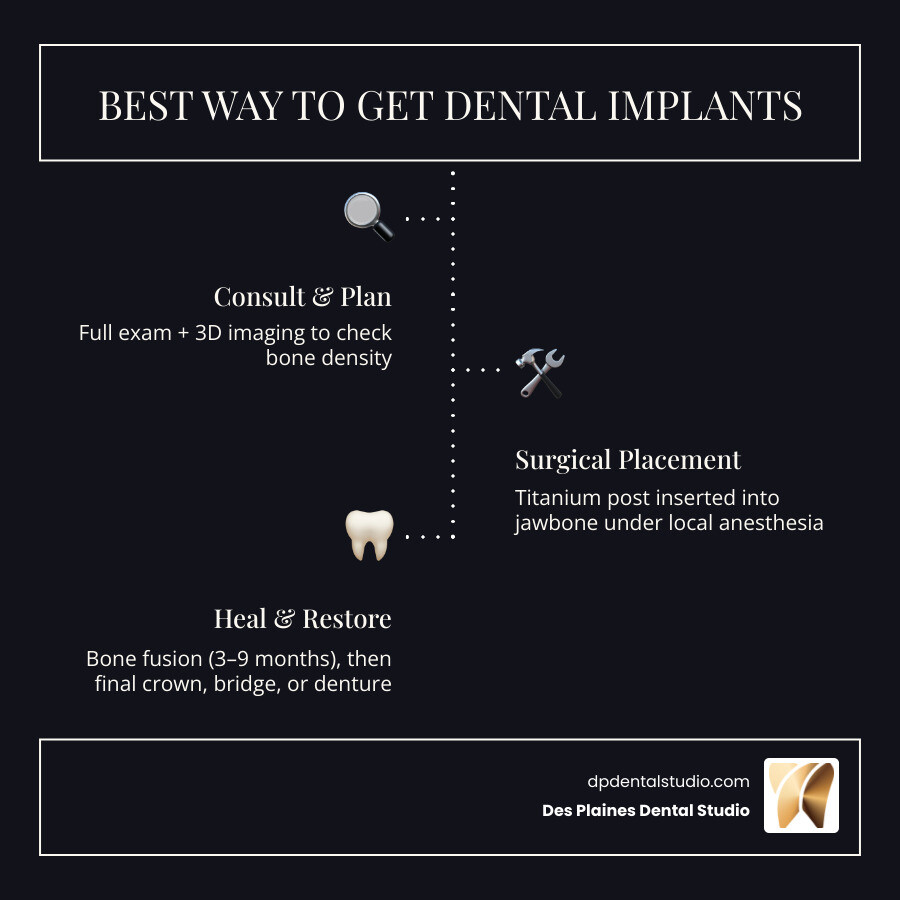
- Consult a qualified implant dentist — get a full exam and 3D imaging to check bone density and candidacy
- Address any prep work first — treat gum disease, complete any needed bone grafting, or handle extractions
- Have the implant surgically placed — a titanium post is inserted into your jawbone under local anesthesia
- Allow time for osseointegration — the bone fuses to the implant over 3 to 9 months
- Receive your final restoration — a crown, bridge, or denture is attached once healing is complete
- Maintain it like a natural tooth — brush, floss, and visit your dentist regularly
This is a multi-stage process. It takes time, but the results can last a lifetime — with 10-year survival rates of 95–98% in well-maintained patients.
Missing teeth aren’t just a cosmetic issue. Once a tooth is gone, the jawbone beneath it begins to shrink. Implants are the only tooth replacement option that stops that bone loss. And unlike bridges, they don’t require shaving down the healthy teeth on either side.
That said, implants aren’t right for everyone. Cost, health conditions, and bone density all play a role. This guide breaks all of it down clearly.
I’m Dr. Marta Milejczyk, and with over 25 years of experience in restorative and implant dentistry — including advanced training in full mouth rehabilitation — I’ve helped hundreds of patients navigate the best way to get dental implants for their unique situation. Let’s walk through everything you need to know to make a confident, informed decision.
What Are Dental Implants and How Do They Work?
To truly appreciate why dental implants are widely considered the gold standard of tooth replacement, it helps to understand their structural anatomy. Unlike traditional surface-level treatments, a dental implant replicates the entire structure of a natural tooth, from the root to the crown.
A standard dental implant consists of three distinct parts:
- The Implant Post: This is a threaded screw that is surgically positioned directly into the jawbone. It acts as an artificial tooth root. Most modern implants utilize titanium bone implants because titanium alloy is incredibly strong, lightweight, and highly biocompatible. This means your body does not recognize it as a foreign object, allowing the bone to fuse directly to it.
- The Abutment: Once the post is securely anchored in the bone, a small connector piece called an abutment is attached to the top of the post. While small, this connector is vital for securing your new tooth. For a detailed breakdown of what to expect financially for this step, you can explore dental abutment costs what to expect when youre connecting.
- The Restoration: This is the visible, functional part of your new tooth. Depending on how many teeth you are replacing, your restoration will be a custom-made crown, a bridge, or a full-arch denture. High-quality dental implant restorations are crafted to match the exact shade, shape, and contour of your surrounding natural teeth.
The magic behind the success of dental implants is a biological process called osseointegration. Discovered in 1965 by Swedish researcher Per-Ingvar Brånemark, osseointegration is the process where living bone cells grow directly into and fuse with the microscopic pores of the titanium post.
This fusion provides a level of stability that no other tooth replacement option can match. Because the implant is anchored directly into your jaw, it stimulates the bone just like a natural tooth root. This stimulation is critical for jawbone preservation; without it, the jawbone quickly begins to resorb (shrink) within months of tooth loss, which can eventually lead to a sunken facial appearance and further tooth loss.
Types of Dental Implants Available
Depending on your specific oral health needs, bone density, and the number of teeth you are missing, we will recommend one of several types of dental implants:
- Endosteal Implants: This is the most common type of implant. The post is shaped like a small screw or cylinder and is placed directly into the jawbone. It is ideal for patients with healthy, dense jawbones.
- Subperiosteal Implants: These implants sit on top of the jawbone but under the gum tissue. They are used primarily for patients who do not have enough healthy jawbone to support an endosteal implant and cannot or do not wish to undergo a bone grafting procedure.
- Single Tooth Implants: If you are only missing one tooth, we can place a single post topped with a single custom crown. This is a highly conservative option because it allows us to restore your smile without altering the adjacent healthy teeth. To learn more about this approach, read about our single tooth implant des plaines il services.
- All-on-4 Full-Arch Implants: If you are missing all of your teeth on the upper or lower jaw, you do not need an individual implant for every single missing tooth. Instead, we can secure a full arch of permanent, highly stable prosthetic teeth using just four strategically placed implants. This life-changing option is detailed in our guide on all-on-4 dental implants des plaines il.
The Best Way to Get Dental Implants: Step-by-Step Process
Getting dental implants is a journey that requires careful planning, biological healing, and precise craftsmanship. When patients ask us about the best way to get dental implants, we emphasize that rushing the process is never the answer. A methodical, step-by-step approach ensures your implant fuses perfectly and lasts a lifetime.
Here is what you can expect during the multi-stage process:
- Initial Consultation and 3D CBCT Imaging: The journey begins with an in-depth examination. We utilize state-of-the-art 3D Cone Beam Computed Tomography (CBCT) scans to capture highly detailed, three-dimensional images of your jawbone, nerve pathways, and sinus cavities. This allows us to assess your bone volume and precisely plan the exact angle and depth of your implant placement before surgery even begins.
- Treatment Planning: Using the 3D images, we map out your customized treatment plan. We review your complete medical history, discuss your goals, and select the ideal implant type and anesthesia options to ensure a comfortable, pain-free experience.
- Pre-Implant Work (If Needed): If you have an existing damaged tooth, we will perform a gentle tooth extraction. If your jawbone is too thin or soft to support an implant, we will perform bone grafting for dental implants. A bone graft creates a solid, robust foundation by placing natural or synthetic bone material in the area, which your body gradually replaces with its own strong bone over a few months.
- Implant Placement Surgery: During this minor surgical procedure, we make a small incision in the gum to expose the bone, prepare a precise pilot hole, and gently insert the biocompatible titanium post. We then close the gum tissue over the implant to protect it. Thanks to advanced local anesthesia and our gentle techniques, most patients report that this step is surprisingly comfortable.
- The Healing Phase (Osseointegration): This is where patience pays off. Over the next several months, your jawbone will gradually grow around and fuse with the titanium post.
- Abutment and Final Restoration: Once osseointegration is complete, we attach the abutment to the post. After your gums heal around the abutment (usually about two weeks), we take highly accurate impressions to design your custom crown, bridge, or denture. Finally, we secure your beautiful, permanent new teeth in place.
How Long Does the Entire Process Take?
Because your body needs time to safely grow new bone around the implant, the entire process is a journey rather than an overnight fix.
The healing phase (osseointegration) typically takes anywhere from three to nine months, depending on your overall health, bone quality, and whether you required a bone graft. If a bone graft or sinus lift is necessary prior to implant placement, it can add one to four months of healing time before the implant post can be placed.
Many patients wonder: Will I have to go without teeth during this time? Absolutely not. We use customized temporary restorations—such as temporary bridges or lightweight flippers—especially for teeth in the “smile zone,” so you can smile, speak, and eat with confidence throughout your healing journey.
While some modern techniques advertise immediate results, it is important to understand the realities of immediate loading. To explore what is truly possible, read our detailed analysis: can you really get a brand new smile in just one day.
Evaluating Candidates, Costs, and Alternatives
To help you visualize how dental implants compare to more traditional tooth replacement methods, we have compiled a direct comparison:
| Feature | Dental Implants | Traditional Dental Bridges | Traditional Dentures |
|---|---|---|---|
| Average Longevity | Lifetime (with proper care) | 10 to 15 years | 7 to 10 years |
| Bone Preservation | Yes (stimulates bone growth) | No (bone resorbs over time) | No (accelerates bone loss) |
| Impact on Adjacent Teeth | None (preserves natural enamel) | Requires shaving adjacent teeth | Can put stress on remaining teeth |
| Stability & Comfort | Feels and functions like real teeth | High stability, but can decay | Can slip, click, or cause sore spots |
| Long-Term Cost-Effectiveness | High (rarely needs replacement) | Moderate (requires replacement) | Low (requires relines & replacements) |
While implants are highly successful, they are not suitable for everyone. To be a good candidate for dental implants, you must have:
- Adequate Jawbone Density: There must be enough bone volume to anchor the titanium post. If bone loss has occurred, a bone graft can often resolve this.
- Healthy Gums: Active periodontal disease can cause implant failure. Any gum issues must be fully treated before surgery.
- Good Systemic Health: Uncontrolled diabetes, active cancer treatments, or severe autoimmune conditions can slow down bone healing. However, controlled conditions are usually perfectly fine.
- Commitment to Avoiding Tobacco: Smokers have a 2 to 3 times higher implant failure rate compared to non-smokers, as tobacco use severely restricts blood flow and slows down the osseointegration process.
If you are currently managing gum concerns, we encourage you to read our guide on implants vs keeping your teeth the ultimate guide to early gum disease reviews. If you are still exploring all your options to fill the gaps in your smile, you can find a friendly overview at des plaines dentist filling in the gaps your options for missing teeth.
Understanding the Cost of Dental Implants
The cost of dental implants is an investment in your long-term health, comfort, and confidence. While the upfront cost is higher than bridges or dentures, implants are far more cost-effective over time because they rarely need to be replaced.
The national average cost for a single-tooth dental implant post is $2,143, with a typical range of $1,646 to $4,175. However, it is crucial to note that this initial figure often only covers the titanium screw itself. The custom-made dental crown that sits on top can add $488 to $3,254 to the total, depending on the materials used.
For full-arch replacements, the average national cost for an All-on-4 full arch dental implant is $15,176, though highly customized cases can range from $20,000 to $35,000 per arch.
Several key factors influence the final price of your treatment:
- Geographic Location: Dental implant costs vary significantly by state. For example, Hawaii has the highest average cost at $3,565, while Alabama has one of the lowest at $1,790. In Illinois, the average cost for a single-tooth implant sits right around $2,207.
- Preparatory Procedures: If you require gentle extractions, bone grafting, or a sinus lift, these will add to the overall cost.
- Materials Used: Premium biocompatible titanium, high-end zirconia, and custom-milled porcelain crowns offer superior aesthetics and durability but carry a higher price tag.
To help you plan your budget, we have created several comprehensive pricing guides:
- Get a clear overview of general pricing at average cost of dental implants.
- Read our deep-dive financial breakdown at dental implant costs complete guide.
- Evaluate the long-term value of your investment with the ultimate guide to dental implants costs and benefits.
- If you are replacing a back tooth, check out molar implants 101 what it costs to replace your back teeth.
- For full-mouth restoration costs, explore our guides on the price of full mouth dental implants, the average cost of full dental implants, and the average cost to replace all teeth with implants or dentures.
Insurance and Financing Options
Many dental insurance plans now recognize the health benefits of implants and will cover at least a portion of the treatment—frequently the final crown or restoration—even if they consider the surgical post placement elective. Basic plans often cover 30% to 50% of major services, up to your annual maximum limit (which typically ranges from $1,000 to $2,000).
A highly effective strategy to minimize out-of-pocket expenses is smart sequencing. By planning your treatment across two calendar years—for example, performing extractions and bone grafting in December, and placing the implant and crown in February—you can maximize two years of annual insurance maximums.
For detailed strategies on navigating your insurance, read our dental implants insurance guide 2026. If you are curious about utilizing your medical insurance for your procedure, check out how to get dental implants covered by medical insurance and explore the sneaky guide to getting medical insurance for dental implants.
To ensure your care is accessible, we offer flexible financing options, including third-party healthcare financing (like CareCredit) and in-office payment plans that break your total cost into manageable monthly payments.
How to Find the Best Dental Implant Provider Near You
Choosing the right dental provider is the single most important decision you will make on your implant journey. Because implant dentistry is highly specialized, you want to partner with a team that possesses advanced training, extensive experience, and a commitment to patient comfort.
When evaluating potential providers, look for the following:
- Advanced Credentials: Ask if the dentist has specific postgraduate training in implantology or is a member of recognized organizations like the American Academy of Implant Dentistry (AAID).
- State-of-the-Art Technology: Ensure the clinic utilizes 3D CBCT imaging and digital surgical guides. This technology dramatically increases the safety, precision, and comfort of the procedure.
- Comprehensive Care: The best providers handle your entire journey—from the initial 3D scan and surgical placement to the final beautiful crown—under one roof. This ensures seamless communication and a consistent standard of care.
If you are ready to find a highly qualified team close to home, start your search with our dental implants near me locator.
How to Find Affordable Dental Implants Without Sacrificing Quality
While it is natural to look for ways to save money, we strongly caution against choosing a provider based solely on a “discount” price. Ultra-low-cost dental implant promotions often cut corners by using generic clone implants, skipping vital 3D planning, or outsourcing restorations to low-quality labs.
The cheapest implant is the one that is placed correctly the first time and lasts a lifetime. A failed implant due to poor planning or cheap materials can cost thousands of dollars to correct.
The best way to get dental implants affordably is to find an experienced, reputable provider who offers flexible payment options, honest upfront pricing with no hidden fees, and smart treatment sequencing to maximize your insurance benefits. For practical tips on budget-friendly dental care, read our guide on how to find the cheapest dental implants without losing your mind.
Why Choosing a Local Specialist is the Best Way to Get Dental Implants
While some patients consider “dental tourism” to save money, traveling abroad for complex surgical procedures carries significant risks. If an implant fails to fuse or requires an adjustment, flying back to another country is highly impractical.
Choosing a local specialist right here in Des Plaines, IL, ensures you have access to essential follow-up care, routine healing checks, and immediate emergency support if you ever have a question or concern. Our team at Des Plaines Dental Studio is proud to be a trusted dental implants provider des plaines, offering personalized, compassionate care right in your neighborhood.
If you are ready to explore your options with a team that puts your comfort first, we invite you to schedule a consultation with us by visiting our Dental Implants Near Me pillar page.
Frequently Asked Questions About Dental Implants
Do dental implants hurt during or after the procedure?
The surgical placement of a dental implant is surprisingly comfortable. We use advanced local anesthesia to completely numb the area, ensuring you will feel no pain during the procedure. For patients who feel anxious, we also offer gentle sedation options to help you feel completely relaxed.
After the anesthesia wears off, you may experience mild-to-moderate swelling and soreness for three to five days. This post-operative discomfort is typically very manageable and easily controlled with over-the-counter pain relievers or cold compresses applied for 20 minutes at a time.
How long do dental implants last?
With proper care, the biocompatible titanium post is designed to last a lifetime. It becomes a permanent part of your jawbone.
However, the visible crown or bridge on top experiences daily wear and tear from chewing. Most high-quality implant crowns last around 15 years (and implant-supported dentures last at least 7 years) before they may need to be repaired or replaced. Maintaining excellent oral hygiene—including daily brushing, flossing, and professional cleanings twice a year—is the key to preventing peri-implantitis (gum inflammation around the implant) and ensuring your smile lasts a lifetime.
What are the risks and potential complications of implant surgery?
Like any minor surgical procedure, dental implant surgery carries a few minor risks, including localized infection, temporary nerve irritation (causing minor numbness in the lip or chin), or sinus issues if an upper implant is placed too close to the sinus cavity.
Fortunately, these complications are rare. With proper 3D CBCT planning, a sterile surgical environment, and an experienced dentist, dental implants have a highly documented 10-year success rate of 95% to 98%. If an implant does fail to fuse during the healing phase, it can typically be gently removed, the bone cleaned, and the procedure successfully retried after about three months of healing.
Conclusion
Finding the best way to get dental implants doesn’t have to be overwhelming. By understanding the step-by-step process, choosing high-quality biocompatible materials, and partnering with an experienced local dentist, you can permanently restore your smile, protect your jawbone, and regain your absolute confidence.
At Des Plaines Dental Studio, we are dedicated to providing a welcoming, patient-centered, and completely pain-free experience. We believe that everyone deserves a healthy, beautiful smile, which is why we offer comprehensive insurance support and flexible financing options to fit your budget.
If you are ready to take the first step toward a brand-new smile, we are here to help. Reach out to us today and schedule your personalized consultation at dental implants near me.